
Zonff Partners retweetledi
Zonff Partners
952 posts


Zonff Partners
@ZonffPartners
With capital and resource commitment, we go hand in hand with our investees to bring about commercial innovation and technological revolution.
Silicon Valley Katılım Mart 2021
953 Takip Edilen8.2K Takipçiler

Zonff Partners retweetledi
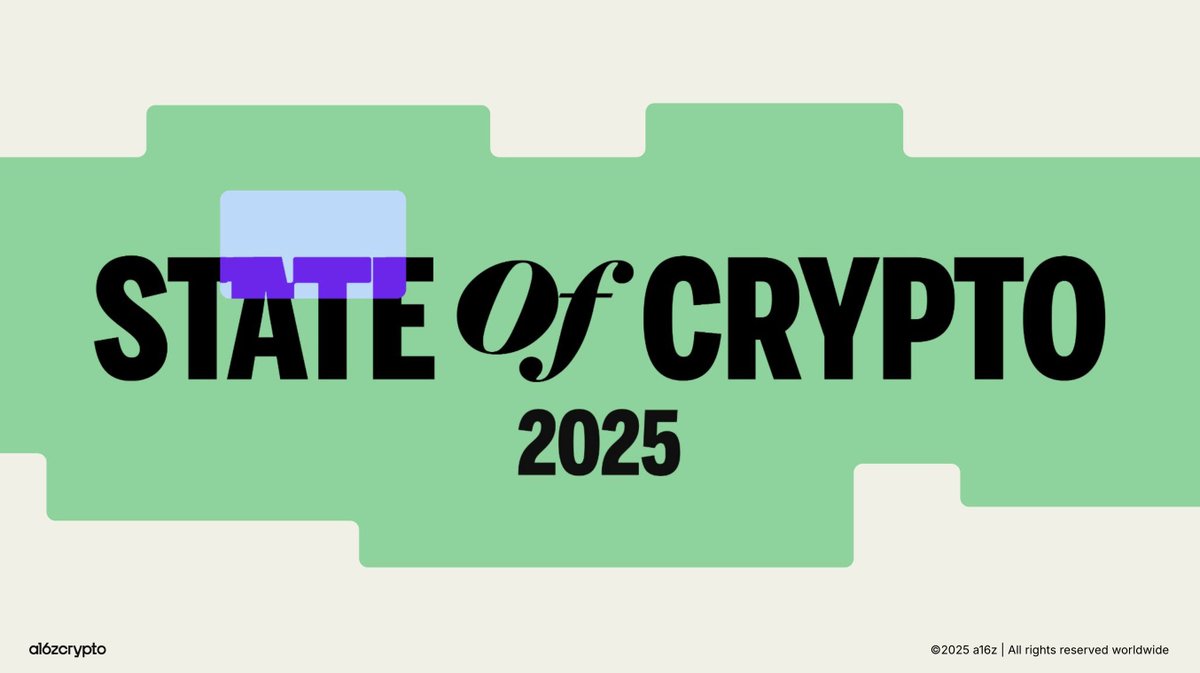
Our latest State of Crypto report is here.
The main theme for the year is the maturation of the crypto industry:
• Traditional financial institutions and fintechs launched crypto products
• DeFi and stablecoins went mainstream
• Blockchains got faster and cheaper
• The regulatory shift in the U.S. revived builder confidence
Find the full 2025 State of Crypto report here: a16zcrypto.com/posts/article/…
See below for a few highlights.
English
A practical manifestation of information arbitrage
Fhantom@FhantomBets
*Speculating* how the Nobel Peace Prize winner was leaked: Last night I hosted a *difficult* interview with the alleged “insider” in the Nobel Peace Prize market on Polymarket. Despite an hour of questions, we were still stuck wondering how a trader or team could know Maria Machado would win 12 hours early. It turns out the answer may have been hiding in plain sight — on the Nobel website itself. From the interview a few themes stood out. There was potential for some sort of web scraping, as the trader said he used a similar tactic to pull the Lex Fridman transcript for a mention market, that this information was accessible by anyone, and that “you can brute force your way into a lot of things”. That suggests a there was a way to find the URL for Machado before it was published. The Nobel site runs on WordPress. Like many WordPress setups, it has an XML sitemap that lists every indexable page, even ones not yet public. If someone were monitoring this sitemap, they could easily notice a new page appear, something like "nobelprize.org/prizes/peace/2…" Most likely, someone wrote a bot or script that watched the uploads folder or sitemap for new files. When this image appeared, they connected the dots. On the Nobel website, the official portrait of Machado at nobelprize.org/uploads/2025/1… carries a “last-modified” timestamp in the file’s metadata of 07:18 GMT on October 10, over 1.5 hours before the announcement. This picture was loaded into the official announcement page of Nobel “nobelprize.org/prizes/peace/2…”, a link you could guess by switching in 2025 for 2024 As well, there are other webpages on the XML sitemap which show Machado as the winner before the official reveal, all around the 07:20 GMT mark. The timestamp is proof that by early morning the Nobel site was already loaded with material revealing the winner. It also raises a bigger question: what was visible before that? The data I was able to find only shows the “last modified” date of the webpage, meaning that this image was put up at or before this time. Looking back, we only know the most recent timestamp of this image, it’s possible that 12 hours earlier, the available information on these webpages only hinted that Machado was one of possibly multiple winners. Regardless, it’s cool to see that a few hours before the official announcement, there was definitely strong evidence that Machado was the winner. There are still a few questions that remain unanswered. Unfortunately the rest is.. speculation.
English
A real-world use case for AI and crypto: with just a chat, you can search, compare prices, and place an order, all in one go.
Bankless@Bankless
Recently, Coinbase and Ethereum have unveiled infrastructure that fits together for a bigger vision: ETH as the default rails for AI agents to transact and collaborate seamlessly. Last week's x402 Foundation and Cloudflare's NET Dollar announcements seal the full stack, connecting how AI on ETH drive web commerce. Let's connect the dots.👇 ~~ Analysis by @davewardonline ~~ x402 Back in the 1990s, web architects reserved HTTP status code 402 for "Payment Required," but traditional payment systems like credit cards proved too slow and expensive for microtransactions. Now blockchain has made it practical. Released in May by @coinbase, x402 resurrects this dormant standard, letting websites flag premium content during HTTP requests. When you or your AI agent hits paywalled content, the browser automatically handles a crypto micropayment and unlocks access instantly, no redirects, no logins. Built for chains like Ethereum's @base, x402 enables transactions as small as fractions of a cent, transforming the web into a true pay-per-use marketplace. It's already used in @Google's A2A protocol today! ERC-8004 Then came ERC-8004 last month, a universal standard for AI agents to discover services, verify identities, and transact. Under 8004, each agent gets a blockchain "passport" for reputation checks, extending agent-to-agent protocols with trust layers for secure deals. The x402 Foundation Co-launched by Coinbase and @Cloudflare last Tuesday, the x402 Foundation will steward the protocol through tooling, grant distribution, and advocacy to ensure it becomes the standard for agent-to-agent communication. NET Dollar The latest piece is NET Dollar, a stablecoin announced by Cloudflare last Thursday. Like other stablecoins, NET Dollar will be USD-pegged and 1:1 backed, but it's tailor-made for bots, code-programmable and optimized for agent use across the x402 protocol. Weaving the Stack: How It All Connects Ethereum researcher @binji_x recently outlined how these components create self-sustaining AI economies that run without human intervention. The flow: 1. x402 provides the payment plumbing, routed through Cloudflare's network. 2. The x402 Foundation ensures consistency across implementations. 3. ERC-8004 adds the intelligence layer, letting agents discover each other via Ethereum addresses, verify reputations on-chain, and negotiate terms autonomously. 4. When settling, ERC-8004-equipped agents trigger x402 payments in NET Dollar on Base for speed and stability. A practical example: your personal AI assistant needs weather data for trip planning. It discovers a weather service agent via ERC-8004, verifies its reliability onchain, negotiates access through x402, pays in NET, and receives the data—all in milliseconds, fully verified on Ethereum. This creates what Binji calls "autonomous AI economies" where bots form their own markets. Cloudflare's infrastructure ensures low-latency global delivery, while Base provides Ethereum's security without prohibitive gas fees. The result: Ethereum becomes the default settlement layer for the agentic web. --- For Ethereum, this stack represents an ambitious play to become the backbone for all AI commerce, very in line with the original "Web 3" vision. The Cloudflare partnership amplifies this dramatically. With Cloudflare powering roughly 20% of all websites and handling traffic for over 25M internet properties, championing x402 provides unmatched distribution. Projections suggest agent-driven GDP could hit $10 trillion by 2030, so these rails could allow Ethereum to capture value from every autonomous transaction. For Cloudflare, issuing NET transforms them from a content delivery network into something resembling a digital bank. They can earn yields on stablecoin reserves while monetizing the growing bot traffic that already comprises 30% of global web activity. If there's one thing for you to take away here, it's that these announcements aren't isolated experiments. They're the foundation for an AI-powered internet where agents transact as easily as servers exchange data today, all powered by our very own Ethereum.
English
ETH has clearly become the center of discussion recently, with market sentiment on the rise. It’s widely believed that the ecosystems connected to it are also poised for growth.
EigenCloud@eigencloud
ETH is the engine EIGEN is the accelerator Verifiable Cloud is the highway Verifiability at top speed 🏎️
English
Zonff Partners retweetledi


Many regional compliant stablecoins are likely to face similar issues: domestic transfers are already instant and free, while onshore rules restrict cross-border use. Without utility beyond existing payment rails, adoption may remain niche.
CoinRank@CoinRank_io
🇰🇷 Korean Won stablecoin faces utility doubts With the central bank ditching its CBDC pilot for a privately issued stablecoin, big players are rushing in — KakaoBank exploring issuance & custody, Upbit teaming with Naver Pay on a payment token. But “onshore” rules mean overseas entities can’t directly convert KRW, limiting use to KYC’d Korea-linked addresses. 🚫 Analysts say with Korea’s already instant, free local transfers, the token’s edge in payments is thin — likely confined to domestic use. #Stablecoins #Korea #CryptoNews #Web3 #CBDC
English
Zonff Partners retweetledi

4️⃣, 5️⃣ 8️⃣ 0️⃣, 0️⃣ 0️⃣ 0️⃣ ETH
YES, 4.58 MILLION ETH is locked on EigenCloud
~4% of all the ETH that exists in the world 🌎
English
Hearing mixed reviews about the experience so far. All the more reason to look deeper as sometimes true disruption begins with friction.
Sam Altman@sama
going to try live-tweeting the GPT-5 livestream. first, GPT-5 in an integrated model, meaning no more model switcher and it decides when it needs to think harder or not. it is very smart, intuitive, and fast. it is available to everyone, including the free tier, w/reasoning!
English
Zonff Partners retweetledi

Amazing to see so many major L2s now at stage 1.
The next goal we should shoot for is, in my view, fast (<1h) withdrawal times, enabled by validity (aka ZK) proof systems.
I consider this even more important than stage 2.
Fast withdrawal times are important because waiting a week to withdraw is simply far too long for people, and even for intent-based bridging (eg. ERC-7683), the cost of capital becomes too high if the liquidity provider has to wait a week. This creates large incentives to instead use solutions with unacceptable trust assumptions (eg. multisigs/MPC) that undermine the whole point of having L2s instead of fully independent L1s.
If we can reduce native withdrawal times to under 1h short term, and 12s medium term, then we can further cement the Ethereum L1 as the default place to issue assets, and the economic center of the Ethereum ecosystem.
To do this, we need to move away from optimistic proof systems, which inherently require waiting multiple days to withdraw.
Historically, ZK proof tech has been immature and expensive, which made optimistic proofs the smart and safe choice. But recently, this is changing rapidly. ethproofs.org is an excellent place to track the progress of ZK-EVM proofs, which have been improving rapidly. Formal verification on ZK proofs is also advancing.
Earlier this year, I proposed a 2-of-3 ZK + OP + TEE proof system strategy that threads the needle between security, speed and maturity:
ethereum-magicians.org/t/a-simple-l2-…
* 2 of 3 systems (ZK, OP) are trustless, so no single actor (incl TEE manufacturer or side channel attacker) can break the proof system by violating a trust assumption
* 2 of 3 systems (ZK, TEE) are instant, so you get fast withdrawals in the normal case
* 2 of 3 systems (TEE, OP) have been in production in various contexts for years
This is one approach; perhaps people will opt to instead do ZK + ZK + OP tiebreak, or ZK + ZK + security council tiebreak. I have no strong opinions here, I care about the underlying goal, which is to be fast (in the normal case) and secure.
With such proof systems, the only remaining bottleneck to fast settlement becomes the gas cost of submitting proofs onchain. This is why short term I say once per hour: if you try to submit a 500k+ gas ZK proof (or a 5m gas STARK) much more often, it adds a high additional cost.
In the longer term, we can solve this with aggregation: N proofs from N rollups (plus txs from privacy-protocol users) can be replaced by a single proof that proves the validity of the N proofs. This becomes economical to submit once per slot, enabling the endgame: near-instant native cross-L2 asset movement through the L1.
Let's work together to make this happen.
L2BEAT 💗@l2beat
Glad to report that all 6 rollups affected by the recent Stage 1 requirements changes have performed the necessary upgrades and are now fully compliant. That includes: - @base - @Optimism - @unichain - @Scroll_ZKP - @inkonchain - @KintoXYZ Now onwards to Stage 2! 🫡
English

It’s too soon to call a full bull, but the foundations are quietly forming.

English
Zonff Partners retweetledi

Zonff Partners retweetledi

Caldera's product suite is expanding with the launch of the Caldera Bridge Preview.
The first consumer product built on the Metalayer, powered by $ERA.
A smart bridge aggregator that simplifies cross-chain transactions across the Caldera ecosystem and major liquidity hubs.

English
The CLARITY Act could finally bring the regulatory certainty this industry needs.
a16z crypto@a16zcrypto
The House of Representatives recently advanced a major new “market structure” bill with overwhelming bipartisan support (294 to 134, with 78 Democrats supporting). This bill, the Digital Asset Market Clarity Act or “CLARITY Act” (HR 3633) would establish a clear regulatory framework for digital asset markets. The bill now progresses to the Senate, which is working on its own version of market structure legislation that will be informed by CLARITY. If passed, this bill will establish clear rules of the road for blockchain systems — ending the years of uncertainty that have stifled innovation, exposed consumers to harm, and favored profiteers embracing opacity over the entrepreneurs pursuing transparency. Like the Securities Act of 1933, which established investor protections and powered a century of U.S. capital formation, the CLARITY Act could be a generational law. When our legal frameworks are designed to both foster innovation and protect consumers, America leads — and the world benefits. CLARITY is that kind of opportunity. While this legislation builds on the bipartisan momentum of last year’s FIT21 bill, CLARITY improves upon it in several key ways, which we outline below: covering what the builders need to know, and why this bill is crucial to aligning innovation, consumer protection, and U.S. national security. Learn more about The CLARITY Act in the thread below. And find the full post by @milesjennings & Aiden Slavin: a16zcrypto.com/posts/article/…
English
Zonff Partners retweetledi
Zonff Partners retweetledi

Coinbase will add support for Caldera (ERA) on the Ethereum network (ERC-20 Token). Do not send this asset over other networks or your funds may be lost. Transfers for this asset are available on @Coinbase & @CoinbaseExch in the regions where trading is supported.
English
DePIN might’ve cooled off a bit lately, but connecting real-world infrastructure with blockchain is a long-term play. Solid narratives take time to build.
a16z crypto@a16zcrypto
6 use cases for Decentralized Physical Infrastructure (DePIN): 1. Energy 2. Telecom 3. Transportation 4. AI 5. Robotics See #6 here: a16zcrypto.com/posts/article/… by @guywuolletjr
English
Zonff Partners retweetledi

Zonff Partners retweetledi

