

Max
857 posts


Hello can someone smart explain to me what does it mean
YAM 🌱@yieldsandmore
By our calculations, $1.33B out of $4.4B of USDe's backing is lending against itself. Here’s the rule we used: Estimated self-lending = gross borrowing against USDe/sUSDe collateral × Ethena’s share of supplied liquidity in that market So if a pool has $556M borrowed against USDe/sUSDe, but @ethena supplies 47.4% of the liquidity, we attribute ~$263M of that as Ethena-funded self-lending. We’re not counting the full amount borrowed against USDe/sUSDe as “self-lending” where @ethena is not the only lender. Using this pro-rata method, we get: - Estimated Ethena self-lending: ~$1.33B - Gross amount borrowed against Ethena assets: ~$1.67B - Difference from pro-rata attribution: ~$336M Sources of data: AAVE: research.yuzu.money/aave-exposures Steakhouse USDtb: #overview" target="_blank" rel="nofollow noopener">app.morpho.org/ethereum/vault…
Steakhouse Prime: app.morpho.org/base/vault/0xB… Kamino: kamino.com/earn/lend/ethe… Juplend: jup.ag/lend/ethena/ma… Backing: app.ethena.fi/dashboards/bac… English
what chainlink is providing here is cre: data feeds and orchestration, pricing, valuation, margining, settlement instructions.
all of that gets handled offchain so that their appchain can run fast(er). what's missing is cross-chain messaging and execution.
this is not just absent from the announcement, dtcc has dodged the messaging question every time they've been asked about it directly.
at the same time dtcc has been open that their current appchain architecture can't meet institutional throughput.
jury's still out on the most contrarian crosschain messaging bet right now
DTCC@The_DTCC
Today we announced progress toward our goal of advancing 24/7 collateral mobility. DTCC’s Collateral AppChain, a shared infrastructure platform for collateral, will leverage the Chainlink Runtime Environment (CRE) and @chainlink data standard to enable near real-time collateral management across financial markets and blockchains. The integration will enable the seamless pairing of asset prices, valuations, and movement, with the aim of overhauling how market risk is managed globally and unlock greater capital efficiency. This milestone reflects our broader vision to enable 24/7, near real-time collateral management across the global financial system. Read the full announcement: dtcc.com/news/2026/may/…
English

also, to clarify, Aave faced indirect exposure via bad debt from stolen collateral but was not hacked
English
Markets are pricing it, watch where the next B in liquidity actually flows long-term.
But framing it as purely LayerZero’s villainy vs. Aave’s heroism oversimplifies.
𝕯𝖆𝖓𝖌𝖊𝖗@safetyth1rd
This is not just about being hacked, it’s losing trust Aave got hacked, owned it and worked to fix it. I’ll use them again Layerzero got hacked, blamed everyone but themselves despite being the most to blame That’s why no one wants to use them anymore.
English


proud to introduce @papertrade_xyz - a fair-launched, fully-onchain perpetuals exchange built on hyperliquid by @izebel_eth & @blurr
-1000x leverage
-0 slippage
-No funding costs
-Self-bootstrapping LP
coming soon. learn more at: docs.papertrade.xyz

English
@stoicsavage msig was rotated out almost a year ago
etherscan.io/tx/0xd77e2d2d7…
English

Max retweetledi

THIS IS MY FOUNDER. THERE ARE MANY LIKE HIM BUT THIS ONE IS MINE. MY FOUNDER OWNS HIS MISTAKES AND FIXES THEM IN PUBLIC. HE BUILDS THE RAILS AND STAYS ON THEM. WITHOUT USERS THE PROTOCOL IS USELESS. WITHOUT ACCOUNTABILITY THE FOUNDER IS USELESS. HE MUST SHIP TRUE. HE MUST COMMUNICATE CLEARLY. HE MUST PROTECT THOSE BUILDING ON TOP OF HIM. I WILL HOLD HIM TO THAT STANDARD. SO BE IT UNTIL THERE ARE NO 1/1S BUT PEACE.

Bryan Pellegrino (臭企鹅)@PrimordialAA
I’ve been asking myself why has it taken me so long to write this? Ultimately I still carry a huge amount of cognitive dissonance here. In my mind LayerZero the protocol was like Gnosis Safe and the application was setting their config, and who the )@(!$ would secure billions in TVL on a 1/1? I even tweeted about it, literally 0, I would have bet almost anything on that because almost every major application we helped setup their configs. Someone then going and manually changing that to a 1/1 was outside of the realm of possibility for me. I was wrong. It’s easy to sit back and say ‘it’s just a protocol we have no control over how people use it’ but we have the opportunity to be better. There was a conversation this week speaking to a customer and they just… screamed at me, at the top of their lungs, and swore for a solid ~3-5 minutes straight. We had implemented additional security measures of forcing a more stringent RPC quorum and forcing every chain to provide multiple RPCs and we had done it without telling them and it !)@$d with their business, which frankly is a deadly sin. We had messed with their business and they said communication wise we were completely blowing this. They were completely right. This is something I care about a ton, it is both the result of a huge portion of my life and something that I fundamentally believe in. I literally gifted a copy of Unreasonable Hospitality to every single manager in the company. The entire point of what we’ve built is to enable others to build on top of it, it is to provide a protocol and a platform for people to build on, and we’ve been failing some of our largest customers. The past two weeks have been unbelievably miserable. I’m incredibly grateful for all of the applications who have worked with us over the past 2 weeks, for @zeroshadow_io who has spent endless cycles with us tracking and seizing millions in attacker funds which will be returned to the rsETH team, and for all of the parties who brought together DefiUnited. Particularly @aave for leading and @MikeSilagadze for pushing everyone to get their !@)($ together and sort things out as quickly as possible, and putting himself in the frontline of acquisition talks and everything else to try to get to a solution quickly. @LayerZero_Core is one of the most critical pieces of infrastructure in the industry, the LayerZero protocol has earned the trust of the largest and most important asset issuers in the space. We will do better and we will make the industry better for it. My entire focus over the past 2 weeks has singularly been working with applications to harden their setup, building tooling to assist in tracking and freezing hacker funds, and the rsETH recovery efforts. That is going to shift now to where LayerZero Labs spends it's time and effort. The only thing this company will spend time on is how we can better serve our asset issuers and the upcoming launch of Zero.
English

@0xdoug Europe has more people than U.S.A majority of devs I know use Anthropic directly or indirectly.
English

I’m really struggling to see how the back of the envelope math on this works out…
There are generously 4 million characterized “software workers” in America. That’s pretty broad and includes a lot of people who aren’t really classical engineers don’t produce that much code.
That comes out to nearly $1k per month of average Claude spend across every dev in America. Yes, there’s some international usage, but it can’t be that much. Yes there is some non software Cowork usage, but that doesn’t use that many tokens. Yes, some non engineers are using Claude to vibe code, but I really doubt many are spending hundreds per month on.
Even if we assume 50% of all software workers are using Claude, that comes out to $2k spend per month per Claude user. Thats 10X more than the highest tier Max subscription. So almost all of Anthropics revenue has to be API billing
So the only explanation is that something like 20%+ of software engineers are not only Claude users but on API billing and regularly spending thousands per month. At $5/m Opus tokens that means the average API user has to be going through something like 25 million tokens per day.
*OR* the other possibility is API revenue is heavily power law dominated. Maybe there’s just something like 100k super users who are making up the majority of the revenue. For that to work the typical super user would have to be spending on the order of $50k/month and guzzling nearly 1 billion tokens per day.
Tannor Manson@Futurenvesting
Anthropic is now showing off $44 BILLION in annual recurring revenue. This is up $14 billion (+46.6%) since last month! BULLISH for AI Infrastructure $NVDA $AMD
English
@Fiskantes first generation of cryptobros are already pushing forty
won’t be long now
English

Maybe we just need doxxed old men in suits who are really afraid of going to prison in charge of DeFi
Maybe thats not such a bad model after all 🤔
English

@binji_x Is the EF involved in anyway or just cheering from the sidelines?
English

@dinosaurteef @DefiIgnas how dare you call me negligent? all i did was liquid stake my eth, then restake my liquid staked eth, and then loop it 10x after i saw a 'just use aave' ad.
English

@DefiIgnas Kelp - pointless grift
Eigen - pointless grift
Unichain - pointless grift
Zero - negligent
Aave - negligent
Users - negligent
root cause: pointless grifts evangelized by EF
Vitalik and Bankless Bros should fill the holes they dug…
English

Boggles my mind that L0 blames Kelp for this hack when their own LayerZero Labs DVN, RPC infra, etc. was spoofed into forging a fake message.
Dune reports that 47% of LayerZero OApps’ DVNs run a 1-of-1 DVN security floor. The other 45% run 2-of-2.
So Kelp isn't an outlier here but most apps used 1 DVN.
Maybe I'm missing something here?
English
@safetyth1rd otoh, build the perfect bridge and get no traction because decentralisation is expensive and the market doesn't care.
a case of:
do you want to be right
or
do you want to make money
English

If you actually look at the record
There’s multiple researchers and teams calling out layer zeros poor security practices over years
Each of which gets drowned out by Bryan pellegrino and team gaslighting plus prominent investors who overlook their issues
banteg@banteg
the most concerning thing about layer zero is that it doesn't check cryptographic proofs at all. events generate receipts which get merklized. you can get a proof and check it against the merkle root. even if a node is compromised or even a sequencer, it can't generate a root that injects a fake receipt, because the execution is gated by the state transitions the contracts allow. another thing is a quorum with even a few public nodes would've saved the day here, because they would disagree on the state.
English

forked Dune's LayerZero DVN analysis after the KelpDAO hack. wanted to know how many OApps still run configs structurally identical to what got drained.
of ~3,500 OApps deployments on LayerZero v2 in the last 90 days:
- 1,111 run a strict, consistent 1-of-1 DVN (every message, no optional backstop)
- 28 of those bridged >$100k
- 10 bridged >$1m
open query, forked from Dune's.
methodology notes in the dashboard.
lower bound, coverage limited to V2 ULN302.
dune.com/witcheer/layer…
Dune@Dune
Following the KelpDAO hack, we built an open analysis of DVN security configurations across every active OApp on LayerZero over the last 90 days. Of ~2,665 unique OApp contracts: 47% run a 1-of-1 DVN security floor, 45% run 2-of-2, and ~5% run 3-of-3 or higher. As we know, KelpDAO's rsETH sat in the first bucket. Open query, public methodology, feedback welcome: dune.com/dune/layerzero…
English
you can build beautiful protocols that adhere to the ethos we’re all here for, but get no traction because they get smashed on the rocks of economics.
or take a step back and allow deployers to cut corners and hope they'll move up the spectrum of decentralisation once it becomes economically feasible
English

Following the KelpDAO hack, we built an open analysis of DVN security configurations across every active OApp on LayerZero over the last 90 days.
Of ~2,665 unique OApp contracts: 47% run a 1-of-1 DVN security floor, 45% run 2-of-2, and ~5% run 3-of-3 or higher.
As we know, KelpDAO's rsETH sat in the first bucket.
Open query, public methodology, feedback welcome:
dune.com/dune/layerzero…
English
@JoelKatz @josefabregab @aave from a marketing/pr perspective, yes
from an accounting perspective, no
English

@josefabregab @aave "Users are explicitly taking on additional counterparty risk when using LayerZero’s bridge."
This is incorrect. Every holder assumed the risks associated with the bridge because holders of the bridged tokens have precisely the same claim on the shared pool of collateral.
English

Unpopular opinion: rsETH L2 users should bear the loss.
Users are explicitly taking on additional counterparty risk when using LayerZero’s bridge.
Ethereum rsETH holders didn’t take that risk and shouldn’t bear the consequences. Let alone @aave wETH depositors.
jfab.eth@josefabregab
Update on KelpDAO rsETH: Funds were indeed stolen and not minted. The attack is consistent with a failure in a single-DVN verification setup (@LayerZero_Core), releasing pre-funded rsETH on the destination chain (Ethereum), without any source side (Unichain) debit. Rather than dumping >$200M of rsETH into thin liquidity, the attacker deposited into Aave to borrow WETH, avoiding slippage and extracting immediate WETH liquidity. My original post assumed that these positions were backed. Now we know that collateral did exist on Ethereum and was accepted by Aave, but given the funds were drawn from the bridge’s pre-funded inventory and now KelpDAO has paused withdrawals, my original assumption breaks. If rsETH can’t clear at par, there’s bad debt risk. So, the question now remains: who takes the loss? Aave? (Bad debt) rsETH holders? If Aave ends up with bad debt, this becomes a real stress test for Umbrella. Waiting on Aave, Kelp, and/or LZ comms.
English

checked the numbers and if arbitrum spends the seized money giving priority to arbitrum's aave market:
- in case of socialization of losses -> no bad debt at all on arb
- in case of rsETH on L2s getting rugged -> aave on arbitrum reduces bad debt by 80% ($88M to $17M)
English


@_0xmax It reflects a pattern of behavior of deception, similar to how the term “Decentralized Verifier Network” is a marketing psyops lie
English
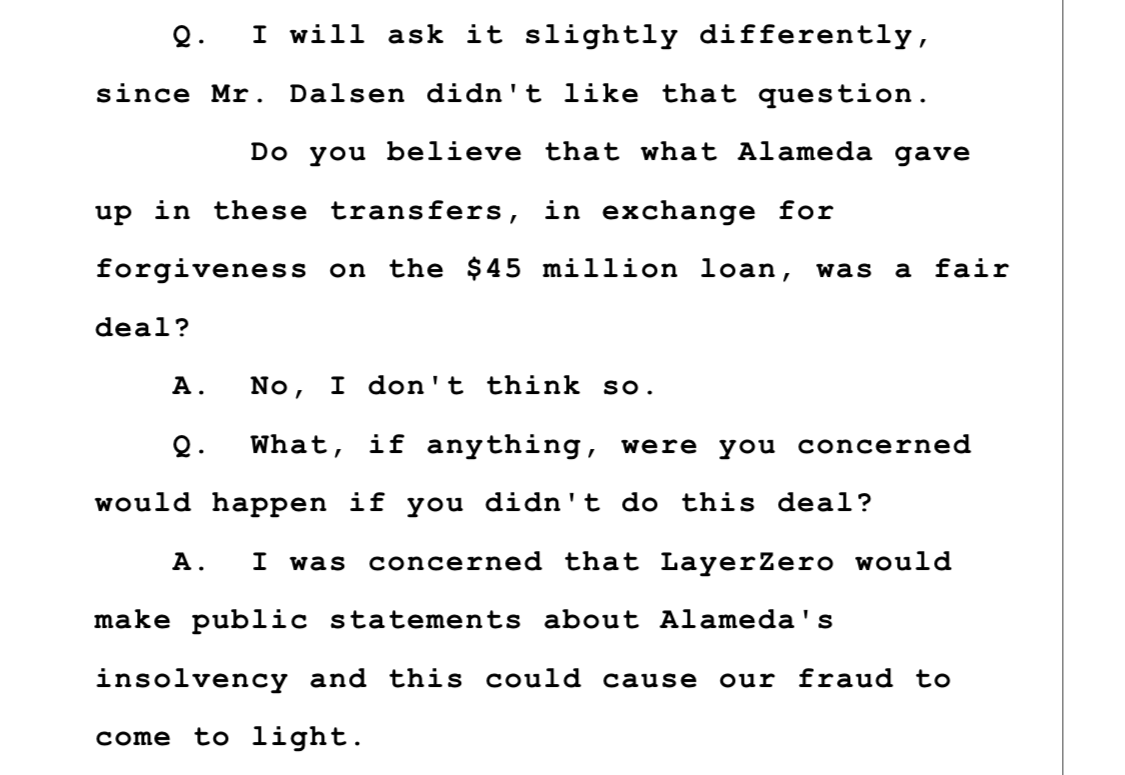
A reminder that, according to the FTX estate’s allegations, LayerZero used its knowledge of Alameda’s financial distress as leverage in a deal involving forgiveness of Alameda’s $45M loan
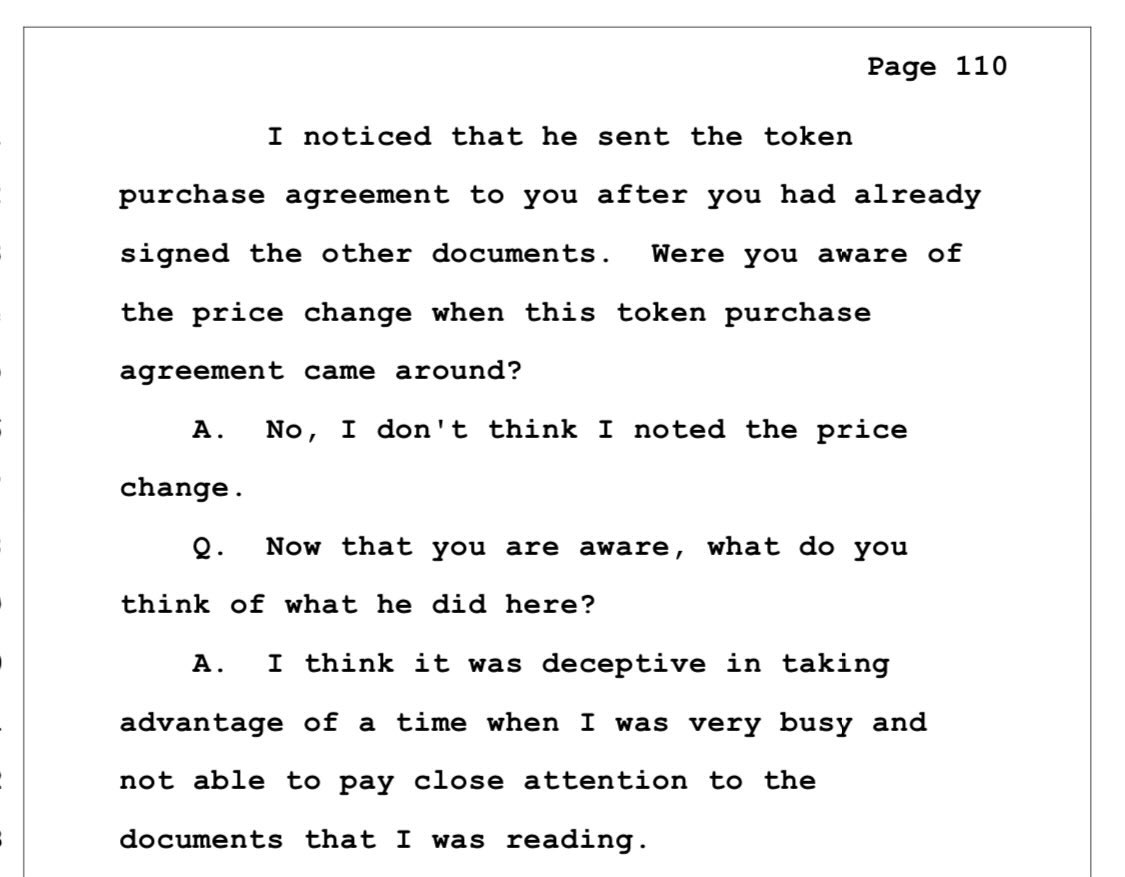
LayerZero then, according to Ellison’s testimony, sent a later agreement with a price change she says she did not notice at the time, which she later called deceptive
Ellison’s deposition: “I was concerned that LayerZero would make public statements about Alameda’s insolvency and this could cause our fraud to come to light.”
English