
Sabitlenmiş Tweet
M_Value Ⓥ
1.4K posts

M_Value Ⓥ
@_AndyVIE_
Crypto VC & Fund Manager | 10+ years in crypto | Sharing my thoughts, deep dives & insights | No financial advice!
Schweiz Katılım Aralık 2017
2.3K Takip Edilen347 Takipçiler
M_Value Ⓥ@_AndyVIE_
Funny how people call #BerkshireHathaway “boring” and fixate on Warren Buffett stepping down. To me, it’s one of the few businesses I’d actually feel comfortable owning in size. Reason is simple: It’s not one company — it’s a collection of businesses people rely on every day. Insurance, energy, rail, industrials… not exciting, but essential. When things turn south, people cut spending but they don’t stop using electricity, shipping goods, or buying basic products. A lot of Berkshire sits right there. On top of that: •Huge cash pile •No pressure to act •Ability to move when others can’t That combination matters more in bad times than good ones. And I actually agree with @MohnishPabrai here — at current levels, I feel more comfortable buying Berkshire than buying the S&P 500. At roughly 4-5% earnings yield, its around intrinsic value as per my calculations. I’m happy to add on weakness.
QME

This is what people under appreciate with $BRK.B especially considering the huge downside protection it provides.
At <$500 I think $BRK.B is very reasonably priced here for the long-term oriented investors.
What are your thoughts on Berkshire? 🤔

Ernest Wong@ErnestWongBWM
It's a herculean accomplishment to match the S&P 500 without big techs other than $AAPL and with a large portfolio allocation to cash
English

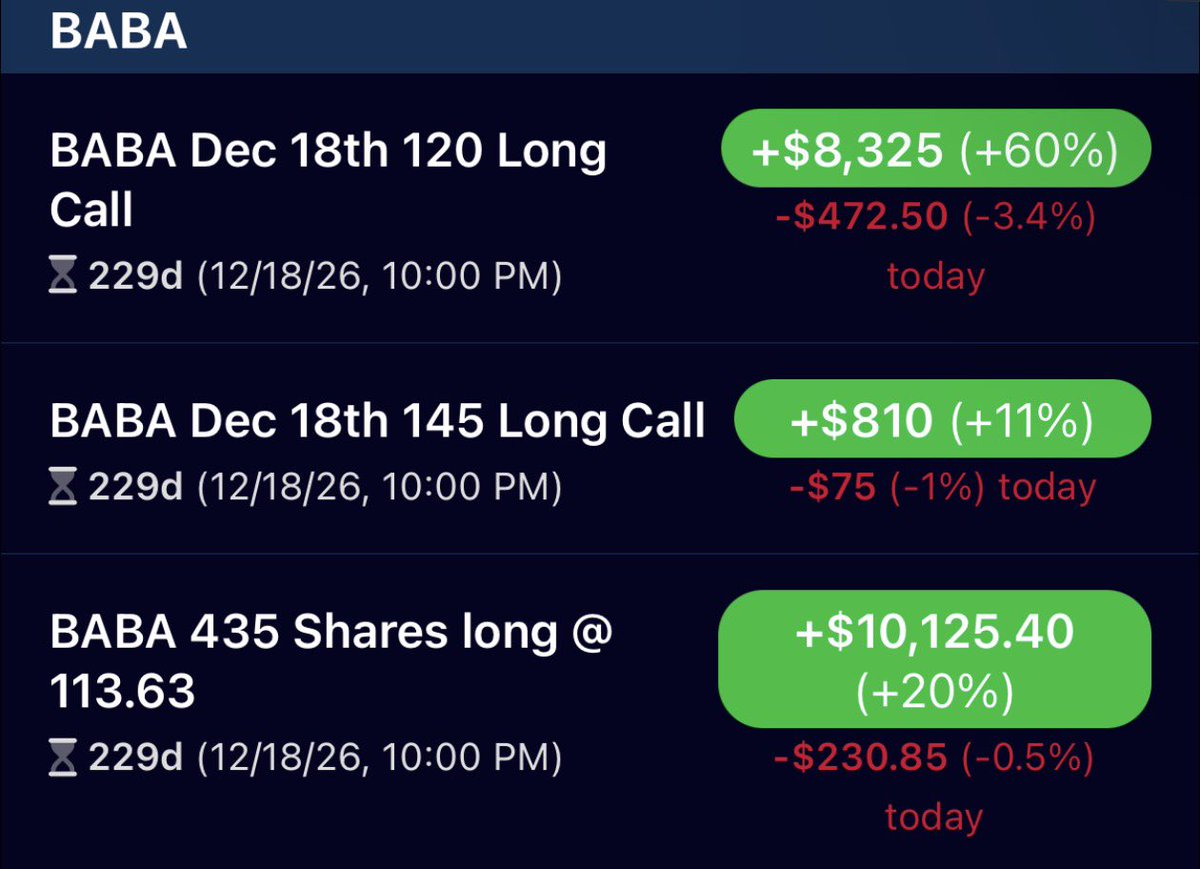
Adding on Monday to my $BABA long. The ultimate laggard of this AI rally.
While $NVDA, $MSFT and $AMZN ripped on the hype, $BABA has been left behind on macro and China noise. But step back and look at how real value builds in AI. It starts with the physical foundation of critical minerals processing, power grids, land and cooling for data centers. Then the chips that run everything. Then the massive data that trains the systems. Then the models that create intelligence. Then the execution layer that turns decisions into real action, whether software agents or physical robots. Finally the applications that reach actual users and businesses.
$BABA owns a massive integrated slice across almost all of it, especially the choke points.
Infrastructure: China dominates critical mineral processing, the true refining bottleneck like old oil empires. $BABA sits right on top with AliCloud data centers, power hungry builds and domestic supply chain leverage. Every AI system in China flows through layers $BABA touches.
Chips: Not global leader but proprietary T Head silicon plus full stack optimization for domestic inference and training, bypassing export walls.
Data plus Models: Proprietary e comm and logistics data moat plus Qwen family, top open weight models globally with over 1 billion downloads and 200 thousand plus derivatives. Owning the data and the model plus cloud deployment is defensible as models commoditize.
Execution plus Application: AliCloud is the China AI deployment rail for enterprise and consumer. Agentic commerce, Wukong platform and full ecosystem. This is where value accrues once the lower layers exist.
My ranking:
Integration depth 8.5 out of 10. Full vertical stack in the number 2 AI superpower. Misses bleeding edge global silicon but wins on domestic infrastructure choke, data moat and distribution.
Trade quality 9.5 out of 10. Classic laggard setup with asymmetric upside as China doubles down on AI self reliance and local spend. This is the picks and shovels plus apps play of the East, not another model hype story.
History shows value concentrates at choke points like refining or routers.
$BABA is positioned on several.
Not advice. Just the setup looks stupidly good from here.
What is your take?
Cassian@ConvexDispatch
English

A lot of discussion around capital allocation at Berkshire Hathaway $BRK.B under Greg Abel given it's present size.
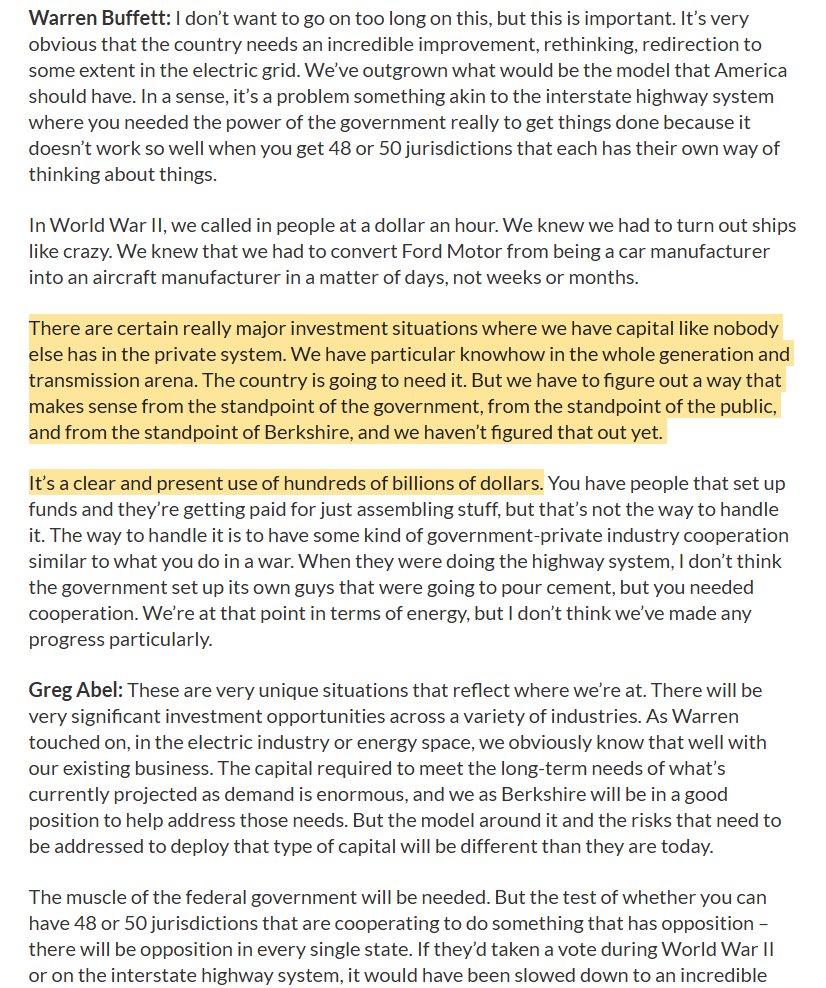
I thought that Warren and Greg were very clear last year's AGM about an opportunity that they see to deploy hundreds of billions of dollars.
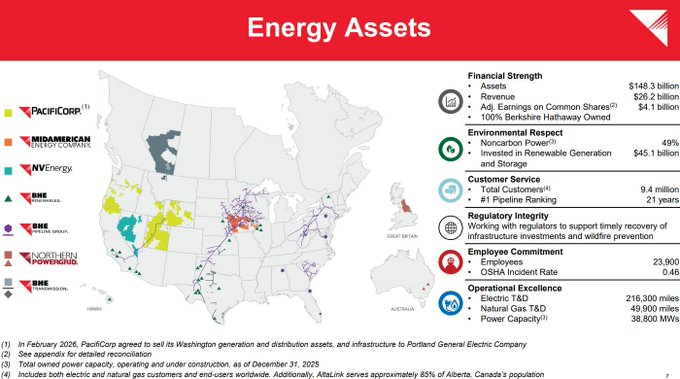
As the PacifiCorp liability is addressed (both customer payouts to the impacted and clarification of wildfire liabilites by the States), I expect to see continued very large investment (M&A and organic) into BH Energy. Potentially very large.
And if not, then buying back the stock at ~1.45x BVPS will be a good use of tens or hundreds of billions of cash flow until another opportunity arises. Maybe too boring and fustrating to the crowd used to Mag7 growth and multiple expansion, but solidly profitable and sustainable.
What's the variant view?
English
Funny how people call #BerkshireHathaway “boring” and fixate on Warren Buffett stepping down.
To me, it’s one of the few businesses I’d actually feel comfortable owning in size.
Reason is simple:
It’s not one company — it’s a collection of businesses people rely on every day. Insurance, energy, rail, industrials… not exciting, but essential.
When things turn south, people cut spending but they don’t stop using electricity, shipping goods, or buying basic products. A lot of Berkshire sits right there.
On top of that:
•Huge cash pile
•No pressure to act
•Ability to move when others can’t
That combination matters more in bad times than good ones.
And I actually agree with @MohnishPabrai here — at current levels, I feel more comfortable buying Berkshire than buying the S&P 500.
At roughly 4-5% earnings yield, its around intrinsic value as per my calculations.
I’m happy to add on weakness.
English
@DudeWhoInvests Gresham’s law applied to human capital: cheap liquidity drives out hard labor.
English

Professor Jiang spoke on a BIG problem that the American economy is facing nowadays…
Jiang: “America has a huge problem, which is there's too much liquidity in the system. And so if you're trying to run a financial system, you can't have that because if there's too much liquidity, no one actually works, right? If you got a million dollars in the bank, you're like 'okay, I could just sit at home and gamble with it or do OnlyFans, or I could go to work from 9 to 5, put up with an asshole boss, do work that is meaningless, and get paid nothing for it, right?”
He has a good point.
English
M_Value Ⓥ retweetledi

The sun was free. They sold you SPF 50 and a vitamin D deficiency.
Sleep was free. They sold you an app, a pill, and a wearable that tells you your sleep was bad.
Walking was free. They sold you a treadmill, a fitness tracker, and a £180 pair of trainers.
Fasting was free. They sold you meal replacement shakes and the anxiety that skipping breakfast would wreck your metabolism.
Cold water was free. They sold you a £3,000 plunge barrel and a podcast episode about it.
Silence was free. They sold you a meditation app with a premium tier.
Animal fat was cheap. They sold you seed oils, then supplements to replace what the animal fat contained.
Tallow was cheap. They sold you a seventeen-step skincare routine and a clinical trial proving your face needs ceramides.
Meat was cheap. They are currently selling you the idea that you shouldn't eat it.
The 20th century removed access to everything the body needs to function.
The 21st century is selling it back, one subscription at a time.
Your great-grandmother had none of the products.
She had all of the things.
English

Watch and bookmark this.
Worth your time!
Warren Buffett & Charlie Munger on how to value businesses.
Investing is simple, not easy!
#buffett #munger #berkshire #investing
English
More of this culture is needed in crypto land
David Kass@DrDavidKass
Greg Abel on CNBC: Greg is investing $15.3 million in Berkshire A shares, his entire Berkshire salary after taxes for 2026. He pledges to do the same every year going forward.
English
Gold lacked fungibility and scalability, too. The historical solution was gold-backed fiat. Bitcoin’s base layer is limited for transacting, but its Proof of Work secures the network flawlessly.
The modern equivalent is Bitcoin-backed programmatic money. You simply wrap BTC in a smart contract and transact it on a high-performance chain with native privacy features.
The base layer secures the value; the execution layer provides the utility?
English
"There's a structural flaw in gold. Because it's physical, you can't really use it to settle international transactions. You either have to store it with a third-party -- a vault in Switzerland, London, or New York, which puts it at high risk of seizure -- or you have to transport it via insecure/slow planes, trains, and busses. No central bank wants these things."
A classic debate/sales technique when you position one thing vs. another is to focus attention on a small issue with one side, rather than providing a balanced view.
Nothing is perfect. And IMO it's far easier to make bitcoin holdings quasi-private than it is to make gold securely non-physical.
Central bank adoption is coming. They'll hold both bitcoin and gold. It'll just take time.
Vivek Sen@Vivek4real_
BREAKING: 🇺🇸 BILLIONAIRE CHAMATH PALIHAPITIYA JUST DROPPED A MASSIVE WARNING AGAINST BITCOIN: “THERE’S A STRUCTURAL FLAW IN BITCOIN.” “BITCOIN LACKS FUNGIBILITY AND PRIVACY.” “IT CAN NEVER BE A HOLDING OF A CENTRAL BANK.”
English
Gold lacked fungibility and scalability, too. The historical solution was gold-backed fiat. Bitcoin’s base layer is limited for transacting, but its Proof of Work secures the network flawlessly.
The modern equivalent is Bitcoin-backed programmatic money. You simply wrap BTC in a smart contract and transact it on a high-performance chain with native privacy features.
The base layer secures the value; the execution layer provides the utility?
English

M_Value Ⓥ@_AndyVIE_
If the fiat system were flawless, Bitcoin would be irrelevant. But money is simply a ledger of collective belief, and our current ledger is being systematically corrupted by its administrators. We are living through the slow, undeniable decay of the Bretton Woods order. When a sovereign power manipulates its currency to subsidize poor execution and political missteps, society pays the hidden tax of inflation. And because of the dollar’s gravity, when the US prints, every other nation bleeds. To understand Bitcoin’s destiny, you must separate its value into two distinct engines: External Circumstances and Internal Compounding. 1. The External Forces (The Environment) Value is never absolute; it is strictly contextual. Water is worthless in a flood, but it is priceless in a desert. Right now, the global financial landscape is turning into a desert. Geopolitical fracture, weaponized reserve currencies, and the total erosion of institutional trust are external factors that Bitcoin does not control, but from which it derives immense utility. Bitcoin doesn’t need to change for its value to explode; the world around it just needs to keep making the same human mistakes. The worse the traditional system performs, the higher the premium on an exit system. 2. The Internal Forces (The Moat) Critics point to other cryptocurrencies and say the technology is easily replicated. They fundamentally misunderstand the difference between software and societal consensus. Yes, the code is open-source. But you cannot fork a network effect. Bitcoin’s internal value—its moat—is built on factors that cannot be copy-pasted: a globally distributed miner network, an unassailable brand, an immaculate conception, and a decentralized community that views its preservation as a moral imperative. Its strongest internal feature is simply time. Every single day the network refuses to die, it forces the world to recalculate. Survival breeds trust, trust breeds adoption, and adoption mathematically hardens the protocol. Is Bitcoin the perfect digital gold today? No. It is still plagued by leverage, speculative mania, and hype. But do not confuse market mechanics with fundamental failure. The current correction is not a death spiral; it is a necessary distribution phase. Leverage unwinds painfully. Weak hands liquidate, and strong hands accumulate. Conviction is transferred from the speculator to the true believer. This is how all emergent, world-changing assets breathe. A true benchmark store of value does not need to yield dividends. It does not need to produce eggs. It only requires absolute scarcity and the ability to port economic energy across time and space. If the world turns hostile and you are forced to flee, you cannot carry a skyscraper across a border. You cannot carry a vault of physical gold. But you can hold a billion dollars of economic energy in your head, memorize twelve words, and walk across any border on earth. You can port your entire life's labor through cyberspace and convert it into physical goods on the other side of the planet. That is not a speculative tech play. That is unprecedented human optionality. We are watching a dual-engine phenomenon. Externally, the fiat architecture is fracturing under the weight of human fallibility. Internally, Bitcoin is hardening, compounding belief, and distributing its supply. It won't be a straight line. There will be systemic hurdles, friction, and volatility. But as long as the old world keeps breaking, the new world will keep building. #btc #bitcoin
QME

I'd like to address this conversation between two people I greatly admire (@friedberg and @RayDalio) as both fellow libertarians and macro experts i try to learn from. The conversation in the video is about bitcoin but I've extended it to be about bitcoin vs gold. Note that @friedberg is clearly super technical and @RayDalio is clearly not technically inclined but grasps the basic concepts of Bitcoin without understanding any of its underpinnings - I've validated this by reading almost everything he's written that mentions bitcoin and tech over the years:
I'll publish this separately later as an X article or Substack but I want to get this out now since I'm getting more and more "fud" oriented questions on these topics.
Several points that matter here:
1. Bitcoin is about 15 years old. Gold was formed about 4.6 billion years ago. Even the Internet is about 3 times older than Bitcoin. Gold exists in the Universe in extreme abundance. There are 250k metric tons of gold discovered so far on earth. That number doubles every 50 or so years. There are another 10^20 kg of gold in our solar system (woah). By contrast Bitcoin is comprised of exactly 2.1^15 sats and will NEVER (ever) grow larger than that number. In other words bitcoin is super scarce compared to gold.
2. large returns tend to require super large volatility. By volatility I don't mean dollars as the dollar is also volatile. I mean purchasing power of your assets vs that which we need to survive and thrive... (food, housing, clothing, education, entertainment, etc.) If your investing time horizon is less than 18 months you should probably focus on things that preserve that purchasing power in the short term. If your time horizon is longer than 18 months you can start to think about growing wealth on a steeper volatility curve that way you can survive drawdown yet capture the upside. Over the last 40 years that has meant technology. Yes tech investing has been extremely volatile but that has been the price for the upside. Bitcoin, because of its scarcity and relatively small float acts like a levered bet (today) on that volatility. That will probably change soon (soon means in 20 years) but for now big gains come with big volatility.
3. Narratives matter greatly in investing, especially in the short term. Gold has the historical advantage of having survived multiple empire transitions. Bitcoin wasn’t around when the last empire fell, nor was it there for the enactment of Bretton Woods or its 1971 "fiat" conclusion. In this regard, Gold holds the "Linday Effect" advantage—it has survived longer, so people trust it will last longer.
But Gold's greatest disadvantage is cultural: Younger generations aren't interested in "analog" boomer-money. If it isn't digital-native, they don't get it, and they don't want to store it. To be clear, Bitcoin is not yet a total replacement for Gold; it is an emerging contender. I believe in 25 years, it will be the primary reserve asset. Most of the massive gains in purchasing power relative to Gold will likely occur in these next two decades before the next empire transition is complete. The question is: will you be positioned for that transition, or holding onto the previous era's ledger?
4. lets talk about privacy. Moving large amounts of gold privately is impossible.... basically look for the large yellow blob. OK I'm partially joking. Yes reasonable amounts of gold can be moved privately but it's difficult, dangerous and expensive to move large amounts of gold privately. Bitcoin can be moved easily peer to peer with no middle man to the transaction in any amount. That movement can be accomplished with minimal to no knowledge of the transacting parties depending on the care they take in executing the transfer. Securitizing gold or bitcoin puts them on a more even playing field for trading and rights transfer but introduces new risks some of which are mitigated by courts and police. It doesn't change the complexity of physically moving the gold or its overall security.
5. the privacy discussion is a good segue into quantum computers and hacking. These days gold vaults are generally pretty safe as long as you don't need to move the gold. The cost of that safety is quite high. The biggest question these days about Bitcoin safety is primarily around quantum computing risks. The quantum risk has been overblown so disproportionately out of whack with reality it's hard to know where to begin. I'll try to simplify this for the no techies among you.... There are two threat surfaces to Bitcoin. I will address them one at a time...
First many older Bitcoin address (going back over 10 years now) exposed their public addresses on the blockchain itself or via reuse. Generally this doesn't happen anymore so newer transactions and wallets are not at risk. Those addresses and the signatures they generate are based upon Elliptic Curve Digital Signature Algorithm (ECDSA) mathematics. However, it is worth noting that the newer Taproot (P2TR) addresses actually reveal the public key by design; while great for privacy today, they do not offer the same 'hashed' quantum protection that Native SegWit does. Stick with segwit... more below.
A quantum computer with enough qubits and time would be able to unlock these wallets and simply move the utxo's (ie the bitcoin locked via the private key) from the older barrel changer (ie wallet) to another newer one. Eventually these Bitcoin will have to be moved to a quantum safe wallet. Again, modern wallets avoid this altogether by using double hashes that are not hackable via quantum computers. Migrating existing Bitcoin to Native SegWit wallets (addresses starting with bc1q) and avoiding public address reuse hardens your wallet beyond any known hacking capability including quantum computers.
OK, for the older Bitcoin not stored with segwit addresses how long do they really have? Experts generally agree that a cryptographically relevant quantum computer (CRQC) capable of this task is at least 5 to 15 years away - or more. Such a computer would need about 1 billion physical qubits (roughly 3000 logical/error correct qubits) to be effective in a single lifetime to brute force the private key.
Second we have the digital signatures used to secure the wallets themselves. A quantum computer with enough logical qubits could brute force crack ECDSA and undo an unconfirmed transaction via a man in the middle attack but this would need to be done in less than 10 minutes - before the transaction is confirmed. That is highly improbable (round off error to zero in probability) in the next 10 years but not out of the question. A few weeks ago, developers formally introduced BIP 360, which proposes a new output type for transactions to build quantum-safe foundations into the protocol. Future upgrades will also likely introduce new, quantum-secure signature schemes (like those currently being standardized by NIST) without requiring a "hard fork" or split in the network.
It could take months to move older wallets to upgraded wallets given the size limitations of bitcoin's blocks which are only generated every ten minutes. So the sooner they get started on these upgrade the better.
Bottom line: 1. if you acquire or mine bitcoin today, ensure you use a Native SegWit wallet (starting with bc1q). Avoid using Taproot (starting with bc1p) for long-term cold storage if your primary concern is quantum-safety. 2. If you have older Bitcoin and move it to a bc1q wallet today you're also fine. 3. Developers haver woken up to the fact that they need to address older wallets en-masse in the next 5 years (or sooner) to be truly safe.
Note: this is NOT investment advice and simply represents my personal opinion as to why Bitcoin is generally a better investment than gold over a reasonably long time frame.
Altcoin Daily@AltcoinDaily
Ray Dalio SLAMS Bitcoin!! “Bitcoin does not have privacy.” “Central banks are not gonna wanna buy Bitcoin.” “Quantum computing” “Who owns it?” What do you think?
English
If the fiat system were flawless, Bitcoin would be irrelevant.
But money is simply a ledger of collective belief, and our current ledger is being systematically corrupted by its administrators. We are living through the slow, undeniable decay of the Bretton Woods order.
When a sovereign power manipulates its currency to subsidize poor execution and political missteps, society pays the hidden tax of inflation. And because of the dollar’s gravity, when the US prints, every other nation bleeds.
To understand Bitcoin’s destiny, you must separate its value into two distinct engines: External Circumstances and Internal Compounding.
1. The External Forces (The Environment)
Value is never absolute; it is strictly contextual. Water is worthless in a flood, but it is priceless in a desert.
Right now, the global financial landscape is turning into a desert. Geopolitical fracture, weaponized reserve currencies, and the total erosion of institutional trust are external factors that Bitcoin does not control, but from which it derives immense utility.
Bitcoin doesn’t need to change for its value to explode; the world around it just needs to keep making the same human mistakes. The worse the traditional system performs, the higher the premium on an exit system.
2. The Internal Forces (The Moat)
Critics point to other cryptocurrencies and say the technology is easily replicated. They fundamentally misunderstand the difference between software and societal consensus.
Yes, the code is open-source. But you cannot fork a network effect.
Bitcoin’s internal value—its moat—is built on factors that cannot be copy-pasted: a globally distributed miner network, an unassailable brand, an immaculate conception, and a decentralized community that views its preservation as a moral imperative.
Its strongest internal feature is simply time. Every single day the network refuses to die, it forces the world to recalculate. Survival breeds trust, trust breeds adoption, and adoption mathematically hardens the protocol.
Is Bitcoin the perfect digital gold today? No. It is still plagued by leverage, speculative mania, and hype.
But do not confuse market mechanics with fundamental failure. The current correction is not a death spiral; it is a necessary distribution phase. Leverage unwinds painfully. Weak hands liquidate, and strong hands accumulate. Conviction is transferred from the speculator to the true believer. This is how all emergent, world-changing assets breathe.
A true benchmark store of value does not need to yield dividends. It does not need to produce eggs. It only requires absolute scarcity and the ability to port economic energy across time and space.
If the world turns hostile and you are forced to flee, you cannot carry a skyscraper across a border. You cannot carry a vault of physical gold.
But you can hold a billion dollars of economic energy in your head, memorize twelve words, and walk across any border on earth. You can port your entire life's labor through cyberspace and convert it into physical goods on the other side of the planet.
That is not a speculative tech play. That is unprecedented human optionality.
We are watching a dual-engine phenomenon. Externally, the fiat architecture is fracturing under the weight of human fallibility. Internally, Bitcoin is hardening, compounding belief, and distributing its supply.
It won't be a straight line. There will be systemic hurdles, friction, and volatility. But as long as the old world keeps breaking, the new world will keep building.
#btc #bitcoin

English
@DeItaone hmm...
x.com/_AndyVIE_/stat…
M_Value Ⓥ@_AndyVIE_
🌏Why #China Tech & AI is Relatively Undervalued and Why the Long-Term Opportunity is Massive China is often viewed through a pessimistic lens, but this perspective overlooks significant long-term opportunities. Here’s why China might be undervalue🧵👇

CHINA EMERGES AS GLOBAL TECH INVESTMENT HOTSPOT
China is becoming a more attractive investment destination as its tech capabilities grow, according to Deutsche Bank CIO Christian Nolting. He expects rising inflows into Chinese equities this year, driven by investors in Europe and Southeast Asia, alongside a weaker US dollar pushing diversification away from US assets.
Nolting says China has evolved beyond low-cost manufacturing into a leading force in AI, robotics, and electric vehicles. This view is shared by other fund managers, who are turning to Asia as a cheaper alternative to expensive US tech stocks.
So far this year, Asian markets are outperforming, with the MSCI Asia Pacific Index up 12% while the S&P 500 remains flat.

English
I still think DePIN is one of the cleanest ways to scale physical infrastructure versus fully top-down models — but only if contributors participate in the economics in a credible, enforceable way (fees, burns, distributions, or explicit revenue-share).
Empirically, value accrual is the weak link: we’ve seen periods where DePIN revenues improved while many DePIN tokens underperformed or stayed depressed.
And in a meaningful subset of revenue-generating crypto networks, the strongest economic rights sit in equity or centralized entities, while the token mainly captures governance / incentives — which can feel like contributors are being paid in a volatile instrument without a guaranteed claim on cashflows. (Not always, but often enough to be a pattern.)
DePIN doesn’t “only work” when token holders = equity holders — but it works best when tokens have a clear, durable claim on the underlying business economics (or when the business is genuinely token-native). If the token is structurally junior to the company’s cashflows, decentralization can drift into optics over alignment.
On buybacks: sometimes they are meaningful and rule-based, sometimes they’re small or discretionary. The important distinction is whether the buyback/distribution is programmatic, transparent, and tied to actual revenue—not a marketing line.
the token price is part of the incentive system. If the network is doing “good business” but the token persistently fails to capture any value, contributors rationally reallocate effort elsewhere. That’s how incentive flywheels lose torque.
Also: institutional capital tends to prefer tokens with verifiable fundamentals, clearer value capture, and access to regulated rails/venues—especially as the market matures.
The fix: more regulatory clarity + better-structured token rights (programmable equity like) + enforceable, transparent economics → sustainable token value capture → broader allocators willing to participate → growing the pie.
Advice to founders: take a smaller slice of a much bigger pie later, instead of defending a tiny pie like it’s the whole bakery today.
English
M_Value Ⓥ@_AndyVIE_
Everyone has a strong opinion on #China. Almost nobody is willing to underwrite the spread. From a first-principles lens, the setup is simple: price is what you pay, value is what you get — and the China vs US gap still looks structurally mispriced to me. I said this publicly at the end of 2024. In 2025, it played out: China tech (#CQQQ) +34.9% vs Nasdaq (#QQQ) +20.8%. Main Street is still dominated by the negative China tape (politics discount, property hangover, demographics). Fair. But that’s not the whole story — not the production layer. The production layer is where China keeps compounding: manufacturing scale, robotics adoption, energy buildout, relentless work ethic, and a system that can plan + execute in decades instead of quarters. 2026 thesis: same setup — cheaper cashflows, bigger optionality (relative price/value still mispriced imo).
QME

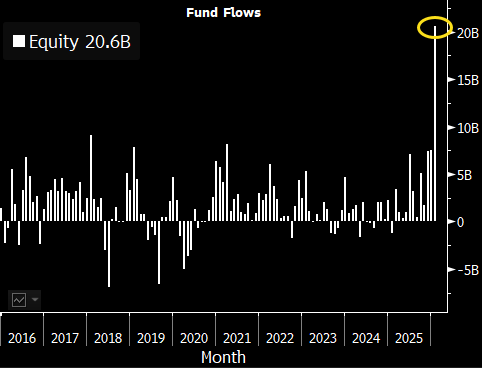
Emerging Markets ETFs just destroyed their monthly flow record by 3x. They make up 3% of aum but took in 13% of the cash. About 40% of it went to $IEMG but dozens took in cash. Also it wasn't really at the expense of US or eq or bonds but in addition to it.
English
One of the most important things for investors — and I don’t see many doing it — is this: spend a lot of time thinking through and writing down a strong long-term thesis.
Because of short-form videos and “finance entertainment,” people tend to pick up ideas they hear, without really thinking them through. Then the market moves, and they keep adjusting their thesis with every fluctuation.
But the big money is usually made by doing the opposite: take the time to build a factually solid thesis, act on it… and then do nothing for a long time.
The market is there to serve you and not to instruct you!
Rule at sea:
1. Set your course on facts.
2. Don’t steer on waves.
3. Use data as your compass, not price.
4. Expect storms — size the ship to survive.
If the map is right and you don’t mutiny mid-voyage, the money will show up.

English