Decentralized Danny

7.4K posts

Decentralized Danny banner
Decentralized Danny

Decentralized Danny

@_dedanny_

DeFi nerd · fundas only $AERO pre-Coinbase · still hunting

onchain Katılım Mart 2020
165 Takip Edilen767 Takipçiler
Sabitlenmiş Tweet
Decentralized Danny
Decentralized Danny@_dedanny_·
I'm in crypto since 2019 What $AERO has that most DeFi protocols dont: ~ Real fee revenue: $87M/year, not incentives ~ Locked supply mechanics: ~54% locked, not just staked ~ Actual fee distribution: 100% to veAERO holders ~ A merger that compresses $AERO n $VELODROME into one $200M fees post-merger is the target, not the pitch That's the difference between a product and a narrative
Aerodrome@AerodromeFi

The best time to trade the S&P onchain was yesterday. The second best time is today.

English

1
0
9
1.3K
Defi Jonaso
Defi Jonaso@Jonasoeth·
The core pain point is that BTC holders still do not have a simple native way to rotate into gold onchain. Today, users usually need to: - send BTC to a CEX - sell BTC - buy XAUt - withdraw back to self-custody Or deal with: - bridges - wrapped BTC - fragmented liquidity - complicated UX onchain So ironically, BTC ↔ gold → one of the most natural hard money trades, still has poor UX today. @build_on_bob is trying to solve this by enabling: > 1-click native BTC → tokenized gold swaps, > fully onchain and non-custodial, > without users needing to deal with bridge/wrapping complexity underneath. The deeper thesis is that if Bitcoin DeFi wants to scale, BTC needs to become as easy to move and use across DeFi/RWAs as stablecoins are today. BOB is trying to build that infrastructure layer for native BTC.
Defi Jonaso tweet media
English
3
0
2
38
DeFi Andree
DeFi Andree@DeFi_Andree·
DeFi is moving from TVL wars to revenue efficiency. For years, the easiest way to judge a sector was simple: who has the most TVL? But this chart tells a different story. DeFi categories are starting to split into two groups: capital-heavy infrastructure vs usage-driven revenue machines. Lending and Bridges sit on massive TVL. They are core infrastructure, but their revenue does not scale proportionally with the amount of capital they hold. That does not make them weak, it just means they are not always the most efficient at monetizing every dollar of TVL. Derivatives and DEXs look very different. They do not need the largest TVL base to generate strong revenue because their business model is tied directly to real activity: trading volume, fees, and repeated user usage. That is the gap most people miss. Some sectors are very good at attracting liquidity. Others are much better at turning usage into revenue. RWA is probably the most interesting middle ground here. It has large TVL, strong revenue, and clearer underlying yield sources. That makes the TVL story and revenue story feel more aligned. Restaking shows the opposite side: huge capital inflows, strong narrative, but weaker revenue capture relative to TVL. This is the difference between attracting capital and building a real business model. The market signal is pretty clear. In 2026, the best DeFi sectors may not be the ones with the most deposits. They may be the ones that can convert capital into recurring revenue, real usage, and sustainable value capture. Which DeFi sector do you think wins the revenue efficiency race this year?
DefiLlama.com@DefiLlama

TVL vs Revenue (log scale) across the top 15 DeFi categories. Capital efficiency varies wildly. Chart generated with LlamaAI.

English
22
1
30
540
Decentralized Danny retweetledi
DeFi Andree
DeFi Andree@DeFi_Andree·
Pendle x Strategy: How DeFi Turns Strategy’s Preferred Stock into an Onchain Bitcoin Credit Curve Bitcoin’s biggest dilemma has always been capital efficiency: a trillion-dollar asset sitting largely idle But the narrative is rapidly shifting Store of Value → Programmable Credit By bridging corporate dividend streams ($STRC) directly onto DeFi rails, we are not just creating another wrapped token. We are witnessing the birth of an on-chain credit curve for the world's most pristine collateral It is no longer about holding spot and praying for price volatility. It is about isolating risk, extracting real value, and trading structured yield. Here is how ~20% Fixed APY engine actually works under the hood ---------- Credit Origination starts with @Strategy ( $STRC ) Instead of letting a massive @Bitcoin treasury sit idle, it generates a dividend stream. Protocols like @saturn_credit, @apyx_fi, @xStocksFi bring this exact yield on-chain So instead of just holding a volatile asset, you are capturing a continuous yield stream backed by institutional-grade collateral. You are holding a productive asset ---------- Not all capital has the same risk appetite. This is the defensive and offensive side of the architecture Through @strata_markets and @roycoprotocol, this tokenized yield is tranched into specific profiles: → Senior Tranche: Safety first. Lower yield, maximum protection → Junior Tranche: Higher yield, absorbing the underlying risk In other words, risk is isolated. Institutional capital can park safely, while degens can chase the premium. Risk control becomes an active position ---------- This is where the market decides the fair value of that yield. You do not need to guess market direction. You only need to choose your exposure That is where the @pendle_fi market data gets interesting: 🔹 For Defensive Capital (PT - Fixed Yield): > Royco (jrRoyAPYUSD): Lock in 20.95% Fixed APY > APYX (apyUSD): Lock in 19.22% Fixed APY > Strata (jrUSDat): Lock in 15.29% Fixed APY > xStocks (STRCx): Lock in 15.06% Fixed APY > Saturn (sUSDat): Lock in 14.33% Fixed APY 🔹 For Aggressive Capital (YT - Levered Upside): > APYX (apxUSD): 72x Leverage > Saturn (USDat): 42x Leverage > Strata (srUSDat): 34x Leverage > Saturn (sUSDat): 26x Leverage > xStocks (STRCx): 25x Leverage The real takeaway is not just high APY, but the power of customizing your payoff structure on a Bitcoin-backed asset ---------- Flywheel = BTCFi as Alpha → Bitcoin can generate dividends → Dividends can be tokenized → Tokenized yield can be tranched and traded And when traders can move between different risk profiles of the same underlying asset, capital flows back in. More capital expands the STRC-backed products, creating a massive on-chain credit curve That is what makes this architecture interesting to me. It is not just another wrapped BTC. It is a primitive for expressing yield views through structured risk ---------- Bitcoin is no longer just something to hold. It becomes the base layer of a credit economy ➥ Institutional collateral + DeFi Composability = BTCFi Alpha.
DeFi Andree tweet media
English
40
13
117
7.7K
Decentralized Danny retweetledi
Aerodrome
Aerodrome@AerodromeFi·
177K AERO Buybacks ✈️ The Aerodrome PGF has acquired and max-locked 177K+ $AERO as part of its programmatic market-aware buyback model over the last 8 days. 180M+ $AERO has been acquired and locked to date via the PGF, Flight School, Relay and other efforts.
Aerodrome tweet media
English
14
31
274
19.1K
DeFi Andree
DeFi Andree@DeFi_Andree·
Saturn x Strata Flywheel: A Yield-Stacking Strategy for Every Risk Appetite @saturn_credit tokenizes STRC (Strategy's preferred stock offering ~11.5% APY dividends) and brings it on-chain as sUSDat. @strata_markets then divides this sUSDat into two risk-adjusted tranches. When these two protocols combine, a powerful flywheel begins to spin. Here is the detailed breakdown of how this flywheel operates ↓↓↓ --- The architecture of this flywheel is divided into 3 core components, operating seamlessly: ① Yield Engine: Originates from the Bitcoin accumulation strategy of a public company (Strategy). By issuing preferred stock, Strategy generates a fixed dividend stream (STRC Dividends) at ~11.5% APY The strength of this approach is evidenced by their accumulation of an additional +77,000 BTC in Q1 2026 alone, solidly fortifying their balance sheet to maintain sustainable yields ② The Bridge: Saturn acts as the infrastructure layer bridging TradFi capital into the DeFi world. The 11.5% dividend from STRC is brought on-chain as USDat, which is then staked to become sUSDat (a yield-bearing asset) ③ The Risk Tailor: This is the bottleneck many RWA projects face: a fixed APY cannot satisfy everyone. Strata solves this by routing sUSDat into Vaults and tranching it into two distinct products: ▸ srUSDat (~7.8% APY): Prioritizes capital protection, perfectly suited for large, risk-averse capital from DAO Treasuries or Conservative Funds ▸ jrUSDat (~25% APY): The first-loss layer absorbing risk in exchange for leveraged yields, purpose-built for Yield Farmers and Degens ➠ Strata tranches risk to attract TVL → Saturn routes capital back to the source to accumulate STRC/BTC → Yield is reinforced to continuously pump new liquidity --- Real Data & Targets: Traction: sUSDat reserves on Strata experienced an up-only growth within just a few days, hitting the $876.07K mark. Capital is continuously flowing in to absorb the 25% yield (jrUSDat) and to seek a safe haven (srUSDat). Target Season 1: Saturn is aiming straight for the ambitious milestone of $500M TVL by August 8, 2026 --- From the current level of ~$150M, the target represents roughly a 3.5x growth, and the flywheel is engineered to auto-run aggressively toward that number ➥ Saturn x Strata synergy transcends a simple RWA integration, it’s a perpetual liquidity flywheel.
DeFi Andree tweet media
English
65
31
288
77.2K
Sachin
Sachin@SachinHMx·
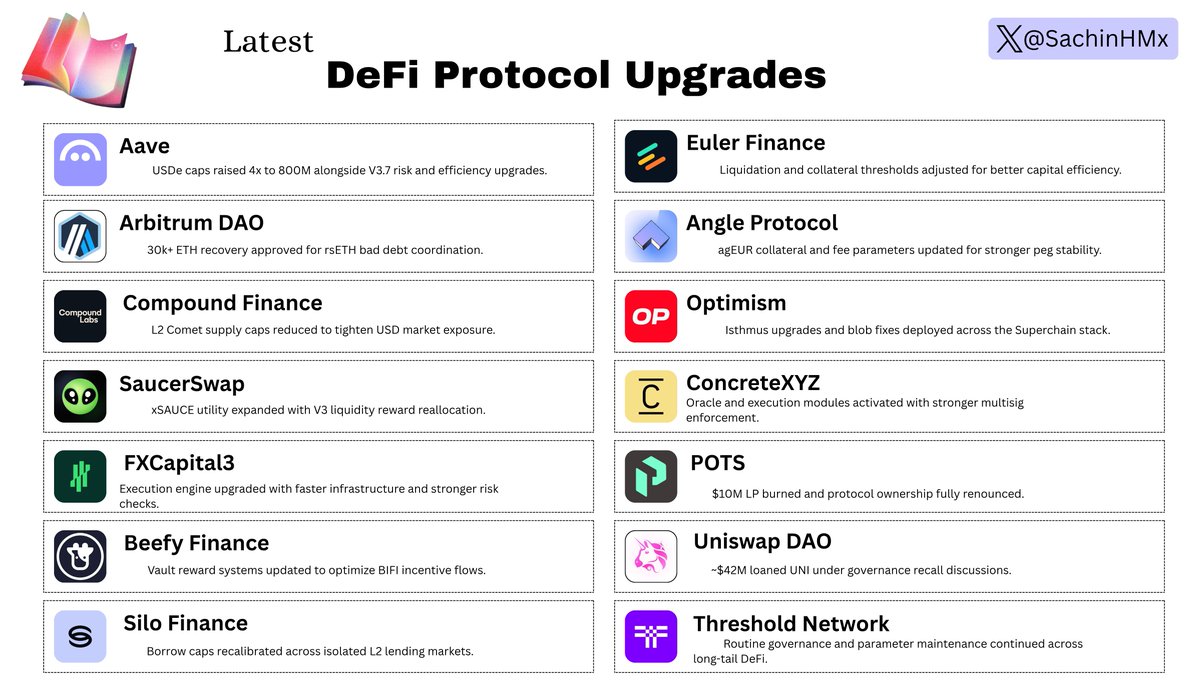
Markets may slow down, but protocol development doesn’t. Risk updates, infra upgrades, governance recovery, token utility changes, and decentralisation moves continued across DeFi this week. Some important protocol-level updates ↓ ► @aave Aave V3 expanded $USDe supply caps from 200M → 800M on @megaeth while tightening weaker markets through Risk Steward cap adjustments and v3.7 efficiency upgrades. ► @arbitrumdao_gov Arbitrum DAO approved a 30k+ $ETH recovery proposal for $rsETH bad debt cleanup across Aave, @ether_fi, @compoundfinance, @LayerZero_Core, and @KelpDAO. ► Compound Compound discussions focused on reducing supply caps across L2 Comets to tighten risk exposure on $USD lending markets. ► @SaucerSwapLabs SaucerSwap shifted rewards toward V3 unified liquidity while expanding $xSAUCE staking utility and fee rebates. ► @FX_Capital3 FXCapital rolled out a protocol upgrade with faster execution infrastructure and enhanced on-chain risk checks. ► @beefyfinance Beefy Finance updated vault strategies and reward allocation systems, impacting auto-compound flows and BIFI incentives. ► @SiloFinance Silo Finance recalibrated borrow caps and onboarding parameters to improve stability across isolated L2 lending markets. ► @eulerfinance Euler adjusted collateral and liquidation thresholds to improve capital efficiency across modular lending markets. ► @AngleProtocol Angle Protocol updated $agEUR fee and collateral parameters to strengthen peg stability during low-volatility conditions. ► @Optimism Optimism deployed Isthmus maintenance upgrades and blob fixes to improve scaling consistency across the Superchain stack. ► @ConcreteXYZ ConcreteXYZ activated new oracle and execution modules alongside stronger multisig enforcement infrastructure. ► @pots_money POTS burned $10M in LP and fully renounced ownership, removing admin control entirely. ► @Uniswap Uniswap DAO discussed recalling and repurposing ~$42M worth of loaned $UNI to tighten governance-token control. ► @TheTNetwork Threshold and other smaller DAOs continued routine governance maintenance and parameter updates across long-tail DeFi ecosystems. Did I miss any major protocol upgrades?
Sachin tweet media
English
8
3
16
536
Sachin
Sachin@SachinHMx·
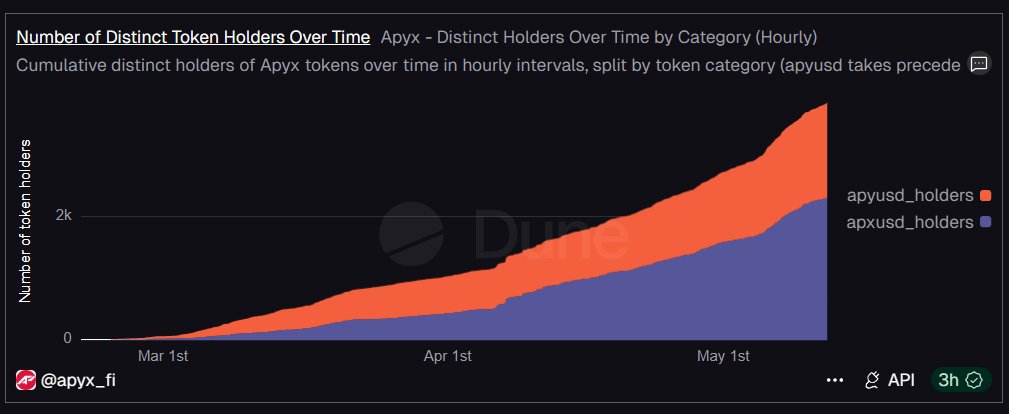
➥ Apyx: The Yield Layer for Onchain Dollars Stablecoin market cap has reached $318B, yet total yield paid out to date is just $1.53B, meaning less than 0.5% of stablecoin capital has generated yield for holders. USDT and USDC dominate on-chain dollars because they are stable, liquid, and scalable, but they generate almost no native yield for holders, creating “The Eroding Money Problem.” Here is how @apyx_fi is solving this with Dividend-Backed Stablecoins. — — — ► What is Apyx? $APYX is the first Dividend-Backed Stablecoin protocol that converts public-market dividend cash flows into programmable on-chain yield through $apxUSD and $apyUSD. Apyx uses real-world cash flows from DATs rather than fragile trading strategies to create scalable on-chain yield. ➤ Digital Asset Treasuries (DATs) This is the foundation of everything. A DAT is a public company that holds crypto assets on its balance sheet and raises capital to accumulate more $BTC, $ETH, or $SOL over time. — ► Digital Credit Apyx generates Digital Credit yield through dividend-paying preferred shares issued by DAT companies, providing recurring cash dividends with lower volatility than BTC-based strategies. Examples include: ➤ STRC (Strategy Short Duration High Yield Credit) STRC is Strategy’s Bitcoin-backed preferred share product with adjustable monthly dividend rates designed to keep the instrument near its $100 par value. STRC currently yields approximately 11.25% through recurring cash dividends. ➤ SATA (Sharplink Adjustable Treasury Allocation) SATA is another DAT preferred share structure used in Apyx’s collateral basket to generate a scalable Digital Credit yield. SATA dividend yields are currently in the ~12%+ range. — ► The Two-Token System Apyx separates stability and yield into two assets: apxUSD for liquidity and DeFi usage, and apyUSD for Digital Credit yield generation. ➤ apxUSD: The Base Stablecoin ▸ Synthetic, non-yield-bearing, overcollateralized stablecoin designed to stay near $1. ▸ Built for trading, liquidity, collateral, lending markets, and DeFi integrations. ▸ apxUSD supply has already grown to ~$371M since launching in Feb 2026. ➤ apyUSD: The Yield Layer ▸ Users deposit apxUSD into the vault to receive apyUSD and earn ~9.2% APY from Digital Credit cash flows. ▸ ERC-4626 non-rebasing vault token with an appreciating exchange rate. ▸ Similar to sUSDe or cToken-style vault share mechanics. — ► The Digital Credit Flywheel Apyx connects DAT preferred shares, public-market dividends, and DeFi stablecoin demand into a single Digital Credit flywheel. More DAT issuance → more preferred shares → larger dividend streams → higher on-chain yield → more stablecoin demand → more demand for preferred issuance → repeat This creates a scalable yield system backed by real public-market cash flows instead of short-term trading inefficiencies or funding-rate arbitrage. The APYX token captures reserve growth, with 50% initially distributed to stakers, positioning it closer to an on-chain public-market equity model than a traditional governance token. — ► Risk Management Apyx uses multiple defense layers to protect the system against preferred share volatility, liquidity stress, and DAT market drawdowns. ❶ Overcollateralization: Apyx claims collateral remains above 100%, keeping supply backed above liabilities. ❷ Rebalancing: Treasury allocations dynamically adjust based on issuer concentration, liquidity, and risk thresholds. ❸ Stress Testing: The protocol simulates DAT drawdowns, rate shocks, and volatility spike scenarios. ❹ Tail Hedges: Apyx uses put options and gamma hedging to reduce downside risk during preferred share crashes. — ► Why this Matters ➤ Novel Yield Source: Apyx introduces a new yield model backed by public-market cash flows instead of recycled DeFi yield or delta-neutral farming. ➤ @pendle_fi Integration: Apyx integrated deeply with Pendle, driving aggressive farming activity and rapid TVL growth. Highest multipliers: ▸YT - apxUSD: 32x ▸LP apxUSD Pendle: 24x ➤ Pips Campaign rewarded early users through phased APYX distributions. ▸ Season 1: 5M APYX (5% supply allocation) ▸ Season 2: Additional 4M APYX APYX also captures reserve growth, with 50% initially distributed to stakers, positioning it closer to an on-chain public-market equity model than a standard governance token. — ► Wrap-Up Apyx has already grown to ~3.9K users, with supply accelerating rapidly from March to May 2026 as capital inflows and narrative adoption continue increasing. This is not positioning itself as just another stablecoin, but as the yield layer for on-chain dollars through tokenised Digital Credit markets. But the model still depends heavily on the DAT market strength because if treasury trades unwind, dividend rates compress, or liquidity dries up, yields fall and peg pressure increases.
Sachin tweet mediaSachin tweet mediaSachin tweet media
English
5
1
11
337
Melvin Luu
Melvin Luu@luluneverstops·
by far my biggest advice for anyone who wants to build with ai but does not know where to start: 1. do not learn to code yet 2. open claude 3. type exactly this: “i have [x years] experience in [your field]. i want to build something useful. ask me questions about the problems i have seen repeatedly in my industry until we find one worth solving.” 4. answer every question honestly 5. you will land on a problem in 20 minutes that people in your industry would pay to have solved and that you are uniquely positioned to understand 6. now ask claude: “what would the simplest possible version of a solution to this look like if i had no technical skills and no budget” 7. it will tell you 8. build that thing. maybe not the full version. the version you can finish this week. 9. send it to 10 people who have the problem and ask them to use it and collect feedback 10. fix what breaks and charge the next 10 people for access
English
2
0
4
83
Decentralized Danny
Decentralized Danny@_dedanny_·
This week's macro calendar is unhinged ~ Monday: Warsh confirmed as new Fed Chair ~ Tuesday: US CPI drops ~ Wednesday: FOMC Chair speaks, Powell final days ~ Thursday: Fed balance sheet update ~ Friday: Trump-Xi sit down 5 potential market tantrums
English
0
0
2
108
Decentralized Danny
Decentralized Danny@_dedanny_·
Elon Musk really built whole empire by turning first principles into a cheat code so... ┣ 💡 What first principles actually is ┃ ┣ Start from fundamental truths, not from what exists ┃ ┣ The opposite = reasoning by analogy (copying what works for others) ┃ ┣ Analogy is faster. easier. has a ceiling. ┃ ┗ You can't get beyond what exists by copying what exists ┃ ┣ 💡 Why we default to copying ┃ ┣ Pattern matching is the brain's default mode ┃ ┣ Analogies work most of the time → so we stop questioning ┃ ┣ When analogy becomes invisible → you think you're thinking ┃ ┗ But you're just running someone else's playbook ┃ ┣ 💡 The real cost ┃ ┣ You optimize for someone else's situation ┃ ┣ 6 months building what nobody wanted (bc copied the template) ┃ ┣ "Be everywhere" advice → wasted months spreading thin ┃ ┗ The template wasn't wrong. It was wrong for you. ┃ ┣ 💡 How to actually use it ┃ ┣ Musk on rockets: material cost = 2% of price. 98% is reducible. ┃ ┣ Ford didn't ask for faster horses. asked: what problem are we solving? ┃ ┣ Bezos rule: Type 1 decisions (irreversible) → first principles ┃ ┗ Type 2 decisions (reversible) → analogy is fine, go fast ┃ ┣ 💡 3 questions that break the pattern ┃ ┣ What do I actually know vs what am I assuming? ┃ ┣ Why do I believe this? Where did it come from? ┃ ┗ If I started from zero, what would I do? ┃ ┗ 💡 The uncomfortable truth ┣ First principles = you own the outcome ┣ Analogy = you have an excuse when it fails ┣ Most ppl choose the excuse ┗ That's where all the opportunity is
Jaynit@jaynitx

x.com/i/article/2019…

English
0
0
2
194
woisau
woisau@woisau1·
@DannyDailyNote $AERO showing real fee revenue…Respect. @origin_trail however did 1.3M $TRAC customer spend last month on verifiable AI memory infrastructure. +37% MoM. This is the next wave. $TRAC x.com/dmitry_charts/…
Dmitry (Charts never lie)@dmitry_charts

The month of Mar is over, 1.3M $TRAC (~$410k) was spent by customers on @origin_trail network, +37% MoM. With network earnings split 2:1 between @gnosis_ and @base. All that TRAC will be distributed among delegators in the coming epochs. source - othub.io

English
1
0
1
166
Decentralized Danny
Decentralized Danny@_dedanny_·
I'm in crypto since 2019 What $AERO has that most DeFi protocols dont: ~ Real fee revenue: $87M/year, not incentives ~ Locked supply mechanics: ~54% locked, not just staked ~ Actual fee distribution: 100% to veAERO holders ~ A merger that compresses $AERO n $VELODROME into one $200M fees post-merger is the target, not the pitch That's the difference between a product and a narrative
Aerodrome@AerodromeFi

The best time to trade the S&P onchain was yesterday. The second best time is today.

English
1
0
9
1.3K
Melvin Luu
Melvin Luu@luluneverstops·
if you want to start to make $$$ online but feel overwhelmed by the countless paths available, - agency - newsletters - ecommerce - apps - trading - faceless content - yada yada simply ask yourself this: if all of them had the exact same chance of succeeding, which one would you pick? the first thing that immediately comes to your mind that’s the one. now stop researching, stop looking sideways. commit to it for 90 days and go all in. after 90 days you can reevaluate with real data.
English
2
0
4
92