selfsim retweetledi
selfsim
2.7K posts

selfsim
@_selfsimilar_
Research and Development Ai and Fin tech

United States Katılım Nisan 2016
4.9K Takip Edilen396 Takipçiler
selfsim retweetledi
selfsim retweetledi
selfsim retweetledi

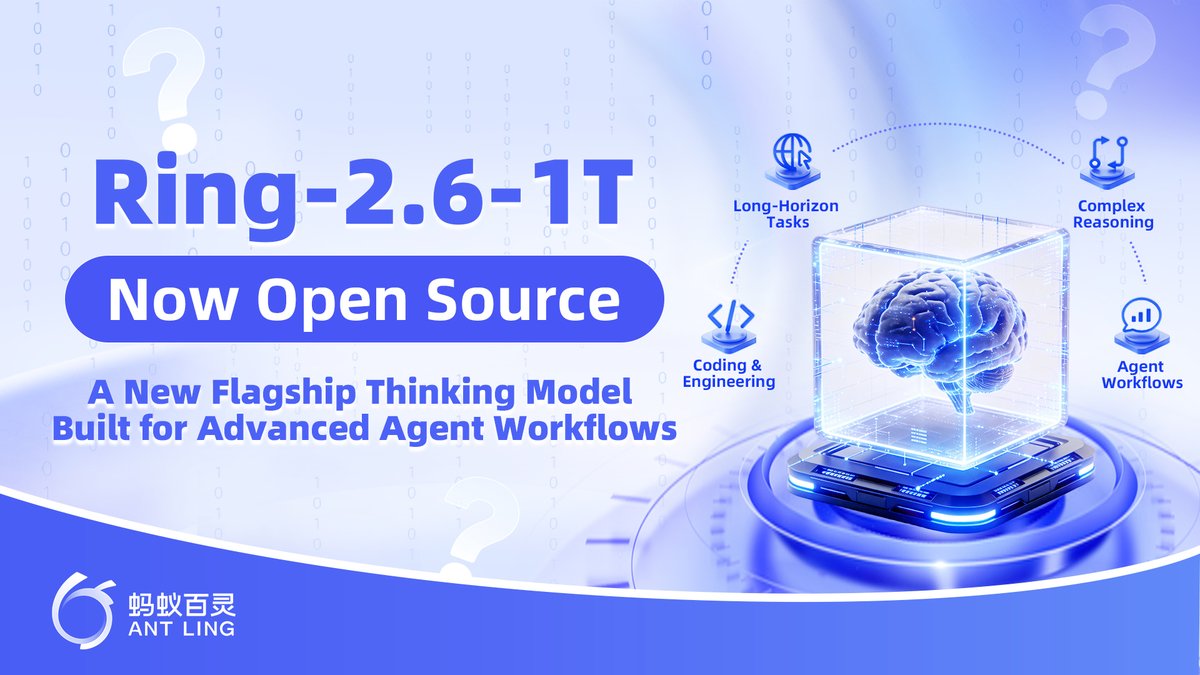
🚀 Ring-2.6-1T is now open source.
A trillion-scale flagship thinking model built for real-world complex tasks: Agent workflows, coding & engineering, long-horizon tasks, complex reasoning, research, and enterprise automation.
It is designed to move beyond “answering” toward execution: understanding context, planning steps, calling tools, and staying stable across long task chains.
Highlights:
- Advanced agentic workflow support.
- Reasoning effort levels: high for agentic tasks, xhigh for complex reasoning.
- Scalable asynchronous RL via the IcePop algorithm, enabling stable, trillion-scale training for long-horizon agentic RL.

English
selfsim retweetledi
selfsim retweetledi

Your Hermes Agent can now build full videos with the official HyperFrames skill by @HeyGen
HyperFrames videos are HTML-native, so your agent has total control over the final output
Video made entirely by Hermes using the HyperFrames skill
English
selfsim retweetledi
selfsim retweetledi
selfsim retweetledi

Meet Human Operator from MIT Media Lab: a wearable that lets AI temporarily take control of your hand using electrical muscle stimulation.
Watch it crush piano, draw perfectly, and mix cocktails like a pro — all from a simple voice command.
“I gave an AI a body.”
This isn’t sci-fi. This is tomorrow.
#HumanOperator #MITMediaLab
English
selfsim retweetledi
selfsim retweetledi

SURPRISE model for the low VRAM folks! Qwen3.5-9B-DeepSeek-V4-Flash is live!
Compared to the base 9B, this DeepSeek-V4 distill wins by a country mile in two specific places:
Reasoning: base overthinks and hits the 8K thinking cap on 3 of 5 prompts; distill clears all 5 cleanly. 2.2× faster time, 2.6× less reasoning length.
Creative front-end design: On creative prompts, the base ships flatter visuals with overlay/animation bugs; distill produces output that punches well above a 9B. See it all for yourself in my full write-up and interactive space! Link in comments! Base and distill raw outputs are presented so you can draw your own conclusions!
Tool calling: 5/6 PASS on both, the fine-tune didn't break tool calling!
Throughput: 143 tok/s flat on both with a 5090, but you could run this model on pretty much anything!
This was a test on our new training pipeline with the Asus GX10 unit, and having confirmed success with this fine-tune, we've already launched the Qwopus 3.6 27B training, which will be completed soon!
It astounds me what we can do with an incredibly clean dataset, a decent base model, and a GX10. You'd think improvement over highly funded lab offerings would not be possible, but here we are!
This is the first model fully completed in the Wyoming lab!
Yeehaw!
huggingface.co/Jackrong/Qwen3…
English
selfsim retweetledi

🤗🤗🤗introducing Hugging Science -- the home of AI for science 🤗🤗🤗
open models and datasets are the powerhouse of science (see the PDB), but finding the models and data you actually need for your breakthrough is hard af
you shouldn't need to scrape arxiv, own your own wetlab, fight a custom HDF5 parser, build a fusion stellarator, and beg for compute before you've trained a single epoch
so we're changing that
we've put all the best science on @huggingface in one place:
- 78GB of genomics data
- 11TB of PDE simulations
- 100M cell profiles
- 9T DNA base pairs
- 13M molecular trajectories
- 400k medical QA pairs
and much more, all open, and all ready for training (+ you can also now filter and search by domain, task, and keyword)
we've put together all the biggest releases from our partners at NASA, Google, OpenAI, Meta FAIR, Arc Institute, Ginkgo, SandboxAQ, Proxima Fusion, NVIDIA, Ai2, OpenADMET, InstaDeep, Future House, Polymathic AI, LeMaterial, Earth Species Project, Merck, and Eve Bio
if you're not sure where you fit in -- work on open challenges for problems that matter: including fusion stellarator design, ADMET, antibody developability, multilingual medicine, catalysis and materials, and scientific reasoning.
we're already changing how science gets done:
a fusion startup needed a benchmark for stellarator plasma confinement that didn't exist. @proximafusion shipped ConStellaration on Hugging Science: a leaderboard, dataset, and eval metrics, all in one place.
a drug discovery team wanted to predict hPXR induction. OpenADMET put up a blind challenge: 11,000+ compounds assayed at Octant, 513 held out, two tracks (pEC50 + structure). Anyone in the world can train and submit.
an antibody team at @Ginkgo released GDPa1, a developability dataset for stability, manufacturability, and immunogenicity prediction, with a live leaderboard scoring every submission.
if you know a problem the ML community should be working on, let us know. make a challenge! this is about putting all the tools for solving science in one place. so we can hillclimb!
→ huggingscience.co
English
selfsim retweetledi
selfsim retweetledi

Physicist Stephen Wolfram's exploration of a theory of everything, and simulating the universe. [Select image to magnify.]
Source:
Stephen Wolfram, "Finally We May Have a Path to the Fundamental Theory of Physics… and It's Beautiful," Stephen Wolfram Writings. writings.stephenwolfram.com/2020/04/finall…

English
selfsim retweetledi
selfsim retweetledi

Eric Schmidt, former CEO of Google, offers a sobering view: The biggest technological shift in human history is happening, and almost no one is talking about it.
Schmidt opens with a startling industry prediction:
"We believe as an industry that in the next one year the vast majority of programmers will be replaced by AI programmers. We also believe that within one year you will have graduate level mathematicians that are at the tippy top of graduate math programs."
He explains why this matters so much. Programming and math aren't just two fields among many:
"Programming plus math are the basis of sort of our whole digital world."
And the AI labs are already using AI to build better AI:
"The research groups in OpenAI and anthropic and so forth… around 10 or 20% of the code that they're developing in their research programs is being generated by the computer. That's called recursive self-improvement."
@ericschmidt then lays out the timeline most people haven't grasped:
"Within 3 to 5 years we'll have what is called general intelligence AGI which can be defined as a system that is as smart as the smartest mathematician physicist artist writer thinker politician."
He gives this belief system a name:
"I call this by the way the San Francisco consensus because everyone who believes this is in San Francisco it may be the water."
But the truly unsettling part comes next.
Once AI starts improving itself, humans become optional to the process:
"The computers are now doing self-improvement… they don't have to listen to us anymore. We call that super intelligence or ASI… computers that are smarter than the sum of humans. The San Francisco consensus is this occurs within six years."
And here's where Schmidt sounds the alarm. The conversation isn't keeping pace with the technology:
"This path is not understood in our society. There's no language for what happens with the arrival of this. This is happening faster than our human that our society, our democracy, our laws will address."
His closing thought captures why this matters:
"That's why it's underhyped. People do not understand what happens when you have intelligence at this level which is largely free."
English
selfsim retweetledi
selfsim retweetledi