Adrien Gaidon

3.2K posts

Adrien Gaidon banner
Adrien Gaidon

Adrien Gaidon

@adnothing

Co-Founder and Chief Strategy Officer at @WaldenRobotics . Adjunct Prof of CS at @Stanford, ex partner at @CalibrateVC & head of ML at @ToyotaResearch

San Francisco, CA Katılım Şubat 2012
1.5K Takip Edilen4.8K Takipçiler
Adrien Gaidon
Adrien Gaidon@adnothing·
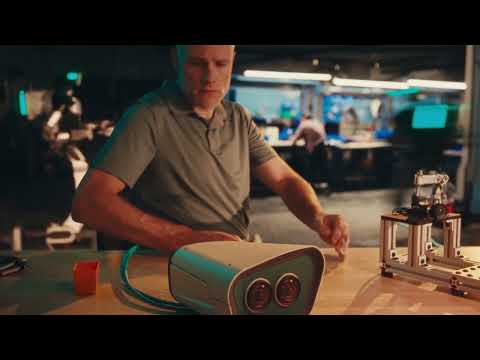
Come say hi and hear about what've already learned being deployed in the field with a general-purpose robot that people love to work with! (And our stickers are indeed the best...)
Walden Robotics@WaldenRobotics

Hot off our launch yesterday, our CEO @RussTedrake is giving a talk today Thursday July 16 in SF at the Autonomous conference at 4:30pm PT on "Deploying general-purpose robots (introducing Walden Robotics)". Come hang out with Russ and Adrien (@adnothing ) at the conference to chat about useful robots doing real work today (and get some of our cool stickers...)!

English
2
2
14
1.9K
Chris Paxton
Chris Paxton@chris_j_paxton·
This is a great vision for robotics.
Adrien Gaidon@adnothing

The hardest problems in AI aren't research problems anymore. They're deployment problems. It’s how we actually deliver real value, today, to build the future people want. That’s why, after 20 years in AI, my next step was inevitable: make robots do useful work for and alongside people, right now. Today, I am delighted to announce the launch of @WaldenRobotics to tackle just that. We started this year and are coming out of stealth today with a $300M seed round backed by some of the most serious companies and investors in the world. They have seen firsthand our general-purpose robots being useful in production on day one, and getting better every day after. You can see a glimpse of what we've been building in the video below. Physical AI has gone through a rapid phase transition, in part thanks to pioneering research from my friends and co-founders @RussTedrake , @Ben_Burchfiel , Siyuan Feng, @RaresAmbrus , and many others at Walden. But from our long experience working together with co-founders Kerri Fetzer-Borelli and Dave Johnson, we learned how hard it is to deploy cutting-edge AI in a real, live, incredibly sophisticated production environment with an intricate ballet of automation and human ingenuity. That’s why we deliberately created Walden Robotics as a full-stack, human-centric, customer-focused robotics company from the start: we seeded the company with a world-class team across hardware, software, AI, deployment, operations, product, and business talent, so we could continuously optimize our whole system end-to-end, deeply and purposefully, from real-world experience with real customers. The efficacy of this strategy speaks for itself: since February, our general-purpose robots have been doing useful work in production at a Toyota plant in North America, moving from first pilot to real work in under two months. Not a lab. Not a demo. Not a future promise. Real work on a real line, today, at one of the best large-scale manufacturers in the world, with general-purpose robots that get better every day. And this is just the beginning. Two ways to find us: If you run a manufacturing or logistics business and want robots that are widely useful now, not someday, let's talk. We own “hirearobot.com” for a reason! And if you want to build them: we're hiring across the company, from software, to hardware, AI, ops, product, business, and more. In particular, as the Chief Strategy Officer at Walden, I am recruiting for three incredibly impactful founding roles to fuel our agent-native go-to-market engine. Check out waldenrobotics.com/careers Let’s build together!

English
2
4
158
25.1K
Russ Tedrake
Russ Tedrake@RussTedrake·
In January, I started "building something new" with an incredible team. Today I finally get to share some first details about what we've been building. We've called it Walden Robotics (waldenrobotics.com). I thought long and hard about my own reasons for starting this company. It's not only about the robots. It's also about people. I've tried to capture those thoughts in my first Walden blog post: waldenrobotics.com/news/why-walden It's been an incredible ride so far. Within just a few months of forming the company, we were already operating a general-purpose robot with an end-to-end policy in production in one of the most important factories in North America. It's amazing at how much I've already learned from that experience. There is a lot of work to do, but the mission has never been so clear. Please help me welcome Walden Robotics into the world. And stay tuned for more updates! youtube.com/watch?v=fewvZr…
YouTube video
YouTube
English
66
116
1.1K
192.3K
Adrien Gaidon
Adrien Gaidon@adnothing·
It's a pleasure and privilege to count Russ as a friend and co-founder at @WaldenRobotics Check out his blog below to learn more about our purpose. Our robots are already doing real work for and alongside people today, and we're just getting started. Let's build together!
Russ Tedrake@RussTedrake

In January, I started "building something new" with an incredible team. Today I finally get to share some first details about what we've been building. We've called it Walden Robotics (waldenrobotics.com). I thought long and hard about my own reasons for starting this company. It's not only about the robots. It's also about people. I've tried to capture those thoughts in my first Walden blog post: waldenrobotics.com/news/why-walden It's been an incredible ride so far. Within just a few months of forming the company, we were already operating a general-purpose robot with an end-to-end policy in production in one of the most important factories in North America. It's amazing at how much I've already learned from that experience. There is a lot of work to do, but the mission has never been so clear. Please help me welcome Walden Robotics into the world. And stay tuned for more updates! youtube.com/watch?v=fewvZr…

English
9
3
68
9.2K
Adrien Gaidon
Adrien Gaidon@adnothing·
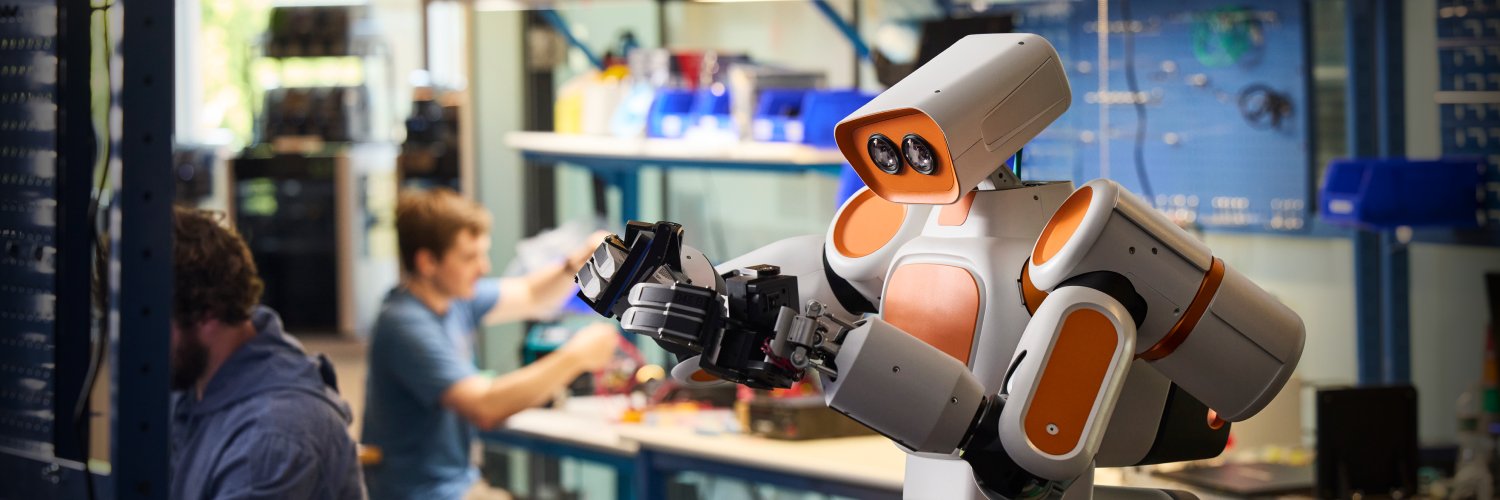
The hardest problems in AI aren't research problems anymore. They're deployment problems. It’s how we actually deliver real value, today, to build the future people want. That’s why, after 20 years in AI, my next step was inevitable: make robots do useful work for and alongside people, right now. Today, I am delighted to announce the launch of @WaldenRobotics to tackle just that. We started this year and are coming out of stealth today with a $300M seed round backed by some of the most serious companies and investors in the world. They have seen firsthand our general-purpose robots being useful in production on day one, and getting better every day after. You can see a glimpse of what we've been building in the video below. Physical AI has gone through a rapid phase transition, in part thanks to pioneering research from my friends and co-founders @RussTedrake , @Ben_Burchfiel , Siyuan Feng, @RaresAmbrus , and many others at Walden. But from our long experience working together with co-founders Kerri Fetzer-Borelli and Dave Johnson, we learned how hard it is to deploy cutting-edge AI in a real, live, incredibly sophisticated production environment with an intricate ballet of automation and human ingenuity. That’s why we deliberately created Walden Robotics as a full-stack, human-centric, customer-focused robotics company from the start: we seeded the company with a world-class team across hardware, software, AI, deployment, operations, product, and business talent, so we could continuously optimize our whole system end-to-end, deeply and purposefully, from real-world experience with real customers. The efficacy of this strategy speaks for itself: since February, our general-purpose robots have been doing useful work in production at a Toyota plant in North America, moving from first pilot to real work in under two months. Not a lab. Not a demo. Not a future promise. Real work on a real line, today, at one of the best large-scale manufacturers in the world, with general-purpose robots that get better every day. And this is just the beginning. Two ways to find us: If you run a manufacturing or logistics business and want robots that are widely useful now, not someday, let's talk. We own “hirearobot.com” for a reason! And if you want to build them: we're hiring across the company, from software, to hardware, AI, ops, product, business, and more. In particular, as the Chief Strategy Officer at Walden, I am recruiting for three incredibly impactful founding roles to fuel our agent-native go-to-market engine. Check out waldenrobotics.com/careers Let’s build together!
English
26
42
363
62.3K
Adrien Gaidon
Adrien Gaidon@adnothing·
Physical AI is accelerating, isn't it? It's almost like something big is happening 😉 The age of demos is coming to an end, and the age of real, useful, high-value work is upon us. Exciting times!!
English
4
2
33
2.5K
Danfei Xu
Danfei Xu@danfei_xu·
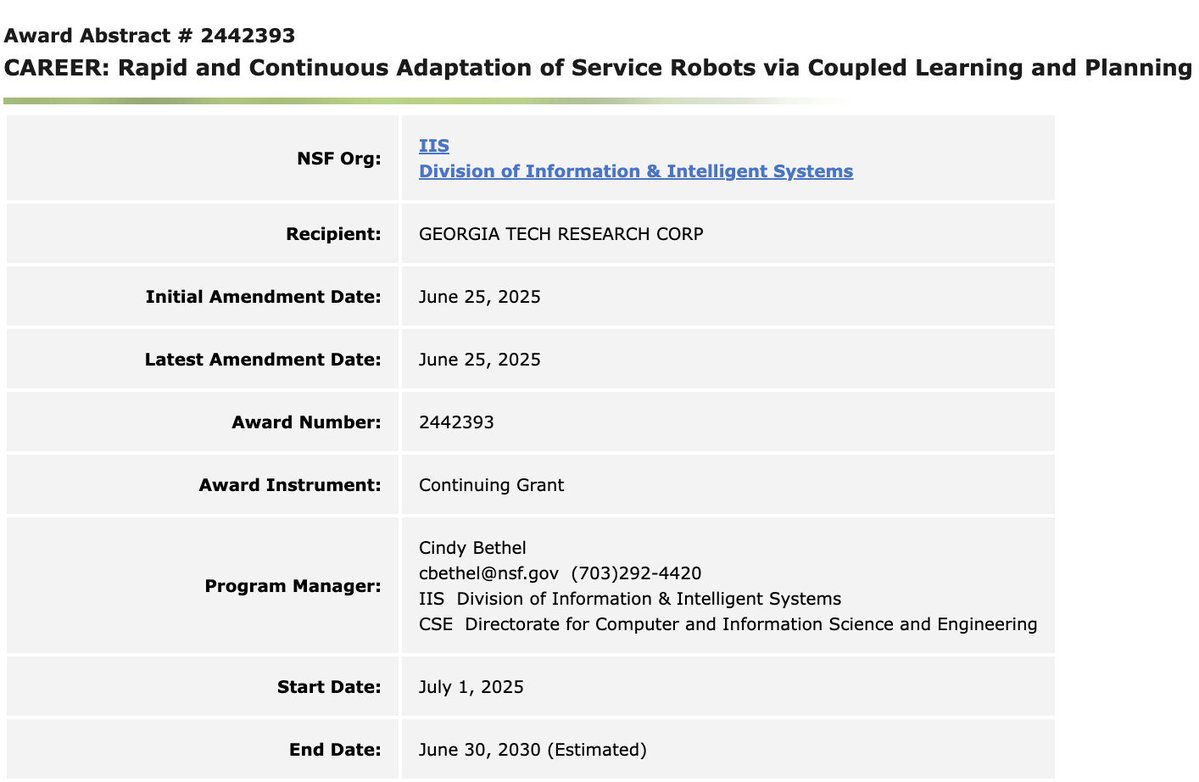
Honored to receive the NSF CAREER Award from the Foundational Research in Robotics (FRR) program! Deep gratitude to my @ICatGT @gtcomputing colleagues and the robotics community for their unwavering support. Grateful of @NSF for continuing to fund the future of robotics research.
Danfei Xu tweet media
English
30
6
211
12.1K
Adrien Gaidon
Adrien Gaidon@adnothing·
@karpathy 💯 Good structure and design principles (e.g., separation of concerns) are key to scaling verification in large teams (humans or agents) and code bases. The common denominator in {software,ML,prompt,AI} Engineering 😉 (and personally an inspiration in self-supervised learning)
English
0
0
1
573
Andrej Karpathy
Andrej Karpathy@karpathy·
Related tweet from earlier where I was describing my own (developing) workflow of "AI Assisted coding" where among other things I try really hard to structure it to decrease verification. x.com/karpathy/statu…
Andrej Karpathy@karpathy

Noticing myself adopting a certain rhythm in AI-assisted coding (i.e. code I actually and professionally care about, contrast to vibe code). 1. Stuff everything relevant into context (this can take a while in big projects. If the project is small enough just stuff everything e.g. `files-to-prompt . -e ts -e tsx -e css -e md --cxml --ignore node_modules -o prompt.xml`) 2. Describe the next single, concrete incremental change we're trying to implement. Don't ask for code, ask for a few high-level approaches, pros/cons. There's almost always a few ways to do thing and the LLM's judgement is not always great. Optionally make concrete. 3. Pick one approach, ask for first draft code. 4. Review / learning phase: (Manually...) pull up all the API docs in a side browser of functions I haven't called before or I am less familiar with, ask for explanations, clarifications, changes, wind back and try a different approach. 6. Test. 7. Git commit. Ask for suggestions on what we could implement next. Repeat. Something like this feels more along the lines of the inner loop of AI-assisted development. The emphasis is on keeping a very tight leash on this new over-eager junior intern savant with encyclopedic knowledge of software, but who also bullshits you all the time, has an over-abundance of courage and shows little to no taste for good code. And emphasis on being slow, defensive, careful, paranoid, and on always taking the inline learning opportunity, not delegating. Many of these stages are clunky and manual and aren't made explicit or super well supported yet in existing tools. We're still very early and so much can still be done on the UI/UX of AI assisted coding.

English
10
4
380
132.9K
Andrej Karpathy
Andrej Karpathy@karpathy·
Good post from @balajis on the "verification gap". You could see it as there being two modes in creation. Borrowing GAN terminology: 1) generation and 2) discrimination. e.g. painting - you make a brush stroke (1) and then you look for a while to see if you improved the painting (2). these two stages are interspersed in pretty much all creative work. Second point. Discrimination can be computationally very hard. - images are by far the easiest. e.g. image generator teams can create giant grids of results to decide if one image is better than the other. thank you to the giant GPU in your brain built for processing images very fast. - text is much harder. it is skimmable, but you have to read, it is semantic, discrete and precise so you also have to reason (esp in e.g. code). - audio is maybe even harder still imo, because it force a time axis so it's not even skimmable. you're forced to spend serial compute and can't parallelize it at all. You could say that in coding LLMs have collapsed (1) to ~instant, but have done very little to address (2). A person still has to stare at the results and discriminate if they are good. This is my major criticism of LLM coding in that they casually spit out *way* too much code per query at arbitrary complexity, pretending there is no stage 2. Getting that much code is bad and scary. Instead, the LLM has to actively work with you to break down problems into little incremental steps, each more easily verifiable. It has to anticipate the computational work of (2) and reduce it as much as possible. It has to really care. This leads me to probably the biggest misunderstanding non-coders have about coding. They think that coding is about writing the code (1). It's not. It's about staring at the code (2). Loading it all into your working memory. Pacing back and forth. Thinking through all the edge cases. If you catch me at a random point while I'm "programming", I'm probably just staring at the screen and, if interrupted, really mad because it is so computationally strenuous. If we only get much faster 1, but we don't also reduce 2 (which is most of the time!), then clearly the overall speed of coding won't improve (see Amdahl's law).
Balaji@balajis

AI PROMPTING → AI VERIFYING AI prompting scales, because prompting is just typing. But AI verifying doesn’t scale, because verifying AI output involves much more than just typing. Sometimes you can verify by eye, which is why AI is great for frontend, images, and video. But for anything subtle, you need to read the code or text deeply — and that means knowing the topic well enough to correct the AI. Researchers are well aware of this, which is why there’s so much work on evals and hallucination. However, the concept of verification as the bottleneck for AI users is under-discussed. Yes, you can try formal verification, or critic models where one AI checks another, or other techniques. But to even be aware of the issue as a first class problem is half the battle. For users: AI verifying is as important as AI prompting.

English
134
534
4.4K
845.8K
Adrien Gaidon
Adrien Gaidon@adnothing·
Hello from #ICRA2025 in sunny Atlanta 👋 Looking forward to catching up with my robotics colleagues! I'll also be chairing a session on Thursday (ThET6) with Katherine Liu from @ToyotaResearch where we will present our work OmniShape tri-ml.github.io/omnishape/ See you there!
Adrien Gaidon tweet media
English
0
0
12
1.1K
Adrien Gaidon
Adrien Gaidon@adnothing·
💯 Developing appreciation (or even enthusiasm!) for being proven wrong is a learning superpower. Having some formal training in logic, information theory, and epistemology is a way to rationally convince yourself that this is the way. Then you have to put in the reps to eventually enjoy it (with moderation, otherwise you become a troll).
English
0
1
11
1.4K
Arvind Narayanan
Arvind Narayanan@random_walker·
I tell students on the first day of class that if you're truly learning it's supposed to feel uncomfortable. The reason is that real learning is not simply the accumulation of facts; it is deep understanding, building mental models of the world, and other higher-level abilities. The problem is that we already have simple, intuitive, and usually incorrect mental models of most things in the world around us. So real learning usually involves *unlearning*. And that has an extremely high cognitive cost and we're very resistant to doing it, presumably for evolutionary reasons. Students go so far as to learn concepts in class but somehow parcel them so that they think the concepts are only applicable to the toy problems on tests but not the world around us! Turns out these mental gymnastics are still easier than actually updating their mental models. (The screenshots are from the book "What the best college teachers do.") It only gets harder, not easier, to learn as we progress in our careers, because in addition to the cognitive cost of learning, you have to face the prospect of admitting that you were wrong in front of subordinates, if not in public, and admitting to yourself that you've been making suboptimal decisions all along. I've found that the only way to continue to learn is to develop a kind of masochism where you learn to enjoy, or at least love-hate, the feeling of having been wrong. It's not easy but I think it's necessary!
Arvind Narayanan tweet mediaArvind Narayanan tweet media
English
23
153
877
209.9K
Adrien Gaidon
Adrien Gaidon@adnothing·
3D is mainstream now: incredible progress in the past few years (e.g., on zero-shot performance). No reason to stay in 2D: elevate your vision 😉
Rui Li@leedaray

🚀 Details of the #CVPR2025 award candidate papers are out. 14 of 2967 accepted papers made the list, spanning 3D vision, embodied AI, VLMs/MLLMs, learning systems, and scene understanding. 3D vision leads with the most entries. I collected the TL;DR, paper, and project links👇

English
0
0
11
1.2K
Andrej Karpathy
Andrej Karpathy@karpathy·
There's a new paper circulating looking in detail at LMArena leaderboard: "The Leaderboard Illusion" arxiv.org/abs/2504.20879 I first became a bit suspicious when at one point a while back, a Gemini model scored #1 way above the second best, but when I tried to switch for a few days it was worse than what I was used to. Conversely as an example, around the same time Claude 3.5 was a top tier model in my personal use but it ranked very low on the arena. I heard similar sentiments both online and in person. And there were a number of other relatively random models, often suspiciously small, with little to no real-world knowledge as far as I know, yet they ranked quite high too. "When the data and the anecdotes disagree, the anecdotes are usually right." (Jeff Bezos on a recent pod, though I share the same experience personally). I think these teams have placed different amount of internal focus and decision making around LM Arena scores specifically. And unfortunately they are not getting better models overall but better LM Arena models, whatever that is. Possibly something with a lot of nested lists, bullet points and emoji. It's quite likely that LM Arena (and LLM providers) can continue to iterate and improve within this paradigm, but in addition I also have a new candidate in mind to potentially join the ranks of "top tier eval". It is the @openrouter LLM rankings: openrouter.ai/rankings Basically, OpenRouter allows people/companies to quickly switch APIs between LLM providers. All of them have real use cases (not toy problems or puzzles), they have their own private evals, and all of them have an incentive to get their choices right, so by choosing one LLM over another they are directly voting for some combo of capability+cost. I don't think OpenRouter is there just yet in both the quantity and diversity of use, but something of this kind I think has great potential to grow into a very nice, very difficult to game eval.
Arena.ai@arena

Thanks for the authors’ feedback, we’re always looking to improve the platform! If a model does well on LMArena, it means that our community likes it! Yes, pre-release testing helps model providers identify which variant our community likes best. But this doesn’t mean the leaderboard is biased; see the clarification below. The leaderboard reflects millions of fresh, real human preferences. One might disagree with human preferences—they’re subjective—but that’s exactly why they matter. Understanding subjective preference is essential to evaluating real-world performance, as these models are used by people. That’s why we’re working on statistical methods—like style and sentiment control—to decompose human preference into its constituent parts. We are also strengthening our user base to include more diversity. And if pre-release testing and data helps models optimize for millions of people’s preferences, that’s a positive thing! Pre-release model testing is also a huge part of why people come to LMArena. Our community loves being the first to test the best and newest AIs! That’s why we welcome all model providers to submit their AIs to battle and win the preferences of our community. Within our capacity, we are trying to satisfy all requests for testing we get from model providers. We are committed to fair, community-driven evaluations, and invite all model providers to submit more models for testing and to improve their performance on human preference. If a model provider chooses to submit more tests than another model provider, this does not mean the second model provider is treated unfairly. Every model provider makes different choices about how to use and value human preferences. We helped Meta with pre-release testing for Llama 4, like we have helped many other model providers in the past. We support open-source development. Our own platform and analysis tools are open source, and we have released millions of open conversations as well. This benefits the whole community. We agree with a few of this writeup’s suggestions (e.g. implementing an active sampling algorithm) and are happy to consider more. Unfortunately, there are also a number of factual errors and misleading statements in this writeup. - The simulation of LMArena, e.g. in Figures 7/8, is flawed. It’s like saying: “The average 3-point percentage in the NBA is 35%. Steph Curry has the highest 3-point percentage in the NBA at 42%. This is unfair, because he comes from the distribution of NBA players, and they all have the same latent mean.” - We designed our policy to prevent model providers from just reporting the highest score they received during testing. We only publish the score for the model they release publicly. - Many of the numbers in the paper do not reflect reality: see the blog below (released a few days ago) for the actual statistics on the number of models tested from different providers. See also in thread our longstanding policy on pre-release testing. We have been doing so transparently with the support of our community for over a year.

English
180
413
4.3K
691.1K
Chris Paxton
Chris Paxton@chris_j_paxton·
So I recently joined Agility robotics to help lead AI efforts, and I wanted to share this as one of the first things I worked on: - whole body control, running sim-to-real RL, all day for like 4 days straight at GTC - manipulating previously unseen objects - we bought them monday and put them on a shelf
English
39
20
398
19.7K
Ian Huang
Ian Huang@IanHuang3D·
🏡Building realistic 3D scenes just got smarter! Introducing our #CVPR2025 work, 🔥FirePlace, a framework that enables Multimodal LLMs to automatically generate realistic and geometrically valid placements for objects into complex 3D scenes. How does it work?🧵👇
English
21
83
372
117.1K
Adrien Gaidon retweetledi
Stanford AI Lab
Stanford AI Lab@StanfordAILab·
We do a lot of cutting edge research at the Stanford AI Lab, but really our main job is educating students. Here is a list of great SAIL Graduates of 2025, who are variously looking for academic and industry jobs! 💪 ai.stanford.edu/blog/sail-grad… Compiled by @NikilSelvam Alex Nam @judyhshen
English
10
50
89
12.5K
Adrien Gaidon
Adrien Gaidon@adnothing·
The biggest bottleneck in robotics today? Data. Scaling up robot demonstrations is crucial, but we are still 5-6 orders of magnitude away from LLMs 😱 So how do we close that huge gap? Ken's talk at #GTC25 is phenomenal and makes a strong case for scaling with Production Data™️ The evidence from @AmbiRobotics is clear, and we see that too at @CalibrateVC with startups like @BradPorter_ 's CoBot, @GrayMatterRobot, and more. But to do that, you need a product, iteration in the field, continuous delivery of value, clear ROI... Robotics startups don’t just need funding - they need customers. More broadly, Venture Capital is only a catalyst for the real reaction that happens in the field. The best AI companies know that and ship fast to get paid twice: in data AND in 💵. That’s the unstoppable flywheel that happens when you build something people want. That's not to say only production data matters. Robotics is so hard you need ALL the data: web data, sim, teleop, AND production data. But only one scales with customers. That's why we believe purpose-built robots are a massive unlock from today's foundation models AND the path to build tomorrow's even more general embodied AI. PS: if you’re building in this space or thinking about jumping in, let's talk 😁
Ken Goldberg@Ken_Goldberg

Looking fwd to presenting @nvidia #GTC at 1pm today!

English
0
2
12
2.7K
Adrien Gaidon
Adrien Gaidon@adnothing·
@Karttikeya_m @eladgil Personalized tutoring with AI is the longest lever arm on the world. It is so much harder than a ChatGPT wrapper, as @emollick pointed out. That's why you need a crazy team like @Karttikeya_m 's at SigIQ: ML expertise, a passion for education, and a unique approach on hard tests!
Ethan Mollick@emollick

The data so far on AI-as-a-tutor shows just letting students use AI chatbots often undermines learning by just giving answers. But AIs properly prompted to act like tutors, especially with instructor support, seem to be able to boost learning a lot through customized instruction

English
0
0
0
124
Karttikeya Mangalam
Karttikeya Mangalam@Karttikeya_m·
@eladgil @eladgil also recommend to checkout sigiq.ai — cracked AI PhD founding team building the exact vision (even the company’s first 3 letters come from the 2-sigma paper!) — our custom built AI tutors >> general LLMs (4o etc) on some of worlds toughest exams.
English
1
2
9
796
Elad Gil
Elad Gil@eladgil·
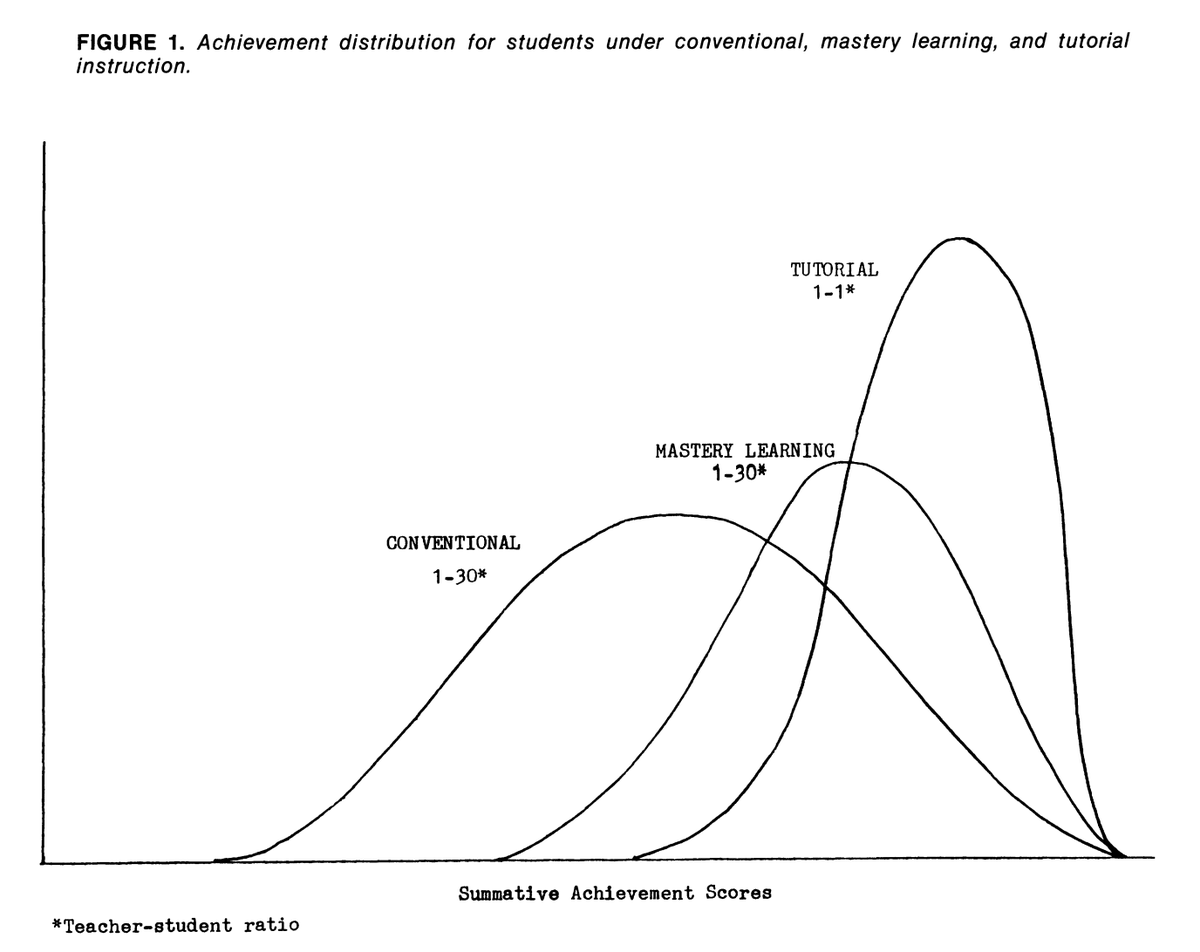
Why AI based tutors are going to be such a big deal 1:1 tutoring = 2 sigma improvement in learning achievement Image from "The 2 Sigma Problem: The Search for Methods of Group Instruction as Effective as One-toOne Tutoring" by Benjamin S. Bloom
Elad Gil tweet media
English
106
177
1.6K
424.5K
Lucas Beyer (bl16)
Lucas Beyer (bl16)@giffmana·
The placement of a line break matters. I parsed this as (scaling test-time compute without verification) or: "rl is suboptimal" When it's really "scaling test-time compute without (verification or rl) is suboptimal" I was all excited about the former variant, actually!
Lucas Beyer (bl16) tweet media
Tanishq Mathew Abraham, Ph.D.@iScienceLuvr

Scaling Test-Time Compute Without Verification or RL is Suboptimal "In this paper, we prove that finetuning LLMs with verifier-based (VB) methods based on RL or search is far superior to verifier-free (VF) approaches based on distilling or cloning search traces, given a fixed amount of compute/data budget."

English
10
12
184
22.3K