Sabitlenmiş Tweet
xlog
29.2K posts


xlog
@aiNeoHuman
here for meMErs, digi—tail humans and pracademics
swaroop's fingertips Katılım Mayıs 2009
257 Takip Edilen1.9K Takipçiler
xlog retweetledi

Giampaolo Tomassetti spent 12 years inside the Mahabharata and painted it like he lived it. The book is called Mahabharata: Indian Art Series.
I keep it on my coffee table. Every time I flip through it, I’m reminded what happens when someone gives a decade of their life to a single idea.


Narendra Modi@narendramodi
A glimpse of Kashi in Rome! Mr. Giampaolo Tomassetti, an Italian painter, presented his work on Varanasi. His passion for Indian culture goes back over four decades. In the 1980’s he started as an illustrator for books on Vedic culture. From 2008 to 2013 he worked on 23 large paintings relating to the Mahabharat.
English
@FabulasGuy there are so many "hit-and-run-experts" like her and we will see more, its ok for them to do what they want to do
English

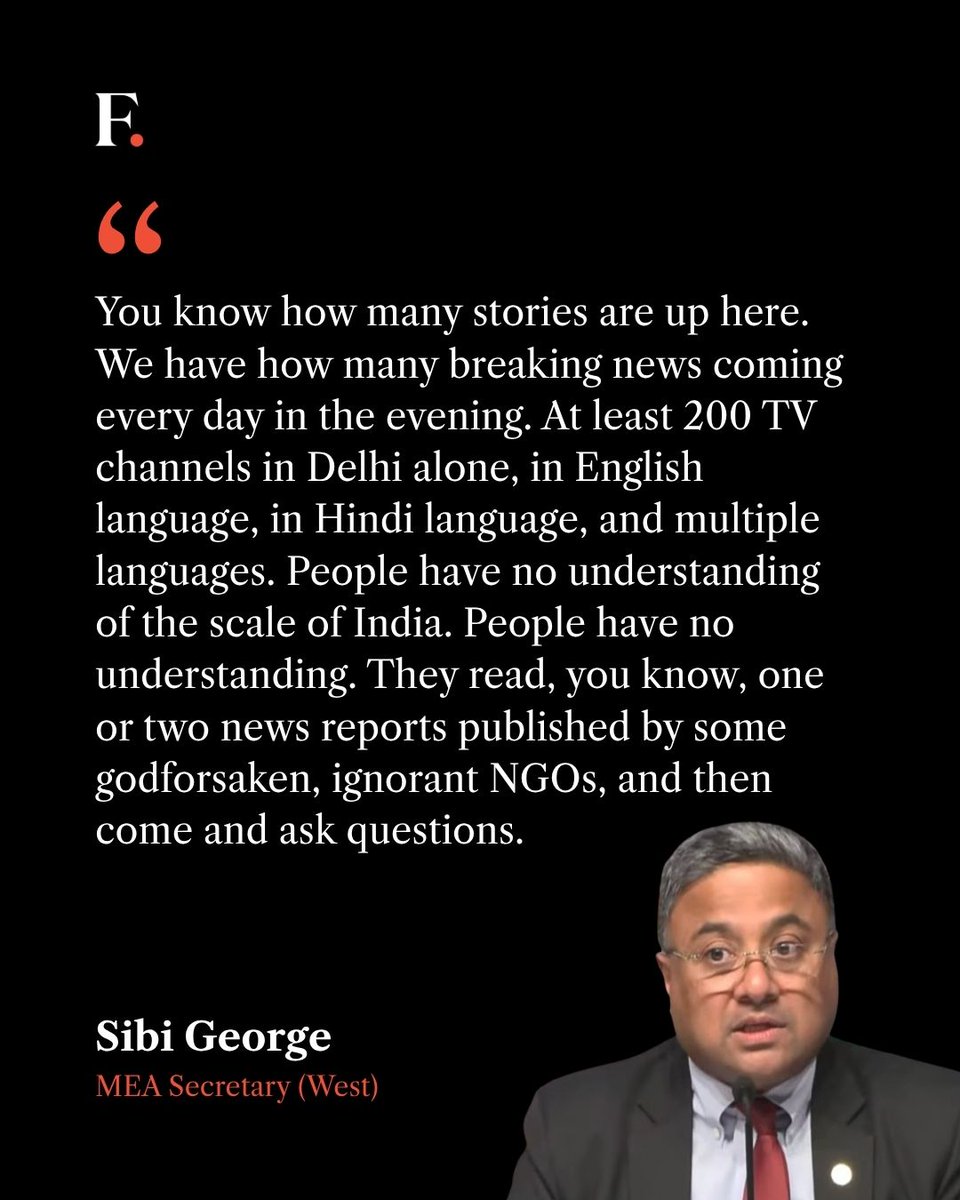
Going to an event and shouting like a troll is easy.
But facing real journalism and tough questions yourself? Not so easy.
Norwegian journalist Helle Lyng was brutally exposed by NDTV journalist.
When asked what she actually knows about India, her answer sounded no different from what she heard in the MEA press conference:
“I love India, I love Yoga, Indian food.”
that seemed to be the full extent of her knowledge about India lol
English
xlog retweetledi

Marc Andreessen says AI is teaching sand to think and it could be the most important technology in the history of humanity:
"Imagine a form of alchemy that turns sand into thought."
"Chips are made out of sand. They're made out of silicon, so they're literally made out of sand."
"We plug the chip into a data center, into power, we light it up, and we put AI on it, and all of a sudden it's thinking."
"We've turned sand into thought. And so it's possibly the most revolutionary technology in the history of the species."
"It's certainly on par with electricity and steam power. It's certainly more important than the internet."
@pmarca with @joerogan
English

Why haven’t you written or even started that book you wanted to write?
Because you’ve optimized your time on a factory schedule. To an abstract MRR god. You’ve convinced yourself that money is the solution to life.
If you want to do creative work that flows through you, you must surrender. Wake up and plop around for a bit without a plan. See what sort of pull you have once the manager in your head telling you to be productive quiets down. This might take days, months, or for some people years.
The odds are you are never going to ship that project you swear you are going to do. Because the forces of today’s world want us to fit into legible containers. Even people who have written books, many wrote the book that “makes sense”. I’m talking to you too. Go deeper. Don’t waste it.
I want to help you actually move in this direction.
The first step is to abandon your 5am fever dreams.
Just get up and pay attention
English
xlog retweetledi

Andhra govt clears 800 acres for RIL's AI data centre in Vizianagaram district economictimes.indiatimes.com/tech/artificia…
Română
xlog retweetledi
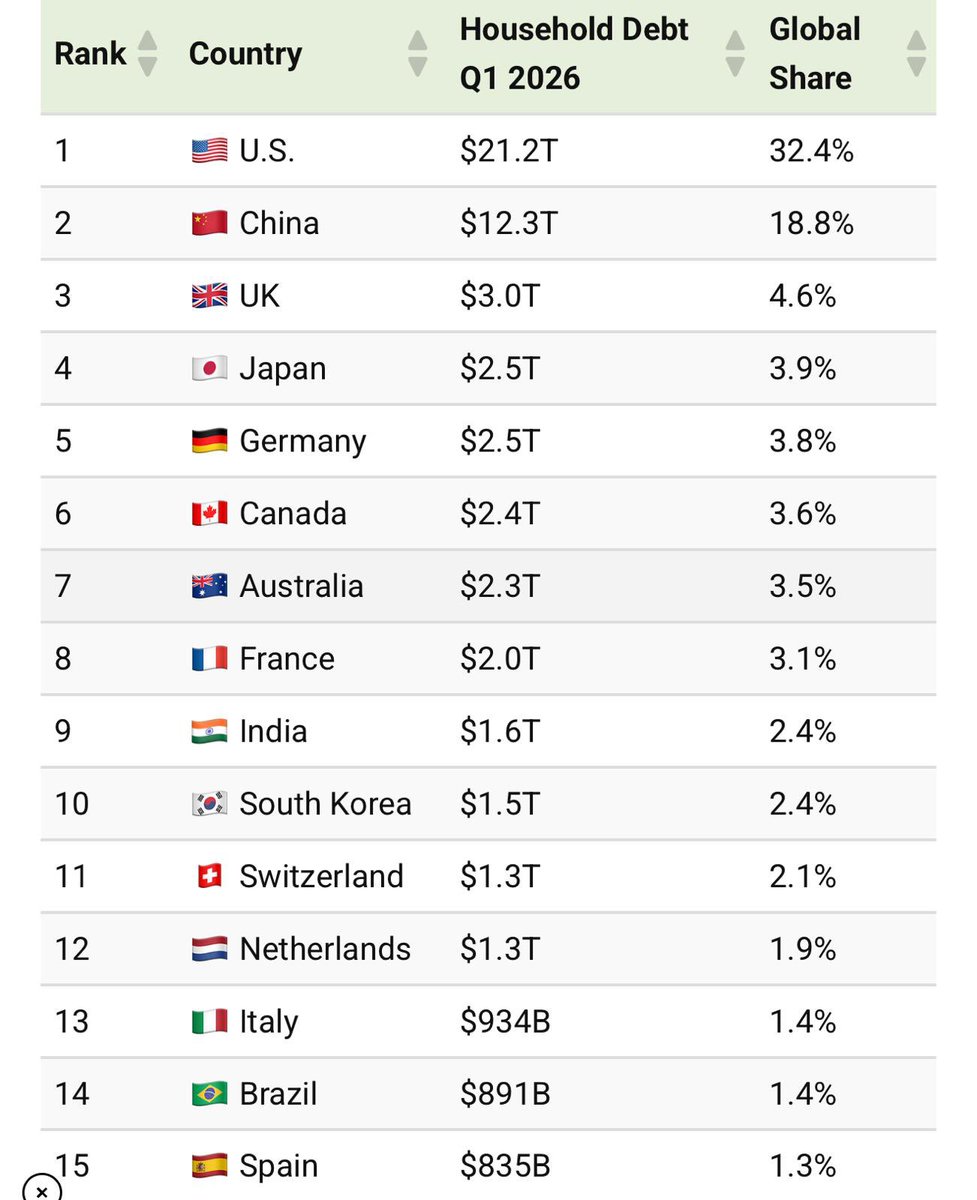
Amidst all the economic gloom India’s low per capita household debt is something to be cheerful about. India has ~340 million families vs US ~133 million.
US - per family debt - $158,000
India per family debt - $5333.
India’s low household debt of around 41-42% of GDP, is a structural advantage protecting the economy from severe downturns. It provides families with strong resilience against income and job losses, leaves enormous headroom for credit growth & minimises systemic financial risks compared to highly leveraged developed economies
Mumbai, India 🇮🇳 English
xlog retweetledi

Allu Aravind was at the Art of Living ashram yesterday and was mind blown by his experience with the Intuition process children! Here’s what he has to say!
English
xlog retweetledi

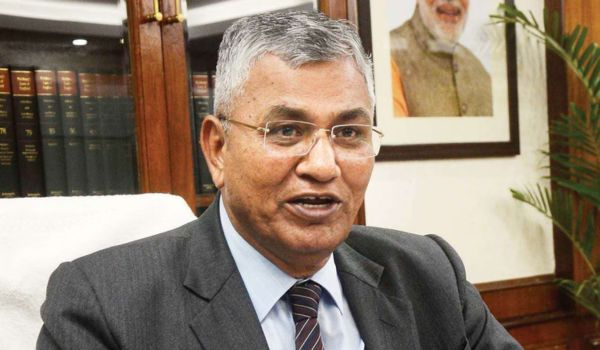
‘One Nation, One Election’ can save nearly 7 lakh crore rupees and increase India’s GDP growth by 1.6 per cent: JPC
READ: newsonair.gov.in/one-nation-one…
English
xlog retweetledi
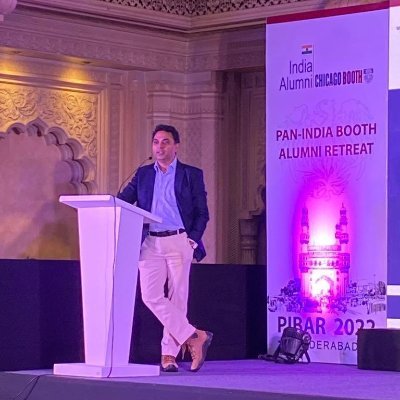
Full analysis (9 pages, institutional frameworks, operational opportunities, data): linkedin.com/posts/prof-kri…
English
xlog retweetledi
Did you know that the U.S. defaulted on its sovereign obligations in 1971 when it unilaterally reneged on dollar-gold convertibility.
Russia defaulted in 1998 and 2022.
Argentina: 9 times since independence.
Pakistan: required IMF bailouts 23 times.
Greece defaulted in 2012.
And India? Zero defaults. Not even in 1991!
Yet Western investors classify India as "emerging risk" and call U.S. Treasuries the "risk-free rate."
This isn't risk analysis. This is cognitive bias a la Daniel Kahneman's book "Thinking, Fast and Slow". Humans systematically overweight culturally proximate information while underweighting statistical patterns that don't fit our mental models.
Western strategic planners trust Western partners not because the data supports it, but because the cultural markers feel familiar.
Three facts that challenge everything about how we assess partnership risk:
FACT 1: Across 5,000 years of recorded history, India has rarely waged wars of territorial conquest. Not in 3000 BCE when the Indus Valley Civilization had technological superiority. Not in 1000 CE when Indian mathematics and metallurgy exceeded Europe by centuries. Not in 2026 when it possesses nuclear weapons and the world's 4th-largest military. Not in 2047 when it projects to be a top-two economy.
Compare: China (annexed Tibet 1950, 14 territorial disputes, South China Sea expansion). Russia (Georgia 2008, Crimea 2014, Ukraine 2022). Europe (500 years of colonial conquest across three continents). U.S. (military interventions in 20+ countries since 1945).
This pattern is observable strategic behavior anchored in the Arthashastra, Kautilya's 2,300-year-old treatise arguing that short-term territorial expansion undermines the systemic conditions for sustained prosperity. The concept of "mandala" (circle of states) recognizes that each power's long-term interest depends on system equilibrium.
FACT 2: India has never defaulted on debt, treaties, or security guarantees since independence in 1947. The most revealing test: 1991 balance of payments crisis. Reserves fell to $1.2 billion = just three weeks of imports. Default appeared certain. Instead, India implemented painful reforms, honored every obligation. India didn't use political costs as an excuse to default. Commitments were kept.
This behavior isn't accidental. It's anchored in the Sanskrit concept of ṛṇānubandhaḥ, that obligations are metaphysically binding across time. The Mahabharata established 2,000 years ago that rulers who break commitments violate cosmic order and create systemic instability.
Philosophy became institutional architecture: investment-grade credit through multiple crises, $600B forex reserves (6th globally), zero defaults on government securities across 77 years.
FACT 3: During COVID-19, India exported 300 million vaccine doses to 110 countries while its own vaccination was incomplete. 96 countries received doses free through "Vaccine Maitri."
Meanwhile: U.S. ordered 1.2 billion doses for 330 million people (4x population). EU ordered 4.6 billion for 450 million (10x population). Canada ordered 400 million for 38 million people (10x population).
Western nations didn't begin international distribution until domestic targets were substantially met.
The distinction? India's Economic Survey 2020-21 quoted Sanskrit: "āpadā hi prāṇa rakṣā hi dharmasya prathama aṅkuraḥ" (in calamity, protecting life is the first duty). Not Indian life. Life in general.
This aligns with Vasudhaiva Kutumbakam (the world as one family), not as rhetoric but as policy. India supplies 60% of global vaccines and 20% of generic medicines normally, maintained production during its own constraints, built digital public infrastructure (UPI processes more transactions than all nations combined) and offers it open-source to developing countries.
WHY THIS MATTERS NOW:
Every CFO, sovereign wealth fund, and policymaker is asking: "Who can we depend on for the next 50 years?"
Ukraine shattered the illusion that economic integration prevents aggression. COVID exposed single-source dependencies. Taiwan reveals semiconductor concentration risk.
The global economy is re-optimizing from efficiency to trust.
But here's where Kahneman's research becomes critical: most strategic planners are making decisions using "System 1" thinking (fast, intuitive, pattern-matching based on cultural familiarity) rather than "System 2" thinking (slow, analytical, data-driven assessment of long-horizon behavioral patterns).
The result? Systematic mispricing of partnership risk.
Strategic planners face a choice:
- China: manufacturing efficiency + demonstrated willingness to weaponize interdependence (sanctions on South Korea over THAAD, Australia over COVID inquiry, Lithuania over Taiwan, Belt & Road debt traps in 60+ countries)
- Russia: resource access + repeated weaponization (invaded Ukraine despite economic integration, cut gas to freeze European cities)
- U.S.: innovation + extraterritorial enforcement (billions in fines on European banks for transactions legal in Europe, CLOUD Act overrides local privacy laws, "America First" tariffs hit Canada, Mexico, EU alongside rivals)
- India: 5,000-year track record of territorial restraint + zero defaults + systemic thinking during crises +
challenges (infrastructure gaps, bureaucratic complexity, uneven state capacity).
The question isn't perfection. It is: which risk profile aligns with 50-year partnership objectives when analyzed through System 2 rather than System 1 thinking?
THE UNCOMFORTABLE TRUTH:
If India's pattern suggests lower long-duration risk, why is trust in India still "emerging"?
Kahneman would predict exactly this outcome. Three cognitive biases at work:
1. **Availability bias:** We assess risk based on vivid, recent, culturally proximate information. NATO expansion incorporated Poland, Czech Republic, Hungary rapidly because they registered as "European." India's democracy, rule of law, English-language business environment gets discounted because cultural markers differ.
2. **Confirmation bias:** Western institutions have decades of frameworks built around current partnerships. New data contradicting established models gets filtered out rather than integrated.
3. **Status quo bias:** Existing relationships are comfortable. The U.S.-Europe alliance, U.S.-Japan partnership, Five Eyes intelligence sharing operate with established protocols. Structural change requires crisis-level disruption to overcome inertia.
The crisis arrived.
For boards evaluating long-term partnerships—semiconductors, pharmaceuticals, digital infrastructure, maritime security, critical minerals—India presents a risk profile worth systematic, System 2 analysis.
Because of demonstrated behavior across sufficient time horizons to be statistically meaningful.
In an era of fragmentation, weaponized interdependence, and trust deficits, historical patterns become predictive indicators.
Kahneman spent decades showing that intuitive judgments systematically diverge from statistical reality. Strategic partnership assessment is no exception.
The question is: Are we assessing risk based on data, or based on what feels familiar?
In the 21st century, power matters. But trust may matter more.
And trust should be measured by track record, not by cultural proximity.
English
if only people acknowledge this there will be more peace for themselves
"India is not perfect. Of course there are incidents. India has a population the size of North America, South America and Europe combined. But India is much more peaceful than Europe or the Americas."
as it is evident, India is one-sixth of the world's population but certainly much less than one-sixth of the world's problems
Erik Solheim@ErikSolheim
In defense of Indian 🇮🇳 democracy! During Prime Minister Narendra Modi most successful visit to Norway a minor incident happened. A Norwegian journalist demanded that the prime minister starts holding press conferences. She claimed that Indian democracy is in bad shape. May be its time to pause? May be its time to be a bit curious to the world’s largest democracy? Two weeks ago five Indian states and territories held elections. The turn out in the battlefield state of West Bengal was 94%. In the last local election in Norway it was 62%, in many European local elections turn out is below 50%. Can voting in massive numbers be a signal Indians trust their democratic process? In the same election BJP won big in Assam and West Bengal. It lost even bigger in Kerala and Tamil Nadu. Can this diversity be a signal that Indian democracy is reflecting the will of the people? The journalist referred to a democracy ranking putting India at 157 in the world, behind many dictatorships and deeply troubled states. When a ranking is so obviously contrary to common sense, why not ask critical questions to those making the ranking rather than demand that leaders shall comment on nonsense? I recommend Salvatore Babones book “Dharma democracy”. The book debunks convincingly the flawed methodology of these rankings. It was referred to a ranking claiming it’s very dangerous to be a journalist in India. Reality is that it is more dangerous to be journalist in the US and far more dangerous in the vast majority of other nations in the world. Let’s be real. India is not perfect. Of course there are incidents. India has a population the size of North America, South America and Europe combined. But India is much more peaceful than Europe or the Americas. That’s remarkable - given the ethnic, language and religious diversity of India and the many development challenges. Unless we consider democracy a form of government only suited for some very small, peaceful and homogeneous Western European nations, may be we should commend Indian democracy? India is the only major former UK colony which became and has remained a democracy. Its sometimes claimed that the Brits taught India democracy. If that was the case why isn’t Myanmar or Pakistan or the Gulf kingdoms democracies??? Reality is that Indian democracy is both homegrown and extraordinary successful.
English

xlog retweetledi

The curse of being the smart child is that you are genetically coded to be your family's unpaid crisis manager—and the world's. A massive 2024 population registry study published in The Economic Journal proved that higher general fluid intelligence directly causes increased altruism, cooperation, and prosocial behavior. Because an intelligent brain calculates long-term consequences and systemic risks faster than everyone else around it, it sees the family or societal trainwreck coming miles away. It means you are either a psychological hostage to your own foresight, or a reluctant savior trying to fix a world that doesn't even see the cliff it’s walking over.
PsikoBilim@Psikobilim_
Bir insan ne kadar zekiyse o kadar çok yardımsever olma eğilimindedir. Çünkü zeki kişiler, iş birliğinin uzun vadeli toplumsal faydalarını daha iyi görebilirler.
English
xlog retweetledi

xlog retweetledi
From "snake charmers" to "mouse charmers"—India has moved on, but it seems sections of the European press are stuck in a time warp.
The cartoon in Aftenposten says more about the artist’s limited imagination than India’s global standing. Pity!
Disappointing to see Aftenposten, Norway’s largest paper, reach for a tired 19th-century colonial trope in 2026. Depicting the leader of the world’s most populous democracy as a "snake charmer" isn't "clever"—it’s a lazy caricature that ignores the reality of modern India. 🇮🇳🇳🇴
#MediaBias #Norway #ModiInOslo
English
xlog retweetledi

As India gains prominence, it will need to learn to ignore much of the noise. हाथी चले बाजार, कुत्ता भूँके हजार।
Indian officials and diplomats should handle the Helle Lyng kind of nuisance dispassionately, supported by facts and reasoning. Ms. Lyng has just established her career.
English
@ThePrintIndia there are a few people in India who aren't offended by this derogatory comments, what do you have to say about them?
English
xlog retweetledi