Ryan Dahlen

707 posts

Ryan Dahlen banner
Ryan Dahlen

Ryan Dahlen

@aka_az_chi

22 yr old Influencer and Value Investor looking to make the world a better place. #4NIAMY🕊️ 🕊️ not financial advice $oss@7 $pltr @18 $vsat @9 $iren @12

Katılım Mayıs 2024
116 Takip Edilen37 Takipçiler
Sabitlenmiş Tweet
Ryan Dahlen
Ryan Dahlen@aka_az_chi·
$OSS “White House officially proposes $1.5 trillion defense budget.” 🐂🐂
Ryan Dahlen tweet media
English
5
0
19
913
Ryan Dahlen retweetledi
Ryan Dahlen
Ryan Dahlen@aka_az_chi·
One we find a comfortable zone to buy, ALL IN ON: -$oss -$kopn -$rdw All 5x worthy IMO
GIF
English
0
0
0
42
Ryan Dahlen retweetledi
Atlas Vision
Atlas Vision@EliasNicholas·
The market is finally connecting the dots. $THEON + $ONDS + $UMAC + $FABC Soldiers. Drones. Autonomy. AI. One ticker. $KOPN
Atlas Vision tweet media
English
2
14
32
1.2K
Ryan Dahlen retweetledi
Sun Liao
Sun Liao@sunxliao·
Just need 10 doubles to be a millionaire. Easier than finding a 1000X trade IMO.
Sun Liao tweet media
English
170
162
2.7K
276.1K
Ryan Dahlen retweetledi
Perspez
Perspez@perspez·
$SLNH After covering the financing side and how Kati 2 has evolved from an 83MW concept into a 100MW first phase, a 350MW campus plan and a longer-term 1GW+ roadmap, the next question is timing. When can this actually move from design and customer discussions into lease, construction and energization? The timeline is becoming clearer. Soluna broke ground on Project Kati in September 2025. The broader Kati campus was described as a 166+ MW wind-powered campus in Willacy County, Texas, developed in phases. Kati 1 is the Bitcoin hosting phase, while Kati 2 is the AI/HPC expansion phase. Then, on January 15, 2026, Soluna announced the Metrobloks partnership for Kati 2. That was the first major public step showing Kati 2 as a real AI/HPC project, not just a concept. The initial development was described as a 100+ MW Critical IT AI/HPC data center, with an expansion roadmap supporting more than 300 MW of total Critical IT capacity. Metrobloks is expected to lead design, development, leasing and day-to-day operations, including securing pre-lease commitments and customer engagement, while Soluna contributes site control, power entitlements, electrical equipment and development expertise. By February 2026, the project had already expanded in scope. Soluna said it was engineering a 350MW Critical IT Tier 3 AI campus spread across 7 buildings, had secured over 500 acres of additional land, launched an RFP process to 10 construction management firms, and was actively engaged in negotiations with 3 potential single-tenants to pre-lease the full campus. That is important because it shows the Kati 2 plan did not start yesterday. The pieces have been moving for months: land, power, Metrobloks, design, leasing, construction management RFP, customer discussions and capital planning. In tuesday's interview with @disruptorinvest, @jbelizaireCEO added more timing detail. He said Soluna is targeting construction start for the first 100MW phase in 2026, with the goal of energizing the first data hall / first 100MW path sometime in 2027. That means Kati 2 is not being framed as a distant AI/HPC idea for 2029 or 2030. The implied sequence is: Lease / tenant selection → final design → financing structure → long-lead equipment → construction start in 2026 → first energization path in 2027. John also made clear that Soluna is not waiting passively for a signed lease before doing the work. He talked about engineering, long-lead equipment procurement, general contractor RFP, key vendor selection on the power side, electrical design, power-side preparation and the detailed design work that follows once the lease is signed. He also said the timeline is faster than where people are probably modeling Soluna today. The reason is simple: demand is unprecedented, tenant urgency is real, and Soluna is trying to do as much preparation as possible before the lease is announced. The quote that stuck with me from the interview was when John said they are trying to execute “as fast as we humanly can” and that they put “every ounce of energy” into making it happen. In AI infrastructure, time-to-power is becoming one of the most valuable assets. Customers do not just want capacity. They want capacity fast. A site that can realistically begin delivering capacity in 2027 is a very different asset from a site stuck waiting years for grid upgrades, permitting or interconnection. Of course, the timeline still depends on the customer. If a hyperscaler, neocloud or chip OEM requires design changes, specific redundancy standards, power architecture changes or different technical requirements, that can affect timing. But the public roadmap is now much more concrete than before. The next major announcement window is therefore likely around the tenant / lease side. Based on the roadmap and how management has been speaking, the market should be watching Q3 closely for potential announcements related to a hyperscaler, neocloud or chip OEM partner.
Perspez tweet media
Perspez@perspez

$SLNH @jbelizaireCEO sharing this @WSJ article is worth paying attention to. The article is not about @SolunaHoldings directly, but it validates almost every major theme behind the Soluna thesis. WSJ’s core message is that America’s data-center buildout is falling behind schedule, even while hyperscalers are throwing unprecedented amounts of capital at AI infrastructure. According to the article, supply-chain backlogs, permitting fights and power availability are delaying data-center construction. JP Morgan found that more than 60% of planned 2027 data-center capacity is still not under construction, with another 7% already delayed. The AI race is no longer only about who has the biggest capex budget. It is about who can actually secure power, get connected, manage grid strain and bring capacity online fast. WSJ also notes that @Microsoft, Alphabet, @Meta and @amazon collectively spent $410B on capex last year and are expected to spend more than $670B this year. @Google alone is now raising $80B for data centers. But even that kind of money does not automatically solve the bottleneck. Power is the bottleneck. Grid approval is the bottleneck. Transformers, turbines, permitting and interconnection are the bottlenecks. That is why the line John highlighted matters: “Having on-site power is becoming a strategic advantage for tech companies.” That is basically the Soluna model in one sentence. Build where power already exists. Build near generation. Use behind-the-meter structures. Reduce dependence on congested grid queues. Create flexibility around how compute loads interact with the grid. The article also explains that Google is moving closer to the power layer. Google acquired Intersect for $4.75B, a wind and solar developer with projects intended to support data centers. It is also investing in demand response and load shifting, including a three-year agreement with Voltus that could create up to 100MW of flexible capacity in PJM. That is very important. The largest tech companies are no longer treating power as a utility bill. They are treating power as strategic infrastructure. That is where Soluna already sits. Kati 2 fits directly into this trend: Las Majadas wind, ERCOT access, grid flexibility, potential on-site generation, gas optionality, solar, BESS and grid-stability solutions. Dorothy / Briscoe adds another layer because Soluna now controls power generation directly at one of its key campuses. The market is slowly waking up to a simple reality: Not all MW are equal. Capital without power is not enough. Land without grid access is not enough. A data center plan without a realistic path to energization is not enough. The winners will be the companies that can combine power, location, flexibility, speed and bankable execution.

English
4
7
76
6.2K
Ryan Dahlen retweetledi
Megatrend Investor 📈
Megatrend Investor 📈@MegatrendGlobal·
Cool! $OSS customer Built Robotics is meeting with industry giants Waymo, Kodiak, and Serve Robotics to discuss how autonomous systems are revolutionizing roads and construction sites alike.
Megatrend Investor 📈 tweet media
English
2
3
62
1.6K
Ryan Dahlen retweetledi
Megatrend Investor 📈
Megatrend Investor 📈@MegatrendGlobal·
@Zeff_Pena @stocktalkweekly We are still at the very beginning of this new wave of AI, and $OSS could be among the biggest winners, as they are perfectly positioned for the Edge AI trend and address both the defense and commercial sectors.
English
0
3
20
890
Ryan Dahlen retweetledi
LA_Moon
LA_Moon@LAMoon__X·
$OSS Only 500M MC. 2-5B MC totally reasonable mid term.
English
2
1
34
1.4K
Ryan Dahlen retweetledi
Megatrend Investor 📈
Megatrend Investor 📈@MegatrendGlobal·
Congratulations to everyone who bought $OSS at $2 - you now have a TENBAGGER! 🥳 My average price is around $4, so this is a 5x return for me. But I'm not here for a 5x return. I'm here for 50 to 100x. 🫡
Megatrend Investor 📈 tweet media
English
20
10
109
10.2K
Ryan Dahlen retweetledi
WTD_Fund
WTD_Fund@FundWtd·
$OSS On Feb. 9, 2026, OSS + Tauro announced a live HSB Sensor Bridge demo at AFCEA West. Most people probably ignored it. But read what they actually said: • Real-time multi-sensor ingest • Deterministic latency • Precision time synchronization • Data streamed directly into GPU memory • AI processing at the tactical edge • Applications: autonomy, ISR, C2, vehicle situational awareness • Rugged deployment across air, land and maritime platforms • Alignment with MOSA/open architecture • Scales from prototype to programs of record Tauro even called it a Holoscan Sensor Bridge demo. That matters because NVIDIA’s next major narrative is Physical AI: Machines operating in the real world need to ingest cameras, radar, lidar, imaging and auxiliary sensors, fuse that data, run inference and make decisions in real time. That is absolutely not a normal datacenter workload. It needs rugged edge infrastructure. OSS appears to be positioning itself right in that layer: Sensors → direct-to-GPU ingest → AI inference → real-time decision-making → rugged deployment. This is why I think the market may be mispricing OSS. It is not just “rugged servers.” It may be becoming a picks-and-shovels infrastructure provider for Physical AI in defense and autonomy. Q1 revenue +55% YoY. Gross margin 51.6%. Book-to-bill 1.8x. 450M market cap. If Physical AI moves from demos to programs of record, OSS could be sitting much closer to the critical infrastructure layer than investors realize. Not financial advice. $RKLB $ONDS $GSIT $ASTS $BKSY $PL $QBTS $PNG.NE $PLTR $NBIS $AMBQ $LPTH
WTD_Fund tweet media
English
2
2
43
1.6K
Ryan Dahlen retweetledi
Soluna
Soluna@SolunaHoldings·
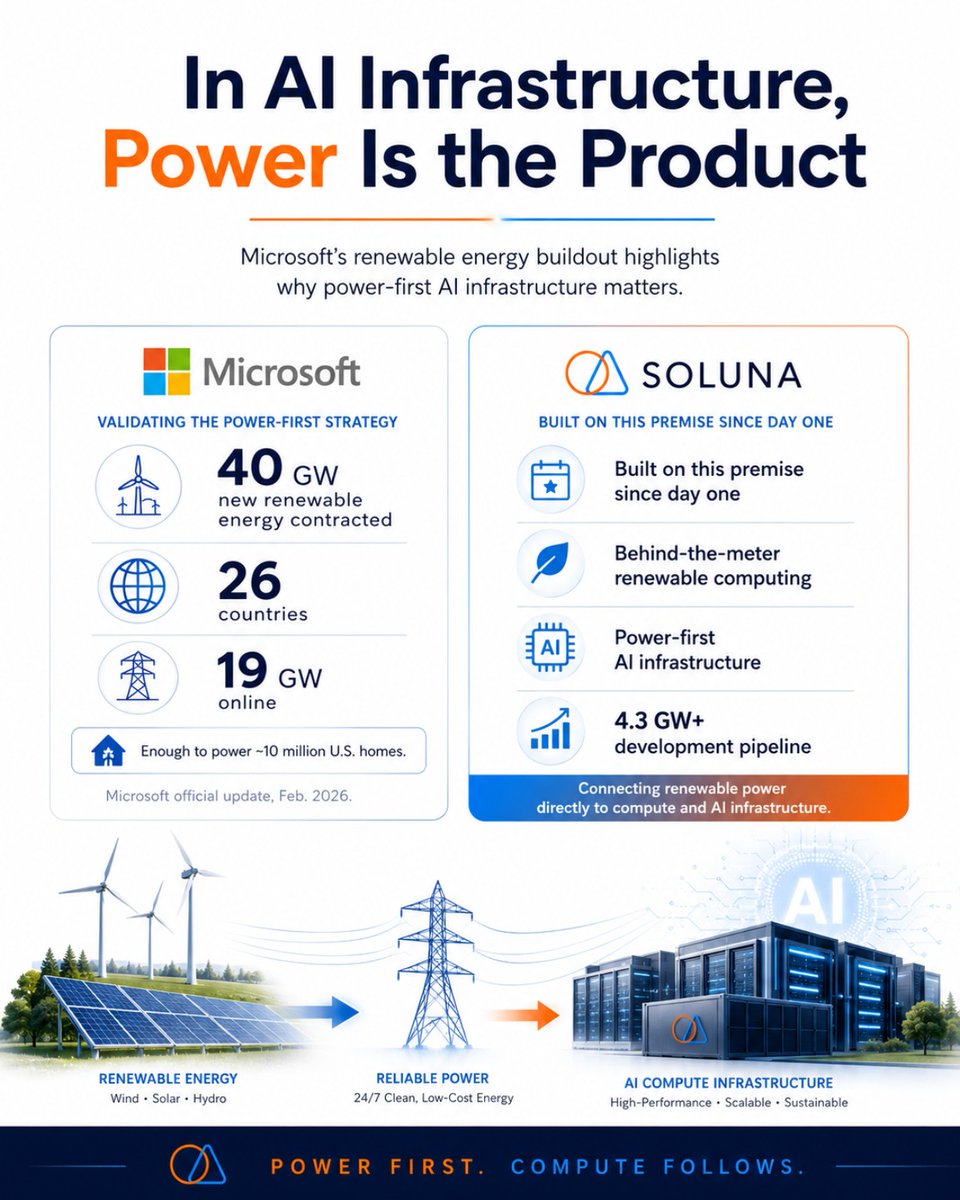
In AI infrastructure, power is the product. Microsoft just made that case with billions spent on new capacity commitments, including 40 gigawatts of new renewable energy capacity contracted across 26 countries. Soluna has been building on this premise since day one. $SLNH #RenewableComputing
English
7
23
178
26.6K
Ryan Dahlen retweetledi
Jw
Jw@jwtrading0·
$Oss This list of customers will only continue to grow over the coming years
Megatrend Investor 📈@MegatrendGlobal

@RosannaInvests $OSS boasts the best risk-reward ratio out there when it comes to Edge AI! It is still largely flying under the radar, yet it features an elite client base and a years-long partnership with NVIDIA!

English
1
5
22
3.1K
Ryan Dahlen retweetledi
Poonam Soni
Poonam Soni@CodeByPoonam·
Do you understand what NVIDIA just did? They didn't announce anything. Just coordinates: 25.0528, 121.5990 That's Taipei. Computex starts June 2. And three words — "A new era of PC." Here's what I think is coming. - NVIDIA has been quietly building an ARM-based chip for Windows PCs. - Developed with MediaTek. - Designed to run AI natively on your laptop. - Not a GPU. - Not a data center chip. - A processor. For your PC. And if the leaks are right — it could match RTX 4070 performance in a thin, efficient laptop. 👀 Intel. AMD. Qualcomm. They've owned this space for decades. NVIDIA is walking in. Jensen Huang also hinted at a "surprise new product nobody knows about yet" for the second half of 2026. This tweet might be that first signal. A company that makes the world's most powerful AI chips now wants to power your everyday PC. That's not an upgrade. That's a new era...
NVIDIA@nvidia

A new era of PC. 25.0528, 121.5990

English
322
478
6K
2M
Ryan Dahlen retweetledi
WTD_Fund
WTD_Fund@FundWtd·
David G. Bassett who last served as Director of the Defense Contract Management Agency for the US Army and Pentagon, overseeing tens of thousands of defense contracts exceeding 1 Trillion USD and previously led major Army acquisition and modernization programs such as tactical communications and combat vehicle systems is actively pushing $OSS
WTD_Fund tweet media
English
2
2
26
1.7K