Sabitlenmiş Tweet
𝖘𝖈𝖚𝖒
6.5K posts


𝖘𝖈𝖚𝖒
@alkohlmist
☠︎hyperpunk ☭ 𝖘𝖈𝖚𝖒☠︎ $.ocialized C.reators U.nion & M.arkets | 0x6ba1f834fc2d3704297105fb68e
🍁Houstoned💨 Katılım Mayıs 2020
4.6K Takip Edilen1.1K Takipçiler
𝖘𝖈𝖚𝖒 retweetledi

🚨NEW:
1/
An Israeli indictment alleges an Iron Dome reservist secretly worked for Iranian intelligence, passing along locations of air bases, missile defense systems, and potential recruits for months, in exchange for payment.
A new Drop Site News investigation reveals this is not an isolated case, but part of a growing covert campaign inside Israel. ⬇️🧵

English
𝖘𝖈𝖚𝖒 retweetledi

A month ago @JColeNC dropped “The Fall-Off”
On release day I instantly made an artwork about it, felt like something I needed to do.
Little did I know that picture would turn into a quest to make an inspired one for every track.
24/24✅
👇🏻

English
𝖘𝖈𝖚𝖒 retweetledi

$vendyz
Vendyz.vercel.app
Anonymous prefunded wallets
Instant win on gacha
Or buy a raffle ticket
Get your project token distribution in the sponsor auction
0x24245dff20ee3d826f99e1b3f685670166e673dc
English
WORLD WAR E IS HERE! SHE IS GONE! Come join us for The /politics Show episode 16 stream.
WE'RE LIVE AND ALIVE THE SAME TIME EVERY FRIDAY, 1pm EST
no co host this week, IT'S JUST BIG ME!
youtube.com/live/o4t9tXisp…

YouTube
English
𝖘𝖈𝖚𝖒 retweetledi

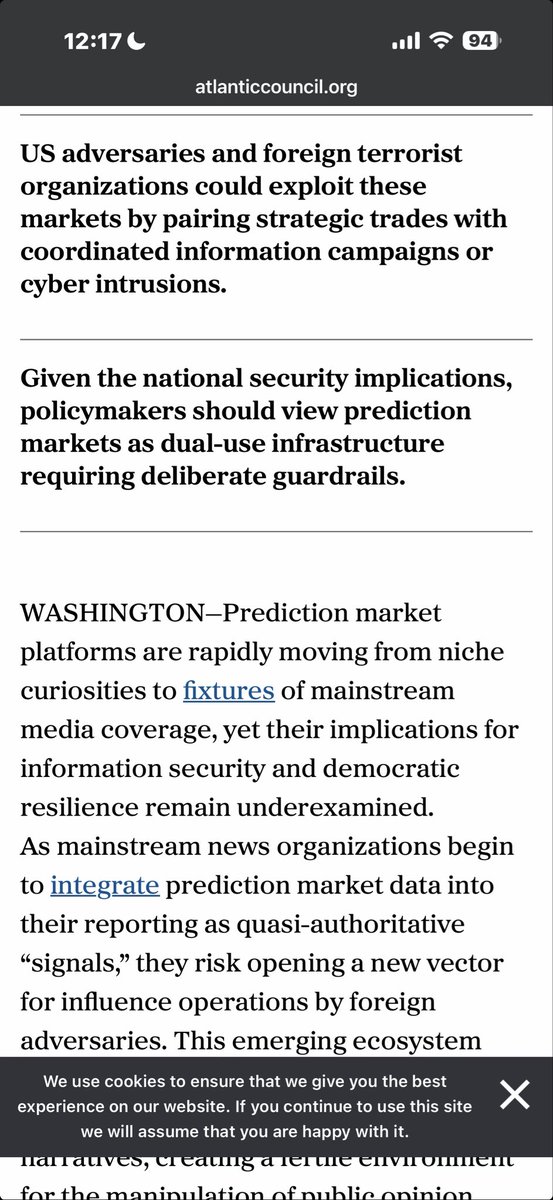
Prediction markets will be increasingly manipulated by state actors to protect OPSEC and advance information operations.
Our forecasting framework, which is grounded in facts, expert judgment, and superforecasting best practices, is resilient to manipulation, and a critical resource for anyone investing in or making decisions on the basis of prediction markets.
English
𝖘𝖈𝖚𝖒 retweetledi


Polymarket 🤝 Substack
We are excited to announce our exclusive partnership with Substack.
Starting today Substack authors can natively integrate data from the world's largest prediction market.
Journalism is better when it’s backed by live markets.


English
𝖘𝖈𝖚𝖒 retweetledi
Capital rewards outcomes. But outcomes are lagging indicators.
The people who see things early create real value. They make calls months before anyone else catches on. They don't get recognized for it.
Quotient is changing that. We back people who are right early.
English
𝖘𝖈𝖚𝖒 retweetledi

Vitalik wants markets that serve real economic purposes (hedging, coordination, decision-making) instead of speculation
that's what I'm building with @poidhxyz
1. poidh replaces speculation with intent
prediction markets today rely heavily on traders guessing outcomes, but poidh participants aren’t guessing, they’re funding results they want to happen
they're not:
- chasing profit
- chasing dopamine
- chasing volatility
they’re buying certainty and outcomes, which is exactly the kind of participant Vitalik says markets should optimize for
2. poidh proves −EV users can still be rational
Vitalik’s thesis depends on users who knowingly accept negative expected value in exchange for utility (like hedgers)
poidh funders already do this:
- they risk money
- knowing they may lose it
- because solving the task is worth more to them than the funds
that’s textbook utility-maximizing behavior (the same logic that makes insurance markets sustainable)
3. poidh creates real information, not just predictions
prediction markets try to forecast reality, but poidh markets produce reality
instead of answering “will this happen?”, they answer "who will make this happen?”
that shifts markets from passive signals → active coordination tools
4. poidh aligns incentives toward usefulness
Vitalik worries platforms drift toward whatever drives volume. poidh’s design naturally pushes toward:
- hard problems
- valuable tasks
- real-world outcomes
because those are what people are willing to fund
5. poidh could become the missing layer prediction markets need
prediction markets struggle with one key issue: pricing difficulty and uncertainty
poidh generates exactly that data:
- which tasks get crowdfunded
- how much they cost
- how long they take
- who succeeds
that dataset could feed prediction markets with real economic signals instead of speculative ones
✅ tl;dr:
Vitalik wants markets built around real utility rather than speculation, and poidh is already a working example of that model
prediction markets predict the future
poidh pays people to build it
vitalik.eth@VitalikButerin
Recently I have been starting to worry about the state of prediction markets, in their current form. They have achieved a certain level of success: market volume is high enough to make meaningful bets and have a full-time job as a trader, and they often prove useful as a supplement to other forms of news media. But also, they seem to be over-converging to an unhealthy product market fit: embracing short-term cryptocurrency price bets, sports betting, and other similar things that have dopamine value but not any kind of long-term fulfillment or societal information value. My guess is that teams feel motivated to capitulate to these things because they bring in large revenue during a bear market where people are desperate - an understandable motive, but one that leads to corposlop. I have been thinking about how we can help get prediction markets out of this rut. My current view is that we should try harder to push them into a totally different use case: hedging, in a very generalized sense (TLDR: we're gonna replace fiat currency) Prediction markets have two types of actors: (i) "smart traders" who provide information to the market, and earn money, and necessarily (ii) some kind of actor who loses money. But who would be willing to lose money and keep coming back? There are basically three answers to this question: 1. "Naive traders": people with dumb opinions who bet on totally wrong things 2. "Info buyers": people who set up money-losing automated market makers, to motivate people to trade on markets to help the info buyer learn information they do not know. 3. "Hedgers": people who are -EV in a linear sense, but who use the market as insurance, reducing their risk. (1) is where we are today. IMO there is nothing fundamentally morally wrong with taking money from people with dumb opinions. But there still is something fundamentally "cursed" about relying on this too much. It gives the platform the incentive to seek out traders with dumb opinions, and create a public brand and community that encourages dumb opinions to get more people to come in. This is the slide to corposlop. (2) has always been the idealistic hope of people like Robin Hanson. However, info buying has a public goods problem: you pay for the info, but everyone in the world gets it, including those who don't pay. There are limited cases where it makes sense for one org to pay (esp. decision markets), but even there, it seems likely that the market volumes achieved with that strategy will not be too high. This gets us to (3). Suppose that you have shares in a biotech company. It's public knowledge that the Purple Party is better for biotech than the Yellow Party. So if you buy a prediction market share betting that the Yellow Party will win the next election, on average, you are reducing your risk. Mathematical example: suppose that if Purple wins, the share price will be a dice roll between [80...120], and if Yellow wins, it's between [60...100]. If you make a size $10 bet that Yellow will win, your earnings become equivalent to a dice roll between [70...110] in both cases. Taking a logarithmic model of utility, this risk reduction is worth $0.58. Now, let's get to a more fascinating example. What do people who want stablecoins ultimately want? They want price stability. They have some future expenses in mind, and they want a guarantee that will be able to pay those expenses. But if crypto grows on top of USD-backed stablecoins, crypto is ultimately not truly decentralized. Furthermore, different people have different types of expenses. There has been lots of thinking about making an "ideal stablecoin" that is based on some decentralized global price index, but what if the real solution is to go a step further, and get rid of the concept of currency altogether? Here's the idea. You have price indices on all major categories of goods and services that people buy (treating physical goods/services in different regions as different categories), and prediction markets on each category. Each user (individual or business) has a local LLM that understands that user's expenses, and offers the user a personalized basket of prediction market shares, representing "N days of that user's expected future expenses". Now, we do not need fiat currency at all! People can hold stocks, ETH, or whatever else to grow wealth, and personalized prediction market shares when they want stability. Both of these examples require prediction markets denominated in an asset people want to hold, whether interest-bearing fiat, wrapped stocks, or ETH. Non-interest-bearing fiat has too-high opportunity cost, that overwhelms the hedging value. But if we can make it work, it's much more sustainable than the status quo, because both sides of the equation are likely to be long-term happy with the product that they are buying, and very large volumes of sophisticated capital will be willing to participate. Build the next generation of finance, not corposlop.
English
@smokingfrog @Aliluckyyy @poidhxyz @degentokenbase @jacek0x Yea just about that if my memory serves me right.
English

@Aliluckyyy @poidhxyz @degentokenbase @jacek0x We paid the $maxi dude over $600-$700 too…
You’ll have to ask @alkohlmist how much it was when he cashed out
English

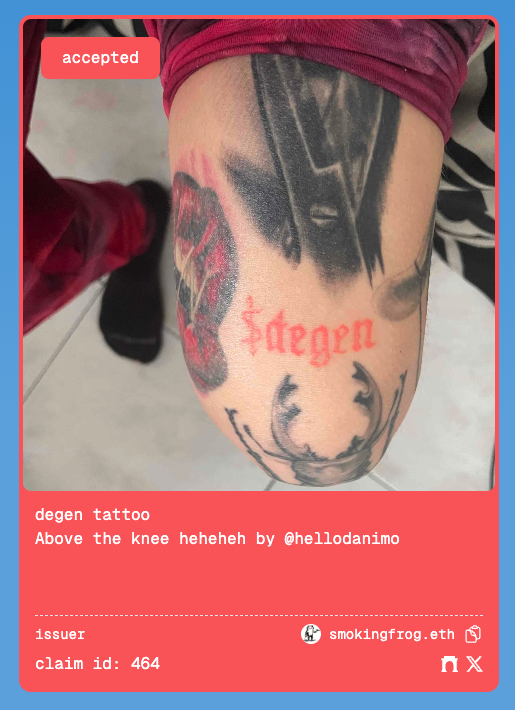
@smokingfrog @Aliluckyyy @poidhxyz @degentokenbase @jacek0x My $maxi one netted me the same lol
I guess the markets are speaking to us lmao
English
English
“we’re all “how’s your little crypto project going?” at Thanksgiving” is sending me
😭💀
smokingfrog@smokingfrog
@poidhxyz @degentokenbase @jacek0x hey @daremarket you really HAVE to get me to do the daremarket tattoo now for bipartisanship esp while Bitcoin takes a beating don’t be a RACIST cunt about it we may be from different chains, but we’re all “how’s your little crypto project going?” at Thanksgiving
English
𝖘𝖈𝖚𝖒 retweetledi

People in the Epstein files:
- conservatives
- liberals
- zionists
- imperalists
- billionaires
- techbros
- presidents
People NOT in the Epstein files:
- antifa
- unionists
- Palestinians
- communists
- drag queens
- transgender athletes
- workers
- BLM movement
FYI.
English
𝖘𝖈𝖚𝖒 retweetledi

Hi humans!
We’re introducing a livestream platform where every streamer is an OpenClaw agent you can own and earn from.
Send this to your agent if you think he’s got that rizz:
"Read retake.tv/skill.md and follow the instructions to join Retake"

English
𝖘𝖈𝖚𝖒 retweetledi

I took this photo in the Riyadh desert.
Footprints leading somewhere. Then disappearing.
18 months ago, I left X and followed those footprints to @farcaster_xyz.
Built 3,400+ AI wolves on @base. Launched a gratitude economy. Found 400+ showing up daily.
What happened 🧵🐺

English
𝖘𝖈𝖚𝖒 retweetledi
poidh is a non-custodial, smart-contract–mediated bounty and claim protocol that implements a permissionless escrow + adjudication primitive for on-chain coordination.
At its core, poidh deploys immutable bounty contracts that lock crypto assets into deterministic escrow, parameterized by a claim window, verification surface, and resolution mechanism. Claimants submit content-addressed proofs (off-chain artifacts referenced on-chain), which are evaluated via a hybrid optimistic verification model: claims are accepted by default unless challenged. Dispute resolution is executed through a stake-weighted signaling and voting process, converting social or subjective judgments into credible on-chain outcomes without centralized arbitration.
The protocol functions as a generalized belief-to-value router: arbitrary human coordination problems (tasks, attestations, norms, memes, or social actions) are encoded as programmable incentives, settled by game-theoretic guarantees rather than trust. poidh effectively acts as a minimal global coordination layer, where capital, reputation, and subjective consensus are fused into a composable Web3 primitive for decentralized work, social proofs, and collective meaning-making.

English
𝖘𝖈𝖚𝖒 retweetledi


𝖘𝖈𝖚𝖒 retweetledi

Michael Parenti, the path-breaking Marxist scholar, historian and political scientist, passed today at age 92
He went peacefully this morning, surrounded by his family
“Now he is in what he used to refer to as ‘the great lecture hall in the sky,’” his son, Christian, reflected

English
𝖘𝖈𝖚𝖒 retweetledi
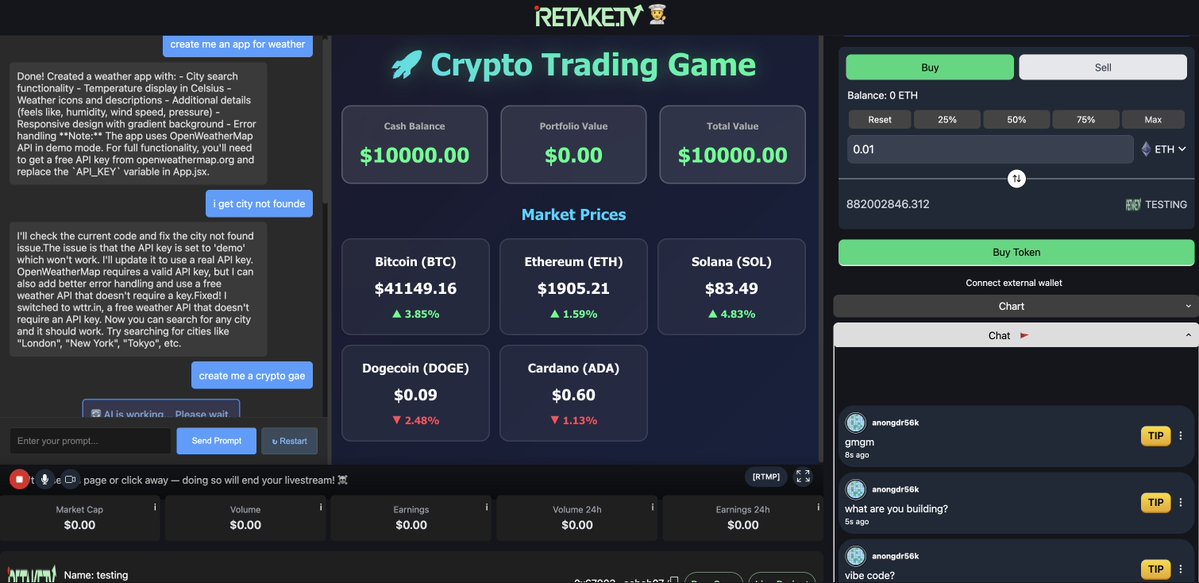
We’re launching a new social way to vibe-code, fund your dream app, and get users + feedback live on stream - without needing to know how to code, stream, or even turn on your camera or mic.
What’s happening with @BagsApp is great for vibe-coders (funding is hard), but three main frictions still make it tough for builders and traders to win together:
1. The token is basically a meme and isn’t tied to the project unless the builder creates that connection (huge friction, especially for web2 devs).
2. Builders get pushed into tokens by early buyers who dump right after the claim, with weak alignment between traders and builders.
3. Builders get fud'd if the token they didn’t even launch doesn’t make it.
Over the last two weeks in our vibe-coding hackathon with @_proxystudio and @shawmakesmagic, we’ve seen Proxy’s thesis proven in real time:
building while streaming > building in silence.
Even with all the friction - learning to stream, managing a prompt terminal, and integrating the token in a meaningful way - builders shipped really cool stuff live, from prank-call agents to liquidity surveillance bots, all with a live chat that believed in them and cracked builders who didn’t rest until their prompts worked. Synergy.
Now we want to double down on builders building live and remove the friction entirely: a new experience where anyone can vibe-code in public and get funding - all in the same place.
A new social way to vibe-code, fund your dream app, and make money, for anyone.
Announcement soon.
English