
Sabitlenmiş Tweet
Anders
2.3K posts


Anders
@andersavail
"above average easier to take advantage of" - my pals, 2025
(✧ω✧) Katılım Ocak 2011
1K Takip Edilen383 Takipçiler
Anders retweetledi

Anders retweetledi

People freaking out over my AI spend. What nobody sees: Part of what excites me so much about working on OpenClaw is that I'm trying to answer the question:
How would we build software in the future if tokens don't matter?
We constant run ~100 codex in the cloud, reviewing every PR, every issue. If a fix on main lands, @clawsweeper will eventually find that 6 month old issue and close it with an exact reference.
We run codex on every commit to review for security issues (as it's far too easy to miss).
We run codex to de-duplicate issues and find clusters and send reports for the most pressing issues.
We have agents that can recreate complex setups, spin up ephemeral crabbox.sh machines, log into e.g. Telegram, make a video and post before/after fix on the PR.
There's codex that watch new issues and - if it fits our documented vision well, automatically create a PR of it. (that then another codex reviews)
We have codex running that scans comments for spam and blocks people.
We have codex instances running that verify performance benchmarks and report regressions into Discord.
We have agents that listen on our meetings and proactively start work, e.g. create PRs when we discuss new features while we discuss them.
We build clawpatch.ai to split all our projects into functional units to review and find bugs and regresssions.
We do the same split for security with Vercel's deepsec and Codex Security to find regressions and vulnerabilities.
All that automation allows us to run this project extremely lean.
English
Anders retweetledi

Asset allocation is a zero-sum game.
You cannot be overweight everything. There is an adding up constraint.
Today, Information Technology + Communications Services is roughly 43% of the S&P 500. Energy + Materials is roughly 6%. Commodity hedge fund AUM is essentially nil. Macro AUM is a rounding error. HALO strategies have all been starved of capital.
When tech re-rates toward neutral, the rotation is measured in trillions. A move from 43% to 25% is eighteen points of a $66 trillion index — roughly $10 trillion of capital looking for a new home. The new capital intensity of the hyperscalers alone will create a significant rerating carlyle.com/carlyle-compas…. Yes, the math is imperfect. Bid-ask spreads destroy and create wealth along the way. But the broader point holds.
The money does not vanish. It rotates. And there is only one asset class on the other side of that trade big enough to absorb it — one that has been starved of capital for fifteen years. HALO.
The flow is forced. The rotation is unavoidable. And it will overshoot as it always does.
Asset allocation is conservation of mass.
6/10
English
Anders retweetledi

Anders retweetledi

Aren’t we glad Hyperliquid invested in a policy arm instead of onboarding degenerate gamblers to perps with paid growth like a lot of the timeline said they should
English
Anders retweetledi

Counterpoint - Hyperliquid is an unregistered, centralized market that clearly should be registered with CFTC if there is a US nexus and Coinbase partnership just increases argument that the US has jurisdiction/nexus.
Austin Barack@AustinBarack
The reaction after the reaction to the news this morning tells me $HYPE is ATH bound (soon) Initial take by markets: CME and ICE lobbying regulators will hurt Hyperliquid. 30 min delayed take by markets: CME and ICE realize Hyperliquid is a formidable competitor built on more efficient rails and they can't compete with HL on product. Also, the Coinbase partnership has meaningfully reduced regulatory risk and the team is as always 3 steps ahead. Wouldn't be surprised to see a break of all time highs before month end. Nfa as always
English
Anders retweetledi

If you've been tracking @chainlink migrations (i.e., LZ to CCIP), you're watching one of the greatest GTM teams in crypto in action
Johann is a beast.
English
Anders retweetledi

Group AI psychosis sesh in black tie attire at the local castle
English
Anders retweetledi

Remember when SBF was trying to throw DeFi front-end providers under the bus?
Well, CLARITY Act cleared Senate Banking 15-9 yesterday and it's the opposite of what he was pushing for.
I can't overstate how massively bullish I think it will be for Euler, Aave, Morpho, Uniswap if it passes.
§15H says user interfaces that read or display blockchain data don't trigger broker, dealer, or exchange registration. Ship a frontend on a permissionless protocol and you are not, by that act alone, a regulated intermediary.
BRCA says non-custodial developers are not money transmitters. Publish protocol code, don't custody funds — federal regulators can't touch you as an MSB.
Title III's control test says a protocol stays "decentralized" if no single holder ≥20%, with security councils and nodes/validators explicitly carved out. That test was written around the governance designs @eulerfinance, @aave, @morpho, @Uniswap already use.
Still has to clear Senate floor and conference. But the direction is set.
The DeFi renaissance is coming.
Michael Bentley@euler_mab
Dear @SBF_FTX, I think you are throwing front end hosts under the bus. DeFi websites might look to the untrained eye like exchanges etc, but in practice they are purely information providers. Please can we all agree not to concede ground on this so soon? twitter.com/euler_mab/stat…
English
Anders retweetledi

I have given this protocol and chain my energy, heart, and soul. I bought and earned every HYPE I own, I paid for an NFT in 2025. No airdrop, no grants, just belief based on available information.
Hyperliquid.
anḍ̴͆͒ŷ̶͙̱̲@andyhyfi
Dear Everyone, @HypurrFi is winding down and transitioning its Prime and Yield markets to @eulerfinance. There is no security breach, there is no exploit. All markets are healthy and solvent. We believe that lending and derivatives make HyperEVM a standout place to build in not just crypto, all of technology. That belief remains unshaken, which is why we are proud to hand over infrastructure management back to Euler to manage these powerful markets on the best chain for finance. The demand for Euler markets is significant, and we’re excited to see how Euler and Clearstar grow finance on hyperliquid. But the economic reality of building as HypurrFi does not add up. People need to be paid, security needs to be constant. Simply put, there is not an ethical economic path forward for HypurrFi. The math doesn’t math. I have given this protocol and chain my energy, heart, and soul. Nothing about this sunset changes my belief in Hyperliquid as a massive change in how we build onchain and how we interact with finance globally. I bought and earned every HYPE I own, I paid for an NFT in 2025. No airdrop, no grants, just belief based on available information. I am not going anywhere. Hyperliquid. What is actually happening to the millions of TVL in HypurrFi? The HypurrFi UI will remain online for users to withdraw, Legacy and Pooled Market's will be settled and shut down by July 15th, you are encouraged to unwind and migrate promptly. The Pooled Market has been adjusted to prevent more debt from being issued, HYPE/USDC/USDT0 remain available for supply to give borrowers time to repay, the remaining markets have been frozen for new borrow and lend. USDXL rates will be set at 30% to incentivize repayment long before market closure, the time to repay is now, if you need liquidity you can mint from the USDXL page with USDT0 while markets are operational. HypurrFi Support will remain available until May 28th, after which Discord will be closed. A migration tool has been added to the UI, check the relevant dashboards to help guide your migration positions to an appropriate Euler market. Hyperliquid support will be added to the Euler UI over the coming days. Hyperscan.com will continue to be available, we are working with Enigma to keep it running and expand its capabilities as a testnet explorer The HypurrFi Card and HypurrFi Points have been discontinued I’m happy to talk to partners, friends, and competitors about this situation. It wasn’t easy. Please be graceful as the team is working with Partners to ensure the transition to Euler is strong, and we remain online to help lenders and borrowers navigate the transition. PLEASEPLEASEPLEASE be careful with your OpSec during this period. Any disruption to normal activity is a haven for scammers. Verify you have official links ONLY. DO NOT USE GOOGLE to fund HypurrFi locations, use official X accounts, verify in DMs if you have an existing chat with team, do not reply to imposters. Stay safe.
English
Anders retweetledi

Anders retweetledi

I’m pro-decentralization to my core. Which means even though I hold $LINK, I still want REAL competition in cross-chain infrastructure. I want different platforms choosing different providers, even when those choices don’t benefit my own portfolio.
But at the same time, I can’t in good faith recommend another cross-chain solution when none of them come remotely close to Chainlink’s security profile.
How can a competitive environment even exist, when others cannot achieve the bare minimum?
Kraken@krakenfx
Kraken is deprecating its existing cross-chain provider and migrating to @Chainlink CCIP as its exclusive cross-chain infra to secure Kraken Wrapped Bitcoin (kBTC) & all future Kraken Wrapped Assets. Kraken chose Chainlink CCIP because it offers enterprise-grade infrastructure with strict security & risk management requirements, including: • ISO 27001 and SOC 2 Type 2 certifications • Secure by default architecture • 16 independent nodes • Native rate limits, and more. Together, Chainlink and Kraken can help accelerate the global adoption of crypto by unlocking utility and distribution for all Kraken Wrapped Assets across DeFi. For kBTC customers, no action is required. More details on the migration process to follow on official Kraken channels.
English
Anders retweetledi

Today we release Lighthouse Attention, a selection-based hierarchical attention for long-context pre-training that delivers a 1.4-1.7× wall-clock speedup at 98K context.
It runs the same forward+backward pass ~17× faster than standard attention at 512K context on a single B200, without a custom sparse attention kernel, a straight-through estimator, or an auxiliary loss.
During training, queries, keys, and values are pooled symmetrically into a multi-resolution pyramid. We then score every pyramid heads, and a top-k cascade selects a small hierarchical dense sub-sequence, and after a sorting pass that enforces causality, we use standard attention for token mixing. A brief full attention resume at the end converts the checkpoint back into a competent dense-attention model.
Validated this using 530M parameter Llama-3 models across 50B tokens, with up to 1M-token benchmarks across 32 B200s under context parallelism.
The work on Lighthouse Attention was led by @bloc97_, @SubhoGhosh02, and @theemozilla.

English
Anders retweetledi

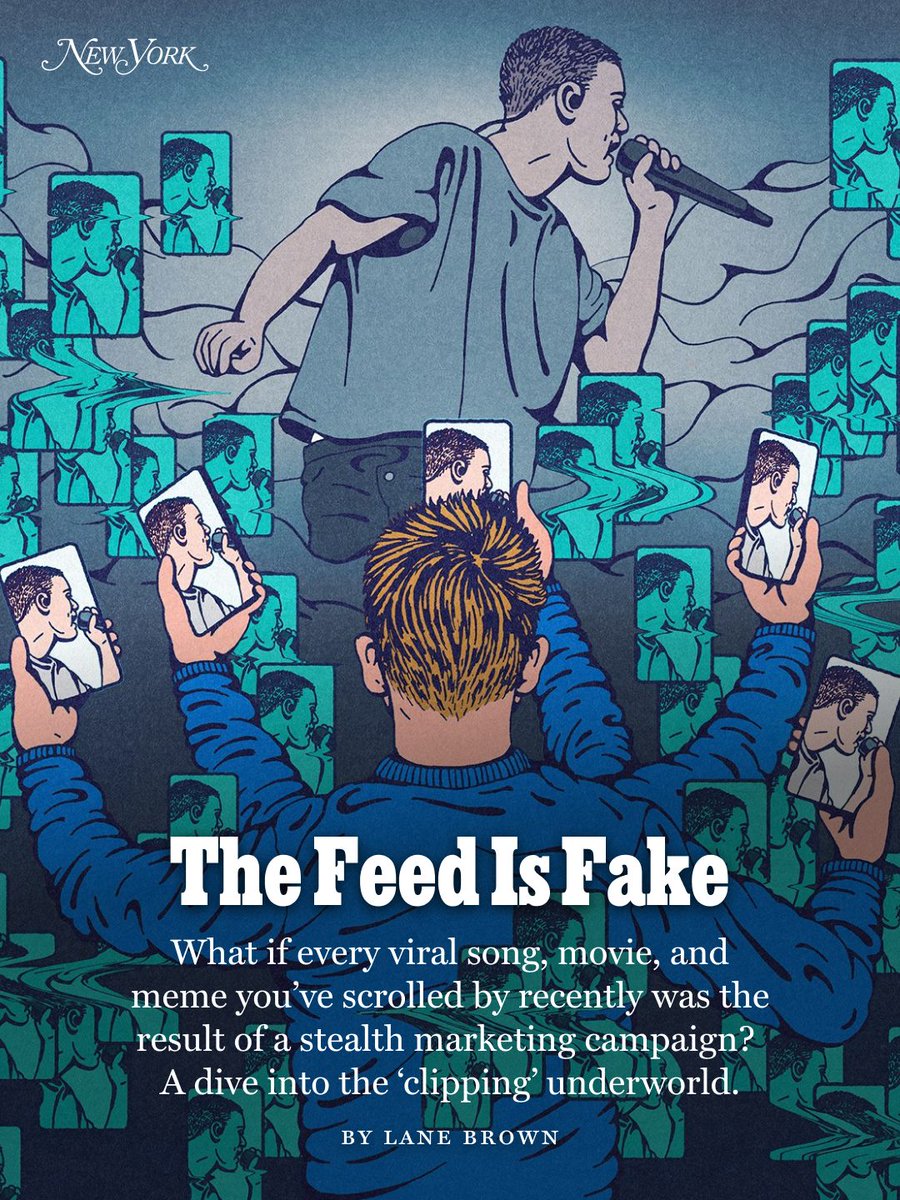
Joe Lim estimates that 90 percent of what you see on the internet is advertising in disguise, and he should know. For three years, Lim ran a company called Floodify, which at its peak operated 65,000 dummy social-media accounts used to drum up attention on behalf of paying clients.
The point of this kind of marketing is that nobody is supposed to notice it. But lately, the machinery has started to show.
In April, Justin Bieber headlined two consecutive weekends at Coachella. Coachella is the biggest stage in pop music save only for the Super Bowl, the kind of event that in theory generates its own attention. And yet on both weekends, a Discord server writer Lane Brown had been monitoring hosted paid campaigns for Bieber’s Coachella performances, offering clippers — people who are hired to turn a song, trailer, interview, stump speech, or whatever into short, social-media-friendly fragments — as much as a dollar per thousand views.
“On social media, popular opinion is being formed, measured, and manipulated all at once, and every signal the platforms produce — a trending song, a backlash, a talking point, the feeling that ‘everybody’ is suddenly talking about the same thing — can now be fabricated by unseen actors with hidden agendas,” writes Brown.
“Everybody is doing this now,” Lim says. “And if you’re not, you’re behind.”
Brown reports on how the same techniques are now being used to fool people on every app they go to in order to find out what other people think, not just in music but across entertainment, politics, consumer products, and celebrity gossip: nymag.visitlink.me/w6Bu9N
English
Anders retweetledi

the white collar guys are feeling threatened.
can’t even blame them. i’d probably shit on my body and do the same thing if Jeff says he want to start eating my lunch.
Hyperliquid.
Luke Cannon@lukecannon727
The New York Stock Exchange basically realized they have a 6 month window to regulate Hyperliquid or else become a builder codes frontend on the house for all of finance. Sorry Lynn, I'm not going to trade in your pits.
English
"If you are looking for talented, crypto native, and kind people to join your ranks, I know that they will contribute meaningfully and with their full heart, so please reach out."
The Hypurr 🐾🐱 folks are incredible and would level up any team lucky enough to have them.
androolloyd.hl@androolloyd
Dear @HypurrFi Community. HypurrFi is winding down and transitioning its Prime and Yield markets to Euler. Euler is a world class team and has an amazing vision for what programmable credit markets can enable, we saw this early on, and the value it will create for Hyperliquid. We are excited they will carry the torch we lit. The Hyperliquid opportunity is greater than ever, Euler understands this deeply and is working alongside Clearstar to ensure that opportunities for credit extend far beyond what is available on the chain today. I'm sure you have a lot of questions, but first things first, the protocols remain solvent and healthy, there are no issues, we're not going away overnight and that this isn't a change in belief or conviction on Hyperliquid, it's just a change in direction for us. What does this mean for you right now? The HypurrFi UI will remain online for users to withdraw. Legacy and Pooled Market's will be settled and shut down on June 30th, you are encouraged to unwind and migrate promptly. The Pooled Market has been adjusted to prevent more debt from being issued, HYPE/USDC/USDT0 remain available for supply to give borrowers time to repay, the remaining markets have been frozen for new borrow and lend. USDXL rates will be set to 30% to incentivize repayment long before market closure, the time to repay is now, if you need usdxl to repay, you can mint from the USDXL page with USDT0 while markets are operational. HypurrFi Support will remain available until May 28th, after which Discord will be closed. A migration tool has been added to the UI, check the relevant dashboards to help guide your migration positions to an appropriate Euler market. Hyperliquid support will be added to the Euler UI over the coming days. Hyperscan.com will continue to be available, we are working with Enigma to keep it running and expand its capabilities as a testnet explorer The HypurrFi Card and HypurrFi Points have been discontinued If you're a pooled or legacy market lender or borrower, the time to repay and close out your positions is here. I want to extend my gratitude to the entire Hyperliquid community for the love you have shown all of us at HypurrFi over the last year, many of us will be around in some capacity so if you see any of us on your travels, be sure to say hello. If you are looking for talented, crypto native, and kind people to join your ranks, I know that they will contribute meaningfully and with their full heart, so please reach out. Catch you in the order books. Hyperliquid
English
Anders retweetledi

Harvard Business Review research reveals that excessive interaction with AI is causing a specific type of mental exhaustion ( or "AI brain fry"), which is particularly hitting high performers who use AI to push past their normal limits.
A survey of 1,500 workers reveals that AI is intensifying workloads rather than reducing them, leading to a new form of mental fog.
While AI is generally supposed to lighten the load, it often forces users into constant task-switching and intense oversight that actually clutters the mind.
This mental static happens because you aren't just doing your job anymore; you are managing multiple digital agents and double-checking their work, which creates a massive cognitive burden.
The study found that 14% of full-time workers already feel this fog, with the highest impact seen in technical fields like software development, IT, and finance.
High oversight is the biggest culprit, as supervising multiple AI outputs leads to a 12% increase in mental fatigue and a 33% jump in decision fatigue.
This isn't just a personal health issue; it directly impacts companies because exhausted employees are 10% more likely to quit.
For massive firms worth many B, this decision paralysis can lead to millions of dollars in lost value due to poor choices or total inaction.
Essentially, we are working harder to manage our tools than we are to solve the actual problems they were meant to fix.
---
hbr .org/2026/03/when-using-ai-leads-to-brain-fry

English
Anders retweetledi

Anders retweetledi

English

@morganlinton Damn, this sucks because I've been paying $300/month to xAI for like 6 months now. Where's the love for the most dedicated and loyal users?
English

Okay, this promo + Grok Build is the tipping point for me. SuperGrok Heavy here I come 💪
Super interested in token efficiency, and thinking about using Grok Build to create an operating system from scratch, and then compare it to what Codex built.
Feels like a pretty serious test of an agentic coding tool right?

English