Alex Hanley

1.8K posts

Alex Hanley banner
Alex Hanley

Alex Hanley

@ap_hanley

Hang gliders and high explosives. Bitcoin power tools at @FrostsnapTech and @HardBlockBTC

Sydney, Australia Katılım Eylül 2021
2.8K Takip Edilen1.1K Takipçiler
Alex Hanley retweetledi
Adam Back
Adam Back@adam3us·
@robin_linus Yes! but if we want to stretch that far into the improbability drive, all HD wallets are already quantum prepared. Simply deprecate key spend, and introduce a ZK signature of knowledge which signs the transaction by proving the address is derived from it, and you know the seed.
English
5
2
13
809
Alex Hanley
Alex Hanley@ap_hanley·
@francispouliot_ Imagine having this attitude to the inflation bug The security of elliptic curve cryptography was the assumption you opted into in the same way you opted into the assumption that there would be a fixed supply
English
0
0
1
54
Extractive Ghost of Unhosted Marcellus 👻
@Kilombino_ Consider this: if you present me a supposedly thoughtful text that you want me to read and engage with, and I notice that you didn't write it I automatically feel rickrolled and disrespected. The reader's time and energy is also limited edition.
English
4
1
16
350
Extractive Ghost of Unhosted Marcellus 👻
I can't stop seeing AI slop everywhere. Just stop, it makes you look absolutely retarded and as soon as the patterns are noticed I automatically refuse to keep reading. Using AI to write doesn't give you any edge whatsoever.
Extractive Ghost of Unhosted Marcellus 👻 tweet media
English
8
7
73
1.4K
Alex Hanley
Alex Hanley@ap_hanley·
@stephanlivera The paper basically showed that the whole long range vs short range discussion is irrelevant BIP360 dead on arrival
English
1
0
2
439
Stephan Livera
Stephan Livera@stephanlivera·
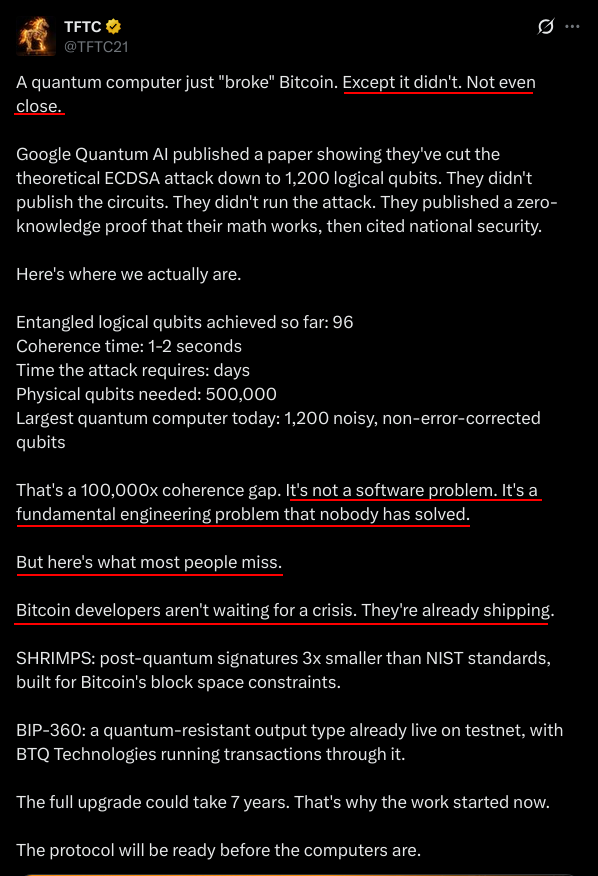
So everyone's talking about Google Quantum AI’s new research paper, “Securing Elliptic Curve Cryptocurrencies against Quantum Vulnerabilities: Resource Estimates and Mitigations.” Cue the predictable Bitcoin quantum FUD: “Why haven’t the devs fixed this already?!” Reality is, it’s not a simple patch. Post-quantum signatures come with serious tradeoffs and Bitcoin faces unique constraints that general tech and web apps don’t. Post-quantum signatures are generally much larger transaction sizes - often 5–50× or more in the signature-heavy parts → higher fees, more compute. Hardware wallets would need a big shift. The choice of scheme (stateless, stateful, or hybrid) would change how we custody coins. HD wallets, watch-only wallets, FROST, MuSig2, silent payments… some of the privacy and UX wins we love today could be gone, degrade or require clunky workarounds. Bitcoin has to stay decentralized: small blocks, permissionless validation. Web servers can throw bigger payloads around; Bitcoin can’t without sacrificing the very properties that make it Bitcoin. Even “standard” post-quantum schemes like ML-DSA (which Android is integrating) produce signatures 35–66× larger than today’s ~70-byte ECDSA signatures, making them too heavy for Bitcoin’s tight constraints on block space, fees, and hardware. That’s why researchers like @n1ckler (and @blksresearch) are doing vital work right now: exploring the right tradeoffs for Bitcoin specifically. Hash-based crypto? Lattice-based? Something else? Which Bitcoin-optimized forms of SPHINCS make sense? SHRINCS (tiny ~324-byte stateful signatures with static backups) or SHRIMPS (for multi-device stateful setups)? How many times will a user sign with the same key? Can we assume user devices can securely maintain state, or do we need fully stateless fallbacks? Would we expand the block size with some kind of quantum witness discount? What do we do about quantum-vulnerable coins? These are the hard, Bitcoin-specific questions that matter. Practical steps are already being taken. BIP 360, proposed by @cryptoquick, @Ethan_Heilman, and @isabelfoxenduke, is a thoughtful first step: it introduces a new Pay-to-Merkle-Root (P2MR) output type that gives us Taproot-like functionality without the quantum-vulnerable keypath spend. It’s designed as an enabling primitive — conservative, upgradable, and focused on reducing address exposure risks while the ecosystem figures out the heavier lifting of actual post-quantum signatures. Bitcoin builders have spent 15+ years improving what is otherwise a very clunky experience in a decentralized environment. Rushing big protocol shifts risks breaking that. This isn’t something to knee-jerk “just fix.” It deserves careful, ongoing research and exploration, not panic. That said, informed skeptics like @reardencode and @bergealex4 are also right to push back. The paper improves resource estimates for breaking secp256k1 (fewer logical qubits, potentially minutes-long attacks on a hypothetical machine), but as @reardencode notes, it’s still theorycrafting: we’d need a large-scale fault-tolerant quantum computer with hundreds of thousands of physical qubits maintaining coherence for minutes — something far beyond today’s best devices (hundreds of qubits coherent for microseconds). A true CRQC capable of breaking ECDSA by 2029 (or even soon after) remains a big maybe. Bitcoin's strength is in deliberate, methodical and conservative steps to address threats.
Stephan Livera tweet mediaStephan Livera tweet media
English
36
57
327
40.9K
Alex Hanley
Alex Hanley@ap_hanley·
So it turns out all the panic about which keys are hashed and which aren't seems like it was likely nonsense Short range attack vs long range attack discussions rendered moot IF we get a CRQC then it probably doesn't matter..
Charles Guillemet@P3b7_

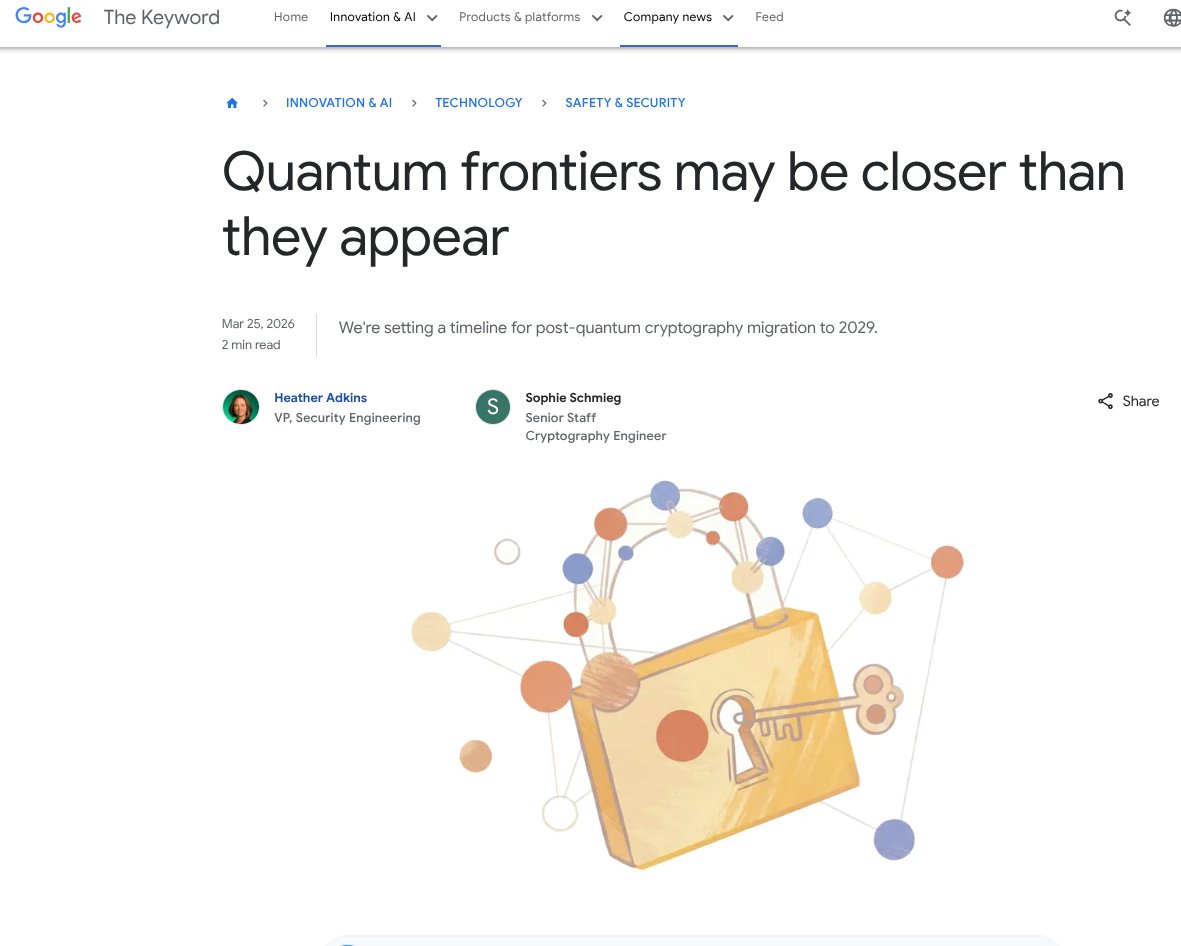
Today, Google Quantum AI published a research paper that might boost the post-quantum migration. Their team has tailored Shor’s algorithm to solve the 256-bit Elliptic Curve Discrete Logarithm Problem. ECDLP is the hard mathematical problem that secures ECDSA: the signature scheme underpinning most blockchains, TLS certificates, and countless authentication systems, using fewer than 1,200 logical qubits and 90 million Toffoli gates. Translated to hardware: fewer than 500,000 physical qubits, executing in a few minutes. A few minutes. Less than a Bitcoin block time. Less than two Ethereum epochs. The long-standing argument that public keys can simply remain hidden is now moot (In fact, it has always been x.com/P3b7_/status/1…). What exactly changed Shor's algorithm has been known since 1994 as a generic quantum approach to factoring integers and computing discrete logarithms. But "known" and "practical" are very different things. The real progress is in the engineering: how many qubits and gates you actually need once you compile the algorithm into a fault-tolerant quantum circuit. The last breakthrough by the INRIA Rennes team required ~2,100 logical qubit count for ECDLP. Google's engineers optimized the full circuit stack to ~1,200 logical Qubits. The recent algorithmic trendline is clear: every 12-18 months, the resource estimates drop significantly. And these are pure algorithmic gains: they compound on top of hardware improvements, which remain a major challenge. However, as of today, we're still far from having such a quantum computer. This didn't change. Zero Knowledge Proof Here's where it gets interesting. Google chose not to publish their optimized circuits. Instead, they released a zero-knowledge proof that their circuits achieve the claimed resource counts. We have no doubt they know how to do it, but no clue how (sounds magic ;-)) The reasons are likely multiple: competitive advantage, national security implications, or simply not wanting to hand a blueprint to adversaries. Regardless, it establishes a powerful (and elegant) precedent. What’s ironic: Google's ZK proof is not itself post-quantum secure. What’s next? The good news is that we already have the tools: Post Quantum Cryptography, now we need to migrate. A few days ago, Google announced it is targeting 2029 for full post-quantum readiness. NIST plans to deprecate RSA signatures by 2030 and disallow all legacy algorithms by 2035. Most organizations haven't started their cryptographic inventory. Major blockchain protocols are currently discussing the path forward. Cryptography exists to create mathematical trust in the security of systems. That trust is now being eroded, not by a working attack, but by the increasingly credible prospect of one. In security, the moment you start doubting the foundation is the moment you should be rebuilding it. What this means for blockchains For blockchain ecosystems specifically, the threat is central. ECDSA on secp256k1 (Bitcoin) and P-256 curves (broadly used elsewhere) is the cornerstone of security. Unlike traditional systems where you can rotate certificates behind a corporate firewall, blockchain migration requires coordination across decentralized, permissionless networks. This process will likely take time. I'll be diving deeper into the concrete challenges and strategies for PQC migration on blockchains and secure systems at my keynote this Thursday at EthCC conference.


English
0
0
0
83
Adam Back
Adam Back@adam3us·
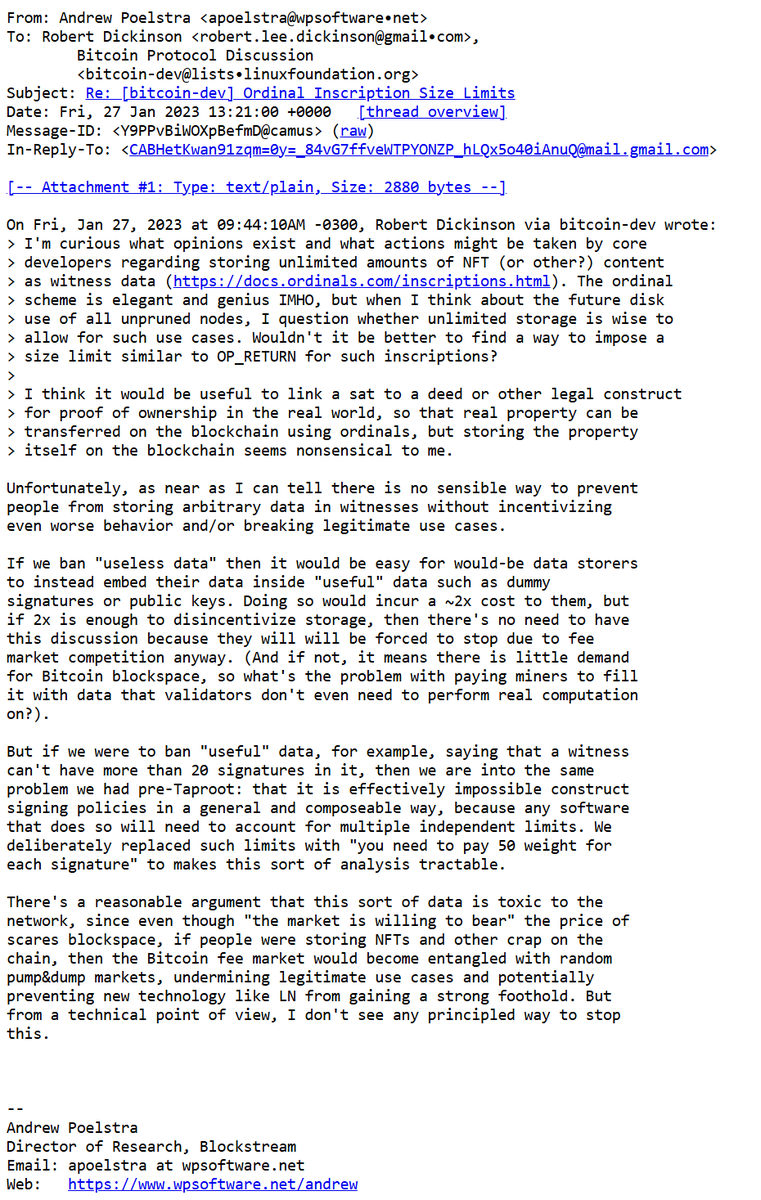
evergreen explainer about the spam problem fundamentals, from Andrew Poelstra (@blksresearch). read a few times, very carefully to adjust intuitions.
Adam Back tweet media
English
35
47
317
58K
mike
mike@mike_4131·
@ap_hanley @BitMEXResearch @rodarmor @Vladcostea @adam3us @KonradSGraf I don't want the box on the shelf Luckily in our example there is not a single box Both parties can choose whatever rules they want for their money You just refuse to choose. Actually you do choose, you choose the same rules as me, and complain about it, instead of being free
English
1
0
0
24
Alex Hanley
Alex Hanley@ap_hanley·
@mike_4131 @BitMEXResearch @rodarmor @Vladcostea @adam3us @KonradSGraf It's a collective action problem. There's no point in taking action by yourself, you have to build consensus and act together for a succesful outcome. Step 1 is fighting on twitter to correct misonceptions This is the foundational step before anything else can occur
English
1
0
0
29
mike
mike@mike_4131·
@ap_hanley @BitMEXResearch @rodarmor @Vladcostea @adam3us @KonradSGraf keep dodging the question some think the best course of action is to do nothing others think the best course of action is to do something so when are the people like yourself going to do something? you have complete freedom and sovereignty what are you waiting for?
English
1
0
0
25
Alex Hanley
Alex Hanley@ap_hanley·
@mike_4131 @BitMEXResearch @rodarmor @Vladcostea @adam3us @KonradSGraf Firstly, Core is not taking the position that spam does not exist, just that they don't think that it is beneficial to take action. So you are wrong there. Secondly, they have not demonstrated they have engaged with the ideas I am referring to. So a fail on both accounts
English
1
0
0
24
mike
mike@mike_4131·
@ap_hanley @BitMEXResearch @rodarmor @Vladcostea @adam3us @KonradSGraf Core literally wrote pages engaging the ideas, across the mailing list, twitter, github, stackexchange, blogposts some people think the best course of action is to do nothing others like yourself think the best course of action is to do something so my question to you is: when
English
1
0
0
44
Alex Hanley
Alex Hanley@ap_hanley·
@mike_4131 @BitMEXResearch @rodarmor @Vladcostea @adam3us Your view that this is all subjective - that there is no criteria by which we can identify spam, come to agreement, and take action is simply incorrect. Try reading Action Based Jurisprudence by @KonradSGraf, and what he classifies as "Objective, intersubjectively ascertainable"
English
1
0
0
33
mike
mike@mike_4131·
@ap_hanley @BitMEXResearch @rodarmor @Vladcostea @adam3us you personally choose not to fix (what you consider to be) a bug you could choose to fix it right this second. you along with all other knots users, and spam fighters but you wont because you have no conviction in the slop you peddle
English
1
0
1
38
Alex Hanley
Alex Hanley@ap_hanley·
@adam3us @BitMEXResearch @rodarmor @Vladcostea Is this the worst form of spam or the best? At the end of the day, if it can be recognised as spam, then it can be targeted. If it can't, then it is difficult or impossible to build a social movement or scams around it.
English
0
0
0
51
Adam Back
Adam Back@adam3us·
@ap_hanley @BitMEXResearch @rodarmor @Vladcostea i agree it's spam. but note the worst variant of spam isn't even detectable because they encrypt it and stuff it into transactions fake public keys (which is even less space efficient). so we can't really do much about it at the limit due to permissionlessness, steganography etc.
English
1
0
7
390
Alex Hanley
Alex Hanley@ap_hanley·
@mike_4131 @BitMEXResearch @rodarmor @Vladcostea @adam3us Are you familiar with the "What is a bug?" quip? You need to reflect on what it means that we accept that bugs exist. If the technical code as it exists today defines what is consensus, then by definition bugs cannot exist
English
1
0
0
42
mike
mike@mike_4131·
@ap_hanley @BitMEXResearch @rodarmor @Vladcostea @adam3us then by your definition, bitcoin must not be a monetary network, since the consensus of all of its users is that non-monetary data is fully permitted and acceptable i think your definition of both "monetary network", and "spam" are flawed
English
1
0
1
49
Alex Hanley
Alex Hanley@ap_hanley·
@rationalaussie Can you please take a break from doom posting and go read the back catalogue from the @mises institute and educate yourself
English
0
0
0
101
Rational Aussie
Rational Aussie@rationalaussie·
Imagine the impact of a $200k job instead costing $20, and a year's worth of work taking 20 minutes. Then tell me with a straight face that AI will create more jobs than it destroys. You'd have to be a bona fide retard to believe that.
English
96
19
337
19K
Alex Hanley
Alex Hanley@ap_hanley·
@BitMEXResearch @rodarmor @Vladcostea @adam3us You can take the position that it's counterproductive to do anything about it and we have already optimised against spam as far as is practicable, but to claim that it's not spam is idiotic
English
0
0
0
13
Alex Hanley
Alex Hanley@ap_hanley·
@BitMEXResearch @rodarmor @Vladcostea @adam3us Non-monetary data on a monetary network is spam. It's really that simple. Having knowledge of all other monetary transactions is a requirement of the design of bitcoin, so knowledge of the payment benefits C since it allows them to participate in the network
English
5
0
1
345