Ashok Kumar Pathak

7.3K posts

Ashok Kumar Pathak banner
Ashok Kumar Pathak

Ashok Kumar Pathak

@ashokpathak1604

Banker with a social cause. An ardent supporter of free will and critical thinking.

Mumbai, India Katılım Nisan 2016
296 Takip Edilen4.2K Takipçiler
Ashok Kumar Pathak retweetledi
Math Files
Math Files@Math_files·
17 Equations That Changed the World by Ian Stewart 1. Pythagoras’s Theorem a² + b² = c² Pythagoras, 530 BC 2. Logarithms log(xy) = log(x) + log(y) John Napier, 1610 3. Calculus df/dt = lim₍h→0₎ (f(t + h) - f(t)) / h Newton, 1668 4. Law of Gravity F = G·(m₁m₂) / r² Newton, 1687 5. The Square Root of Minus One i² = -1 Euler, 1750 6. Euler’s Formula for Polyhedra V - E + F = 2 Euler, 1751 7. Normal Distribution Φ(x) = (1 / √(2π)) · e^(-x²/2) C.F. Gauss, 1810 8. Wave Equation ∂²u/∂t² = c² ∂²u/∂x² J. d’Alembert, 1746 9. Fourier Transform f(ω) = ∫₋∞⁺∞ f(x) e^(-2πiωx) dx J. Fourier, 1822 10. Navier–Stokes Equation ρ(∂v/∂t + v·∇v) = -∇p + ∇·T + f C. Navier, G. Stokes, 1845 11. Maxwell’s Equations ∇·E = 0 ∇×E = (1/c) ∂H/∂t ∇·H = 0 ∇×H = (1/c) ∂E/∂t J.C. Maxwell, 1865 12. Second Law of Thermodynamics dS ≥ 0 L. Boltzmann, 1874 13. Relativity E = mc² Einstein, 1905 14. Schrödinger’s Equation iħ ∂ψ/∂t = Hψ E. Schrödinger, 1927 15. Information Theory H = -Σ p(x) log p(x) C. Shannon, 1949 16. Chaos Theory x₍t+1₎ = kxₜ(1 - xₜ) Robert May, 1975 17. Black–Scholes Equation (½)σ²S² ∂²V/∂S² + rS ∂V/∂S + ∂V/∂t - rV = 0 F. Black, M. Scholes, 1990
English
37
535
1.8K
97.6K
Ashok Kumar Pathak retweetledi
Lex Fridman
Lex Fridman@lexfridman·
Humans just launched into space, on their way to the moon (flyby around it). It'll be farthest humans have ever traveled into deep space 🤯 Congrats to all the incredible engineers & teams involved! LFG!!!!!!!
English
449
633
13.5K
592.3K
Ashok Kumar Pathak retweetledi
Nirupama Menon Rao 🇮🇳
Nirupama Menon Rao 🇮🇳@NMenonRao·
I am no stranger to criticism and have learnt, over time, to absorb it without losing focus. That is part of public life. What is harder to accept is the steady erosion of civility in our discourse. Disagreement is essential; derision and vituperative, personal slander is not. A confident society does not fear dialogue—it conducts it with balance, clarity, and respect. As for me, I follow the teaching of Sri Ramakrishna and his advice: “forbear, forbear, forbear.” That has guided me through my life’s journey.
English
0
440
2.1K
938K
Ashok Kumar Pathak retweetledi
Goshawk Trades
Goshawk Trades@GoshawkTrades·
Nassim Nicholas Taleb: "you should study risk taking, not risk management"
English
25
739
5.4K
212.9K
Ashok Kumar Pathak
Ashok Kumar Pathak@ashokpathak1604·
Why we love, And bicker with those we love; Why we depend on one another, Mistrust those we depend on; Why our emotions are powered by moral themes; Not just physical threats; Why deluded people are certain of their convictions; Evil ones convinced of their rectitude! Why??
English
0
0
2
58
Ashok Kumar Pathak retweetledi
Steve Burns
Steve Burns@SJosephBurns·
“The three most harmful addictions are heroin, carbohydrates, and a monthly salary.” ― Nassim Nicholas Taleb
Steve Burns tweet media
English
57
456
3.8K
223.3K
Ashok Kumar Pathak retweetledi
Oxford Mathematics
Oxford Mathematics@OxUniMaths·
Oxford Mathematician Torin Fastnedge has won the Gold Medal for Mathematical Sciences at the 2026 @STEM4Brit poster competition held in the House of Commons on March 17th for his poster 'Mathematical Modelling of Microfibre Release by Washing Machines'. maths.ox.ac.uk/node/80797
Oxford Mathematics tweet media
English
1
13
81
4.2K
Ashok Kumar Pathak retweetledi
The Rest Is Science
The Rest Is Science@RestIsScience·
The Little Albert Experiment
English
1
2
6
337
Ashok Kumar Pathak retweetledi
Oxford Mathematics
Oxford Mathematics@OxUniMaths·
So who discovered the Fibonacci sequence? Fibonacci? No, afraid not (no disrespect Leonardo Bonacci, aka Fibonacci). Another scientist? Nope. Who then? Here's @MarcusduSautoy (it wasn't him either in case you're wondering).
English
57
474
1.5K
87.6K
Ashok Kumar Pathak retweetledi
Sunil Gupta
Sunil Gupta@HeySunilGupta·
I’m completely stranded at Moscow airport… alone, helpless, and running out of hope. No one from @makemytripcare or @etihad is answering my desperate messages. Russia doesn’t accept Visa or Mastercard anymore. I have ZERO cash left. Not even for food or water. The Etihad ground staff is avoiding me more than my ex ever did — literally turning their faces away and telling me “just call customer care”… which has been busy for hours. I’m standing here like a beggar in my own nightmare. I don’t know how I’m going to get home. I’m scared. I feel abandoned by the very companies I trusted with my journey. My family is waiting and I can’t even tell them I’m safe. Please… if anyone from Etihad, MakeMyTrip, or even the Indian embassy sees this — HELP ME. And if you’re reading this, just one RT could save me. I’m begging. #StrandedInMoscow
English
1.3K
6.8K
11.8K
2.7M
Ashok Kumar Pathak retweetledi
Math Files
Math Files@Math_files·
There’s an integral so elegant and mysterious that it appears everywhere—from physics to probability to quantum mechanics. It’s called the Gaussian integral: This integral defines the shape of the normal distribution—the famous bell curve. It explains why test scores cluster around an average, why measurement errors behave predictably, and why randomness in nature follows statistical patterns. And its exact value is =√π. Not an approximation. Not a coincidence. Exact. The result is closely associated with Carl Friedrich Gauss, who studied the bell curve while analyzing astronomical errors and showed that this distribution naturally models randomness better than any other simple function. What makes the integral remarkable is that it cannot be evaluated using standard single-variable calculus techniques. Instead, we square the integral, interpret it as a double integral over the entire plane, switch to polar coordinates, and compute the result. This transformation turns a seemingly impossible problem into one that evaluates cleanly to π, giving the final answer √π.
Math Files tweet media
English
75
272
1.6K
68.3K
Ashok Kumar Pathak retweetledi
A A Rahim
A A Rahim@AARahimdyfi·
In Parliament's Zero Hour, I demanded an END to slavery-like conditions in PSBs! 500+ employees lost to stress in 10 yrs amid 32k vacancies, forced sales targets & no work-life balance. Time to protect our employees dignity! #EndBankSlavery #WorkLifeBalance @FinMinIndia
English
86
572
1K
23.6K
Ashok Kumar Pathak retweetledi
Massimo
Massimo@Rainmaker1973·
Valentine's Day in math
English
50
589
2.8K
150.1K
Ashok Kumar Pathak retweetledi
Science girl
Science girl@sciencegirl·
Math is beautiful: the Valentine’s day formula
English
260
2.6K
13.8K
1.1M
Ashok Kumar Pathak
Ashok Kumar Pathak@ashokpathak1604·
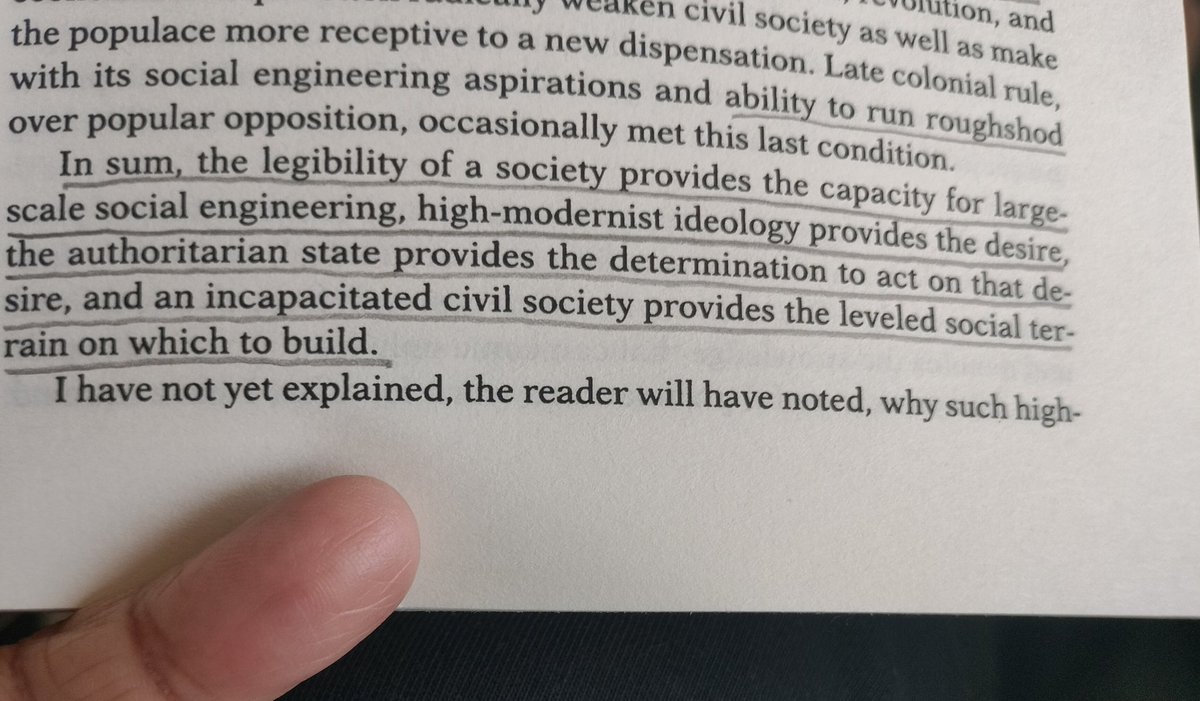
The genius of James C Scott: The problem with state legibility! Sharp insights.......crisp description! ~from 'Seeing like a State'.
Ashok Kumar Pathak tweet media
English
0
1
3
79
Ashok Kumar Pathak retweetledi
Rob Henderson
Rob Henderson@robkhenderson·
"young people have fallen out of love with liberalism...Liberalism is not the human default...sustained only in a society that is peaceful, affluent and high-trust all at once—a rare combination in our species’ history." nytimes.com/2026/01/26/opi…
English
6
30
310
13.1K
Ashok Kumar Pathak retweetledi
Gautam Menon
Gautam Menon@MenonBioPhysics·
"When the economy is growing, but the growth comes from the sale of nebulisers, air purifiers, and chemotherapies and surgeries, then we’re heading in the wrong direction" theprint.in/theprint-essen…
English
79
938
4.1K
90.7K
Ashok Kumar Pathak
Ashok Kumar Pathak@ashokpathak1604·
Currently, this book (Beginning of Infinity) is my bed time companion. Every night 5-10 pages.....and it is more than enough to digest mentally!
Anders K.@Falliblemusings

I used to think Sapiens was a great book. Sweeping, provocative, the kind of book that makes you feel like you finally understand the big picture of human history. It's on every CEO's bookshelf, assigned in universities, praised as a masterwork of synthesis. Yuval Noah Harari is treated as one of the serious thinkers of our time. But something nagged at me. Some passages felt off. Claims that human rights are just figments of our collective imagination, not real things, just stories we tell ourselves. That nations, laws, money, justice, doesn't exist outside our heads. That meaning itself is a delusion we've invented to cope. That we're far more powerful than ever before but not happier. That hunter-gatherers had it better because they had no dishes to wash, no carpets to vacuum, no nappies to change, no bills to pay. That sounded depressing to me, but was perhaps just the realistic scientific worldview? What it meant to see the world clearly, without comforting illusions. Then I read The Beginning of Infinity by @DavidDeutschOxf. Deutsch has a concept he calls 'bad philosophy.' Not philosophy that's merely false, but philosophy that actively prevents the growth of knowledge. Ideas that close doors rather than open them. That makes problems seem unsolvable by design. After soaking in Deutsch's framework (it's dense, a bit like digesting a delicious whale), it becomes clear: Harari's books are riddled with bad philosophy. They're smuggling nihilism in under the guise of scientific objectivity. Some examples: On meaning: "Human life has absolutely no meaning. Humans are the outcome of blind evolutionary processes that operate without goal or purpose... any meaning that people inscribe to their lives is just a delusion." On human rights: "There are no gods in the universe, no nations, no money, no human rights, no laws, and no justice outside the common imagination of human beings." On free will: "Humans are now hackable animals. The idea that humans have this soul or spirit and they have free will, that's over." On progress: "We thought we were saving time; instead we revved up the treadmill of life to ten times its former speed." The Agricultural Revolution? "History's biggest fraud." We didn't domesticate wheat, "it domesticated us." On our cosmic significance: "If planet Earth were to blow up tomorrow morning, the universe would probably keep going about its business as usual. Human subjectivity would not be missed." On the future: "Those who fail in the struggle against irrelevance would constitute a new 'useless class.'" Homo sapiens will likely "disappear in a century or two." This is bad philosophy. It tells us our problems are cosmically insignificant, our solutions are illusions, and that progress is neither desirable nor within our control. It's also perfect nonsense. No one would ever go back to being hunter-gatherers. Would you rather worry about your kid spending too much time on Roblox, or face the 50% chance she won't reach puberty? And our so-called "fictions"? They ended slavery. They gave women equal rights. They solved hunger. They eradicated smallpox. They turned sand into computer chips. They got us to the moon, and hopefully soon, to Mars and beyond. These "fictions" are already reshaping the universe, and over time they may become the most potent force in it. Now compare Deutsch: "Humans, people and knowledge are not only objectively significant: they are by far the most significant phenomena in nature." "Feeling insignificant because the universe is large has exactly the same logic as feeling inadequate for not being a cow." "Problems are soluble, and each particular evil is a problem that can be solved." "We are only just scratching the surface, and shall never be doing anything else. If unlimited progress really is going to happen, not only are we now at almost the very beginning of it, we always shall be." Where Harari sees a species of deluded apes stumbling toward obsolescence, Deutsch sees universal explainers, the only entities we know of capable of creating explanatory knowledge, solving problems, and potentially seeding the universe with intelligence. The difference isn't academic. Ideas shape action. If you believe life is meaningless, progress is a trap, and humans are hackable animals with no free will, how does that affect what you build? What you fight for? What you teach your children? Harari's books sell because they flatter a fashionable pessimism. They let readers feel sophisticated for seeing through the "delusions" everyone else lives by. That smug cynicism is corrosive. And it's everywhere: in schools, in media, in bestselling books. More than half of young adults now say they feel little to no purpose or meaning in life. This is what happens when you teach an entire generation bad philosophy. Less progress, less health, less wealth. Less flourishing. And ultimately, a higher chance that civilization and consciousness go extinct. Fortunately, there's another equally well-written, but much truer, account of homo sapiens, appropriately titled 'The Beginning of Infinity'. And this one smuggles no despair in by the backdoor. But let's give Harari credit where it's due. He is right about one thing: if planet Earth blew up tomorrow, we wouldn't be missed. Because there'd be no one left to miss us, just a careless universe, blindly obeying physical laws. We are the only ones who can miss, but we're not going to. We're going to aim, hit, and keep going. Full credit for the amazing meme to @Ben__Jeff

English
0
0
4
96