
Adam Morgan

4.5K posts

Adam Morgan banner
Adam Morgan

Adam Morgan

@aymorgan

Senior Product Designer at @Careem - previously worked at @WeAreInsightful @TheVeryGroup @Laterooms @Parcel2Go

Dubai, United Arab Emirates Katılım Ağustos 2010
5.5K Takip Edilen2.1K Takipçiler
Adam Morgan
Adam Morgan@aymorgan·
@hexednobility @ryancarson Was just thinking the same thing. Surely markdown is more efficient from prompt/input/token perspective. Plus you can define how you want your markdown displayed in a webpage via CSS. HTML is great for displaying content but aren’t you passing html tag “noise”.
English
0
0
0
24
zakk
zakk@hexednobility·
@ryancarson Depends on what they are for, I’ve landed on an approach of If human clarity more important - HTML If agent clarity more important - markdown The “markup” part of HTML is far more verbose than md for LLM consumption
English
7
0
31
2.1K
Adam Morgan
Adam Morgan@aymorgan·
@shiri_shh …and I’m over here trying to hit my usage limit. 🤖
GIF
English
0
0
1
128
shirish
shirish@shiri_shh·
The Anthropic team is dogfooding Claude Code at insane levels. In the last 52 days, the Claude team dropped 50+ major UPDATES. One employee alone hit $150,000 in a single month on Claude Code 80% of employees use it daily, with power users racking up six-figure bills.
shirish tweet media
Claude@claudeai

Your work tools in Claude are now available on mobile. Explore Figma designs, create Canva slides, check Amplitude dashboards, all from your phone. Give it a try: claude.com/download

English
92
52
939
431.9K
Ryan Carson
Ryan Carson@ryancarson·
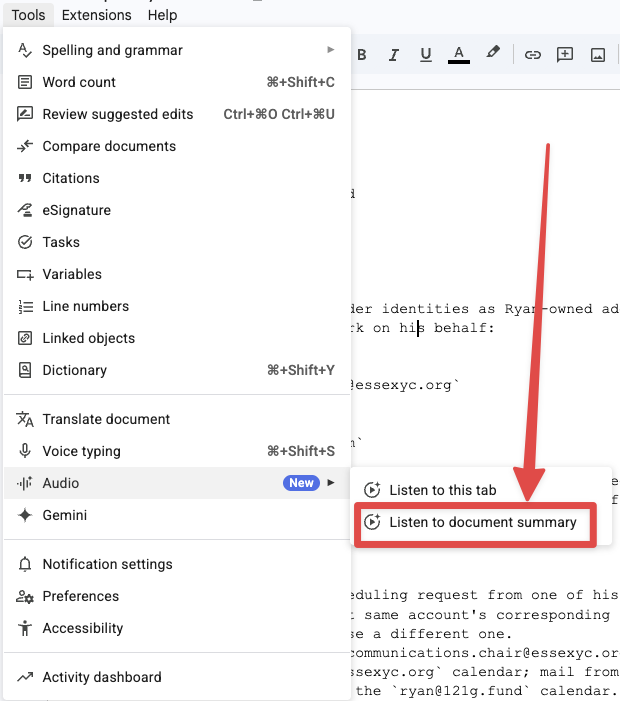
This is so good. Well done Gemini + Google Docs team. I'm much better at listening than reading, so I love this feature.
Ryan Carson tweet media
English
17
4
94
6.4K
Adam Morgan retweetledi
Ole Lehmann
Ole Lehmann@itsolelehmann·
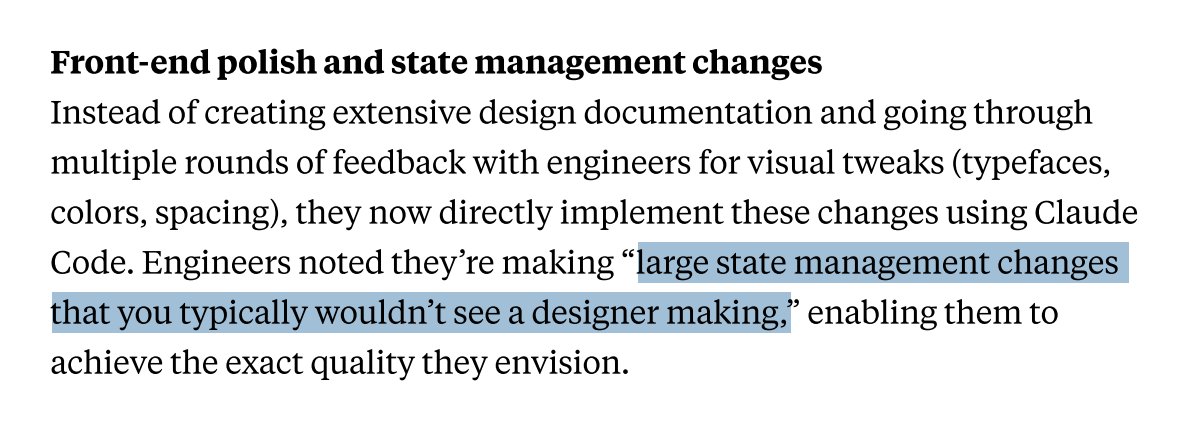
what's happening inside Anthropic right now is genuinely fascinating: DESIGNERS are now shipping production code with no engineer in the loop at all these are non-technical people with zero coding background. engineers on the team said designers are making "large state management changes you typically wouldn't see a designer making" think about what that means for a second. at every tech company in the world, designers and engineers are two separate roles. designers make mockups, engineers write code. that's been the deal for decades. at anthropic, that line is completely disappearing now. here's what their designers actually do now: it starts with a screenshot. 1) a designer takes their figma mockup and pastes the image directly into claude code. 2) claude looks at the image and generates a fully functional prototype from it. working code that engineers can immediately build on. this alone replaced the entire traditional cycle of: make static design → write spec → hand to engineer → wait → review → give feedback → wait again → repeat. but that's just prototyping. from there, designers implement front-end changes themselves. typefaces, colors, spacing, layout, etc directly in the codebase. no ticket filed, no engineer pulled in. and it goes further than visual polish. designers are now making state management changes (the code that controls how data moves through the app, even junior engineers find this tricky) and for their ongoing backlog of polish and bug fixes, they don't even open claude code. they just file a github issue (basically task description) describing what they want changed… and claude automatically proposes a code solution. then the designer reviews it and ships it. so there's a persistent stream of improvements flowing into production without pulling a single engineer off their work. they also use claude code to map out edge cases during the design phase. the stuff that used to only get discovered later when engineers actually built the thing. so now the designs are better AND they ship faster because the edge cases are already handled before engineering starts. one detail i love: they set up a custom memory file that tells claude: "you're working with a designer who has little coding experience. give detailed explanations. make smaller, incremental changes." claude adapted its entire approach based on that one file. here are some cool numbers, straight from the product design team: • claude code is now open alongside figma 80% of the time • 2-3x faster execution across the board. the designers' reaction when it all clicked: "holy crap, I'm a developer workflow" the boundaries between roles are dissolving. quietly. i think what's happening internally at anthropic is 2-3 years ahead of what will happen to the rest of the world
Ole Lehmann tweet media
English
35
16
145
26.3K
Rob Hallam
Rob Hallam@robj3d3·
This 18 year old literally has 12 $200 Codex plans. Here's exactly how he organizes them to build 100x faster: (we're cooked)
English
194
50
1.1K
590K
Adam Morgan retweetledi
Lenny Rachitsky
Lenny Rachitsky@lennysan·
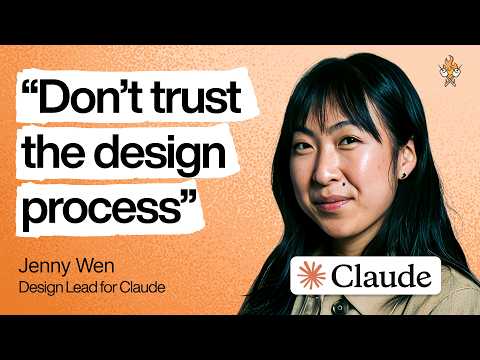
Design lead for Claude: The classic design process is dead. Here's what's replacing it. Jenny Wen (@jenny_wen) leads design for Claude at @AnthropicAI, was previously director of design at @Figma, and a designer at @Dropbox, @Square, and @Shopify. In our in-depth conversation, we discuss: 🔸 Why the classic discovery → mock → iterate design process is becoming obsolete 🔸 What a day in the life of a designer at Anthropic looks like, including her AI tool stack 🔸 Whether AI will eventually surpass humans in taste and judgment 🔸 Why Jenny left a director role at Figma to return to IC work 🔸 The three archetypes Jenny is hiring for now This conversation changed how I think about the future of design. Listen now 👇 youtu.be/eh8bcBIAAFo
YouTube video
YouTube
English
88
304
3.1K
1.5M
Adam Morgan retweetledi
Noah Zweben
Noah Zweben@noahzweben·
Announcing a new Claude Code feature: Remote Control. It's rolling out now to Max users in research preview. Try it with /remote-control Start local sessions from the terminal, then continue them from your phone. Take a walk, see the sun, walk your dog without losing your flow.
English
1.5K
1.3K
16.9K
4.5M
Adam Morgan retweetledi
Thariq
Thariq@trq212·
Figma just shipped the ability to bring UI work done in Claude Code straight into Figma as editable design frames. Use this to explore new ideas in Figma, view multi-page flows on the canvas, or reimagine user experiences.
English
152
270
3.5K
1.3M
Adam Morgan
Adam Morgan@aymorgan·
@euboid Congrats dude, been following along since the launched - great to see your progress. 🚀
English
0
0
0
112
Wilson Wilson
Wilson Wilson@euboid·
We just hit $3K MRR for ferndesk.com 🥳 -- 3 months get to $1K -- 2.5 months get to $2K -- 19 days to get to $3K The things that got us to $2K are the exact same things that got us to $3K. Same tempo, same playbook, same boring daily reps. The only thing that's changed is compounding is finally starting to kick in. The journey to $5K continues 🏇
Wilson Wilson tweet media
English
77
7
363
16.4K
Adam Morgan retweetledi
Claude
Claude@claudeai·
Introducing Claude Opus 4.6. Our smartest model got an upgrade. Opus 4.6 plans more carefully, sustains agentic tasks for longer, operates reliably in massive codebases, and catches its own mistakes. It’s also our first Opus-class model with 1M token context in beta.
English
1.7K
4.7K
39.3K
10.6M
Jeffrey Wang
Jeffrey Wang@jeffzwang·
I need Linear but where every task is automatically an AI agent session that at least takes a first stab at the task. Basically a todo list that tries to do itself
English
126
9
712
142.7K
Adam Morgan
Adam Morgan@aymorgan·
@Shpigford Nice 👍🏻 love the logo Any tips for defining a style that AI reuses instead of that awful multicoloured default UI. I built couple “design system” pages with details of foundation styles, core components and pattern and include that in the prompt - setup too a bit of time tho.
English
0
0
0
105
Josh Pigford
Josh Pigford@Shpigford·
the presscut landing page is coming together!
Josh Pigford tweet media
English
4
0
19
2.2K
Adam Morgan retweetledi
Marc Hemeon
Marc Hemeon@hemeon·
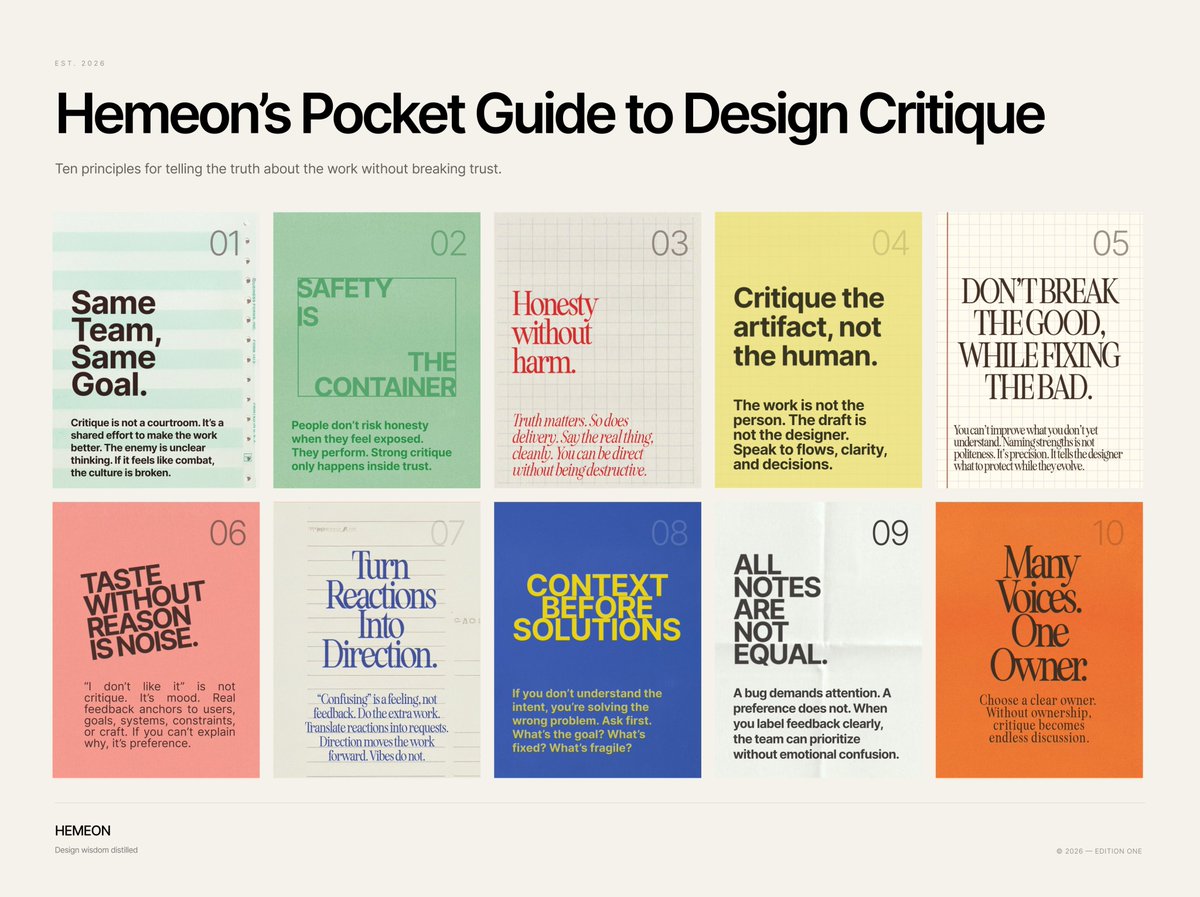
I'm back with a new pocket guide - 10 principles for better design critique. I've sat in hundreds of design crits over 30+ years as a designer. These are tried and true. Hemeon’s Pocket Guide to Design Critique 01 / Same Team, Same Goal Critique is not a courtroom. It’s a shared effort to make the work better. The enemy is unclear thinking, weak craft, and lazy solutions. If it feels like combat, the culture is broken. 02 / Safety Is the Container People don’t risk honesty when they feel exposed. They perform. They defend. They shrink. Strong critique only happens inside trust. Tend the room before you touch the work. 03 / Honesty Without Harm Truth matters. So does delivery. Say the real thing, cleanly. You can be direct without being destructive. If people leave wounded instead of clearer, the moment failed. 04 / Critique the Artifact, Not the Human The work is not the person. The draft is not the designer. Speak to flows, clarity, and decisions. The moment feedback touches identity, growth stops. 05 / Don’t Break the Good, While Fixing the Bad. You can’t improve what you don’t yet understand. Naming strengths is not politeness. It’s precision. It tells the designer what to protect while they evolve. 06 / Taste Without Reason Is Noise “I don’t like it” is not critique. It’s mood. Real feedback anchors to users, goals, systems, constraints, or craft. If you can’t explain why, it’s preference. 07 / Turn Reactions Into Direction “Confusing” is a feeling, not feedback. Do the extra work. Translate reactions into requests. Direction moves the work forward. Vibes do not. 08 / Context Comes Before Solutions If you don’t understand the intent, you’re solving the wrong problem. Ask first. What’s the goal? What’s fixed? What’s fragile? Critique without context is theater. 09 / All Notes Are not Equal. A bug demands attention. A preference does not. When you label feedback clearly, the team can prioritize without emotional confusion. 10 / Many Voices, One Owner Choose a clear owner. 
Without ownership, critique becomes endless discussion. Thank you for reading. Drop a comment on the best tips you have for running a design crit. Would love to hear your ideas!
Marc Hemeon tweet media
English
12
100
859
53K
Adam Morgan
Adam Morgan@aymorgan·
@Shpigford Haha! I say the same thing to my wife… then suddenly it’s 2am! 🤦🏼‍♂️ Feel like I could keep going but waking up for gym/work is starting to get pretty painful. 😴🫩
GIF
English
0
0
1
23
Josh Pigford
Josh Pigford@Shpigford·
just one more prompt, honey, then i'll come to bed
English
21
5
113
12.5K
Dan Shipper 📧
Dan Shipper 📧@danshipper·
dropping something heavy tomorrow
Dan Shipper 📧 tweet media
English
35
18
427
20.8K
Adam Morgan retweetledi
Drew Breunig
Drew Breunig@dbreunig·
Claude: "I've defined phase one of your project to be completed during weeks 1-4 and updated the spec." Me: "Implement phase one now." *5 minutes pass* Claude: "Phase 1 is complete."
English
177
159
4.2K
489.1K
Adam Morgan
Adam Morgan@aymorgan·
@danshipper @kieranklaassen @every Noooo! 🤦🏼‍♂️ Forgot about this and I was meant to subscribe. Was it recorded Dan and are these live sessions available to watch for paid subscribers?
English
0
0
0
15
Adam Morgan retweetledi
Naval
Naval@naval·
Good Products are Opinionated. “Every great founder I’ve seen up close, or even from afar, is highly opinionated and they’re almost dictatorial in how they run things. Also, early-stage teams are opinionated. And the products they build are opinionated. Opinionated means they have a strong vision for what it should and should not do. If you don’t have a strong vision of what it should and should not do, then you end up with a giant mess of competing features. @Jack Dorsey has a great phrase: “Limit the number of details and make every detail perfect.” And that’s especially important in consumer products. You have to be extremely opinionated. All the best products in consumer-land get there through simplicity. You could argue the recent success of ChatGPT and similar AI chatbots is because they’re even simpler than Google. Google looked like the simplest product you could possibly build. It was just a box. But even that box had limitations in what you could do. You were trained not to talk to it conversationally. You would enter keywords and you had to be careful with those keywords. You couldn’t just ask a question outright and get a sensible answer. It wouldn’t do proper synonym matching, and then it would spit you back a whole bunch of results. That was complicated. You’d have to sift through and figure out which ones were ads, which ones were real, were they sorted correctly, and then you’d have to click through and read it. ChatGPT and the chatbot simplified that even further. You just talk to it like a human—use your voice or you type and it gives you back a straight answer. It might not always be right, but it’s good enough, and it gives you back a straight answer in text or voice or images or whatever you prefer. So it simplifies what we looked at as the simplest product on the Internet, which was formerly Google, and makes it even simpler. And you just cannot make a product that’s simple enough. To be simple, you have to be extremely opinionated. You have to remove everything that doesn’t match your opinion of what the product should be doing. You have to meticulously remove every single click, every single extra button, every single setting. In fact, things in the settings menu are an indication that you’ve abdicated your responsibility to the user. Choices for the user are an abdication of your responsibility. Maybe for legal or important reasons, you can have a few of these, but you should struggle and resist against every single choice the user has to make. In the age of TikTok and ChatGPT, that’s more obvious than ever. People don’t want to make choices. They don’t want the cognitive load. They want you to figure out what the right defaults are and what they should be doing and looking at, and they want you to present it to them.”
English
204
1.1K
8.1K
466K
Naveen Naidu
Naveen Naidu@naveennaidu_m·
Six months ago, a user wrote about Monologue after 2 days. Today he published a follow-up: → 156,818 words dictated → 17+ hours of typing saved → Uses it daily for coding → "This is just how I work now" Building software that changes how people work. This is why I do it. zettel.org/monologue-revi…
English
12
5
46
4.4K
Adam Morgan retweetledi
Arvid Kahl
Arvid Kahl@arvidkahl·
I don’t get it. Otherwise smart people proclaim the end of SaaS because AI takes over the software part. Software-as-a-Service was never about the software and always about the service. AI changes nothing about the business reasons to buy instead of build. And yes, you can built much faster with AI assistance. But professional software never had an implementation problem. People figure these things out every day. The hard part is the spec, the requirements, understanding what this will cost to run and maintain, not just to build. That’s what the -as-a-service part does. It outsources the headache of everything but the cost to build.
English
145
52
678
71.4K