

Batster
2K posts
Batster
@batster41
founder of @duelmastersgg, @smile_mem; building gaming platform Duelmasters - make bets on streamers in your favorite games; link below
Katılım Mart 2016
2.6K Takip Edilen2.1K Takipçiler
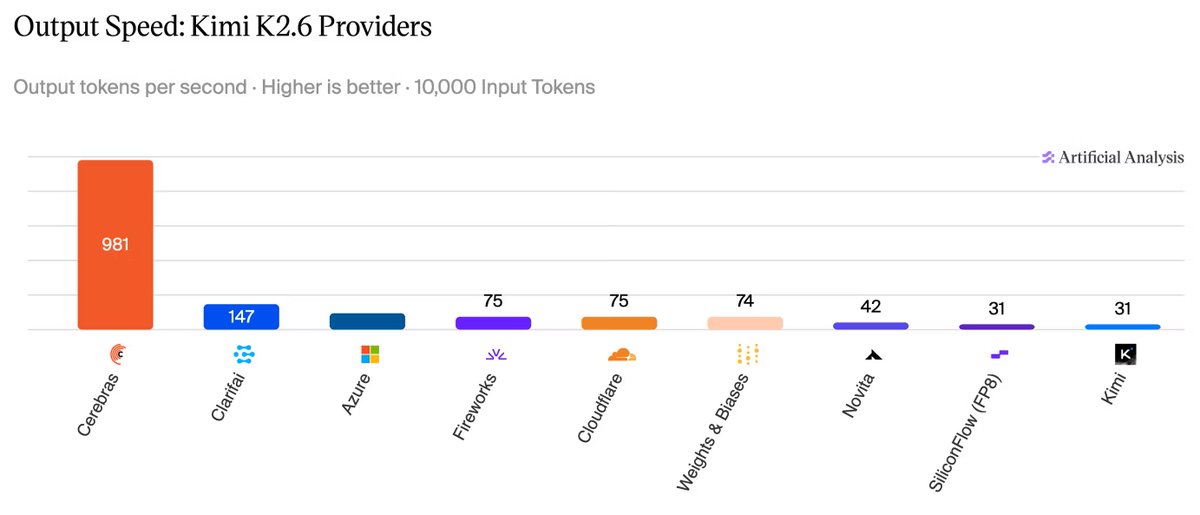
Cerebras is now running Kimi K2.6 – a trillion parameter model – in enterprise trials.
At ~1,000 tokens/s, this is the fastest frontier model performance ever measured by Artificial Analysis @ArtificialAnlys.
English
+ morale for current subnet holders and future buyers. There should be a precedent showing that holders have a basic level of safety and freedom of choice if a subnet owner decides to exit, instead of everyone simply being forced to absorb the losses. In the long run, this would positively impact the valuation and trust in every subnet.
English
Also, it’s important to consider that SN3 is a mammoth. Reaching the natural point of deregistration will take a very long time, and a huge amount of value will be extracted during that process. Those TAO rewards will simply keep getting sold into the market, creating constant sell pressure and making life even harder for miners.
For example, Chutes is already struggling to support many models because, at current TAO prices, it’s simply not profitable enough for miners. They even have stricter than usual API limits because there isn’t enough hardware available — largely as a consequence of TAO price pressure.
These effects are much more far-reaching than they may seem at first glance.
English

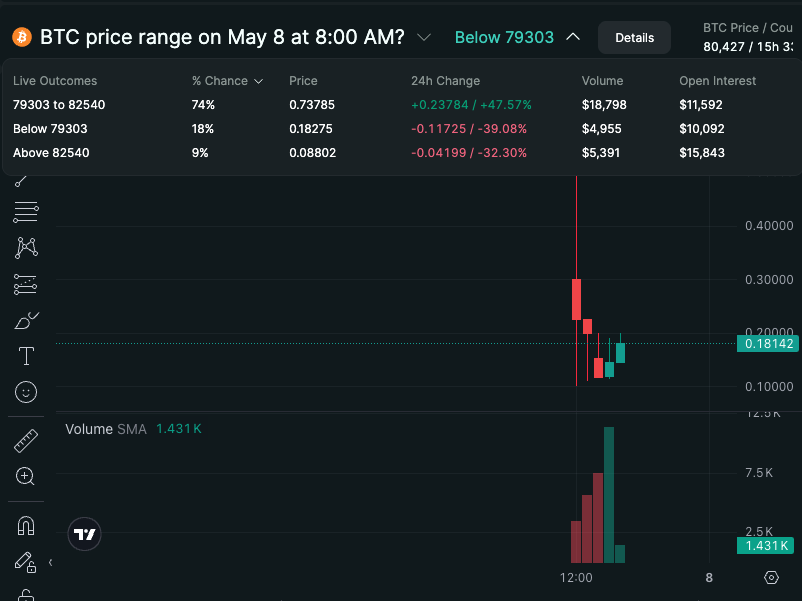
Hyperliquid adds range markets on BTC to their prediction market style frontend called Outcomes
It's a weird choice to only have 3 ranges, you want to have many more ranges at specific intervals, for example optimum is every $100 for BTC, this will massively increase volume on these markets
English

🚨 Someone built an AI that reads candlestick charts the way GPT reads English.
Trained on 12 billion records from 45 exchanges. Outperforms every model by 93%. Live BTC demo. Free.
It's called Kronos.
The first open source foundation model built for financial markets. Not a general AI repurposed for finance. An AI that speaks the native language of candlestick patterns.
Every other model treats financial data like weather data. Kronos treats financial data like financial data.
Here's what it does:
→ Price forecasting. Feed it candlesticks. It predicts where price goes next.
→ Volatility prediction. Forecasts how volatile an asset will be before it happens.
→ Zero-shot. No fine-tuning. Works on any asset, any market, any timeframe.
→ 45 exchanges. Binance, NYSE, NASDAQ, LSE, and 41 more.
→ 4 model sizes. 4M params runs on a laptop. 499M for max accuracy.
→ Live demo running right now. BTC/USDT. 24-hour forecast. Updated hourly.
Here's the wildest part:
→ 93% more accurate than the leading time series model
→ 87% more accurate than the best non-pretrained baseline
→ All zero-shot. No fine-tuning. Out of the box.
Hedge funds spend millions on proprietary models. Bloomberg Terminal costs $24,000/year.
This runs on your laptop. Few lines of Python. Free.
Built at Tsinghua University. Accepted at AAAI 2026. Models on Hugging Face.
11.6K GitHub stars. 2.4K forks. MIT License.
100% Open Source.
Get it here on GitHub: github.com/shiyu-coder/Kr…
🚨Want to learn Algorithmic Trading Strategies (that actually work)?
On May 14th, we are hosting a free workshop to help you get started with algorithmic trading with Python.
Register here (500 seats): learn.quantscience.io/join

English


Auto Top-Up is now in billing.
Head to: chutes.ai/app/api/billin…
Pick a floor and a refill amount, save a card, and your balance refills automatically.
People asked for it and we delivered.
Chutes.ai

English

i'm done. codex is fucking incredible
after heavily using claude code for over 13 months, i've moved to codex
opus 4.7 is painfully slow and takes 5-10 mins for a one-liner. the app is super buggy and flickers constantly. low thinking is useless. and they keep nerfing the model for some reason??
codex's new app is genuinely beautiful and gpt-5.5 thinking-medium is the perfect balance
ngl @sama you cooked on this one
English

JUST IN: Where would @Polymarket migrate from Polygon?
Polymarket’s new VP of Engineering says the platform is planning a chain migration as growth outpaces its infrastructure, citing the need for more blockspace, cheaper gas, and much smaller block times.

English
@DrocksAlex2 they need more revenue to afford more compute by paying miners. it would be wise to balance supply and demand by increasing prices until they find their sweet spot. if they have too much users and not enough compute then they definetely not in the position of balanced s/d
English

@batster41 i don't think demand is too big, it IS
only reason would be to do things in civilized ways for users. Unlike Anthropic who just ban ppl out of the blue or remove features randomly
English
@DrocksAlex2 if youthink demand is too big why they wont increase price? even last increase is tiny in comparison to industry average prices
English
$TAO is getting another headliner. More coming soon - the ecosystem is entering an exponential growth phase
ORO@oroagents
Introducing Oro, the biggest agent competition in the world. Powered by Bittensor, Live Now.
English

@Crypto_Goblinz who was that one DVN signer? layerzero itself
both failed
English

The KelpDAO exploit (~$290M, is NOT a LayerZero protocol bug. It's a configuration issue and a case study every project with a cross-chain token needs to look at today.
KelpDAO shipped their rsETH OFT with a 1/1 DVN security stack. One required verifier. Zero optional. Threshold 0. Straight from LayerZero Scan's ReceiverOAppConfig on the rsETH bridge pathway:
• requiredDVNCount: 1
• requiredDVNNames: [LayerZero Labs]
• optionalDVNCount: 0
• optionalDVNThreshold: 0
Source and Destination OApp both labeled "Kelp DAO." Destination is the rsETH OFT Adapter on Ethereum: 0x85d456B2DfF1fd8245387C0BfB64Dfb700e98Ef3.
How the attack worked: the forged message's source packet was never actually emitted on the source chain (Unichain). The single required DVN signed an attestation for something that didn't exist and because it was the ONLY required DVN, there was no independent verifier to contradict it. Everything downstream then executed exactly as designed: commitVerification → lzReceive → peer check → OFT decode → rsETH mint. The contracts weren't broken. The verification layer was. One signature and 116,500 rsETH materialized out of thin air on Ethereum.
To be clear: LayerZero V2 is modular by design. Apps pick their own security stack X-of-Y-of-N, multiple independent DVNs, thresholds, block confirmations. No one is forced into any configuration. The protocol gave projects the full toolkit. KelpDAO chose 1/1.
Even reputable DVNs can have a bad day key compromise, infra failure, bad actor, whatever. That's exactly why you want multiple independent verifiers. Redundancy is the whole point. A 1/1 DVN is the cross-chain equivalent of a 1-of-1 multisig on a treasury.
Baseline for any OFT/OApp with serious TVL:
• Multiple required DVNs (3–4+)
• Independent providers (don't stack correlated risk) use canary DVN as it’s also its own independent client.
• Optional DVNs + threshold on top
• Sane block confirmations
If you're a founder or dev with an OFT live in production, pull your Send/Receive ULN config today. Call getConfig() on the endpoint. If requiredDVNCount is 1 and optionalDVNCount is 0, reconfigure before the market does it for you.
Anyone can verify any OApp's config on layerzeroscan.com right now.
Security is the application's responsibility. LayerZero hands every project a powerful, modular security stack it's on the project to actually use it. Kelp's full RCA is still coming, but the root enabler is already onchain and visible to anyone who looks.
Check your configs. Stay safe out there.


English
@RenzoAI @movement_xyz @hyperlane when will i be able to bridge ezeth from line to eth and unstake it?
English

Renzo only has one bridge route that uses LayerZero OFT, which connects ezETH to @movement_xyz.
We have disabled bridge functionality on Movement to reduce risks as the rsETH exploit evolves. We are actively working with @hyperlane to ensure all other routes remain secure.
English
The new Bittensor proposal is retarded
Owners already only get 18%, forcing them to lock tokens to not be fucked due to governance because we had one ‘bad actor’ is retardio at best
Owners should get more, why otherwise would talented people build on top of bittensor when they can get much more elsewhere without handcuffs?
@const_reborn lets organise a twitter spaces where i will proof you doubters wrong
English

Just spoke to a DePIN project whose token has been completely beaten down by market conditions, now trading at a single digit FDV.
Meanwhile, they’re sitting on an incredibly valuable dataset, with interest from all leading AI labs and a commercial revenue pipeline of $40M+, which is like 10x their entire FDV.
They’re committed to bringing the majority of that value back to the token via buybacks.
There are generational liquid opportunities out there for those actually paying attention.
This bear market is a blessing.
English

Exploits are what teach a system its weak spots.
The quicker you find them the faster you learn.
The outcome of this eventful evening is that Bittensor will invent lock-based subnet ownership -- specifically: ownership of a subnet determined by a team's long term economic commitment to the project.
This will mean: 1) investors see long in advance if an owner has unlocked their tokens, 2) be able to reprice the subnet before the owner and 3) liquidly direct their own conviction to another team, or agent, to manage the system.
Thank you @DistStateAndMe for helping further Bittensor's decentralization and develop a solution to one of cryptos oldest problems: founders who rug their token holders.
Looking forward to training some 1T param models with the miners who are experts in this unique field.
"What is dead can never die"
English