Ben Far

1.9K posts

Ben Far

Ben Far

@ben0far

Co-Founder https://t.co/Q5QW36hduV

Katılım Mayıs 2011
4.5K Takip Edilen1.6K Takipçiler
Ben Far
Ben Far@ben0far·
@RyanSAdams Lol this was obvious the moment L2s became a thing
English
0
0
1
70
RYAN SΞAN ADAMS - rsa.eth 🦄
In early 2024 it was becoming obvious Ethereum L2 roadmap had a fatal flaw. No shared liquidity. Each L2 was a separate nation - with its own borders and economics - rather than the United Chains of Ethereum we'd envisioned in 2021 and 2022. To be blunt: the L2 roadmap was a bit of a let down. At DevCon 18 months ago many hoped for an "Ethereum 3.0" plan that would unify our rollups. Instead, we got Justin Drake's 5 year long early Lean Ethereum journey. (Which has since solidified into a brilliant execution plan to scale & strengthen Ethereum, but at the time was received with disappointment.) We wanted a plan to unite the chains. @koeppelmann's presented an early form of that plan - he called them Native Rollups. These would be rollups that share liquidity, composability, and validators with Ethereum's L1. Rather than L2s as a loose alliance of chains that opt-in to shared security (the NATO model) we'd get a strongly coordinated yet federated economic union of chains (the U.S. model). No hard forks required. I hadn't seen much movement on this vision until now. But @etheconomiczone appears to be a serious attempt at a United Chains of Ethereum. ZK is the tech unlock and we get the zk genius of @jbaylina leading this. The engineering ability of @gnosis_ gives credibility this will ship. And the support of @ethereum foundation makes me optimistic this will remain open and credibly neutral. If Ethereum pulls this off - if it unites its chains into an integrated economic zone - while shipping quantum upgrades and L1 scaling of Lean Ethereum in parallel... Ethereum will gain an unstoppable network effect. It will finally deliver on its core promise Ethereum = world ledger. ETH = world reserve asset.
Sebastian Bürgel@SCBuergel

The "Ethereum 3.0 vision" is what @RyanSAdams called it That vision is now a mission and it's called "Ethereum Economic Zones" Incredibly proud to be team Gnosis ☺️

English
30
48
410
76.1K
Ben Far
Ben Far@ben0far·
Prediction markets make more unlikely things likelier
English
1
0
0
47
sam.
sam.@samthekorean·
i’m looking for ambitious founders across asia (SEA included) to come and work at our zerobase hq located in seoul for 1 month. -4 weeks of building -1 demo day -get funded up to $250k -referred to a16z speedrun -unlimited kbbq & soju flights included. comment if you’re interested in coming to seoul!
sam. tweet mediasam. tweet mediasam. tweet media
English
293
23
586
74.9K
Ben Far
Ben Far@ben0far·
@BullTheoryio Haven’t thought it through too deeply, but my initial reaction is that this should mean more demand for cyber companies, not less. Companies need to spend more to ensure they’re secure.
English
1
0
0
101
Bull Theory
Bull Theory@BullTheoryio·
BREAKING: Anthropic accidentally leaked its next AI model and it just wiped out $14.5 billion from cybersecurity stocks in a single day. Claude Mythos was accidentally stored in a publicly accessible data cache and discovered before Anthropic could announce it. The model showed dramatically higher scores on cybersecurity tests, meaning AI can now detect and respond to threats at a level that traditionally required entire teams of security professionals and expensive enterprise software. Investors immediately started pricing in the question nobody in the industry wants to answer: if an AI model can do this, why does anyone need CrowdStrike? And the market answered immediately: - CrowdStrike is down 5.85%, wiping out $5.5 billion. - Palo Alto Networks is down 6.43%, wiping out $7.5 billion. - Zscaler is down 5.89%, wiping out $1.35 billion. - Tenable is down 9.70%, wiping out $185 million
Bull Theory tweet media
English
340
950
5.5K
1.5M
Aaron Levie
Aaron Levie@levie·
We dramatically underestimate how much change management it is going to take to automate most knowledge worker tasks. Between data being in legacy environments or systems or without good APIs, context missing for doing the task, teams that are less technical, and other factors, there’s still a lot of work to drive real AI transformation in an enterprise. This is actually great news if you’re building right now because the opportunity is to build the software bridges to make this easier, or to build new services firms to help with this change management. Opportunity is all around for those looking.
Jason Shuman@JasonrShuman

Silicon Valley thinks AI agents are a $20/mo self-serve subscription. Main Street is paying local agencies $10,000 just to turn them on. Everyone assumes AI will be bought primarily online like Slack or Zoom. I think they are wrong. Some of the biggest winners in the AI boom won't be the software vendors. It will be the humans installing it. Here is the reality of SMBs right now: • 54% lack internal AI expertise. • 41% have data quality too poor for AI to even work. • 41% already prefer buying AI through a local IT provider. You cannot "1-click install" a genius AI into a messy CRM or a 15-year-old server. It will just execute the wrong tasks at the speed of light. The AI software will be cheap and a lot will absolutely be bought online. Making it actually work for a messy, real-world business will be expensive. Very bullish on the "Do It For Me" economy being back.

English
121
122
1.2K
265.3K
JFMorro
JFMorro@AlpenglowAgents·
@vchennai2 See the way our agents memory works is we save everything in a giant flat file system them we train 3 other agents ato search through that memory to find what we need and remind the original agent what he is supposed to remember…lololol😂
English
1
0
2
396
Ben Far
Ben Far@ben0far·
@shiftj Third parties can still request this from their vendors if they want > But real diligence is still better than outsourced reassurance. Classic approach: > security teams did their own due diligence > they were responsible for the outcome > sellers had to pass those checks
English
0
0
0
9
JC
JC@shiftj·
6/ What’s actually better? There’s no perfect alternative. But real diligence is still better than outsourced reassurance. Classic approach: > security teams did their own due diligence > they were responsible for the outcome > sellers had to pass those checks That model is slower. It’s more expensive. But it forces people to actually evaluate security. SOC 2 won because it scales better, not because it proves more. 👇 Which raises the real question: do you even need it?
English
3
0
8
3.1K
JC
JC@shiftj·
Unpopular Opinion: SOC 2 is a scam. It's not just Delve. The entire system is flawed. 👇 1/ Why are CPAs auditing your security?
English
31
9
297
50.1K
Ben Far
Ben Far@ben0far·
You misunderstand what a SOC2 is designed to do. A SOC2 doesn’t mean the company is secure. It means that, to a reasonable level of assurance, the description of the system is accurate and the control objectives as stated in the report are met. The point of the report is to give assurance to third parties on the system of control, not on the applications/databases themselves. That would require a different kind of opinion.
English
0
0
0
5
Ben Far
Ben Far@ben0far·
Building on this, I think there will be both structured and fuzzy APIs. Structured APIs for transactions, like booking the hotel. Fuzzy APIs for agent-to-agent queries, like finding out the conditions under which a booking is refundable. You don't want your agent reading 20m tokens of internal company policy. It just needs an endpoint where it can ask the company's agent which already has the context.
English
0
0
0
23
andrew chen
andrew chen@andrewchen·
Web 1.0 came with new channels: - email, search, link sharing, etc Web 2.0 too: - feeds, creators, viral invites, etc Mobile: - app stores, SMS invites, vertical vid, mobile ads What about AI? I’ve been complaining that AI hasn’t come with much. But we’re seeing a big growth channel opening now: Products that are built as APIs/CLIs that can be pulled into new projects by Codex/Claude on the fly Maybe the “AI-native hotel app” doesn’t mean a mobile booking app with an AI chat panel. It means a CLI that can book a hotel for you, that an AI agent can pull into a bespoke answer or project or into code. Bolting on an AI chat panel is this generation’s weak form of AI. Maybe the full reinvention involves making it agent-first not human-first and once you start looking at it that way, a lot of existing products suddenly feel mis-specified. they’re built as destinations, but agents don’t want destinations. they want capabilities. composable, callable, reliable capabilities. So instead of “go to Expedia” or “open the app,” the future interaction is more like: an agent assembles a workflow on the fly. it pulls a flight search tool, a hotel booking tool, maybe a weather model, maybe even your personal preference graph. none of these are full products in the traditional sense. they’re more like endpoints with taste and state. This flips distribution completely. historically you win by owning the surface area. seo, app store ranking, homepage traffic. in an agent world, you win by being the default callable primitive. the thing that shows up again and again in agent-generated plans because it works, has clean interfaces, and returns structured outputs. distribution shifts from “top of funnel” to “top of call stack.” And the crazy part is this might actually compress product surface area dramatically. the best products might look more like tight, extremely well-designed CLIs with opinionated defaults rather than sprawling UIs. almost like the stripe api moment, but for everything. imagine if every vertical had a “stripe-level” primitive that agents preferentially use. there’s also a weird inversion of brand here. humans used to choose brands. now agents will. so the brand becomes partially machine-legible. reliability, latency, error rates, schema clarity. you can almost imagine “agent seo” where the ranking factors are things like success rate across thousands of agent runs, or how easy your tool is to integrate in a chain-of-thought execution loop. This also suggests a new kind of moat. not just data or network effects, but integration depth with agent ecosystems. if claude or codex or openclaw learns that your tool is the safest way to accomplish X, it gets baked into prompts, templates, maybe even fine-tunes. you become a default. and defaults, historically, are insanely sticky. The contrarian take is that most current “AI features” are a local maximum. chat panels, copilots, assistants. they’re transitional. the real end state might look closer to invisible infrastructure that agents orchestrate. the ui is just a debug layer for humans to peek into what the agents are doing. so maybe the new growth channels for ai look like: - being callable - being composable - being reliable at scale in agent loops - being embedded in agent templates and workflows - being the default primitive in a given domain and if that’s right, then the question for any new product isn’t “what’s the ui” or even “what’s the killer feature.” it’s “what’s the minimal, highest-leverage capability we can expose such that agents will repeatedly choose us when building something new.”
English
130
87
821
209.5K
Ben Far
Ben Far@ben0far·
It took 8 years from my feb 2018 article to now, to define what cryptoassets are.
Ben Far tweet media
RYAN SΞAN ADAMS - rsa.eth 🦄@RyanSAdams

THEY DID IT. The SEC and CFTC just dropped a landmark document that officially classifies crypto assets. They're actually telling us which crypto assets are securities and which ones aren't - by name! THIS IS SOMETHING GENSLER REFUSED TO DO (he focused on prosecuting crypto out of existence) This rule doc gives crypto many of the benefits of the clarity bill - it lifts us out of the gray market - it gives every asset a path. It's almost like the Clarity act just passed by way of regulator. (of course, the actual clarity act will harden all this into legislation and make it irreversible in the event we get another Gensler, we still want it) This rule says there's 5 categories for crypto assets: 1) Digital Commodities - assets tied to a functional, decentralized crypto system (e.g., BTC, ETH, SOL, XRP, ADA, DOGE). Not securities. (yes, they name them on page 14) 2) Digital Collectibles - NFTs, meme coins, artwork tokens, in-game items. Not securities (fractionalized collectibles may be an exception). 3) Digital Tools - membership tokens, credentials, domain names (e.g., ENS). Not securities. 4) Stablecoins - payment stablecoins under the GENIUS Act are not securities. Other stablecoins, it depends. 5) Digital Securities - tokenized versions of traditional securities. Like tokenized stocks. Always securities. Amazing! This makes so much sense I can't believe it's coming from a regulator. No more enforcement threats to Ethereum developers and crypto exchanges. How about the Howey test? More common sense! If an issuer makes specific promises of managerial efforts from which buyers expect profits, the offering is a security until those promises are fulfilled. Then it's a commodity. The asset itself was never the security, the deal around it was. (E.g. XRP was a security pre launch, became a commodity after). How about stuff like staking and mining? Mining? Not a securities transaction. Staking? Also not a securities transaction, that includes custodial and liquid staking even with LSTs! How about wrapping BTC? Not a securities transaction. Airdrops? NOT SECURITIES. NO MORE GEO BANS PROTECTING AMERICANS from free airdrops. Remember this is a joint doc from the SEC and CFTC, They're actually cooperating on this, no internal strife, this is binding to both. SEC regulates $80-100 trillion assets CFTC regulates $5-10 trillion assets Both of the world's largest capital markets are showing us that crypto assets are here to stay and they're welcome alongside traditional assets. Every country will follow. This is the biggest move toward legitimacy I've seen in all my time in crypto. Maybe bigger than the genius act since is covers all crypto assets. Well done @MichaelSelig and @SECPaulSAtkins. And especially well done to the indefatigable @HesterPeirce. Her fingerprints are all over this, couldn't have happened without her eight years of principles-based curiosity.

English
0
0
1
94
Andrew Ng
Andrew Ng@AndrewYNg·
Should there be a Stack Overflow for AI coding agents to share learnings with each other? Last week I announced Context Hub (chub), an open CLI tool that gives coding agents up-to-date API documentation. Since then, our GitHub repo has gained over 6K stars, and we've scaled from under 100 to over 1000 API documents, thanks to community contributions and a new agentic document writer. Thank you to everyone supporting Context Hub! OpenClaw and Moltbook showed that agents can use social media built for them to share information. In our new chub release, agents can share feedback on documentation — what worked, what didn't, what's missing. This feedback helps refine the docs for everyone, with safeguards for privacy and security. We're still early in building this out. You can find details and configuration options in the GitHub repo. Install chub as follows, and prompt your coding agent to use it: npm install -g @aisuite/chub GitHub: github.com/andrewyng/cont…
English
385
749
5K
628.5K
Ben Far
Ben Far@ben0far·
@TFTC21 SIG / CME investing in Blockfills' equity on a venture basis is different to an institution assessing Blockfill's for counterparty risk. RE: Susquehanna and CME Ventures did their due diligence and still got it wrong. If they can't assess counterparty risk in this market
English
0
0
1
503
TFTC
TFTC@TFTC21·
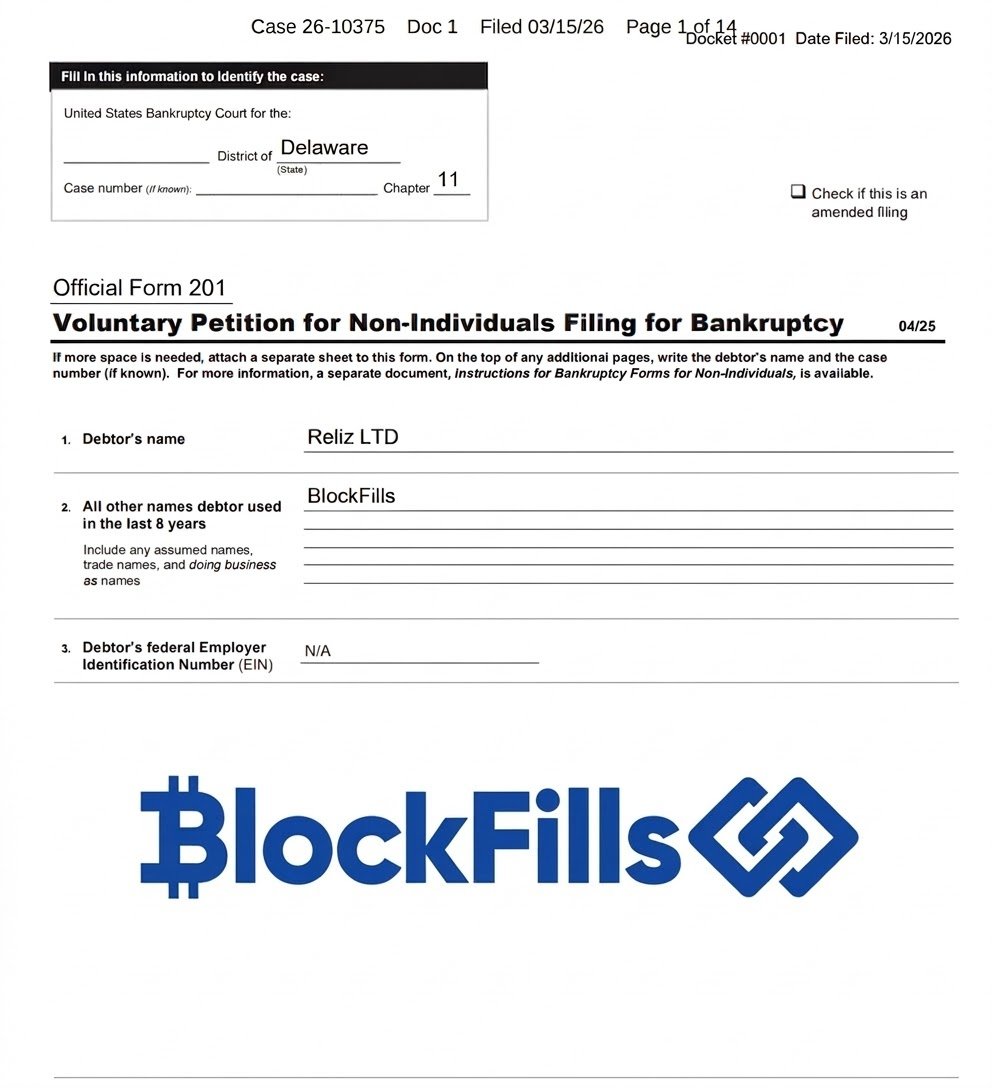
BlockFills just filed for Chapter 11 bankruptcy. $50-100 million in assets against $100-500 million in liabilities. BlockFills was a Chicago-based institutional crypto trading and lending firm backed by Susquehanna, CME Ventures, and Nexo. They processed over $60 billion in trading volume in 2025 and served around 2,000 institutional clients including hedge funds, asset managers, and mining companies. Here's the timeline of how it unraveled: February 11 - BlockFills halts all customer withdrawals and deposits, citing "market and financial conditions." Late February - CoinDesk reports the firm lost approximately $75 million. CEO and co-founder Nicholas Hammer steps down. Early March - Dominion Capital sues, alleging BlockFills misappropriated customer crypto assets, commingled client funds with operational funds, and concealed significant losses. A federal judge issues an emergency order freezing BlockFills' bitcoin holdings. March 15 - Chapter 11 filed in Delaware. Reliz Ltd. and three affiliated entities enter bankruptcy. The pattern is identical to every crypto lending blowup we've seen. Aggressive leverage in derivatives, counterparty risk exposure to other struggling firms, client funds not properly segregated, and losses hidden until they couldn't be hidden anymore. This is what happens when you hand your bitcoin to a third party and trust them to manage the risk. Not your keys, not your coins isn't a meme. It's a risk management framework. The firm's own backers include some of the biggest names in traditional finance. Susquehanna and CME Ventures did their due diligence and still got it wrong. If they can't assess counterparty risk in this market, what chance does a retail investor have? The answer is simple. Stop trusting intermediaries with your bitcoin.
TFTC tweet media
English
35
109
562
90.9K
Ben Far
Ben Far@ben0far·
@noyesclt This is similar to the classic product vs channel dichotomy in payments discourse late 2000s / early 2010s.
English
0
0
1
60
Tom Noyes
Tom Noyes@noyesclt·
New Blog - Why cards are a layer of abstraction and the consumer interface for payments (and Stablecoins are just another rail). Just as Durbin gave merchants the power to route a Debit over Signature or PIN rails, V/MA now give Issuers power to route over stablecoin, BNPL and domestic scheme rails (ex flex credentials). Few have talked about the hidden costs and rules around stablecoins. For example, Solana's Token 2022 spec provides the only way for Issuers to meet OCC and FinCen guidance (IMHO), but a permanent delegate creates significant uncertainty in acceptance as any coin could be burned at any time.... blog.starpointllp.com/2026/03/stable…
English
2
3
41
5.1K
Ben Far
Ben Far@ben0far·
@Rick_Barber_ @StaniKulechov So you have used USDT collateral to borrow USDC. Aave only lets you repay the loan and take back the USDT by paying back the loan in USDC. You’d ideally like to choose to pay back the loan in either USDT or USDC. Is that right?
English
1
0
0
25
Rick Barber
Rick Barber@Rick_Barber_·
I have collateral in USDT, and take out a loan of USDC. AAVE has never allowed you to pay a loan with the same collateral except through liquidation (which is ironic), but if I go to pay my loan in USDC and choose collateral in USDT, the transaction never completes. It accepts the attempt, but it always fails. I have tried generous slippage, etc. Nope.
English
1
0
0
27
Stani
Stani@StaniKulechov·
Earlier today, a user attempted to buy AAVE using $50M USDT through the Aave interface. Given the unusually large size of the single order, the Aave interface, like most trading interfaces, warned the user about extraordinary slippage and required confirmation via a checkbox. The user confirmed the warning on their mobile device and proceeded with the swap, accepting the high slippage, which ultimately resulted in receiving only 324 AAVE in return. The transaction could not be moved forward without the user explicitly accepting the risk through the confirmation checkbox. The CoW Swap routers functioned as intended, and the integration followed standard industry practices. However, while the user was able to proceed with the swap, the final outcome was clearly far from optimal. Events like this do occur in DeFi, but the scale of this transaction was significantly larger than what is typically seen in the space. We sympathize with the user and will try to make a contact with the user and we will return $600K in fees collected from the transaction. The key takeaway is that while DeFi should remain open and permissionless, allowing users to perform transactions freely, there are additional guardrails the industry can build to better protect users. Our team will be investigating ways to improve these safeguards going forward.
English
2.9K
960
11K
6.6M
Rick Barber
Rick Barber@Rick_Barber_·
The CowSwap slippage is punitive even on smaller transactions. It's considerable cheaper to withdraw collateral, swap, then re-deposit. I won't even start with the inability to pay loan in stable with collateral in different stable. The platform has lost much of its real efficiency and benefit. Just being honest as a user since 2021.
English
4
2
11
3.3K