Billy Levin

65 posts

Billy Levin

Billy Levin

@billylevin

programmer

Katılım Ekim 2019
162 Takip Edilen8 Takipçiler
Billy Levin
Billy Levin@billylevin·
@misterclayt0n @glcst They all are over there, and it’s people like this who are a good reminder to me to slow down and learn my shit without worrying about being “left behind”. It’s hard in the current climate to not feel “now, now, now” all the time but that just breeds more slop
English
0
0
1
13
davi
davi@misterclayt0n·
> claude code is amazing > claude code sucks wow > codex is the shit, it has /goal > loops are the goat > actually no who cares /goal is stupid > codex is dead it's subagents are dumb > claude code has workflows it's great > claude code is spawning codex instances > wow look at this new codex thing it's great claude code sucks tired boss. feels like everyday something new in the tech world appears that does nothing more than to wear me the fuck out. a new way someone interacts with clankers, a new kind of prompt, a new skill, a new whatever and the remaining feeling that if you don't use the new hot shit you're getting "left behind", it all feels so stupid, so pointless, as if no value has been added
English
5
1
19
837
Billy Levin
Billy Levin@billylevin·
@RhysSullivan Yesterday Sol got something trivially wrong about LSP. Maybe an adversarial review agent or whatever would've caught it but I wouldn't yet trust these agents to autonomously ship real software to real people.
English
0
0
0
36
Billy Levin
Billy Levin@billylevin·
@RhysSullivan We should be using it to learn/discover things more quickly and therefore create higher quality software. A byproduct of this is that software development will still be faster; but making volume the main goal is what causes the endless slop we're drowning in atm.
English
1
0
0
102
Rhys
Rhys@RhysSullivan·
i'm at a weird point with agentic development where if i go slowly, use agents mainly as context gathering, i love shipping and am proud of the product the moment i try to do more with agents though things become a mess. theoretically loops solve this but i am doubtful
English
94
19
782
37K
Billy Levin
Billy Levin@billylevin·
@HSVSphere I picked one as a profession and one as a hobby so that I can be both incompetent and subhuman :)
English
0
0
12
263
Sam Lambert
Sam Lambert@samlambert·
You would not believe how much maturing, testing, breaking, unbreaking, we do on the way up to a production launch. We treat it like we are putting a plane in the sky for the first time. Neki is built like nothing else we've seen before and it makes it even more interesting.
English
4
1
201
11.1K
Billy Levin
Billy Levin@billylevin·
@HSVSphere It's so nice. I was previously working on a tool to gather the code of a call graph in one place to make an implementation with lots of indirection easier to read. It's now not only pointless but probably objectively worse than just asking an LLM for that info whenever I need it
English
0
0
1
364
HSVSphere
HSVSphere@HSVSphere·
One thing that's amazing about LLMs is that they can conjure up valid paths in the source of any software without extra navigation. Previously this was only available to you if you had made the software yourself. Information has never been so free.
HSVSphere tweet media
English
4
2
97
5.1K
Billy Levin
Billy Levin@billylevin·
@VictorTaelin This is so cool and inspiring (not that I understand all of it; that’s part of what makes it inspiring!). I hope you won’t be dissuaded from posting this kind of thing if you want to in future. Many people (such as me who rarely engages with stuff on here) will be thankful!
English
0
0
5
1.1K
Taelin
Taelin@VictorTaelin·
*sighs* it is already depressing enough that most of you can't understand my posts, but not being able to distinguish them from some technically illiterate SF CEO who thinks they'd proven quantum physics or some shit is another level of stupid problem is, when I write too technically, it tends to just flop, which is why I have to resort to these "AI good!" and "AI bad!" posts that, I admit, may sound a bit over-excited sometimes. that said, the proof is simple enough to be explainable in a way you all can appreciate, so, I'll give it a shot. with you, in its full glory, how Fable contributed to Bend's consistency proof, why it was incredible and, yes, very valid first: consistency is basically a word that means: "can we trust this language to formalize mathematics?". or, equivalently, can someone prove a false statement in it? imagine if someone found a proof of 2+2 = 5 in Lean. that person would be able to use this falsehood to perform arbitrary type-level rewrites, and, thus, prove any theorem (like riemann's hypothesis!) trivially, in a few lines of code. that wouldn't net them $1 million, but it would make for a legendary issue on Lean's GitHub, immediately invalidating any proof checked by Lean and undermining the language's credibility. I obviously don't want that to happen to Bend2 fortunately, the techniques for constructing a consistent proof system are well known, even though details vary case by case. it usually involves two main parts: first, prove it is sound (i.e., that evaluating an expression can't change this type). honestly, that's just the "show us your implementation is not hopelessly buggy". it is the easy part. the second part is much more difficult: "prove every well typed program in your language terminates" this is necessary because infinite loops allow one to encode "paradoxes" (like "this sentence is false") and, to explain it in a very silly way, these paradoxes "confuse" the type checker, and allow you to prove falsehoods. so, if I want people to trust Bend as a proof language, I must be able to convince them there's no way to express an infinite loop in it. programs like "while (true)" must be, somehow, banned by our compiler. but how? the way most proof assistants (like Lean) do it is to 1. not have loops to begin with, 2. ban any kind of non-structural recursion. that means that, to call a function recursively, you must ensure that arguments are getting smaller. that's fairly standard, and fairly easy to do. so, is that it? unfortunately, that's not enough, because, in functional languages, there's another way for infinite loops to manifest: self-replicating λ-terms. for example, consider the following Python program: evil = (lambda f: f(f))(lambda f: f(f)) print evil it hangs forever, even though it has no loops and no recursion. turns out it is very easy to accidentally let some variation of "evil" to creep in, and "evil" allows one to prove falsehoods. for example, if the set of all sets contains itself, you can summon evil via Girard's paradox. and if you allow recursive datatypes to store functions, then, you can summon evil via Curry's paradox: data Evil { bad(f : Evil -> Evil) } // this would break Lean! that problem is not exclusive to proof languages. a similar paradox once caused a crisis in mathematics itself! in 1901, Russel proposed a legendary proof of a false statement in naive set theory, which was THE foundation of mathematics back then. the news was that math itself was broken, and every proof ever written by humanity would to be untrusted. crazy times! of course, this has since been "patched". today, we call it "naive" set theory for a reason! but this shows how hard it is to design a consistent proof system. humanity failed to do so for millenniums! in Rocq, Lean and Agda, the way they avoid these self-replicating λ's is via a series of "patches" - i.e., human engineered antibodies to kill the paradoxes we found in the past. for example, the 'Evil' datatype above is syntactically forbidden by disabling certain shapes of recursive datatypes ("positivity checker"), and Girard's paradox is avoided by having an infinite universe of types ("universe hierarchy"). this disables the "does the set of all sets contain itself" paradox, which, in turn, disables the `evil = λf.f(f) λf.f(f)` summoned by it. this is all solid and stablished, and people are very confident Lean and others are trustworthy. that said - and that's where I tend to change things - I argue that's overkill. while these restrictions indeed avoid paradoxes, they're also very strict, and ban perfectly valid programs. for example, it is impossible to write a fast interpreter (i.e., via HOAS) in these, and alternatives (like PHOAS) are very contrived. this makes these languages substantially less practical. Bend aims to be a proof language that is also viable as a real world programming language, so, it is of my interest to find more permissive termination argument. and that's what I was working on, with the help of Fable my argument goes like this: first, only allow recursion when arguments decrease. so far, this is the same approach used by Lean and others, nothing new here. now, we must find a way to avoid self-replicating λ-terms (like `λf.f(f) λf.f(f)`) from creeping in. that's where we detour. instead of positivity checker and universe hierarchies, I simply re-use a feature of Quantitative Type Theory (QTT) - which, in short, is an industry standard way to have O(1) arrays in an FP lang, and which Bend *already implements* - to forbid non-linear lambdas. In other words, in Bend, lambdas must be used linearly, and, thus, cannot be cloned, and that's enforced by the already existing QTT system. this simple addition is sufficient to prevent all incarnations of `evil = λf.f(f) λf.f(f)` in one strike, cutting the evil in the bud, and ensuring Bend is terminating, as it easily exhausts every known way to introduce non-termination: - infinite loops → there are no loops - infinite recursion → only allow decreasing recursion - self-duplicating λ-terms → lambdas can't be cloned from termination, consistency follows easily. and that's it. this is *obviously* correct and so easy I'm sure even you're confident you can't write infinite loops in Bend. aren't you? now, I must be very clear here. these are all *my* design choices. I didn't ask an AI "pls build a consistent proof language" and then got flattered into thinking I'm a genius. I studied the subject 10 fucking years and used AI to aid me materialize and double check my ideas. this is the antidote I found to AI psychosis. I call it "competency" that said, if the solutions are mine, how Fable helped here? well, the argument per se is obviously sound, and nobody serious would contest it. the problem is that implementing a proof assistant is hard, and it is easy to introduce accidental bugs that detour from the intended semantics. turns out the way that Bend2 wasn't faithful to my intention, for a reason that is legitimately hard to see, and that Fable identified never the less. QTT, as described in the original paper, allowed "relaxing" its checks a bit on certain places of the code. this is important for usability, and harmless to proof languages that use QTT (like Idris2), because they don't rely on QTT for termination. but Bend2 does, and these relaxed checks allowed lambdas to be cloned in some circumstances. Fable read my termination argument, studied the QTT paper, audited the implementation, and found that inconsistency, handing me a proof of Falsehood! full proof below ↓ that was Fable's contribution, and, if you can't see how incredible this is, I don't know what could possibly impress you. as for the solution, Fable proposed a few. all bad. my fix was to split Type in two sorts: one for arbitrary types, and other for lower order values. this lets me have the relaxed checks on positions where lambdas cannot occur, while still ensuring lambdas cannot be cloned and, therefore, self replicate. this is the "elegant proof" I mentioned in the post below!
Taelin tweet media
vikar@onehotcoded

@VictorTaelin You sure youre not falling into ai psychosis?

English
88
52
1.4K
245.3K
Billy Levin
Billy Levin@billylevin·
@chronark @ycombinator From the outside looking in, seems like because it’s the type of behaviour that’s actively encouraged by them nowadays
English
1
0
9
674
Billy Levin
Billy Levin@billylevin·
@LiamKearney99 Mm, maybe it’s time to get rid of the editors entirely and “write loops”
English
0
0
0
11
Liam Kearney
Liam Kearney@LiamKearney99·
@billylevin But they have a seperate config file for theming and language configuration which while still minimal in terms of options is still getting a bit verbose
English
1
0
1
58
Liam Kearney
Liam Kearney@LiamKearney99·
Updating neovim made it insanely slow again. Strongly considering another career.
English
3
0
7
356
One Happy Fellow
One Happy Fellow@onehappyfellow·
baby's first commutative diagram
One Happy Fellow tweet media
English
2
1
48
999
Billy Levin
Billy Levin@billylevin·
@LiamKearney99 It’s also just a fun, low-stakes project to hack on recreationally. And it’s serving as a decent code base to test out new concepts on
English
0
0
1
11
Billy Levin
Billy Levin@billylevin·
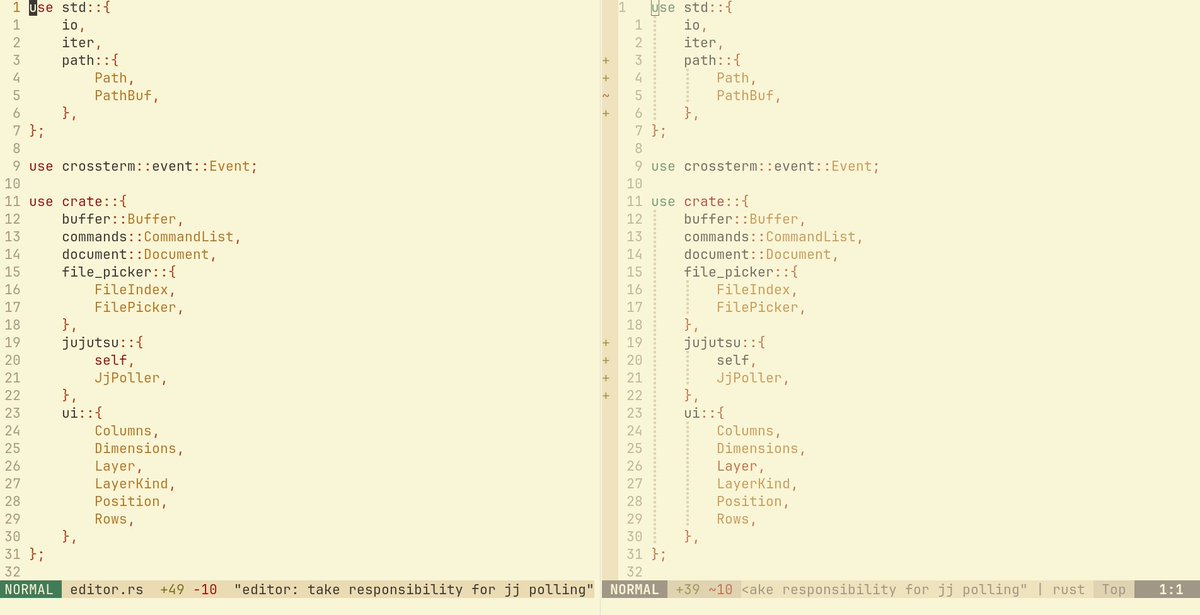
@LiamKearney99 Yep, no config at all, only supports languages I care about, only has key bindings I use, etc. Helix is definitely the pragmatic choice: I’ve accepted that select->act is objectively better but I cba going through that “stuck in the mud” feeling to learn it atm
English
2
0
1
53
Billy Levin
Billy Levin@billylevin·
@LiamKearney99 That would be cool! For the UI I'm more or less just copying what I've currently got in nvim, plus "taking inspiration" from some stuff in Helix
Billy Levin tweet mediaBilly Levin tweet mediaBilly Levin tweet media
English
1
0
1
37
Liam Kearney
Liam Kearney@LiamKearney99·
@billylevin The desire to do this grows with each day. I’d probably start with a REPL ex like thing because I’m actually that bad at UI haha
English
1
0
1
46
Billy Levin
Billy Levin@billylevin·
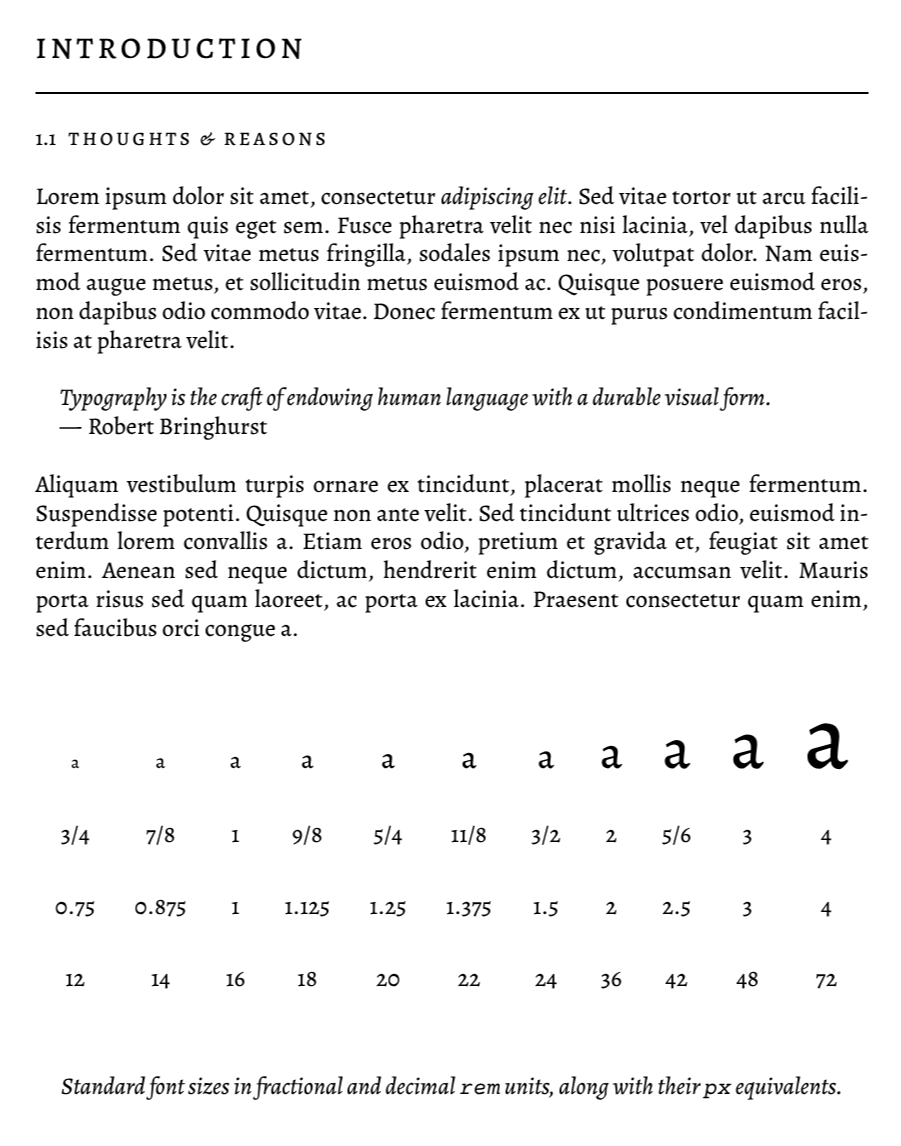
@owickstrom Yes, it’s all very clear! (And I’m enjoying the content)
Billy Levin tweet media
English
1
0
1
13
Oskar Wickström
Oskar Wickström@owickstrom·
Reading "The Elements of Typographic Style", I got way too inspired and went down a CSS rabbit hole trying to reproduce some of it. Everything doesn't transfer to web. (First image is my version, second is from the book.) Now I want to write something real with this stylesheet!
Oskar Wickström tweet mediaOskar Wickström tweet media
English
5
0
38
3.2K
Billy Levin
Billy Levin@billylevin·
@owickstrom Bad time for me to see this: I just printed off a load of stuff from your site a couple days ago 😭
English
1
0
1
18
Billy Levin
Billy Levin@billylevin·
@AnshumanKhanna5 @geistgrail @schteppe It’s not “let’s stop surgeries”. It’s “there are safer versions of these surgeries which we should use unless there’s a good reason not to (i.e. the dangerous version is so much more effective that it’s worth the risk, etc.)”
English
1
0
3
56
Anshuman Khanna
Anshuman Khanna@AnshumanKhanna5·
@geistgrail @schteppe Surgeries have risk So your argument is let's stop surgeries My metaphor, if you do not understand is that a risk exists when you work with something of that much power as hardware (or C) The management of risk is done by tools such as sanitizers and debuggers
English
3
0
1
119
Stefan
Stefan@schteppe·
”any C codebase, if it gets big enough with enough people, it is going to have vulnerabilities. It's not a skill issue in my opinion. It's just a language that allows that kind of thing to happen” youtu.be/QGC40AfmgY0?is…
YouTube video
YouTube
English
8
8
110
87.8K
Billy Levin
Billy Levin@billylevin·
@iusevimBTWW @vaxryy There’s plenty of arcane git knowledge that’s just not worth learning if you use a better tool (jj)
English
1
0
0
25
Eugene Von Furstenberg
Eugene Von Furstenberg@iusevimBTWW·
@vaxryy Stable standards > revolving door chasing perfectionism. POSIX is better experience than anything JS related. Even random tools like VCS are nice since they're slow moving, just master git and move on knowing the knowledge will be useful for years.
English
2
0
8
533
vaxry
vaxry@vaxryy·
posix kinda sucks all things considered but its too late to change it and it works more or less
English
34
4
386
54.4K
Billy Levin
Billy Levin@billylevin·
@owickstrom Nice! I see from the branch name you’re a fellow jj enjoyer :)
English
1
0
0
19