Bo @ Joust

458 posts

Bo @ Joust banner
Bo @ Joust

Bo @ Joust

@bo_joust

Building @getjoust to find out if my stack is actually working. I post my own charts: doses, vitals, bloodwork so we can learn together.

Orange County, CA Katılım Ağustos 2008
771 Takip Edilen978 Takipçiler
Sabitlenmiş Tweet
Bo @ Joust
Bo @ Joust@bo_joust·
The first half of 2026 on one timeline. Bulk from mid January. Started Reta in early March so it would be at working levels when the cut opened. Cut from mid April to June 15, the day I proposed. Every dot is a real weigh-in. Two things this six months taught me:
Bo @ Joust tweet media
English
1
0
5
301
Bo @ Joust
Bo @ Joust@bo_joust·
@peachsweet_tea Hair and skin both moving is a pretty convincing n=1. Did one show up before the other?
English
0
0
0
24
peach
peach@peachsweet_tea·
The best peptide any woman can do is klow. My hair and skin has never been better. I’m obsessed. When I have to cycle off I’ll just do ghkcu and kpv but these two have definitely done wonders for me in this peptide
English
10
0
28
4.6K
Bo @ Joust
Bo @ Joust@bo_joust·
@BerbarianWizard The hCG distinction is helpful. How do you think about it alongside an ICT approach?
English
0
0
0
4
Jamal Dinkoui
Jamal Dinkoui@BerbarianWizard·
The doses used in that paper are 250 mg/day transdermal DHT (125 mg twice daily), raising plasma DHT to ~480 ng/dL (physiological range ~80–200 ng/dL, if you look at labs from the 70s). At that level, it is perfectly logical that it suppresses the HPG axis. The paper cannot be directly extrapolated to low or sub-physiological dosing. I personally prefer ICT (In Cycle Therapy) over conventional PCT: maintaining an efficient endocrine environment rather than trying to maximize LH and FSH. I would generally prefer low-normal LH with high endogenous testosterone over high LH with the same testosterone. LH is a trophic signal. Producing the same testosterone with less stimulation suggests better Leydig-cell responsiveness, high LH with high testosterone can represent compensation. The same principle applies to TSH. This is different from low LH caused by a large exogenous androgen dose, where endogenous production and spermatogenesis remain suppressed. At low doses, DHT is non-aromatizable and may reduce estrogenic feedback without creating the suppressive androgen load seen in this paper. It can functionally oppose estrogen signalling in some tissues, reduce aromatase activity at sufficient exposure and potentially favour 5α-reduced metabolism through tissue-specific regulation of 5α-reductase. DHT-derived compounds were historically used in hypogonadism for this reason. The net effect remains dose-dependent: lower estrogenic feedback may support LH/FSH, while excessive androgen signalling suppresses them. Pregnenolone is part of the same model. It can support downstream steroid availability without forcing the pituitary. It also upregulates StAR, which controls the transport of cholesterol into mitochondria, the rate-limiting step of steroidogenesis. Because of this, pregnenolone can support steroid production in the testes independently of gonadotropins (LH/FSH). Progesterone can oppose excessive tissue estrogen signalling by reducing estrogen-receptor activity in some tissues and increasing estrogen-inactivating pathways such as 17β-HSD2, which converts estradiol into weaker estrone, and sulfotransferases, which favour estrogen conjugation. This is relevant with 19-nor compounds such as trenbolone: they do not aromatize, but their progestogenic activity can interact with estrogen-sensitive tissues and prolactin signalling. Serum estradiol alone does not necessarily describe that tissue environment. Progesterone still has to remain physiological because excessive progestogenic signalling can also suppress the axis. Adequate thyroid signalling supports mitochondrial energy production, cholesterol use, steroidogenic enzyme activity and hepatic estrogen clearance. T3 also increases hepatic SHBG production. I do not consider SHBG inherently harmful: it transports and buffers sex steroids, limits uncontrolled free-hormone exposure and often reflects liver and thyroid function. The objective is adequate thyroid function, not supraphysiological T3. hCG has a different role. It directly replaces LH-receptor stimulation, preserves intratesticular testosterone and testicular volume, but it does not restore endogenous GnRH or LH. It can also increase intratesticular testosterone, aromatase substrate and estradiol. SERMs raise LH and FSH by blocking estrogen feedback at the hypothalamus and pituitary. They can be useful, but they create an artificial estrogen-receptor signal and may raise testosterone and estradiol simultaneously without correcting the metabolic, thyroid, prolactin or tissue environment that produced the problem. The aim of ICT is therefore not the highest possible LH value. It is high endogenous testosterone with the lowest physiological trophic drive required to maintain testicular function, spermatogenesis, steroidogenesis and stable tissue signalling.
SilverFoxLeo@BowTiedHRT

DHT is NOT a PCT tool. There are some accounts on here who often make the claim that topical DHT is an excellent PCT compound. The medical journal that was used, and often cited to support the claim is linked to this tweet. The article does not support what the proponents of DHT claim ie that DHT is a compound that will help you do a successful PCT. It’s being claimed that DHT boosts LH and FSH rather than suppressing them based on a study about transdermal DHT and gynecomastia. Part of it holds some water: the study does show that DHT doesn’t act directly on the pituitary, and it doesn’t suppress the Leydig cells’ own testosterone output either. Where it goes off the rails is skipping the third place DHT actually acts. The same study found DHT suppresses LH through the hypothalamus instead, and the researchers who ran it call this an antigonadotropic effect in their own words, which is actually the mechanism they use to explain why DHT works as a gynecomastia treatment in the first place: the drop in LH combined with a local block on testicular aromatase is what brings estrogen down. That’s not an outlier finding either. Every controlled study I could find on transdermal or percutaneous DHT in men, from the early 1980s through a 2002 randomized placebo controlled trial, shows LH and FSH coming down as DHT goes up, never the reverse. DHT is NOT a PCT tool. Site of action isn’t the same as net effect, and that’s exactly why it pays to slow down whenever a compound claim leans on a cited study. Pull the paper yourself, read what it actually concludes, and let that color your protocol instead of somebody else’s summary of it. onlinelibrary.wiley.com/doi/full/10.11…

English
4
4
137
14.7K
Bo @ Joust
Bo @ Joust@bo_joust·
@mindmusclepro Helpful to separate albumin-bound from free T. How do you handle low SHBG when total T looks fine on paper?
English
1
0
1
18
Mind Muscle Project
Mind Muscle Project@mindmusclepro·
Total Testosterone vs Free Testosterone 🔵 Total Testosterone is all the testosterone circulating in your blood. 🔵 It consists of 1. Testosterone bound to SHBG (Sex Hormone Binding Globulin) (50-70%) 2. Testosterone loosely bound to Albumin (30-50%) 3. Free Testosterone (1-3%) 🔵 Most of your testosterone is bound to proteins & is not readily available to tissues. 🔵 Free Testosterone is the tiny fraction that circulates unbound. 🔵 This is the biologically active form that can readily enter cells & activate androgen receptors. 🔵 Albumin bound testosterone is also considered bioavailable because it is only loosely bound & can easily dissociate. 🔵 This is why someone can have Normal Total Testosterone & Low Free Testosterone, if SHBG is elevated. 🔵 Likewise, someone may have only average Total Testosterone but good Free Testosterone if SHBG is lower. 🔵 You can use Total testosterone to SHBG ratio (called Free Androgen Index) as gauge for your body’s usable testosterone. Nutrients that help improve Free Testosterone (evidence based) ✅ Boron 🔵 Boron has the strongest evidence among nutrients for increasing Free Testosterone, primarily by lowering SHBG. Human studies using around 6–10 mg/day have reported max benefit. ⚠️ Total Testosterone often remains unchanged. ✅ Zinc (Only if you’re deficient) 🔵 Zinc is essential for normal testosterone production. 🔵 Severe zinc deficiency is associated with lower testosterone levels. 🔵 Supplementation can help if deficient ⚠️ Common issue among vegetarians ✅ Magnesium 🔵 Magnesium has modest evidence for improving Free Testosterone ✅ Vitamin D 🔵 Vitamin D deficiency is associated with lower testosterone in observational studies. 🔵 Correcting the deficiency is important, but direct impact on Testosterone is debatable. ✅ Healthy Dietary Fat 🔵 Hormones require healthy dietary fat. 🔵 Several intervention studies have shown that very low fat diets can reduce testosterone levels compared with moderate fat diets. 🔵 But this doesn’t mean more fat is better, just that very low fat diets may not be optimal for androgen production. ✅ Adequate Calories 🔵 Long term chronic Calorie restriction can lower Total Testosterone & Free Testosterone 🔵 Note that Sexual performance isn’t just about Testosterone. There are supplements like MACA, Fenugreek that can increase sexual performance but has no meaningful impact on Testosterone. 🔵 Likewise, Ashwagandha, Tongkat Ali, Shilajit etc may modestly improve testosterone in some populations, but improvements in sexual function often occur through mechanisms beyond testosterone.
Mind Muscle Project tweet media
English
1
1
8
2K
Bo @ Joust
Bo @ Joust@bo_joust·
@angertab Free T alongside SHBG changes the picture fast. Is the cortisol to SHBG link the main mechanism at play here?
English
0
0
0
24
Matt Tardio
Matt Tardio@angertab·
This needs to include checks for free testosterone. Combat vets deal with months of high cortisol from chronic stress, this raises the SHBG that binds to testosterone and crashes free T levels. SSRIs, often prescribed for PTSD, lower T levels and worsen sexual function. This explains the crushing fatigue, low drive, and bedroom problems so many vets face every day. Demand full labs with free T and SHBG checked, not just overall testosterone levels. Ask me how I know.
Secretary of War Pete Hegseth@SecWar

The High-T Department of War.

English
25
25
203
10.7K
Bo @ Joust
Bo @ Joust@bo_joust·
@BowTiedHRT I feel like the distinction between screening and compulsory treatment matters here. To your point, a low result still needs careful context, especially around draw timing and sleep.
English
0
0
0
29
SilverFoxLeo
SilverFoxLeo@BowTiedHRT·
Yes. Let’s weigh in. The framing on the tweet below, treating a testosterone screening program for military members as some fringe experiment that needs its “validity” debated, is exactly the kind of gatekeeping that keeps sound medicine out of the hands of the people who need it most. Ask yourself what this program actually does. It adds an annual blood test for men 30 and older to catch a treatable deficiency. Under 30, it’s optional. If someone comes back low, treatment is still their choice. That’s the entire proposal. A blood draw and a conversation with a competent well trained military physician. Now think about who this covers. Not desk jockeys or civilians who can book a massage and a sauna session after a hard week: Men and women operating at the edges of human endurance, running on broken sleep and MREs, expected to perform under a psychological and physical load that would break most civilians in days. If low testosterone is costing them recovery, strength, and the ability to maintain lean tissue through a deployment, that’s a readiness problem, not a lifestyle problem. Testosterone drives nutrient partitioning and helps preserve lean tissue under caloric stress. Under-recovered, under-slept, calorically stressed troops are precisely the population where that matters most. This isn’t experimental. It’s basic endocrinology applied to the population that needs it applied the most. I’ll grant one thing. Any screening program is only as good as how it’s run: the assay used, the timing of the draw, who reads the result, and whether a diagnosis follows a service member’s career file. Those are implementation questions worth asking. Whether the underlying idea is valid isn’t one of them. Our adversaries have never asked their soldiers to operate at a physiological deficit out of squeamishness and its taken the Department of War long enough to catch up, but we’re here. Thank you @SecWar Hegseth.
Barbara Starr@bstarrreports

Hegseth now orders testing testosterone levels in troops to keep their lethality capabilities at high levels. Can some medical experts please weigh in on validity of this?

English
6
10
89
9.5K
Bo @ Joust
Bo @ Joust@bo_joust·
@BiohackerJake How often are you actually checking fasting insulin when you run HGH alongside Reta?
English
0
0
0
30
💯🧬 Jake 🧬💯
💯🧬 Jake 🧬💯@BiohackerJake·
👉The two biggest fears with HGH/GH peptides. 👈 There are two big fears that get thrown around whenever someone talks about running HGH long-term or using GH peptides — insulin resistance and high IGF-1. A lot of people treat these like automatic red flags. In reality, for most healthy, metabolically optimized individuals, these concerns are heavily overstated and often misunderstood. Let’s break both of them down properly. ‼️The Insulin Resistance Fear Growth hormone does have a temporary anti-insulin effect. This is real. It can reduce insulin sensitivity in the short term, especially at higher doses. But this effect is highly context-dependent. It’s not some automatic “you will become diabetic” outcome like a lot of people claim. If you’re already carrying high body fat, eating like trash, and were insulin resistant before you ever touched HGH or peptides, then yes — pushing GH on top of that is a bad idea. That’s the population where problems actually show up. But if you’ve already done the work — you’re insulin sensitive, you have good body composition, you train hard, you eat properly, and your metabolic health is solid — the risk changes dramatically. In many cases, GH can actually improve insulin sensitivity over time once your body adapts, especially at moderate doses (2–4 IU range). The bigger point is this: we now have tools that can almost completely neutralize the insulin concern. This isn’t theory — these compounds actively improve insulin sensitivity and glucose disposal while you’re running GH. Retatrutide is probably the strongest one right now. Because of its glucagon component, it increases energy expenditure and improves how your body handles nutrients. A lot of people running low-to-moderate dose HGH alongside low-dose Retatrutide report zero negative impact on fasting glucose or insulin sensitivity. It basically acts as a buffer. Metformin is another strong layer. It lowers liver glucose output, improves insulin sensitivity, and activates AMPK. When stacked with a GLP-1 like Retatrutide or Tirzepatide, it creates a very protective environment. Some people also add an SGLT2 inhibitor (like Jardiance or Farxiga) on top of that. This combination is about as close to “permanent metabolic armor” as you can get while running growth hormone or peptides. Other useful tools include ATX-304, dihydroberberine, and proper glucose disposal agents. These aren’t just bandaids — they actively support better nutrient partitioning and keep insulin sensitivity high even when you’re using compounds that have a mild anti-insulin effect. The bottom line on insulin resistance: If you’re metabolically healthy going in and you’re willing to use the tools that exist, this fear is largely solved. It’s not a reason to avoid HGH or GH peptides. It’s a reason to stack intelligently. ‼️The High IGF-1 Fear The second major fear that gets thrown around is elevated IGF-1. A lot of people see a high number on bloodwork and immediately assume it means they’re increasing their risk of cancer or some kind of uncontrolled growth. This fear is real in the community, but it’s often based on incomplete information and worst-case scenarios that don’t apply to most healthy people using these compounds responsibly. Here’s the reality: IGF-1 is a growth factor. That’s literally what it does — it promotes cell growth, repair, and survival. In the context of someone training hard and trying to build or maintain muscle, that’s generally a good thing. However, because IGF-1 can stimulate cell proliferation, some people jump to the conclusion that higher levels must mean higher cancer risk. This fear mostly comes from a few places: older population studies that linked higher IGF-1 to certain cancers, the fact that people with acromegaly (a condition with chronically very high GH and IGF-1) have increased health risks, and the general idea that “more growth = more cancer.” The problem with this thinking is that it usually ignores context. In people who are already metabolically unhealthy — carrying high body fat, insulin resistant, chronically inflamed, and living with poor lifestyle habits — elevated IGF-1 can be more concerning. In that environment, high IGF-1 can potentially accelerate existing problems because the body is already in a pro-inflammatory, pro-growth state that’s not well regulated. That’s the scenario where the fear has some legitimacy. But in a healthy, insulin-sensitive, low-inflammation individual who trains hard and has good metabolic health, the picture looks very different. In this population, moderately elevated IGF-1 is often just a reflection that growth hormone or GH peptides are actually doing what they’re supposed to do. It’s a marker of increased anabolic signaling and recovery capacity, not an automatic disease state. Many of the studies that raised alarm bells didn’t properly control for insulin resistance, inflammation, or metabolic health — which are far bigger drivers of long-term risk than IGF-1 levels alone. Another important distinction is how the elevation happens. Growth hormone peptides (like Ipamorelin, Tesamorelin, CJC-1295, etc.) tend to create more pulsatile spikes in IGF-1 rather than a constant elevation. You’re also usually not running them year-round. This pulsatile pattern is much closer to how your body naturally releases GH and IGF-1, which may be one reason peptides generally have a better long-term safety reputation than people assume. Exogenous HGH, on the other hand, creates a more steady elevation. Even then, in healthy individuals using moderate doses, this doesn’t automatically translate into problems. The real questions that matter more than the IGF-1 number itself are: -Do you have symptoms? -Is your fasting insulin elevated? -Are inflammatory markers (like hs-CRP) high? -Do you have pre-existing conditions or a family history that makes this riskier for you personally? -Are you actually managing the other variables that matter (body composition, insulin sensitivity, inflammation, sleep, etc.)? If someone is symptom-free, insulin sensitive, and metabolically optimized, a higher IGF-1 level is usually not the red flag that many people treat it as. It’s information that should be looked at alongside everything else, not in isolation. This is why blindly fearing IGF-1 and avoiding HGH or GH peptides entirely often doesn’t make sense for people who’ve already put in the work to get metabolically healthy. The fear tends to be loudest from people who either don’t understand the nuance or are looking at it through the lens of very high doses and poor metabolic health — which is a completely different situation than a dialed-in individual using these compounds intelligently.
GIF
English
5
2
21
946
Bo @ Joust
Bo @ Joust@bo_joust·
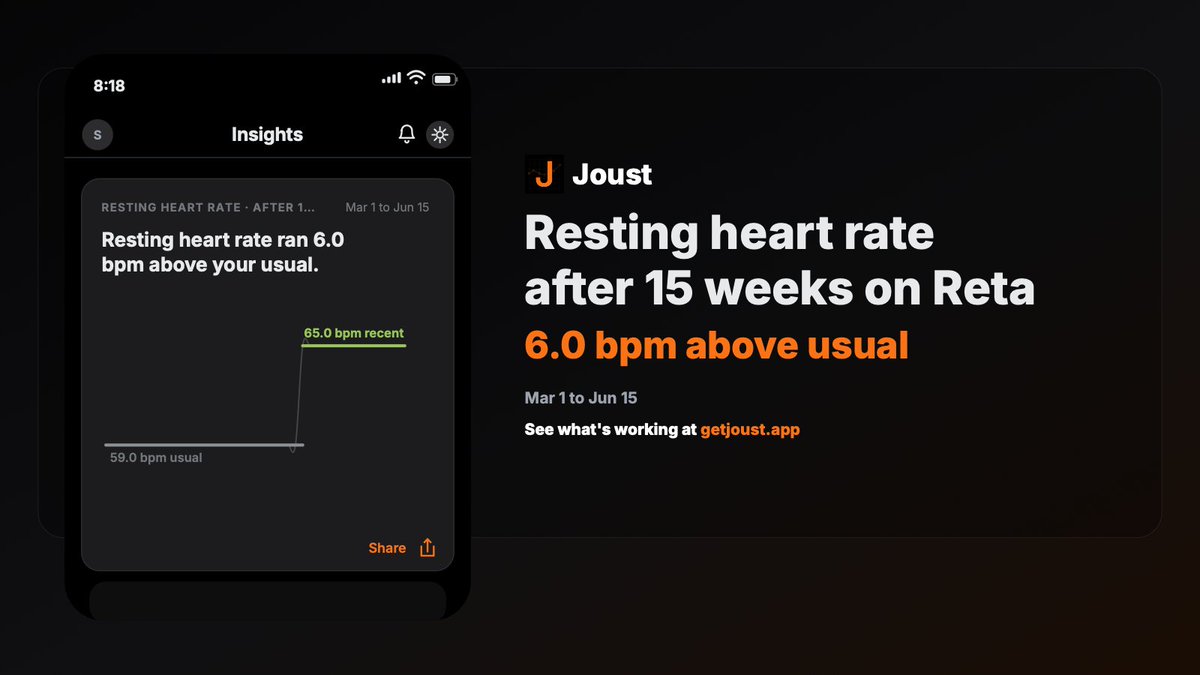
@I_Research_Pept My RHR popped up about 6 bpm and stayed there, so that's the main reason. It's not terrible but if I could get it back down in the 50s I feel like that would be better for me long term.
Bo @ Joust tweet media
English
1
0
1
14
The Dad Experiment | N=1
The Dad Experiment | N=1@I_Research_Pept·
@bo_joust Yeah, why not just stick with Reta? Is it effective at a lower dose for you? I'm actually planning a similar move in the near future. I want to be able to eat more for bulking but still silence the noise a bit.
English
1
0
0
17
The Dad Experiment | N=1
The Dad Experiment | N=1@I_Research_Pept·
3 months on GLP-1s today. I wanted to post a few of the data highlights. 📊 27 lbs. lost BF% down 5% BMI down 3.5 Visceral fat: 16 → 13 Skeletal muscle: UP (in a deficit 💪) - my favorite part And the bloodwork backed it up: HDL (good cholesterol): 31 → 48 Triglycerides: 128 → 72 A1c: 5.4 → 4.9 I didn't just lose weight. I got healthier. The biggest knock on GLPs is that they deteriorate your muscle but many of us are proving that wrong. Still working on LDL, continued body recomp and hormones. But 3 months in? I'll take it. *Still need a DEXA scan, but using smart scale to track general direction. #GLP1 #bodyrecomp
English
19
1
56
3.4K
Bo @ Joust
Bo @ Joust@bo_joust·
My side effects were pretty mild honestly. I switched to reta earlier this year as I started to bulk - I still wanted the craving control but I didn't want to crush my appetite as much, and it worked great for that. I'm on the fence about switching back - I'm worried about having to titrate back up on tirz again.
English
1
0
0
13
The Dad Experiment | N=1
The Dad Experiment | N=1@I_Research_Pept·
@bo_joust Tracking is definitely needed for me to know what works. Mostly want a small stack for the long-term. Did you experience more side effects at the higher doses? When/why did you switch to Reta?
English
1
0
0
17
Bo @ Joust
Bo @ Joust@bo_joust·
This is awesome. I love the detailed tracking. One of the things I noticed on tirz is that I had to really crank the dose up as I got closer to my goal weight - I think my body just got used to it. I was up to 15mg per week for a while. I hope you can stay steady and still see the results!
English
1
0
0
29
The Dad Experiment | N=1
The Dad Experiment | N=1@I_Research_Pept·
Luckily, I track everything and use AI a lot. Here is the weekly rates with a few outliers due to injuries/meds/etc. It's pretty consistently been near 2 lbs/week. I'd say I'm mostly settled in my dose. When I increase, it's very incremental. I'd also say I have a high tolerance to just about any substance (ie when I get anesthesia they need to increase the dose for it to work) and I'm at 8 mg Tirz/week.
The Dad Experiment | N=1 tweet media
English
1
0
0
69
Bo @ Joust
Bo @ Joust@bo_joust·
@BiohackerJake This is an awesome writeup. What changed first after you added it into your stack? Could you feel the difference?
English
0
0
0
18
💯🧬 Jake 🧬💯
💯🧬 Jake 🧬💯@BiohackerJake·
Back to some boring basics I like, but one of my favorites to assist desiccated thyroid. Selenium is one of those “quiet” foundational minerals that most people in the enhanced world completely under-appreciate until they actually start optimizing thyroid properly. I run it daily alongside desiccated thyroid (NP Thyroid) and the difference is real. Here’s why it matters so much. 1. Thyroid Conversion & Protection Your thyroid produces a ton of hydrogen peroxide during hormone synthesis. Without enough selenium, that oxidative stress damages the gland and impairs everything. Selenium is a required cofactor for the deiodinase enzymes (DIO1 & DIO2) that convert T4 → active T3. It’s also the key mineral for glutathione peroxidase inside the thyroid itself, which mops up the free radicals so the gland doesn’t get destroyed. This is why I run selenium with desiccated thyroid instead of synthetic T3/T4 only. Desiccated thyroid already gives you the full spectrum (T4 + T3 + T2 + calcitonin). Selenium makes sure the T4 portion actually converts properly and protects the tissue long-term. Synthetic T4-only leaves you completely dependent on perfect conversion, and a lot of enhanced guys don’t convert well under high training stress, HGH, peptides, or metabolic agents. Full-spectrum NDT + selenium just feels more physiological and sustainable. 2. Broader benefits for the enhanced biohacker Beyond thyroid, selenium is one of the strongest levers for systemic antioxidant defense: -Core component of glutathione peroxidase (GPx) — your primary enzyme that recycles glutathione and neutralizes peroxide -Supports thioredoxin reductase (another major antioxidant system) -Lowers overall oxidative stress from high daily training volume, high stim load, HGH, Retatrutide, and aggressive metabolic compounds -Helps keep inflammation (hs-CRP) in check -Supports immune modulation and recovery -Improves sperm quality and testosterone signaling pathways in men -Mild mitochondrial support under high metabolic throughput In short: when you’re running hard every day and stacking compounds that increase cellular demand, selenium helps keep the damage from accumulating. Practical dosing I use and recommend: 200 mcg daily of selenomethionine (or selenium yeast) is the sweet spot used in almost all the good thyroid studies. RDA is only 55 mcg. Most people (especially if they train hard or eat lower soil-quality food) need more. 200 mcg is extremely safe long-term for almost everyone. I take it in the AM with breakfast (Desiccated Thyroid is always AM fasted as soon as I wake up, usually right with HGH). It’s cheap, non-hormonal, and one of the highest ROI minerals you can add when you’re on desiccated thyroid.
English
3
2
24
1.3K
Bo @ Joust
Bo @ Joust@bo_joust·
@Satoshipeptides Happened to me for about three weeks then went away. Got some relief with Benadryl but it didn’t go away completely until my body was used to it.
English
0
0
3
951
Adam
Adam@Satoshipeptides·
Has anyone noticed a side effect of sensitive skin while using Reta? My wife says that's happening
English
81
0
59
17.3K
Bo @ Joust
Bo @ Joust@bo_joust·
@iliveulongtime That’s amazing! Thanks for sharing your experience. Are you injecting directly into the tendon area?
English
1
0
0
9
I Live U Long Time
I Live U Long Time@iliveulongtime·
@bo_joust I have Achilles tendonitis and even though I've been running 30-40 miles a week I haven't had a single flare up since starting so I think it did help for that. I'll continue to run it a bit longer
English
1
0
0
17
I Live U Long Time
I Live U Long Time@iliveulongtime·
Starting ARA-290 (cibinetide) today. 4mg/day SubQ, 28 days. Not a repair peptide. It's an EPO-derivative that hits the innate repair receptor. Nerve, not tendon. Two months of BPC-157 + TB-500 might have helped my back a little bit but if it's a nerve issue I need a different tool for the job. Reassessing at day 28. Will post what actually happened.
English
4
0
3
298
Bo @ Joust
Bo @ Joust@bo_joust·
@DrKERMD Really impressive - did activity or food changes make the first noticeable difference for you?
English
1
0
1
86
Dr. K, M.D.
Dr. K, M.D.@DrKERMD·
Found an old lifting video from 2021 during peak Covid. I was what I term “muscley fat” - my strength and muscle mass were decent, but I was metabolically unhealthy. My body fat was 25%+ and I became pre-diabetic! This was from years of ignoring cardiovascular exercise and not taking what I ate seriously. Most people naturally gravitate toward either cardio or strength training and then quietly write off the other. The truth is, they serve different but equally important roles. Strength training protects muscle, bone, and metabolic rate as we age. Cardio improves heart health, insulin sensitivity, and recovery capacity. Together, they create a much more resilient and longer-lasting body than either one alone. When I started addressing my metabolic health, treating my testosterone deficiency gave me more energy, drive, and ability to recover from training. GLP-1 meds helped me avoid unhealthy foods and made it possible to stay in a deficit without feeling miserable. That said, neither of those tools would have delivered the same results without consistent resistance training and cardio. By the way, how many pounds does having to wear a mask add to the 315? 🤔 😂
Dr. K, M.D.@DrKERMD

Got rid of my dad bod and prediabetes in ~3 years with testosterone therapy, low dose GLP, high protein diet, and doing some form of exercise at least 6 days per week.

English
3
0
6
20.1K
Bo @ Joust
Bo @ Joust@bo_joust·
@RetaDiary Are you nervous to get to those higher doses? Will they slow down the titration even more if your body reacts poorly as you step up?
English
1
0
1
180
Patient 023 💉
Patient 023 💉@RetaDiary·
ENTRY // 015 Week 15 • Day 99 Current 295.6 lb (-37.2 lb) 4 mg Suppression 7/10 Sleep Great Side effects Almost none Observation One thing I'm weirdly grateful for I don't get to choose my dose. A lot of people don't realize this but I'm in the slow-titration Phase 3 retatrutide trial. My schedule is: 2 → 4 → 6 → 9 → 12 mg The trial can take up to 60 weeks (almost 14 months) to get me to 12 mg. But I can get there sooner. I’ll be in the trial for 113 weeks. If I was doing this on my own, I would've convinced myself I needed 12 mg weeks ago. 😂 Patience has never really been my thing. Instead, the trial has forced me to slow down and actually learn what each dose feels like before moving up. Looking back, I honestly think that's a big reason I've had almost no side effects. Next 10 weeks on a new meal plan. More carbs. Let's see what changes.
Patient 023 💉 tweet media
English
18
0
59
10.3K
MannyJ
MannyJ@mannyjplays·
🚨 Super pumped to announce that I’ve officially partnered with Rescue Research USA as an affiliate! 🧬🔥 I've spent a lot of time looking at companies in the peptide space and there are 3 things I always look for- quality, transparency and customer support Rescue Research USA is a small business built by Chris @ThePepGuy, someone who has been contributing to the peptide research community on X by sharing information, answering questions, and providing valuable info on these compounds. ✅ 3rd party testing for purity, endotoxins, sterility, heavy metals and more! ✅ Batch transparency and lab verification ✅ Fast processing and shipping ✅ Competitive pricing ✅ Personalized customer service from a small business owner who actually cares about his customers In a growing space, quality, transparency, and customer care matter. I’m excited to partner with Chris and Rescue Research USA to help share a company that values testing, accountability, and putting customers first. 💪🧬 Learn more: rescueresearchusa.com (Research use only. Not medical advice. Always do your own research.) 🧪
English
7
3
31
1.9K
Bo @ Joust
Bo @ Joust@bo_joust·
@BiohackerJake Reta during a surplus is an underrated combo. What does the recomp look like when you're eating more, does the toppling scale number move while composition shifts? Or are you gaining a bit?
English
0
0
0
125
💯🧬 Jake 🧬💯
💯🧬 Jake 🧬💯@BiohackerJake·
I never want to be out of a surplus on Reta again. This is a cheat code. TRT dialed in ✅ Reta on high calorie intake ✅ HGH ✅ Terrible picture quality ✅
💯🧬 Jake 🧬💯 tweet media
English
18
2
89
4.9K
Bo @ Joust
Bo @ Joust@bo_joust·
@500ghosts Hell yeah - love that you made the changes needed to get better sleep. Nice work!
English
0
0
1
11
Joe M500ghosts
Joe M500ghosts@500ghosts·
@bo_joust I'm thinking the weight, because gaining the weight is when I stopped breathing in my sleep and snoring like diesel locomotive. I fought getting a c-pap (I have a CDL and needed it to keep my license) but that machine is amazing. But not needed in it SO MUCH BETTER 😊
English
1
0
0
18
Joe M500ghosts
Joe M500ghosts@500ghosts·
6 months of retatrutide: -100 pounds lost -reversed fatty liver disease -lowered blood pressure to normal for first time in my adult life -sleep apnea cured/no more c-pap -sexual performance/pleasure increase -mental attitude more positive
English
3
0
5
817
Bo @ Joust
Bo @ Joust@bo_joust·
@KennyCarmody Lean mass on GLP-1s is genuinely hard to track. BIA went up about 3 points on reta for me, can't tell if that's real or impedance noise on a shifting body. DEXA next.
English
0
0
0
20
Kenny Carmody
Kenny Carmody@KennyCarmody·
🚨Neurosurgeon Dr. Jack Kruse’s warnings on GLP-1 drugs like Ozempic and Wegovy. He compared their effects to what happens to astronauts in space, and the data is alarming. Within days of use, these drugs trigger tinnitus, vision changes, and rapid muscle loss. After a month, astronauts lose up to 20% of their muscle mass. The same thing is now happening on Earth to people taking these medications. A study from the Blau Lab (the same lab connected to Andrew Huberman) shows they destroy muscle and, crucially, stem cells. Once stem cells are damaged, recovery becomes nearly impossible even after stopping the drug. Kruse calls this the most dangerous class of drugs he has seen. It turns users into “astronauts on the planet”, flattened optic nerves, retinal damage, brain bleeding risks, and extreme muscle wasting. The Osbournes are a visible example: they look like walking skeletons, and Sharon Osbourne has said she stopped but the damage continues. Doctors in Europe and the US are being incentivized to prescribe them while Novo Nordisk prints record profits. Don’t outsource your body to Fiat medicine.
English
117
743
2.5K
313.9K