Pranav

1.5K posts

Pranav banner
Pranav

Pranav

@bpranav6

@Columbia | engineering @MarianaMinerals | prev @RedwoodMat | views are personal

Sparks, NV Katılım Kasım 2010
1.2K Takip Edilen468 Takipçiler
Pranav
Pranav@bpranav6·
@AECOdigital @joeschmidtiv 10000%, you can build 100s of tools, if a PE isn't comfortable using that, its next to useless.
English
0
0
2
21
Dr. Marcin Kasiak
Dr. Marcin Kasiak@AECOdigital·
Good piece. One thing missing from the disruption map: The article frames MEP as the clearest AI unlock because the work is rules-based and rote. That's right. But the harder unlock is structural engineering — where the work is NOT rote, where liability follows the engineer of record personally, and where AI-generated output needs a PE stamp before it means anything. Anyone building AI for structural calculations isn't just building software. They're building a new accountability framework for a licensed profession. That's a different company than an MEP automation tool.
English
1
0
1
7
Pranav
Pranav@bpranav6·
Pranav@bpranav6

Amazing to see this problem getting noticed and now that it has gotten VC's interest. Pretty sure there is an investment post coming and can't be excited more. Also, I'm that engineer currently waiting on a Revit model to load and have been doing this everyday for >11yrs. Although I agree with the general premise in need of a better ecosystem, I want to highlight the problem here is not ONLY the software used. Here are my thoughts. 1. "Software built in 1997" is a misleading frame. Windows was built in 1985. What matters is the updates. Revit has had constant feature upgrades (it's not there yet) and Autodesk has built BIM 360/ACC/Forma around it. You can disagree with the pace, but calling it frozen in time is not quite right. 2. There are several tools that assumes browser based, cloud native is the way to go. Cloud Native is right and I like the approach Autodesk has taken here with cloud collaboration models for Revit. Again, these are MASSIVE models, assuming we aren't discussing a residence or an apartment complex, a single facility can have hundreds of thousands of elements/10s of 100s of design files/companies across dozens of disciplines. On one of my projects, atleast 25 different global companies - design partners to low voltage contractor, their drafting contractors worked on the same Revit project at various timezones. Incredibly difficult to cater such a big audience. Sometimes the projects work in silos by necessity, not ignorance. 3. Revit's worksharing capability exists for a reason. "A structural beam moves on Tuesday. The MEP consultant doesn't find out until Friday." NOT TRUE, unless they use outdated practices, if they can't adapt to a feature Autodesk introduced in 2016, I don't expect them to use/adapt to a new tool in 2026. 4. "The platform also doesn't connect the 3D model to the physics-based calculations engineers need to run alongside it. Those happen in separate tools — notably Excel and other third-party software - PARTLY TRUE, although several Revit compatible tools exist, opportunity to create internal tools exist, stamping engineers prefer calculations on tools that they're comfortable with. RISA for structural design calcs, converting it to Revit is tricky. Interoperability challenge - Yes, wish there is a better way. 5. The coordination failures described aren't Revit's fault, they're execution failures. When piping lives in Plant 3D and structures in Revit, yes there WILL be interoperability issues. Surpringly large no. of contractors/trade partners doesn't use Revit in the US, they're stuck on AutoCAD. 6. I worked on some of the most complex projects in the NA, from tallest building on the continent to one-of-a-kind manufacturing facility. I've never seen a single project use all of Revit's capabilities. Why? Because projects trade off features for speed. Owners want highest quality, under budget, fastest timeline and I remember my ex manager said you typically only get two of the three. That's a construction reality, not a software problem. 7. The piece frames this as "Revit bad, AI fixes everything." But the actual bottleneck is: LOD, EIR standards not being enforced, BIM Execution Plans not followed, trade partners using different execution strategies. Organizational discipline without disrupting project schedule is where we will need AI/LLMs. 8. Now on the "AI will automate MEP design" claim. I work alongside MEP engineers daily. Yes, a lot of the work is rule-based. But the rules are layered - building codes, local amendments, AHJ interpretations, equipment vendor specs, owner preferences, vendor availability and site-specific constraints all interact. An AI placing fire alarms in a generic floor plan is a demo. Doing it on a industrial facility or hospital where the mechanical, electrical, and plumbing systems are deeply interdependent? That's where every "automate in minutes" pitch falls apart. 9. The article says document review "catches only 30% of issues" and costs $50-100K and highly manual. That number might be real, but the reason isn't bad software, it's that the reviewers are working from incomplete designs, outdated tools. In cases, Disciplines submit at different completion levels. You're reviewing 60% MEP against 90% structural. AI reading those same incomplete documents won't magically catch what isn't there yet. Garbage in, garbage out. 10. There are already players chipping away at interoperability like IFC.js, Speckle, OpenBIM, Autodesk's own evolving platform. The ecosystem is moving. It's not there yet, its upto the firms to bridge those gaps, democratize access. Compared to 2020, it's much easier to extract the data from these tools today and owners'/GCs must build an intelligence layer on top of these 11. Do I want better tools? Every single day. As someone who scripts automation on top of these platforms daily, I know the pain intimately. But the gap isn't "nobody's thought of this."

QME
0
0
0
12
a16z
a16z@a16z·
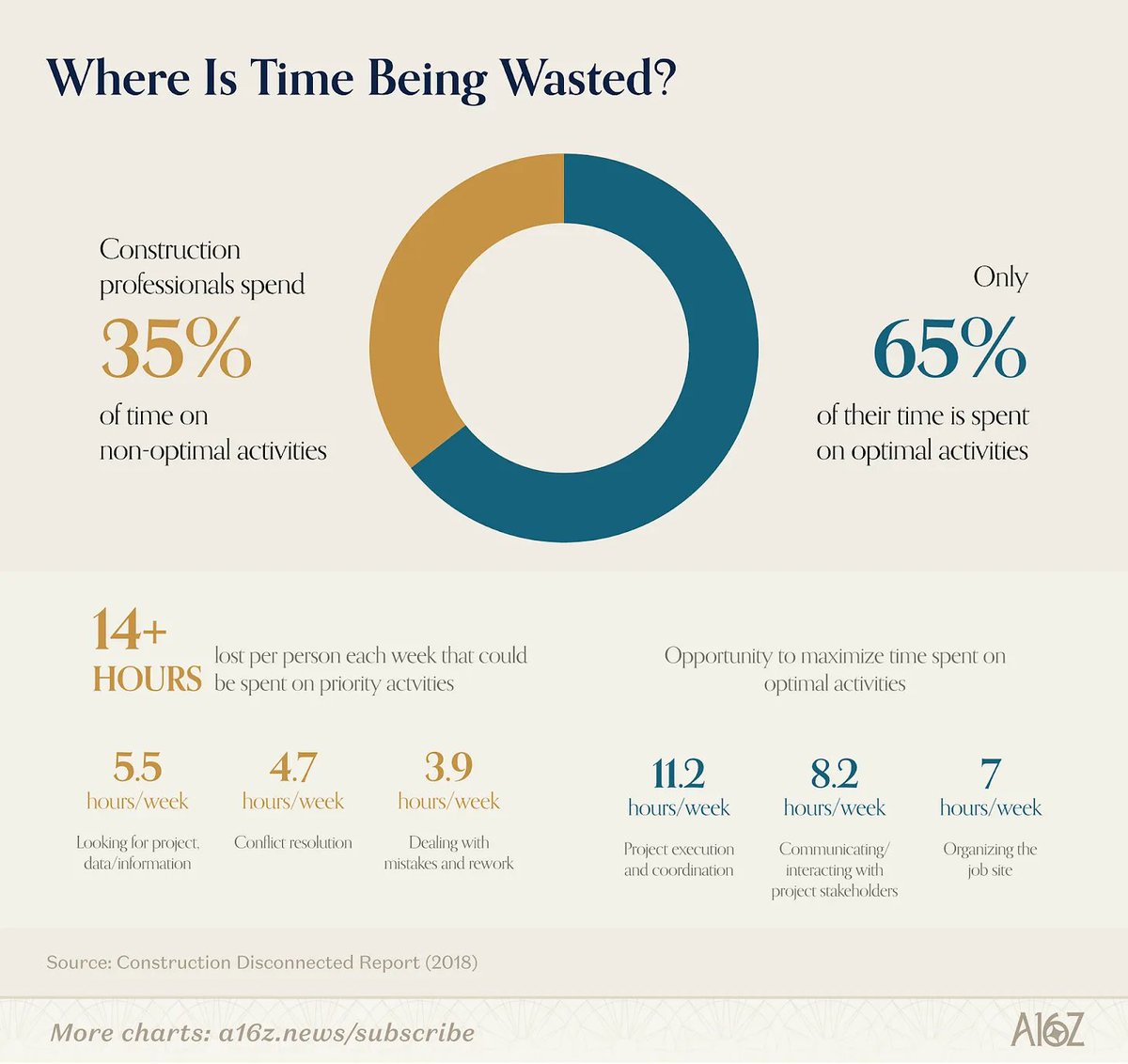
Every building you've ever been in was designed by software built in 1997. The architecture, engineering, and construction industry is one of the largest and least digitized industries in the world. Most of its software is stuck in the 90s. The consequences: 85% of construction projects exceed their budgets and three quarters finish late. The average construction dispute in North America is worth $60.1 million and takes nearly 12.5 months to resolve. LLMs make better software possible, and datacenter buildouts make the demand to fix this $13T industry higher than ever. Full piece: a16z.news/p/every-buildi… @joeschmidtiv @dhaber @CarolineGoggs @zabie_e
a16z tweet media
Joe Schmidt IV@joeschmidtiv

x.com/i/article/2038…

English
55
100
765
153.9K
Amazon Leo
Amazon Leo@Amazonleo·
Amazon Leo is coming to @Delta. Delta will install Amazon Leo on hundreds of aircraft across its fleet, bringing fast, reliable Wi-Fi to tens of millions of customers who fly Delta every year. An initial installation on 500 aircraft will begin in 2028. Read more: spr.ly/6019B6myXZ
English
136
92
734
449.8K
Pranav
Pranav@bpranav6·
Amazing to see this problem getting noticed and now that it has gotten VC's interest. Pretty sure there is an investment post coming and can't be excited more. Also, I'm that engineer currently waiting on a Revit model to load and have been doing this everyday for >11yrs. Although I agree with the general premise in need of a better ecosystem, I want to highlight the problem here is not ONLY the software used. Here are my thoughts. 1. "Software built in 1997" is a misleading frame. Windows was built in 1985. What matters is the updates. Revit has had constant feature upgrades (it's not there yet) and Autodesk has built BIM 360/ACC/Forma around it. You can disagree with the pace, but calling it frozen in time is not quite right. 2. There are several tools that assumes browser based, cloud native is the way to go. Cloud Native is right and I like the approach Autodesk has taken here with cloud collaboration models for Revit. Again, these are MASSIVE models, assuming we aren't discussing a residence or an apartment complex, a single facility can have hundreds of thousands of elements/10s of 100s of design files/companies across dozens of disciplines. On one of my projects, atleast 25 different global companies - design partners to low voltage contractor, their drafting contractors worked on the same Revit project at various timezones. Incredibly difficult to cater such a big audience. Sometimes the projects work in silos by necessity, not ignorance. 3. Revit's worksharing capability exists for a reason. "A structural beam moves on Tuesday. The MEP consultant doesn't find out until Friday." NOT TRUE, unless they use outdated practices, if they can't adapt to a feature Autodesk introduced in 2016, I don't expect them to use/adapt to a new tool in 2026. 4. "The platform also doesn't connect the 3D model to the physics-based calculations engineers need to run alongside it. Those happen in separate tools — notably Excel and other third-party software - PARTLY TRUE, although several Revit compatible tools exist, opportunity to create internal tools exist, stamping engineers prefer calculations on tools that they're comfortable with. RISA for structural design calcs, converting it to Revit is tricky. Interoperability challenge - Yes, wish there is a better way. 5. The coordination failures described aren't Revit's fault, they're execution failures. When piping lives in Plant 3D and structures in Revit, yes there WILL be interoperability issues. Surpringly large no. of contractors/trade partners doesn't use Revit in the US, they're stuck on AutoCAD. 6. I worked on some of the most complex projects in the NA, from tallest building on the continent to one-of-a-kind manufacturing facility. I've never seen a single project use all of Revit's capabilities. Why? Because projects trade off features for speed. Owners want highest quality, under budget, fastest timeline and I remember my ex manager said you typically only get two of the three. That's a construction reality, not a software problem. 7. The piece frames this as "Revit bad, AI fixes everything." But the actual bottleneck is: LOD, EIR standards not being enforced, BIM Execution Plans not followed, trade partners using different execution strategies. Organizational discipline without disrupting project schedule is where we will need AI/LLMs. 8. Now on the "AI will automate MEP design" claim. I work alongside MEP engineers daily. Yes, a lot of the work is rule-based. But the rules are layered - building codes, local amendments, AHJ interpretations, equipment vendor specs, owner preferences, vendor availability and site-specific constraints all interact. An AI placing fire alarms in a generic floor plan is a demo. Doing it on a industrial facility or hospital where the mechanical, electrical, and plumbing systems are deeply interdependent? That's where every "automate in minutes" pitch falls apart. 9. The article says document review "catches only 30% of issues" and costs $50-100K and highly manual. That number might be real, but the reason isn't bad software, it's that the reviewers are working from incomplete designs, outdated tools. In cases, Disciplines submit at different completion levels. You're reviewing 60% MEP against 90% structural. AI reading those same incomplete documents won't magically catch what isn't there yet. Garbage in, garbage out. 10. There are already players chipping away at interoperability like IFC.js, Speckle, OpenBIM, Autodesk's own evolving platform. The ecosystem is moving. It's not there yet, its upto the firms to bridge those gaps, democratize access. Compared to 2020, it's much easier to extract the data from these tools today and owners'/GCs must build an intelligence layer on top of these 11. Do I want better tools? Every single day. As someone who scripts automation on top of these platforms daily, I know the pain intimately. But the gap isn't "nobody's thought of this."

English
1
0
3
118
Pranav
Pranav@bpranav6·
@SawyerMerritt Grok on Tesla is way advanced than this. My prompt: find me a supercharger and a good restaurant in the same complex on my way to SF. The stop has to be 2hrs after we start.
English
0
0
15
544
Sawyer Merritt
Sawyer Merritt@SawyerMerritt·
NEWS: Google is rolling out AI-powered EV trip planning and battery predictions in Google Maps to over 350 car models with Android Auto. The update recommends when and where to charge based on your vehicle and battery level, showing estimated battery at arrival and adjusting ETAs with charging time, something that Tesla already does, but this Google Maps update will reduce the need for multiple apps in non-Tesla EVs. Google: "To deliver accurate battery predictions for hundreds of vehicles, we combine AI with advanced energy models that analyze car details — like weight and battery size — alongside Maps’ real-time information about traffic, road elevation and weather. This will allow us to bring intelligent trip-planning features to most U.S. EVs soon."
English
96
123
1.6K
144.2K
Pranav retweetledi
Mario Nawfal
Mario Nawfal@MarioNawfal·
The CEOs of Mariana Minerals and Galadyne just said one of the biggest lessons they learned from Tesla and SpaceX is this: Flat organizations beat bloated hierarchies every time. Less layers, faster decisions, real speed.
Elon Musk@elonmusk

@bindureddy Google will win the AI race in the West, China on Earth and SpaceX in space

English
36
51
348
119.1K
Pranav retweetledi
Mariana Minerals Co
Mariana Minerals Co@MarianaMinerals·
“We asked, does Mariana exist if we’re not both a software company and a mining company? The answer was no.” Our CEO @tbc415 sat down with @espricewright to discuss what it takes to build a hard tech startup: • when to vertically integrate • how flat orgs actually work • why speed is everything • how to approach talent acquisition Listen to the full conversation linked below👇
English
2
6
15
1.5K
Prashant Sani
Prashant Sani@prashantsani·
Something's wrong with @claudeai Single prompt, used 100% of my current session usage. Single prompt. Anyone else facing this issue? #claude #claudeai
Prashant Sani tweet media
English
445
72
1.9K
629.6K
Pranav
Pranav@bpranav6·
@daniel_s_larson Is that only for folks who have their i140 approved as it clashes with the intent?
English
1
0
0
6.6K
Daniel Larson 蓝丹烨
Daniel Larson 蓝丹烨@daniel_s_larson·
H-1B holders: if you get laid off, be careful using the B-2 route to buy time. That was encouraged during the Biden administration, but now USCIS is issuing RFEs and NOIDs when people later get new H-1B jobs, arguing inconsistent intent. If you file B-2, make sure your actions match what you told USCIS and keep the evidence to prove it.
English
11
15
254
80.3K
Darren Shepherd
Darren Shepherd@ibuildthecloud·
They wanted to limit the user base so they didn't include Windows, the most popular desktop platform that uses the most amount of apps that could possibly be useful for this. Yeah brilliant.
Claude@claudeai

You can now enable Claude to use your computer to complete tasks. It opens your apps, navigates your browser, fills in spreadsheets—anything you'd do sitting at your desk. Research preview in Claude Cowork and Claude Code, macOS only.

English
17
0
40
9.4K
Pranav
Pranav@bpranav6·
@felixrieseberg Does it work only on specific software or any software installed?
English
0
0
1
928
Felix Rieseberg
Felix Rieseberg@felixrieseberg·
Today, we’re releasing a feature that allows Claude to control your computer: Mouse, keyboard, and screen, giving it the ability to use any app. I believe this is especially useful if used with Dispatch, which allows you to remotely control Claude on your computer while you’re away.
English
905
1.5K
18.8K
4.7M
Pranav retweetledi
Breakthrough Energy
Breakthrough Energy@Breakthrough·
Copper is essential to electrification and energy security. New approaches from @MarianaMinerals like autonomous mining could help expand domestic supply—starting with the reopening of a Utah copper mine. bth-energy.com/4bBW02H
Breakthrough Energy tweet media
English
0
3
7
639
Pranav
Pranav@bpranav6·
@VijayT1609 These are the options in the city where I live, we had to wait for a month to get Laxmi/Deep. Most of smaller cities are captured by these folks
Pranav tweet media
English
2
0
3
3.4K
Vijay Thirumalai
Vijay Thirumalai@VijayT1609·
Shame on every Indian if you buy them even if you get this 95% cheaper than MTR
English
14
33
396
55.6K
Pranav
Pranav@bpranav6·
@nikitabier Introduce 'AI Slop' category on reporting
English
0
0
0
18
Nikita Bier
Nikita Bier@nikitabier·
The financial incentive to spam on X will decline enormously over the next 30 days and soon be negative.
English
4.8K
2.3K
39.1K
3.3M
Anthony Morris ツ
Anthony Morris ツ@amorriscode·
heard you like context? Opus 4.6 1M context is out for Max/Teams/Enterprise on desktop
Anthony Morris ツ tweet media
English
77
35
1.1K
93.5K