Blair Pritchard 🇺🇦🥑🥢🌐🏙🚄🛴⚡🇭🇲🇳🇿🏛

2.1K posts

Blair Pritchard 🇺🇦🥑🥢🌐🏙🚄🛴⚡🇭🇲🇳🇿🏛 banner
Blair Pritchard 🇺🇦🥑🥢🌐🏙🚄🛴⚡🇭🇲🇳🇿🏛

Blair Pritchard 🇺🇦🥑🥢🌐🏙🚄🛴⚡🇭🇲🇳🇿🏛

@bpritcha

Long-suffering cleantech bushwhacker

Sydney, Australia Katılım Kasım 2009
2.6K Takip Edilen259 Takipçiler
Jonathan O'Brien
Jonathan O'Brien@jonobri·
The precise planning reform details are not yet available, but we know what we’d like to see most: a National Townhouse Code, setting a minimum density of three-storeys, Australia-wide. This would unlock new homes across inner-city and regional areas alike.
Jonathan O'Brien tweet media
English
2
1
25
481
Jonathan O'Brien
Jonathan O'Brien@jonobri·
By tying the new infrastructure fund to meaningful statewide planning and construction reform, the Feds are upping the stakes for states to do what’s right and make housing legal and easy to build where people want to live. This marks the Comm’s first major housing leadership.
Jonathan O'Brien tweet media
English
6
11
57
3.8K
Liam Vincent
Liam Vincent@liamvincent26·
my ideology in four frames
Liam Vincent tweet mediaLiam Vincent tweet mediaLiam Vincent tweet mediaLiam Vincent tweet media
English
7
0
13
8.3K
Gabriele Gratton
Gabriele Gratton@grattonecon·
I am a YIMBY. I am glad my literal backyard is being developed for some 30 or so houses. I firmly believe housing supply is the solution. But thinking this kind of stuff below in a green area of Katoomba is the right approach is bad politics and bad policy.
Gabriele Gratton tweet media
English
5
0
11
1.4K
Samuel Hughes
Samuel Hughes@SCP_Hughes·
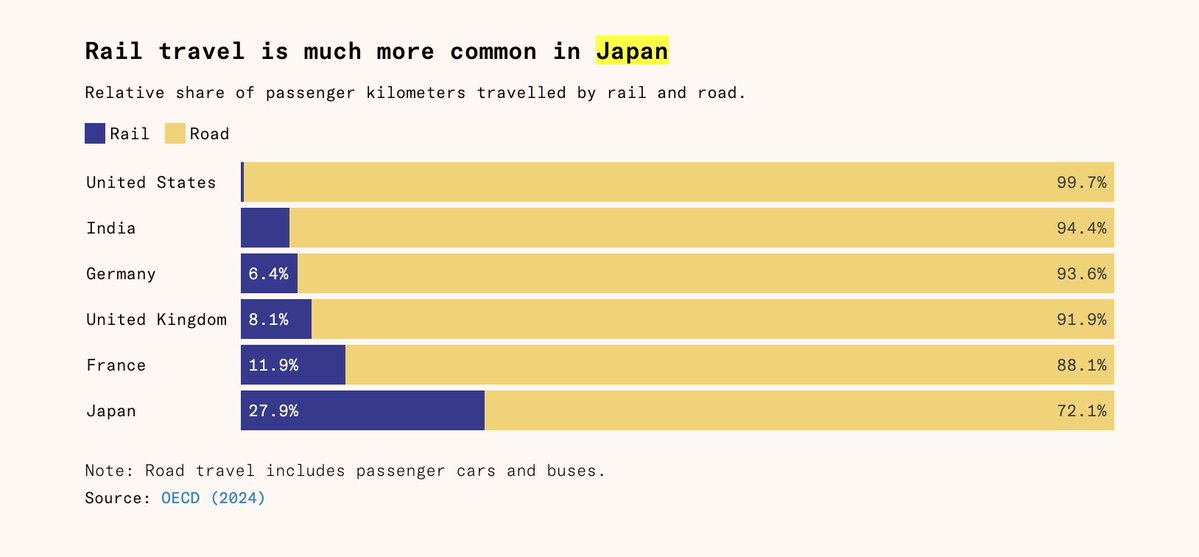
Japan has the world’s best railway system. 28% of Japanese passenger-kilometers are by rail. Germany manages 6.4%, and the USA manages 0.25%. Just one Japanese company, JR East, carries more passengers than China’s entire railway system, and four times as many than Britain’s. What is the secret of its success? worksinprogress.co/issue/why-japa… Part of the answer is that Japanese railway companies don't just operate trains. They run hospitals, supermarkets, department stores, amusement parks, office complexes, and retirement homes around their railway stations. One of them co-built Tokyo Disneyland. Another owns a baseball team. A third created its own all-women musical theater in 1914, which is still running today. The logic is elegant: a railway increases the developable value of land around its stations, but normally that value accrues to landowners, not the railway operator. Japanese railway companies captured this value by owning and developing the land themselves. About half of the revenue of Japanese railway companies comes from ‘side businesses’ like these. Allowing railway operators to capture more of the value they created meant that more lines were profitable, making a far larger system financially viable. This may sound like a radically novel approach. But in fact, an exactly similar system existed in nineteenth-century America. The success of Japanese railways does not lie in some unreplicable feature of Japanese culture: it lies in good policy. If they learnt the right lessons from it, many countries could replicate Japan’s success. Read more (much more) in @Borners1's & @carto_graph's new piece for @WorksInProgMag Issue 23.
Samuel Hughes tweet media
English
154
914
3.4K
660.5K
Matt Cowgill
Matt Cowgill@MattCowgill·
NOVEL IDEA: an Australian podcast about economics and the economy. Note: not about personal finance. Not about federal politics. Not about the daily gyrations in financial markets.
English
25
3
147
11.2K
Quiet_please MDANT 🙏
Quiet_please MDANT 🙏@retrobike_c16·
Finally got round to reading all of the biz case. Some of it was better than I expected. Some of it worse. I don't think the 'worse' bits are unchangeable, but once these things are published the project team is likely to defend them hard 🧵 smh.com.au/national/nsw/t…
English
7
7
44
6.9K
Brad Setser
Brad Setser@Brad_Setser·
Interesting piece from Bloomberg's Shuli Ren, on the risk that Asia's wildly undervalued currencies might have an explosive appreciation ... 1/3 bloomberg.com/opinion/articl…
English
4
34
262
47.8K
Christopher Luxon
Christopher Luxon@chrisluxonmp·
National wants to ensure Auckland can continue to grow to meet the needs of an increasing population. As New Zealand’s largest city, it is the engine room of our economy – and to keep housing affordable, there needs to be capacity to build more homes. However, Aucklanders have raised real concerns about housing intensification in suburban areas right across the city. I’ve listened to those concerns and as a result we are making changes. Today we have announced a significant 23% reduction in the housing capacity Auckland Council needs to make available – that's around 400,000 houses. That means there can be far less blanket intensification required in our suburbs. Because where we build matters – growth should happen where it makes sense. That’s in the CBD, town centres, and along the $5 billion City Rail Link corridor. Intensification shouldn’t be imposed indiscriminately across suburban neighbourhoods. Ultimately, how Auckland grows is for the Council and Aucklanders to decide. But today’s changes give the Council the flexibility to respond to the issues Aucklanders have raised, while ensuring there is more housing in the right locations. We all want a thriving Auckland that stands proud alongside other vibrant cities around the world.
English
161
11
83
53.2K
Ross Douthat
Ross Douthat@DouthatNYT·
This is the origin of the geopolitical situation in Gene Wolfe's Book of the New Sun -- x.com/JakeNomada/sta…
Jake Nomada 🌎@JakeNomada

The Southern Cone Thesis™ I predict the "Southern Cone" region of... - Argentina 🇦🇷 - Chile 🇨🇱 - Uruguay 🇺🇾 - Paraguay 🇵🇾 - Southern Brazil 🇧🇷 Will see *massive* growth here in the coming 5-10+ years Here's why: 1. Argentina's economic potential - this country was once one of the richest in the world. If Argentina turns around economically, the whole region booms 2. Safe haven - the Southern Cone is far, far from everything else. Middle east wars have no effect on life here. Russia-Ukraine conflict doesn't either. Someone drops a nuke, this region shall not be bothered. Oh, and the region features some of the low crime rates in LatAm 3. Unique, but not foreign - culturally, many westerners will feel some semblance of comfort in the region. While all these countries have unique cultures, many westerners will feel at ease and comfortable living here 4. Incredible cities - Buenos Aires 🇦🇷 is arguably the best city in LatAm on a number of levels. Santiago 🇨🇱 offers major benefits, many not found anywhere else in the region. Asuncion 🇵🇾 offers high quality of life for dirt cheap 5. Functional beach cities/towns - The handful of beach cities in this region of the world are actually functional, a rarity in LatAm. I'm talking amazing places like Punta del Este 🇺🇾 and Florianópolis 🇧🇷 6. World class tourism - Patagonia, both in Chile and Argentina, offers some of the best hiking and most stunning views in the world. Oh, and Easter Island 🇨🇱 is well worth a visit too 7. Tax benefits -- Both Paraguay 🇵🇾 and Uruguay 🇺🇾 offer strong tax incentives and benefits for expats willing to live there


English
18
12
166
52.2K
Out of Context Human Race
Out of Context Human Race@NoContextHumans·
A $20 trillion concept proposes a 3,400-mile underwater tunnel connecting London and New York, potentially reducing a 7-hour flight to a 1-hour train ride.
English
828
175
3.4K
2.5M
cinesthetic.
cinesthetic.@TheCinesthetic·
"Young Frankenstein is by far the best movie I ever made. Not the funniest - Blazing Saddles was the funniest, and hot on its heels would be The Producers. But as a writer-director, it is by far my finest." - Mel Brooks
English
131
618
6.8K
265.2K
Tom Harwood
Tom Harwood@tomhfh·
Yes we live better lives than twenty years ago. People in 1979 lived better lives than people in 1950. But that doesn't mean things were working well. Relative decline is bad. From 1945-1979 Britain grew by an average of around 2% a year. West Germany grew by around 4.5% a year. France grew by around 4% a year. So by 1979 Britain was richer than it was, but it was the sick man of Europe too. Britain grew in absolute terms, but in relative terms saw decline. In 1950, Britain was still far richer than West Germany. By some estimates West German GDP per capita was just 62% of that of Britain. But Britain chose the socialist route, while Germany opted for Ordoliberalism. By 1979, West German GDP was 25% *higher* than British GDP per head. Britain was richer than it was, but it had also significantly declined. To put it in context, the GDP of the state of California is greater than the GDP of the *entire world* fifty years ago. The GDP of the United States in 1950 around the size of the GDP of Kazakhstan today. If you grow slowly, sure you've grown. But you've been left in the dust by those that grew well.
CentristDad@CentristDad5

@tomhfh I think the “things are so bad” narrative is good for clicks but it’s far from truth. By any measure we live better lives than in the Blair years. Twitter/X is the upside down of our world. Just negativity without hope.

English
27
15
133
20.2K
Peter Tulip
Peter Tulip@peter_tulip·
Land tax is great in theory but bad in practice. I wish Georgists like @Prosper_Aust would try to remove the idiocies and unintended consequences that afflict our system of land taxes.
Howard Maclean@HowardFMaclean

Getting stuck in the weeds of the Lease Variation Charge system for the ACT, and screaming that the tax bill for a 10 unit development is often substantially higher than a 11 unit development, because of some insane tax design. What the hell are we doing here.


English
5
1
22
4.3K
bubble boi
bubble boi@bubbleboi·
Software is dead. Consulting is dead. Banking is dead. Big law is dead. Private equity is dead. Where do you go now as a slightly above average white boi?
English
1.7K
379
19K
2.4M
Markus J. Buehler
Markus J. Buehler@ProfBuehlerMIT·
How does an embryo reliably "compute" its form - "cell by cell" - using only local interactions and mechanics, yet produce a precise global body plan? I’m excited to share our Nature Methods paper "MultiCell: geometric learning in multicellular development", presenting #AIxBiology research led by @HaiqianYang and the result of a great collaboration with Ming Guo, George Roy, Tomer Stern, Anh Nguyen and Dapeng Bi. A long-standing challenge in developmental biology is to predict how thousands of cells collectively self-organize as tissues fold, divide, and rearrange. In MultiCell, we represent a developing embryo as a dual graph that unifies two complementary views of tissue mechanics with single-cell resolution: cells as moving points (granular) and cells as a connected foam (junction network). This lets the model learn dynamics from both geometry and cell–cell connectivity. On whole-embryo 4D light-sheet movies of Drosophila gastrulation (~5,000 cells), our model predicts key cell behaviors and the timing of events, including junction loss, rearrangements, and divisions with high accuracy, at single-cell resolution. Beyond prediction, the same representation supports robust time alignment across embryos and offers interpretable activation maps that highlight the morphogenetic "drivers" of development. The broader goal is a foundation for cell-by-cell forecasting in more complex tissues, and eventually for detecting subtle dynamical signatures of disease. Kudos to the team for this inspiring collaboration with brilliant researchers to push the boundary of AI for biology! Citation: Yang, H., Roy, G., Nguyen, A.Q., Buehler, M.J., et al. MultiCell: geometric learning in multicellular development. Nature Methods (2025), DOI: 10.1038/s41592-025-02983-x Code/data links are in the manuscript.
English
117
672
4.3K
387.3K
Drew Pavlou 🇦🇺🇺🇸🇺🇦🇹🇼
Jihadi sympathiser next to me at the hardware store was shouting into his phone that the Bondi terror attack was a Jewish false flag so I confronted him Get the hell out of my country, go home.
English
1.8K
3.9K
32.9K
1.1M
Richard Hanania
Richard Hanania@RichardHanania·
Sometimes people will say East Asia developed due to industrial policy. I investigate this claim, through a careful sifting through the data and a review of the most famous book making this argument, How Asia Works by Joe Studwell. Once we look at cognitive test scores, we see East Asians underperforming in terms of wealth. Among major East Asian states that have developed, Korea does the worst and Taiwan the best, which is the opposite of what Studwell argues. He likes Korean industrial policy the best, but it is a massive underperformer. In fact, his book contains an error when it says that Korean GDP per capita was higher than Taiwan, as it did not control for purchasing power parity. Taiwan was already ahead in 2013, when the book was published, and it's pulled ahead further since. Moreover, the things East Asians did have been copied to a large extent by countries like Ethiopia. Studwell can always come up with a theory as to why other countries didn't do industrial policy exactly right. But he has no explanation as to why Northeast Asians all happen to select the right policy and competently pull off the execution. "East Asians are more productive under a market economy" is a much simpler and better supported theory than "East Asians by a remarkable coincidence always figure out the exact right policies that no one else can." When Studwell tries to come up with reasons Northeast Asians knew what to do, the attempts are almost comical, like when he tells us that on a Malaysian leader's tour of Northeast Asia, they refused to tell him the real secret of success. There's no reason I can see to credit industrial policy with East Asian development. Hong Kong, Singapore, and Taiwan have had the least intervention with the market, while China and arguably South Korea have had the most. The former countries are a lot wealthier. This matters a lot because industrial policy is the last stand of central planning. The collapse of the USSR discredited socialism, but the idea that government needs to manage the economy is said to be supported by East Asian success. Of course, Studwell explicitly denies that his ideas apply to advanced economies, so even if his thesis were correct, American advocates of industrial policy would still be wrong. Just another example of how intellectually empty economic populism is. More here, with many charts and graphs: richardhanania.com/p/human-capita…
English
18
37
312
56K