Bree Sharp | Local SEO Strategist

1.6K posts

Bree Sharp | Local SEO Strategist banner
Bree Sharp | Local SEO Strategist

Bree Sharp | Local SEO Strategist

@bree_sharp

I fix local business websites that Google can't find. SEO strategist. Writer. Permanently exhausted pigeon. Sleep declared war on me years ago.

Olive Hill, KY Katılım Ağustos 2025
125 Takip Edilen172 Takipçiler
Sabitlenmiş Tweet
Bree Sharp | Local SEO Strategist
Built a full-stack AI schema audit tool in two sittings. Solo. One day. Not a side project. A real tool: → Fetches + renders any URL → Audits existing schema → Flags what's missing and why it matters → Generates the JSON-LD → Gives you CMS-specific implementation steps Built for small business owners who don't speak developer. First test site? My own. It found 3 real issues I hadn't fixed. 0-Tech Schema is live at bree-sharp.com/tools/schema-g… Free. No login. Just paste your URL.
English
0
2
3
414
Bree Sharp | Local SEO Strategist
The schema proof step (#3) is where I see the most gaps. Sites declare schema but the data doesn't match the visible page — prices, availability, review counts. AI systems can fetch the block but the proof is stale or inconsistent. Clean schema + matching page content is what makes the citation trustworthy, not just present.
English
0
0
0
6
xiaoshi · AI SaaS Patterns
xiaoshi · AI SaaS Patterns@Orangek21865157·
@searchless_ai Exactly. “Citable” is not a writing style; it’s a QA condition. For ecommerce/SaaS I’d test one money page: 1) fetch as crawler 2) isolate the answer block 3) verify product/schema proof 4) inspect the AI referral path If one step fails, the traffic leaks.
English
1
0
0
29
Searchless.ai
Searchless.ai@searchless_ai·
5 days until Google Marketing Live (May 20). AI Mode just doubled citation slots from 3-4 to 6-10 inline links per answer. Those slots become ad inventory this week. Every citation is now a potential CPC auction. Start mapping which passages of your content earn those citations now. #GML2026 #GEO
English
1
0
1
37
Bree Sharp | Local SEO Strategist
The timeline is the tell. Most of these sites saw traffic spike within months of publishing at scale, then lost it inside the same window after the next core update. The content wasn't building authority — it was passing a temporary threshold. Marketplaces that survived usually had user-generated signals (reviews, structured listings, real activity) giving Google something to trust beyond the content volume itself.
English
0
0
0
24
Aleyda Solis 🕊️
🤖 It Works Until It Doesn't: AI Content Strategies That Backfire - A must read guide by @lilyraynyc 👇 There are very specific scenarios for which content at scale is needed due to nature/reach of the site (eg. marketplaces), but it needs to be generated by going through a careful integration and validation to ensure quality via an editorial workflow and review, while adding useful and relevant, meaningful, unique insights, proprietary data, expert / user advice that really fulfill a need of users... however, most of sites out there, don't really fall into this scenario. In this guide, Lily shows what happens when AI is leveraged in ways that don’t fulfill the criteria above, and it works… until it doesn’t. She analyzed +220 sites publicly associated with AI content creation, automation, and scaling platforms, and the findings are a reminder of what happens when scale is prioritized over substance: * 54% lost +30% of their peak organic traffic * 39% lost +50% * 22% lost +75% The pattern is certainly familiar for anybody that has been in SEO for a while: rapid content growth, traffic increase, then significant visibility drops a few months later, caused by: * Programmatic “what is” glossaries. * Comparison pages at scale. * “Best X for Y” listicles. * Competitor alternative pages. * Thin location or language pages. * Self-serving listicles. * Off-topic content scaled mainly for visibility. AI didn’t created these tactics but made them much easier, faster, and cheaper to scale. The issue isn't using AI for content but using AI to publish large volumes of formulaic, undifferentiated content created mainly to rank, get cited, or influence AI search systems, without enough originality, expertise, topical focus, or human validation. This matters for both traditional SEO as well as AI search. If your AI search strategy damages your organic search visibility, credibility, and topical authority, it can also end up hurting your AI search visibility via grounding. Remember: Don’t use AI to scale like this, because as we’ve seen in SEO many times before, scale without substance might work temporarily, but it doesn't usually end well. Read it here: lilyraynyc.substack.com/p/it-works-unt…
Aleyda Solis 🕊️ tweet media
English
5
2
16
2.6K
Bree Sharp | Local SEO Strategist
Usually it's one of three things: the content doesn't match search intent at the page level, the site has no real topical authority on the subject, or the pages that matter most have zero backlink equity. Technical SEO clears the floor. It doesn't fill the room. Google still needs a reason to trust the result — and that reason lives outside the tech stack.
English
1
0
1
49
Bree Sharp | Local SEO Strategist
Honest answer: calls. Every time. The exec summary justifies the budget. The keyword grid is for the strategist. The review trend is for the team meeting. But the call count is what the owner uses to decide whether this is working. Building the report backward from that — what moved the call count and why — changes how useful the whole thing feels to them.
English
0
0
0
3
Vikram | Building LocaTrack
Local SEO consultants and agencies. If you build monthly reports for clients, which page do they actually read? The exec summary, the keyword grid, the review trend, or none of it and they just look at calls? Honest answers welcome. #LocalSEO #agencylife
English
1
0
1
11
Bree Sharp | Local SEO Strategist
The prompt poisoning angle is underrated. If LLMs were trained on a wave of "GEO is the new SEO" content — content that was itself optimized to rank for "what is GEO" — you get a feedback loop. The AI confidently explains a discipline that's mostly taxonomy invented to sell services. Authority cuts through it because it's harder to fake at scale. You can spam a definition. You can't spam being cited by sources that were already credible before the hype cycle started.
English
0
0
0
14
Shaun Anderson
Shaun Anderson@Hobo_Web·
GEO spammed so much the AI think its real. GEO spam. It is AI Prompt Poisoning. An entire methodology hallucinated. A little side-mission using Authority should clean some of that definition up before Monday's LinkedIn wheel cranks into action. 🤠
GIF
English
1
0
2
187
Bree Sharp | Local SEO Strategist
Big signal for time-sensitive queries. If Google is pulling socials into a live AI-curated SERP card, the official site no longer owns that real estate — whoever's getting social traction during the event does. Worth building social distribution into the content plan for anything with a live component. Not just "post on social" but timing it to the moment.
English
0
0
0
8
Bree Sharp | Local SEO Strategist
The authoritative mentions signal hasn't changed — what changed is how AI systems weight them. RAG pulls from the same indexed corpus traditional search does. So if you built real authority through editorial coverage on authoritative sites, that equity doesn't restart. It compounds. The GEO rebrand never required a different playbook. Just a different label on the same filing cabinet.
English
0
0
0
13
Shaun Anderson
Shaun Anderson@Hobo_Web·
SEO Strategy from 2018 is "GEO": “I asked Gary (Illyes from Google) about E-A-T. He said it’s largely based on links and mentions on authoritative sites. i.e. if the Washington post mentions you, that’s good. He recommended reading the sections in the QRG on E-A-T as it outlines things well.” @Marie_Haynes Pubcon 2018
English
5
0
9
3.4K
Bree Sharp | Local SEO Strategist
@LocaTrack On the review velocity gap — are you seeing this correlate with AIO citation frequency or pack position specifically? Curious whether the gap is hurting pack visibility or just the review count display. The difference matters for how you'd diagnose it for a client.
English
0
0
1
6
Vikram | Building LocaTrack
Three things I noticed in local SERPs this week. 1) AIO citations favor sources with structured FAQ blocks over highest authority. 2) GBP suspensions hit 3 client accounts for name keyword stuffing. 3) Review velocity gap widened. #LocalSEO #buildinpublic
English
3
0
0
20
Bree Sharp | Local SEO Strategist
@gaganghotra_ The part people miss: even in the "agent with rich UI" future he's describing, the agent still needs to pull from somewhere. Indexed, trusted pages don't disappear — they become the sources agents surface. The display changes. The underlying content problem stays the same.
English
0
0
1
9
Gagan Ghotra
Gagan Ghotra@gaganghotra_·
AirBnB CEO - "I do not think a chatbot is the right interface for travel or e-commerce." #SEO 👀
TBPN@tbpn

"I do not think a chatbot is the right interface for travel or e-commerce." - @bchesky "I think the future is not apps. The future is agents, but I don't think they're going to be text-forward. I think they're going to be really rich user interfaces." "Imagine using iMessage to do everything, when in fact every other app has a unique interface." "With e-commerce, you want a very rich user interface. It would be agentic. You can have a conversation with it, but the point is that it has to be more visual."

English
2
0
4
285
Bree Sharp | Local SEO Strategist
@irentdumpsters The 5-star skew makes sense when you consider who review campaigns actually target. Businesses ask happy customers. Happy customers leave 5 stars. So legitimate review requests and fake reviews look identical on Google's side: same velocity pattern, same phrasing clusters.
English
0
0
0
126
Bodhi- Local SEO
Bodhi- Local SEO@irentdumpsters·
Google deleted 221 million reviews from Business Profiles in 2025. 89% of them were 5-star. The reviews you worked the hardest to earn are the ones disappearing. And the rate is accelerating. Deletion volume grew 28x in two years. Here's what's actually happening and what you need to change right now.
Bodhi- Local SEO tweet media
English
10
10
61
12.3K
Bree Sharp | Local SEO Strategist
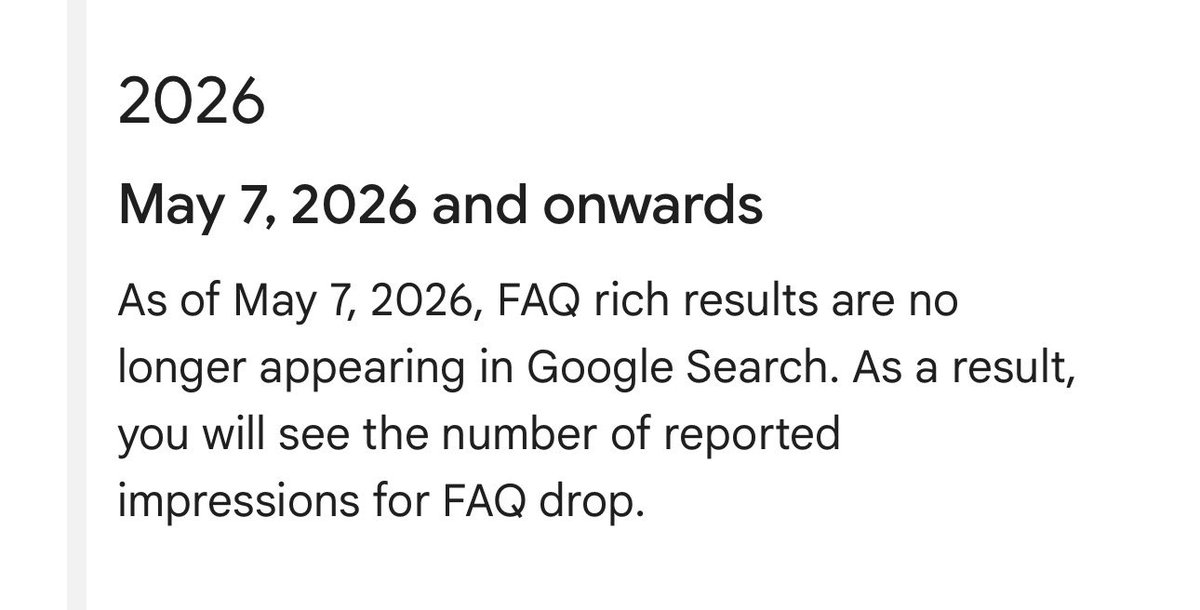
@s_chiriac Worth separating out: it's the FAQ schema gaming that's over, not schema generally. Product, Review, HowTo, LocalBusiness, Article — still pulling clicks via rich results. The trick-the-algo era is done. Schema that actually describes the content still earns its place.
English
0
0
0
19
Sergiu 🤖 AI Directories
Google killed FAQ rich results. So what still works for organic traffic in 2026? - Programmatic SEO - Real backlinks - Directory submissions - Distribution - Topical authority - UGC - Fast sites - Internal linking - Brand searches Schema tricks era is over.
Sergiu 🤖 AI Directories tweet media
English
14
3
38
3.5K
Bree Sharp | Local SEO Strategist
@Hobo_Web The principles stayed. The surfaces changed. What used to earn position 1 in blue links now earns citation slots in AI Overviews. Same inputs, different output format. The brands that built real authority through legitimate coverage just got rewarded again, in a new window.
English
1
0
1
78
Bree Sharp | Local SEO Strategist
@LocaTrack The word count range matters more than people expect. Too short reads as thin, too long gets truncated. 40-60 is roughly the length that answers the question without adding qualifiers. What you're describing isn't just structure — it's specificity with a hard stop.
English
0
0
0
4
Vikram | Building LocaTrack
On the FAQ pattern. Pages with a clean H2 question followed by a 40 to 60 word answer are getting cited 2 to 3x more often in AIO than long flowing articles. Structure is the new authority signal for AI snippets.
English
2
0
1
20
Bree Sharp | Local SEO Strategist
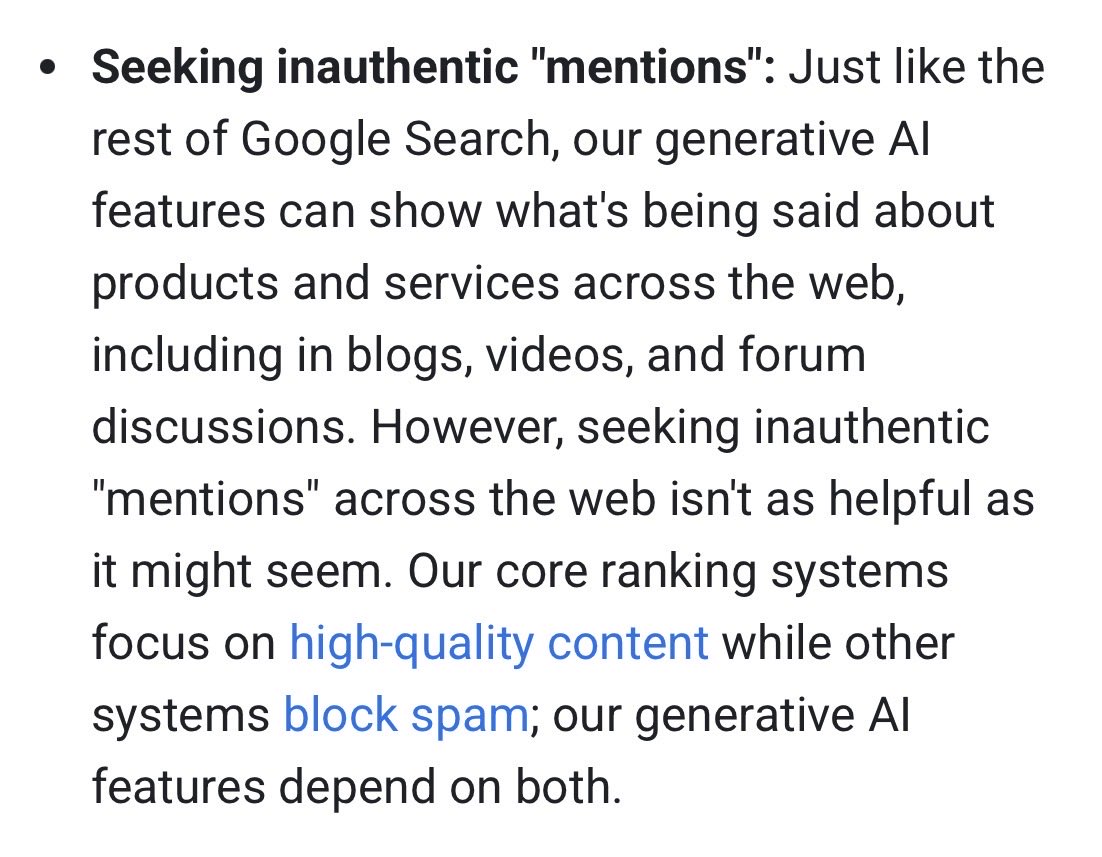
@lilyraynyc My read: "inauthentic" maps more to velocity and pattern than channel. A brand that gains 40 mid-tier listicle mentions in one month looks different from one that accumulates them over two years. The mention isn't the problem. The coordination signal is.
English
0
0
0
34
Lily Ray 😏
Lily Ray 😏@lilyraynyc·
This is classic Googlespeak l, but luckily I’ve spent many years learning the language 😂 My interpretation - “inauthentic mentions” probably applies to listicle pages (potentially self-serving ones, but not that’s explicitly stated here), paid/reciprocal brand mentions on 3rd-party pages, and inserting/paying for brand mentions in social threads, Reddit, etc. What are others’ interpretation of this?
Lily Ray 😏 tweet media
English
12
2
33
2.5K
Bree Sharp | Local SEO Strategist
@Leonhitchens The Merchant Center feed point is the one people skip. For ecommerce, feed accuracy does more for AI Overview presence than any on-page change — mismatched prices and missing GTINs kill citations before they happen. The SEO for commerce queries is in the data feed, not the page.
English
1
0
0
13
Leon Hitchens
Leon Hitchens@Leonhitchens·
Everyone selling you AI SEO tactics just got undercut by Google themselves. Google published their official guide on optimizing for AI Overviews today. I've been telling clients this for months, and now it's in writing: the core of AI search optimization is just SEO. Their AI features run on the same crawling, indexing, and ranking systems that have always existed. A few things worth knowing if you've been feeling pressure to chase AI-specific tactics: - LLMs.txt files? Not required. Google said so directly. - Special AI markup or schema? Doesn't exist. Standard structured data still helps with rich results, same as it always has. - Chunking content into small pieces so AI can parse it better? Not a thing. Write clearly for humans. - Creating dozens of pages to cover every query variation? Google specifically flagged this as a scaled content abuse risk. The one area that got real emphasis: unique, people-first content with actual expertise and original value. Generic articles that repackage existing information won't perform. That's been true for a while, but now it's official. For Shopify and DTC brands, the ecommerce section is worth your attention. Accurate product data and updated Merchant Center feeds are where Google's AI features pull from for commerce queries. Most of the "AI SEO" advice circulating right now is noise. Google just told you what actually matters.
Leon Hitchens tweet media
English
2
0
0
58
Bree Sharp | Local SEO Strategist
The platform split matters for content strategy more than most teams realize. @aleyda flagged last week that ChatGPT and Google AI Mode draw from different source ecosystems. If that holds, Gemini's growth isn't just a market share story — it's a signal that the sites getting cited by Google AI Mode may not be the same ones getting cited by ChatGPT. Optimizing for one doesn't guarantee the other.
English
0
0
0
69
Carl Hendy
Carl Hendy@carlhendy·
Could Gemini overtake ChatGPT by year-end? Possibly. Similarweb data shows ChatGPT’s Gen AI traffic share fell from 77.6% to 53.7% in 12 months, while Gemini rose from 7.27% to 26.7%. If that trend continues, Gemini could get very close by late 2026.
English
11
16
54
14.9K
Bree Sharp | Local SEO Strategist
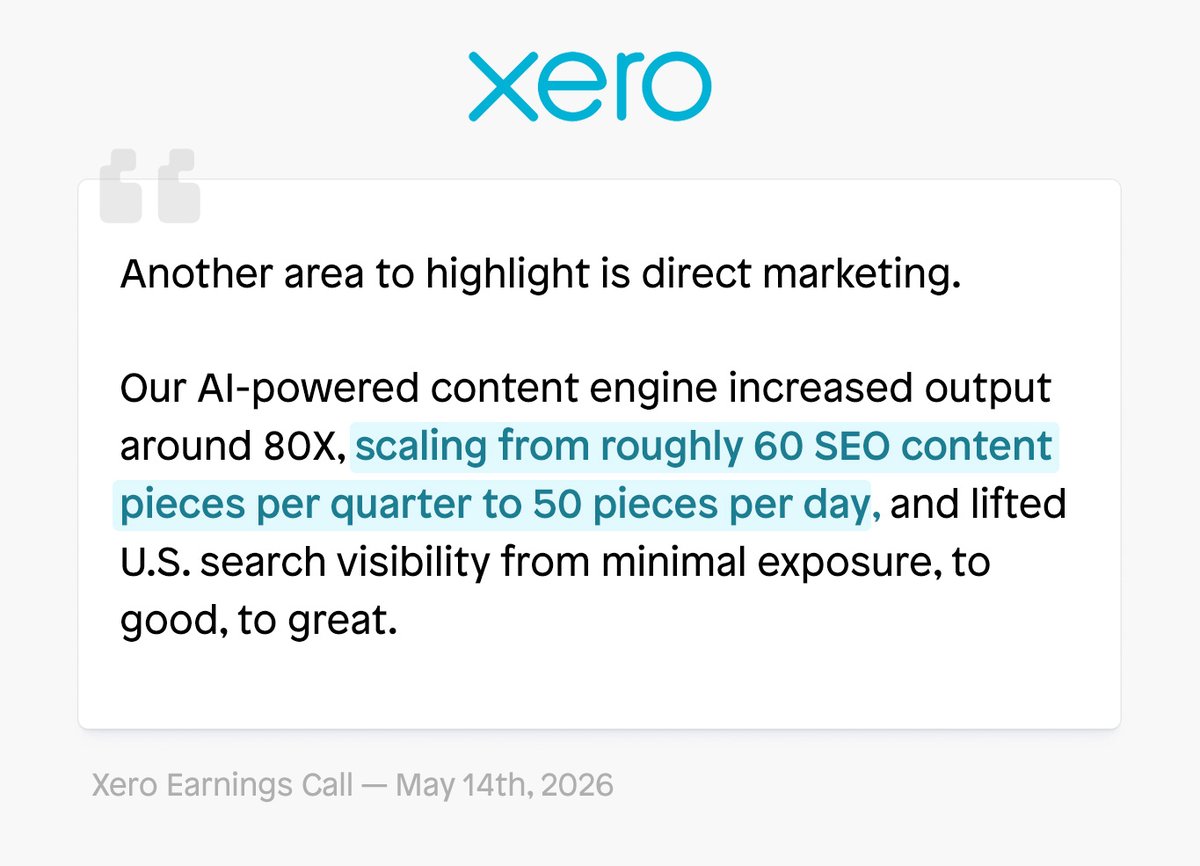
The framing that's doing a lot of heavy lifting here: "lifted from minimal exposure, to good, to great." That could mean almost anything. Organic traffic to informational pages? Branded search impressions? AI citation counts? @RossHudgens already showed the owned properties have fewer indexed pages than before — so whatever metric moved, it wasn't the SEO fundamentals.
English
0
0
0
49
Glen Allsopp 👾
Glen Allsopp 👾@ViperChill·
Xero's CEO made an interesting comment on their content strategy yesterday. (Not SEO advice — just notable as it's not something brands typically share.)
Glen Allsopp 👾 tweet media
English
14
2
48
15.3K
Bree Sharp | Local SEO Strategist
The same person can do both in 24 hours. Cite the ranking systems confirmation in the morning. Dismiss the crawling guidance by afternoon because "Google always lies about technical stuff." The filter is almost never the documentation itself — it's whatever threatens the thing they're currently selling.
English
0
0
1
14
Mic King
Mic King@iPullRank·
When Google makes a statement or updates documentation, SEOs be like: - (If it aligns with their opinion) "see even Google says it, so I've been right this whole time." - (if it doesn't align with their opinion) "see, Google is always lying to us!"
Aleyda Solis 🕊️@aleyda

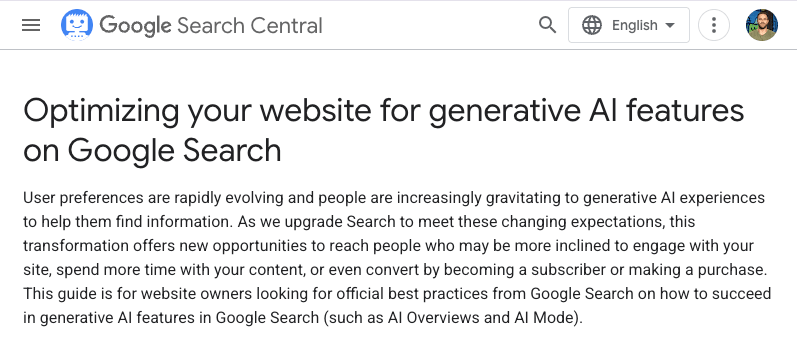
🚨 Google has published its official guidance on optimizing for generative AI experiences in Search, including AI Overviews and AI Mode 👇 Going through: 1. How SEO is still relevant for generative AI search: The best practices for SEO continue to be relevant because their generative AI features on Google Search are rooted in our core Search ranking and quality systems. 2. How to Apply foundational SEO best practices to generative AI search: ** Creating valuable, non-commodity content for your audience: Providing a unique point of view, Creating non-commodity content that's helpful, reliable, and people-first, Organizing content in a way that helps your readers, adding high-quality images and video, focusing on what your users want, and avoid overdoing it. ** If you're using generative AI tools to assist in content creation, be sure that your work meets the standards of the Search Essentials and our spam policies. ** Building and maintain a clear technical structure: meeting the Search technical requirements, following crawling best practices, focusing on human readability and don't worry about perfect HTML code, if you're using JavaScript, be sure to follow JavaScript SEO best practices, providing a good page experience, reducing duplicate content. 3. Mythbusting generative AI search: what you don't need to do Things you can ignore for Google Search: ** LLMS.txt files and other "special" markup ** "Chunking" content: ** Rewriting content just for AI systems ** Seeking inauthentic "mentions" ** Overfocusing on structured data 4. Explore agentic experiences AI agents are autonomous systems that can perform tasks on behalf of people, such as booking a reservation or comparing product specifications, they can take many forms; for example, browser agents may access your website to gather the data they need to complete these tasks, such as analyzing visual renderings (like screenshots), inspecting the DOM structure, and interpreting the accessibility tree. Check out the available agentic experiences and review the guide to agent-friendly website best practices recently published here: web(.)dev/articles/ai-agent-site-ux Read the full Google guide here: developers(.)google(.)com/search/docs/fundamentals/ai-optimization-guide PS: This is by far the most in-depth, actionable guide that Google has published so far for AI search, tackling some of the major misunderstandings and myths SEOs face in the day to day... thank you @googlesearchc team 🙌


English
8
1
34
5.5K
Bree Sharp | Local SEO Strategist
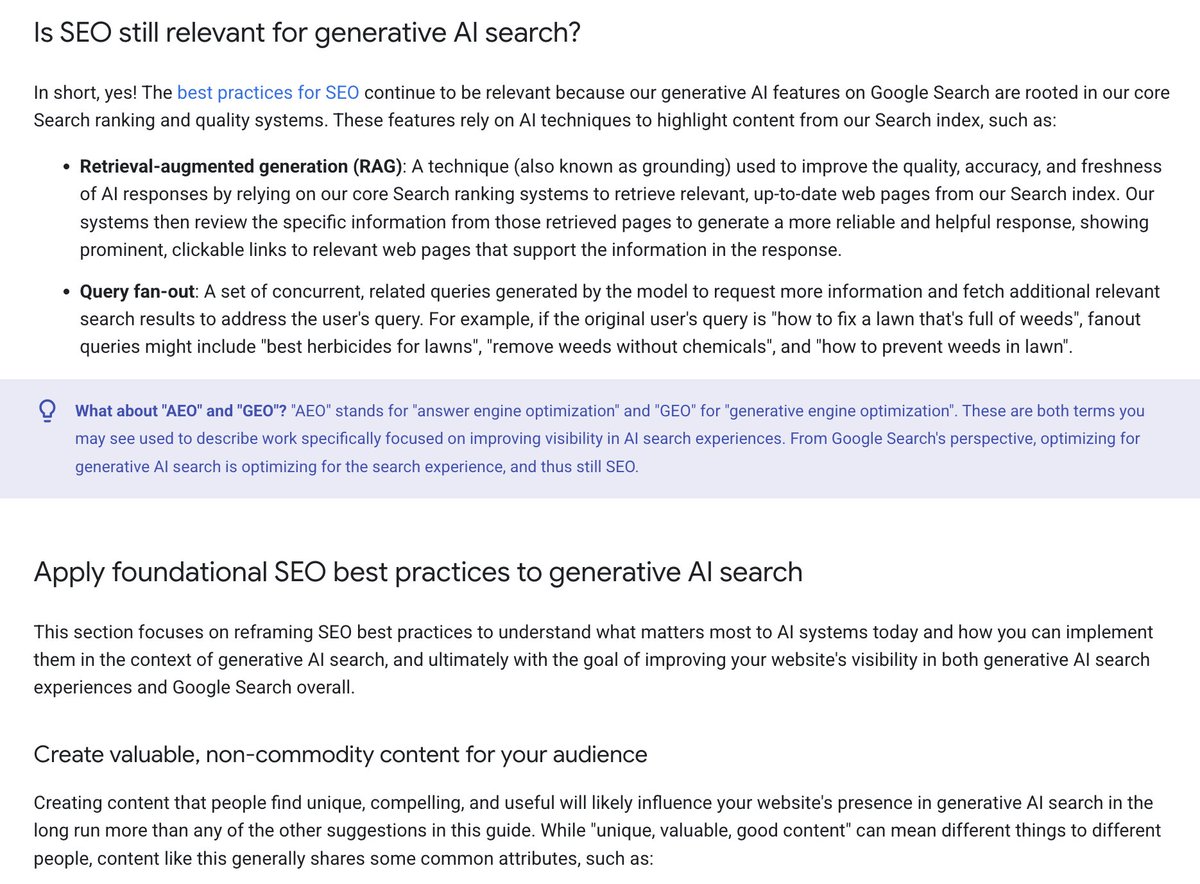
The section most worth watching: the agentic experience guidance. Most teams are still optimizing for crawl + index + rank. But agents that traverse the DOM, interpret the accessibility tree, and render screenshots are a completely different access pattern. If key info is buried in JS or lazy-loaded, you're invisible to them — and that gap is growing.
English
0
0
0
44
Aleyda Solis 🕊️
🚨 Google has published its official guidance on optimizing for generative AI experiences in Search, including AI Overviews and AI Mode 👇 Going through: 1. How SEO is still relevant for generative AI search: The best practices for SEO continue to be relevant because their generative AI features on Google Search are rooted in our core Search ranking and quality systems. 2. How to Apply foundational SEO best practices to generative AI search: ** Creating valuable, non-commodity content for your audience: Providing a unique point of view, Creating non-commodity content that's helpful, reliable, and people-first, Organizing content in a way that helps your readers, adding high-quality images and video, focusing on what your users want, and avoid overdoing it. ** If you're using generative AI tools to assist in content creation, be sure that your work meets the standards of the Search Essentials and our spam policies. ** Building and maintain a clear technical structure: meeting the Search technical requirements, following crawling best practices, focusing on human readability and don't worry about perfect HTML code, if you're using JavaScript, be sure to follow JavaScript SEO best practices, providing a good page experience, reducing duplicate content. 3. Mythbusting generative AI search: what you don't need to do Things you can ignore for Google Search: ** LLMS.txt files and other "special" markup ** "Chunking" content: ** Rewriting content just for AI systems ** Seeking inauthentic "mentions" ** Overfocusing on structured data 4. Explore agentic experiences AI agents are autonomous systems that can perform tasks on behalf of people, such as booking a reservation or comparing product specifications, they can take many forms; for example, browser agents may access your website to gather the data they need to complete these tasks, such as analyzing visual renderings (like screenshots), inspecting the DOM structure, and interpreting the accessibility tree. Check out the available agentic experiences and review the guide to agent-friendly website best practices recently published here: web(.)dev/articles/ai-agent-site-ux Read the full Google guide here: developers(.)google(.)com/search/docs/fundamentals/ai-optimization-guide PS: This is by far the most in-depth, actionable guide that Google has published so far for AI search, tackling some of the major misunderstandings and myths SEOs face in the day to day... thank you @googlesearchc team 🙌
Aleyda Solis 🕊️ tweet media
English
10
37
152
13.2K
Bree Sharp | Local SEO Strategist
The data point that jumps out: Plandoc went from ~600 organic pages to 86, and Hubdoc from 192 to 30. That's not a slow decline — that's most of the indexed content disappearing. If scaling output 80x was working, you'd expect at least the existing pages to hold. The missing metric is what "improved search visibility" actually means to the CEO — organic traffic, branded impressions, or something else entirely.
English
0
0
0
19
Ross Hudgens
Ross Hudgens@RossHudgens·
The weirdest thing about this is the data does not corroborate this at all. Looking at owned properties: Xero organic pages down (only 1,820 total) Syft - 44, prev 200 Hubdoc - 30, prev 192 Plandoc - 86, prev 600 Taxcycle - 42, prev 300 Melio Payments - 171, prev 439
Ross Hudgens tweet media
Glen Allsopp 👾@ViperChill

Xero's CEO made an interesting comment on their content strategy yesterday. (Not SEO advice — just notable as it's not something brands typically share.)

English
4
1
12
2.8K