

Bhaktavaschal Samal
7.3K posts

Bhaktavaschal Samal
@bspectacledGOAT
As long as I offer an abundance of solutions in artificial intelligence, so long I’m alive; a lack of solutions will foreshadow my extinction.
Bhubaneswar Katılım Mayıs 2024
1.1K Takip Edilen439 Takipçiler

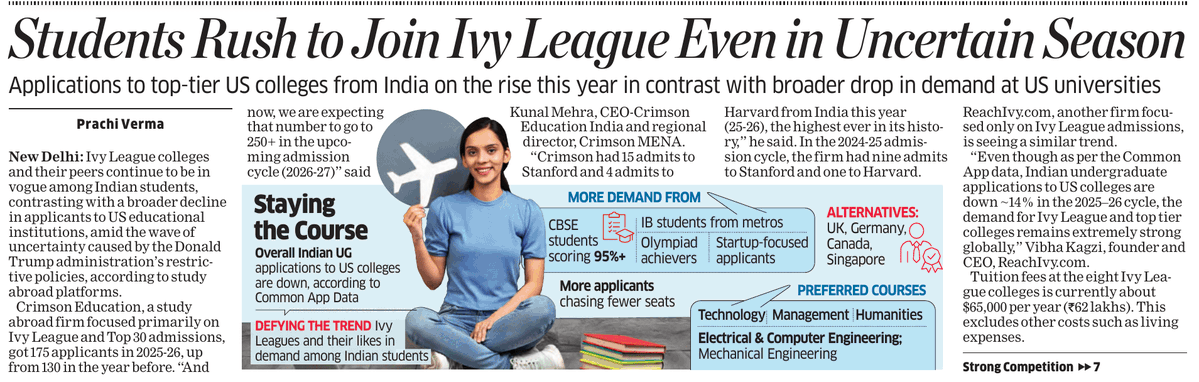
Why Indian students are still chasing Ivy League seats in an uncertain US season
Overall, Indian undergraduate applications to US colleges may be down, but demand for Ivy League and top-tier institutions remains strong.
English


@edenchan @forwarddeploy @amytam01 good to be a samosa and chai lover
like i was in college, even in high school!
English


@pmddomingos if you measure by market caps
openai and anthropic are native ai cos
but google is not!
English
Who’s winning the AI race? In the last year OpenAI’s and Anthropic’s valuations increased by hundreds of billions, but Google’s market cap increased by trillions.
English
@DrDatta_AIIMS not
just sometimes frustration comes in
and movie is the only resort
basically i am loner
i prefer to be!
my books computers are my best friends!
English

Bohot ho gaya ye hustle
Movie dekhna hai
हिन्दी

Kids in STEM whose parents are also in STEM have a huge privilege.
English

luck plays a far bigger role in success than people admit.
NDTV@ndtv
Narayana Murthy trashes AI as hype, asks IT leaders to be less greedy ndtv.com/india-news/nar…
English

@bspectacledGOAT No offense taken. Even talent can be called luck anyways. Where does it come from? If it is genes or Gog gifted, then it's not in our hands.
We should focus on what is on our hands. That is hard work.
English
IIT Delhi to IIM Bangalore to IAS. I got the best education my country had to offer. It taught me how to crack tough exams and manage big responsibilities. But it never taught me how to quiet my own mind or handle loneliness. We spend many years learning how to achieve, but not a single day learning how to be happy.
My thoughts on what is missing in school education.
Emotional Regulation:
We memorized the periodic table, but no one explained the chemistry of a broken heart. School demanded we stay quiet, confusing silence with peace. Now, we don't know how to host our own storms without drowning in them. We feel lost because we were taught to suppress, not to process.
Deep Communication:
We were taught to write perfect essays, but not how to say "I’m hurting" or "No." While there is a strong emphasis on communication, we are not taught the vocabulary of the adult life. There is no course on how to stand our ground in face of bullying by a boss or how to protect our work boundaries by saying 'No'
Critical Thinking:
In school, the person with the most answers won. In life, the person with the most questions survives. This is the reason many adults can repeat opinions confidently without ever questioning where those opinions came from. We are told everything as the gospel truth. So we end up just following blindly
Financial Literacy:
We spent years learning maths and solving for x, but never learned how to keep ourselves from falling in a debt trap. Money isn't just about math; it’s about the dignity of choice. We do not learn how to use debt effectively without it controlling our freedom. How impulsive spending compounds over time, or how money affects stress, relationships, and mental peace. Financial literacy is missing because education often focuses on earning money someday, not managing it wisely once it arrives.
Self-Discipline
School is a world of bells and schedules. Someone else always tells you what to do and when. But adulthood is a world of total silence. We feel stuck because we were never taught how to push ourselves without a teacher watching. Discipline is simply the habit of keeping promises to yourself. This is a habit many of us are lacking
Handling Loneliness
In school, you are always shrouded by people. You never realize how loud the silence of adulthood can be until you’re in it. We feel lonely because we weren't taught how to be our own best friends. Peace is learning that being alone doesn't mean being lonely. It is a sacred space, not a sign of being unwanted.
Reading People
School is a time of innocence where friendships are often given to you. But as we go along, not everyone retains that purity. We feel cheated because we weren't taught to see the hidden intentions or the masks people wear. Reading people is the quiet wisdom of seeing the truth behind the words.
Mental Health Maintenance
We have gym class for our bodies, but nothing for our souls. We are taught to push through exhaustion to finish a project, which is exactly how we end up in burnout. Honoring your nervous system is the only way to make sure the light inside you doesn't go out. We should know when we are dealing with a stressor and unable to handle it anymore. We should know when to reach out for help if we feel that we are drowning in that distress
Knowing Yourself
We spend years trying to be the "best" student, only to realize we don't know who we are without a gold medal. We are left inadequate because we studied every subject except our own souls. The ultimate education is discovering what truly matters to you before the world tells you what to want.
English
grand gesture
He solved Irodov physics for IIT aspirants in his 70’s… even 3 days before he left us he solved calculus problems for his granddaughter in the US!!
i do not know Irodov physics problems were also famous among the engineering aspirants beofe i was born!
i had bought this for my daughter also in 2023
but she had other things in mind!
she was in a different world than papa's Irodov and Resnick–Halliday!
English

Remembering Appa on his 80th!
Finest and brightest of men!
Sorely missed by us all……
Small town boy from Thirukurungudi (a village in TN)…Tamil medium!
Someone told his dad “your son is a bright kid - he should write the entrance exams of this new engineering institute in Chennai”
Clueless about its stature this skinny lanky Tamil lad just walked into IIT Madras in the 60’s! …
Read Carl Sagan and PG Wodehouse, learnt to use the fork, watched “God Father” in its open air theatre, mastered language enough to write poetry and satire, won the gold medal in Mech Engg in BTech! He also rode a Java…..
Built HMT and then AMS… His mechanical engineering designs / problem solving skills were sought after by peers across the country until he passed!
He solved Irodov physics for IIT aspirants in his 70’s… even 3 days before he left us he solved calculus problems for his granddaughter in the US!!
Roamed around in his Banian and veshti making world class uttappam for his grandkids, with no airs about how big a genius he was!
Our biggest regret…. None of us inherit his genius!!
#fathers #dads

English
@sean_a_mcclure have a few Feymann books
hardly get time to read though!
English


@kaushikcbasu still remember his first song "Oh Sanam"
may be it is three decades now
and i was in college
three years into engineering!
i still hum!
English


nexus- an incredibly good demonstration that structured, multi agent decomposition lets LLMs forecast numerical time series better than monolithic prompting
and in some settings, better than specialized numerical models
paper to my reading is not a redefinition of time series; it is a practical framework that respects the statistical definition while expanding the input modality from numbers only to numbers plus text
main limitation is the narrow evaluation scope, leaving open the question of whether the approach scales economically and across diverse forecasting task
benchmark scope is narrow: only Zillow and seven stock tickers and authors themselves acknowledge that paired timestamped numerical-plus-text datasets are scarce,
and that the evaluation is limited to these two domains
still an important paper because it formalizes the direction you were pointing toward
so far as i am concerned, it does not redefine time series as unstructured data.
rather, it says real world forecasting often requires a numerical time series plus unstructured contextual evidence, and that LLM agents can structure and reason over that evidence!
there can be many weaknesses but let is celebrate the strength!
Rohan Paul@rohanpaul_ai
New Google paper: A forecast needs context, not just history. Some patterns are caused by events, not time. Nexus reframes forecasting as a reasoning problem, where events and numbers have to explain each other. Nexus argues that forecasting improves when models read the world around the numbers, not just the numbers themselves. In the Zillow tests, one Claude-based version cut average MAPE by 86.6% versus direct chain-of-thought prompting. That matters because most time series models are fluent in pattern, but mute about cause. A housing inventory curve can reflect seasonality, mortgage pressure, migration, layoffs, and local supply, while a stock price can be bent by earnings, regulation, hype, and fear. Nexus separates those jobs instead of asking one prompt to do everything. One agent turns messy historical text into a clean event timeline, one reads the broad regime, another tracks local shocks, and a synthesizer reconciles them with calibration from past errors. The interesting result is not merely that context helps, but that structure helps the language model use context without losing the time series. The evidence is still narrow: Zillow counts, seven equities, post-cutoff data, and single-run evaluations, so this is not a universal law of forecasting. But the direction is clear: future forecasters will not only extrapolate curves; they will argue about what made the curve move. ---- Paper Link – arxiv. org/abs/2605.14389 Paper Title: "Nexus : An Agentic Framework for Time Series Forecasting"
English
If you talk about GDP per capita, it is at best an average. The actual distribution can range from one dollar to billions, so the average hides extreme inequality.
For someone living on one dollar a day, the struggle for survival is permanent, and escaping poverty within a lifetime is almost impossible.
Think of the millions in India who live below one dollar per day. Some of them are genuinely gifted, but they never have the resources to even pay the exam fee for an AIIMS entrance test, let alone afford basic textbooks in mathematics, physics, biology, or chemistry.
In such a context, one success story is not enough. A country of India’s scale needs millions of people to succeed, not isolated examples.
English

So much talent. He could have easily started an industry disrupting startup. Yet he didn’t.
India is at that inflection point where once the worry of survival is over, people will start to take asymmetric career risks.
Things will change once we reach $5000 GDP per capita.
Asmit@coolcoder56
MBBS from AIIMS Delhi, took IITM Online degree during college, then cleared GATE Exam with AIR-1 and took M.Tech in IISC Bangalore. Now works as director in a US based Medical Informatics company
English
the China case is different
but Dario is not that naive
see the areas in which he stepping enterprise ai, finance, agentic systems of the mythos scale!
who says the Chinese who are developing front end models are not worried
fact is that dario or anthropic are making things public
while the Chinese labs sitting on the fence and seeing, if US labs are developing something!
and if you are not Chinese, you should be worried!
English
China will be just fine with its AI chip production.
Dario may be worried that if China gets enough GPUs, it could beat OpenAI or Anthropic, so he advocates for export controls with AI fearmongering.
But China is no longer relying on NVDA chips or CUDA. It is not hard to imagine that, in a few years, Chinese open or closed models will be used everywhere and may run best on Chinese AI stacks.
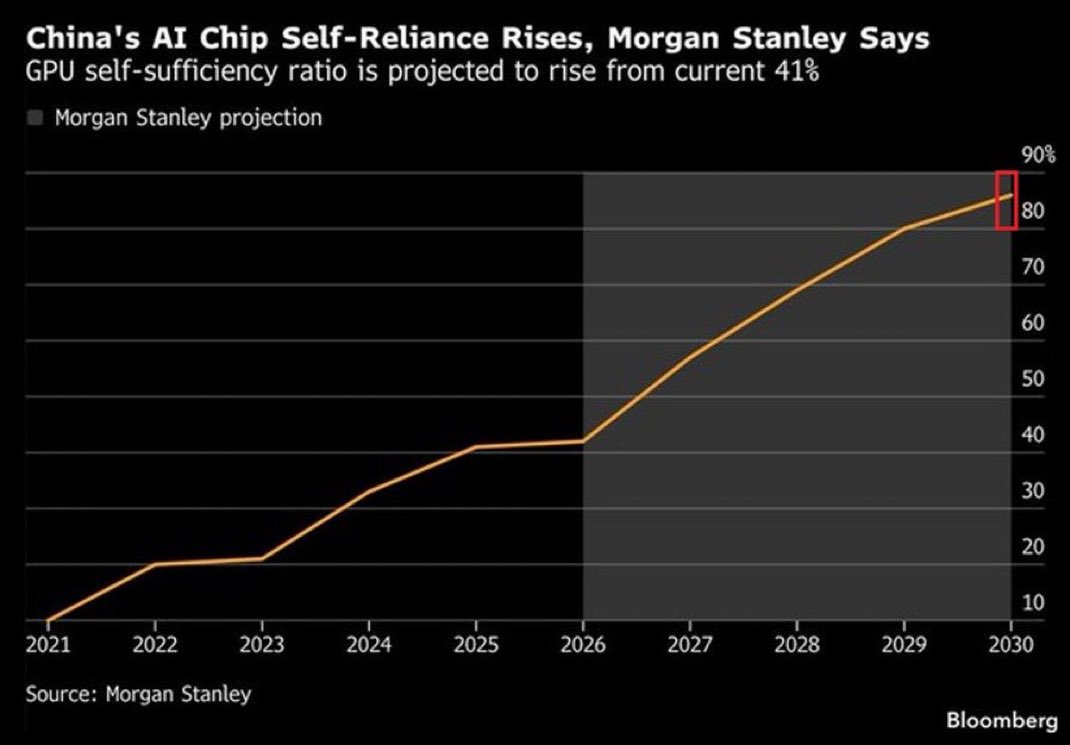
The Kobeissi Letter@KobeissiLetter
China is reducing its reliance on foreign AI chips: China's AI chip self-sufficiency ratio is up to a record 41%. This measures the proportion of domestic AI chip demand met by locally produced chips, rather than imported ones. This ratio has QUADRUPLED over the last 5 years. The AI chip self-sufficiency ratio is now projected to more than DOUBLE to ~85% by 2030, according to Morgan Stanley. In other words, China could meet nearly all of its own AI chip demand domestically within 5 years. China's AI chip independence is accelerating.
English
@Vatsalpandya333 yes!
i missed the steps and missed life completely
when i am trying right now, the odds are not in favour!
English

@bspectacledGOAT Still feels unreal sometimes honestly. Appreciate it 🙏
English
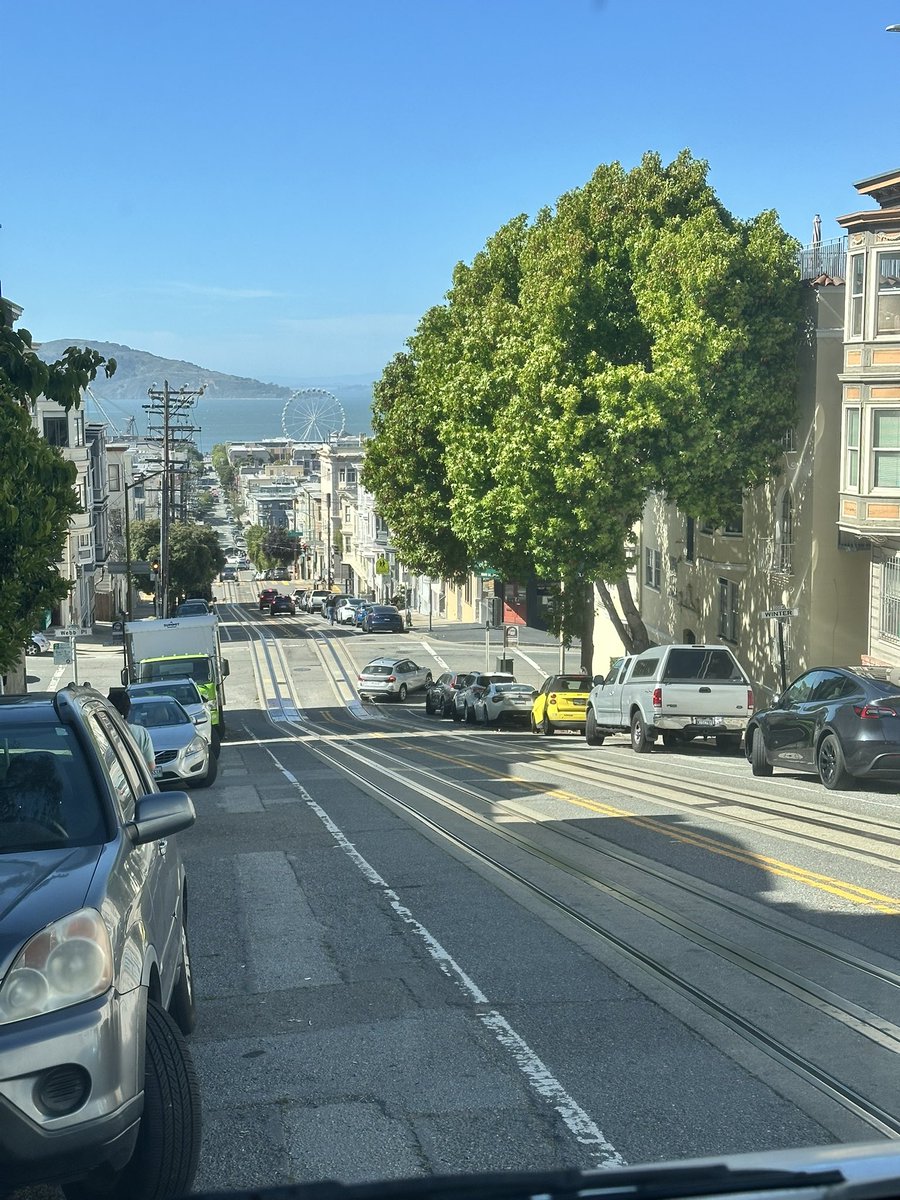
Mumbai to San Francisco.
18-year-old me came to the U.S. with two suitcases and no roadmap.
Now I’m in SF building an AI startup with my cofounders.
Crazy how life works sometimes.
English
the N× more important than reasoning framing( in your case 100o times) is itself the problem
there is no single denominator that makes N well-defined
to my knowledge, capability uplift on standardized benchmarks is one metric, total addressable use cases is another, economic surplus is the third, qualitative shift ness is the fourth, and they don't commute!
the rest continual learning, sft and others- they are moving and will continue to move
and the 8x8 paper is one of the first steps in that direction!
Dan McAteer@daniel_mac8
continual learning is coming in 2026. i'd bet anything on it. it won't necessarily be “just update the weights after every interaction.” it’ll be layered: - context/memory adapts 'fast' - weights adapt 'slow' - the system preserves plasticity instead of overwriting itself "Learning, fast and slow" is a signal in that direction. and if academia is publishing papers on it, you best believe the AI labs are on top of it too. it will be a 1000x more important breakthrough than reasoning. it's honestly terrifyingly awesome.
English
everything looks good in a tweet
the question is- if the government is prepared or the private sector can fill in!
multibillion-dollar rewards and managing 20-year tax holidays requires a highly agile bureaucratic apparatus
foregoing future tax revenues while simultaneously injecting $20B annually requires a massive restructuring of the government finances and balancing this against traditional welfare and infrastructure spending in a developing economy like ours that requires political capital, which is highly sensitive to short-term electoral cycles rather than two-decade technological horizons
Indian private sector is aggressively mobilizing to dominate the infrastructure and service layers, but it remains vastly underprepared for the brutal, deep-tech realities of hardware and foundational science
this may look disheartening, but this is the reality as i understand!
English

To create the momentum to escape the economic drag of a volatile geopolitical environment, technology innovation must be turbocharged. AI has come at an opportune time. It will be an accelerator in this process and help the country leapfrog.
Spend money, forego future tax revenues and let the animal spirits kick in. The world is seeing a resurgence in scientific research akin to that between the 1930s and 1970s. Those countries that take risks and invest will come out two decades from now richer and more powerful than ever. What may seem an elite pursuit at first will end up producing unimaginable benefits for society through dual use technologies, valuable IP, and an innovation and industrial ecosystem that grows exponentially. Failure to do so will relegate countries that depend on 20th century economic drivers to a permanent underclass in the 21st century.
Invest $20B a year in AI compute. Offer 20 year tax holidays + multibillion dollar rewards for companies that a) deliver world class LLMs and robots, b) develop lithography machines, c) produce next generation materials and d) deliver breakthrough technologies in any major applied STEM domain. Set a condition that all profits should be onshored in INR permanently. Fund a blue-skies research program in partnership with local conglomerates and offer companies steep tax discounts for allocating CSR funds to the cause. Invest in a robust legal architecture for intellectual property.
Watch the magic work. The country will not fall behind.
Sidhant Sibal@sidhant
Netherlands: PM Modi says this is a decade of crisis, expressing concern over energy crisis. Warns that gains of last few decades can be wiped off if the situation doesnt improves.
English
@rohanpaul_ai fact is
can the most powerful model of Google-Gemini do that!
English

Google CEO Sundar Pichai on current frontier model's ability to break the security of almost all current software.
"These models are definitely, like really gonna break pretty much all software out there, maybe already, we don't know."
English