

Ben Waldron
977 posts

Ben Waldron
@bwaldron
Cofounder @ Spectrum & Pollinate. Always building something.
Portland, Ore Katılım Mayıs 2007
523 Takip Edilen339 Takipçiler

Given as website running in an Azure App Service what is the easiest, most cost-effective email service i can use? #dotnet
English
Ben Waldron retweetledi

Help restore the tax deduction for software dev in the US (Section 174)
news.ycombinator.com/item?id=442261…

English
Ben Waldron retweetledi

Payroll for engineers should not be penalized by the tax code. If you pay an engineer a salary, you should be able to deduct that salary just as you can the salary of a lawyer or accountant.
Seems obvious and yet!
Garry Tan@garrytan
Help restore the tax deduction for software dev in the US (Section 174) news.ycombinator.com/item?id=442261…
English
@PatrickFIanagan @PatrickFIanagan do you think this assumes an as-is extension vs having some room for ammending this train wreck?
English
If this happens I have a deadline for selling my business. No way I’m going through 174 crap again
Richard Rubin@RichardRubinDC
New: House Republicans are considering a shorter (maybe five-year) tax cut extension as they try to make the budget math work.
English
Ben Waldron retweetledi
Ben Waldron retweetledi

@zetalyrae Section 174 of the tax code. How people are unaware of this yet is almost unbelievable.
English
This is the contribution to tech layoffs that no one is talking about. Sure AI and no more ZIRP are impacts to the big players but this is the reason for SMBs. #section174
Norman Angleton 🇺🇸@AngletonNorman
Here's what I think it is. Preliminary context: By law, all software engineer salaries must be classified as R&D expenditure Summary: -In 2022, a—change in tax policy to section 174 made within the 2017 TCJA—came into effect which requires that all R&D expenditure be amortized over a 5 or 15 year period in the way that real estate is (the logic being that software is an asset, like real estate, and that the R&D expenditure is the price of building it) [1]. -Scenario: A company pulls $1M in revenue at the price of $900K in salaries with no other expenses. Before, the $100K profit would be taxed at the 21% corporate tax rate. Now, only 20% ($180K) of the $900K can be written off, making such a company look on paper like it produced $820K in profit; 21% of this is $172K, this being larger than actual profit. Obviously this scenario is a bit unrealistic, but you get the point how this can have terrible effects. -Of course, in the second year the company would write off 20% of their current year's wages on top of 20% of the previous year's wages, so in the long term this would break even for large firms. Still, this permanently catastrophic for startups, temporarily catastrophic for any low-cash firms, and in the short term, also highly inconvenient for the large firms blindsided by this. Anybody with cash lying around probably had pre-existing reason to do so rather than shelling it out as dividends or investing it, and those kinds of needs don’t just vanish. The result? Mass layoffs [2, see also 3 & 4], companies outsourcing to Germany, senior engineers competing for junior positions, workers bleeding into irrelevant fields, hundreds of applications per position, and so on. 2022 - 165,269 layoffs from 1,064 companies 2023 - 264,220 layoffs from 1,193 companies 2024 - 149,006 layoffs so far from 519 companies Total so far: 578,495 layoffs since 2022. For context [5]: the U.S. software industry employed only 5.2 million people in 2022. A bill [6] to revert the change passed in the house but hasn't been approved by the senate yet. I've heard other speculation about what might be causal from overhiring during covid, to the closing of silicon valley bank, to ai automation, and to the hike in Japanese interest rates affecting carry trades around the globe. While causality is a tricky thing, the alternative conjectures I've heard just don't seem plausible to me. For one, I'm just not very impressed with ai in general. ChatGPT was only released in late November 2022 so it doesn't align well with the timeline (and imo it also only got good to use around march 2023 before falling off again). For the other more-punctuated events people talk about (SVB, etc), I’d expect only short-term effects, but the people who credit them for current pains keep on predicting ends to the layoffs which never materialize. Meanwhile, the change to section 174 lines up well with the crisis starting in 2022 and staying steady since then. As for H1B visas, these should generally have a negative effect on the labor market, but these haven’t seen any kind of punctuated uptick that might explain why things are particularly bad right now. 2023 and 2024 did see a large uptick in H1B *applications*, but this didn’t translate into much of an increased number of visas being granted to applicants [7]: References: [1] blog.pragmaticengineer.com/section-174/ [2] layoffs.fyi [3] news.crunchbase.com/startups/tech-… [4] yellowtail.tech/wp-content/upl… [5] statista.com/statistics/674… [6] congress.gov/bill/118th-con… [7] redbus2us.com/h1b-visa-cap-r…
English
@RepJasonSmith Please fix #section174, any small biz with R&D is getting killed and many are dying in infancy: linkedin.com/pulse/death-bo…
English

If we want the get the economy back on track, Congress needs to give small business owners the assurance and certainty that the Trump tax cuts will be extended so they can grow and hire.
American small businesses have already lost 31,000 jobs since September. We can't afford to wait.
English

I have been through a thing.
I am much better.
Thank you to everyone who reached out.
English
Ben Waldron retweetledi

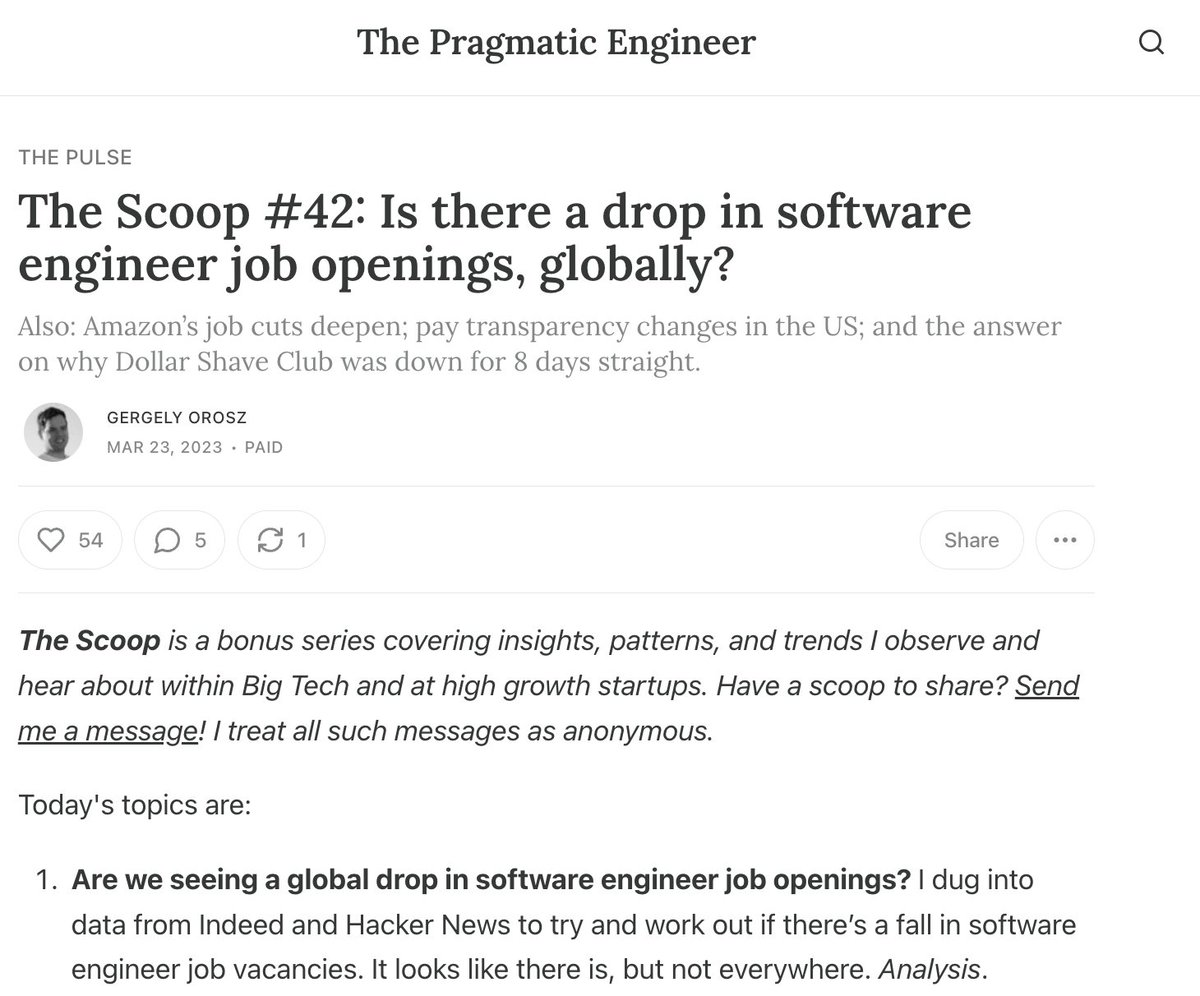
Wall Street journal last week: "Tech jobs have dried up—and aren’t coming back soon"
@Pragmatic_Eng over a year ago: covering the same topic as it was happening
The job market continues to be tough, especially compared to the peak market of 2021-2022
English
He’s right. Most under-reported story in tech because only accountants, CFOs, and owners really understand how diabolical these changes in #section174 actually are.
James Patrick Flanagan@PatrickFIanagan
@ruima There’s a temptation to attribute the slowdown to something more interesting like AI or macro economic trends because those ideas are more intellectually stimulating than idiotic tax policy that was hacked together to game the CBO score of the TCJA, but that’s what happened.
English
@ajcvickers @shanselman apologies upfront, can someone from MSFT help here?
English
Ben Waldron retweetledi
Academic research about Section 174 is beginning to be published and it confirms what everyone in industry already knows: 174 is destroying American research and innovation.

Daniel Bunn@danieldbunn
English
@MikeCrapo Ha! Says the Senator that single handedly blocked the Family Tax Credit and the fix for businesses penalized by #section174. Country over party @MikeCrapo.
English

If Democrats let the Trump tax cuts expire, they will be imposing a multi-trillion dollar tax hike on American families, workers and businesses.
realclearmarkets.com/articles/2024/…
English
Ben Waldron retweetledi
Many of the scientists and engineers that American firms have laid off because of forced amortization have families, and layoffs are bad for families. Something to consider, @ChrisMurphyCT
Laura Weiss@LauraEWeiss16
.@ChrisMurphyCT says he hasn’t made up his mind about his vote on the Wyden-Smith tax bill. He’s among Dems w/ concerns about how much it does for biz compared to families Says he shares concerns of @rosadelauro, a fellow member of CT delegation & lead child tax credit advocate
English
Ben Waldron retweetledi
This should be a no-brainer for Republicans. Do they favor
✅ Pro-growth tax policy
✅ Pro-family child tax credits
✅ Ending fraud in the ERC program
Or do they care more about
❌ Mike Crapo's hurt feelings
Cady Stanton@cady_stanton
Majority Leader Schumer spoke more on the tax bill on the Senate floor this morning, saying this week's vote will "put pressure on Republicans to show where they stand." "The big question right now is, will Republicans join us, or will they stand in the way?"
English
Well, at least it’ll get to a vote! Perhaps A chance for Senators to vote common sense rather than party lines.
Laura Weiss@LauraEWeiss16
Still lots of GOP opposition to the Wyden-Smith tax bill, which will finally get a cloture vote in the Senate this week. Vote is expected to fail But the bill still has some R backing. @SenToddYoung, who previously voiced his support, tells me he’ll still vote for the tax bill
English
@PatrickFIanagan I don’t understand that quote or quite frankly the overall increase at all. Why wouldn’t they take it before? We did amend prior years as to take more credit because these new rules shined a light on us being too conservative with R&D previously.
English
One of the experts quoted explains why (this is consistent with what we did):
“You had firms that qualified for it in the past that weren’t taking it until they needed to; now they need to,” said Christian Wood of RSM US LLP’s Washington National Tax practice.
English
I'm going to lose my mind. "The cost to federal coffers of the tax credit has increased far more than the federal government has saved from the switch to R&D amortization."
So the switch to amortization hurt business and didn't save any money, which was the whole point!
Doug Sword@doug_sword
R&D expensing goes away and R&D spending jumps a record $96 billion in one year. taxnotes.com/tax-notes-toda… @TaxNotes
English
Big Tech is not killing innovation. The fact that US tax code, since 2022 in #section174, penalizes R&D. This means companies focus on quick, predictable wins vs. long term, riskier bets. You reap what you sow. nytimes.com/2024/06/13/opi…
English
English