
Mugarura Eric retweetledi

A litigation attorney called me last month. Solo, mid-sized matter, opposing counsel was a partner at a 200-lawyer firm. Deposition the next morning. She was drowning.
"I have 14 deposition transcripts, 9 expert reports, 200+ exhibits. I can't keep track of who said what. The associate I'm using is six months out of school and is missing things."
I asked her two questions:
- How are you organizing this right now?
- Have you ever heard of Obsidian?
She was using folders. Word docs. Yellow stickies on her monitor. She had not heard of Obsidian.
I told her to do one thing before the deposition.
Set up an Obsidian vault. Drop every transcript, every exhibit summary, every witness profile in. Plain markdown files. Backlink every name across the matter. Run one Claude Code query against the vault before she walked into court.
The query: "Read every deposition in this matter. Identify any place where this witness contradicted earlier testimony, or where any other witness contradicted what this witness said. Quote the exact text."
She set it up Saturday afternoon. Four hours. Free.
She ran the query Saturday evening.
Three contradictions came back. One was material.
In the witness's own deposition six months earlier, he had testified that he had not been in the warehouse on the night in question. In a 30(b)(6) deposition three weeks later, the company's HR director produced a swipe-card log placing him there. Her junior associate had reviewed both depositions separately and never connected them.
The agent connected them in 40 seconds.
Sunday she walked into her co-counsel's office and dropped the printout on his desk.
"Where did you get this?"
"From a markdown file."
The Monday deposition went very differently than expected.
She is not the only litigator I have helped do this in the last six months. The pattern is always the same.
The lawyers running their cases out of folders, Word docs, Clio "matter notes," and human memory are leaving facts on the table.
The ones running their cases out of Obsidian + an API-direct agent are finding the things their associates miss.
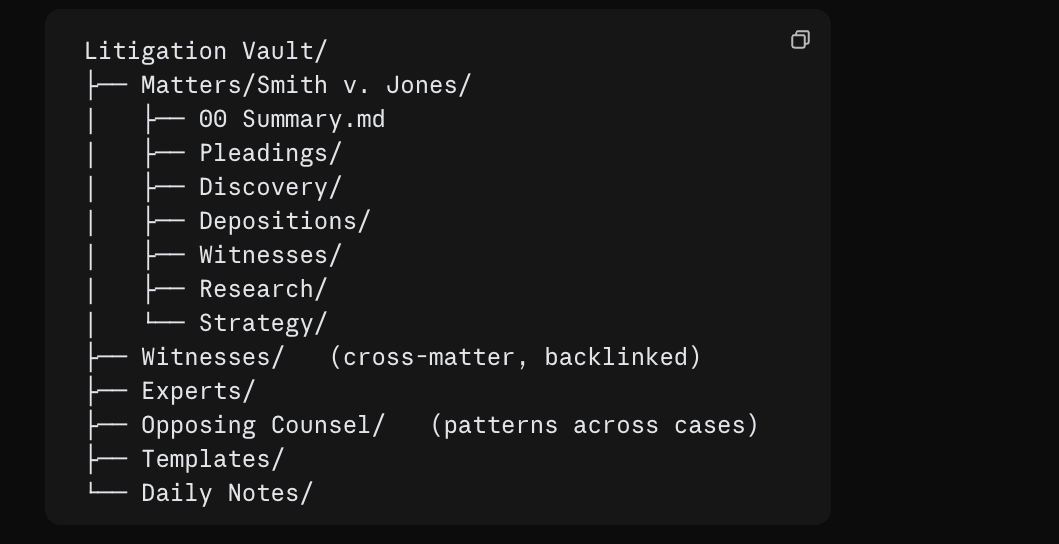
Free plugins do the structural work: Templater for new-matter intake, Dataview for deadline dashboards, Tasks for court deadlines.
The agent layer (Commercial Terms API, ~$50/mo) does what no SaaS will ever do for you:
→ Cross-matter witness lookup. "What do I know about Expert Foster across all matters?"
→ Deposition outline drafting. Reads the witness profile, matter facts, your prior outlines.
→ Exhibit summaries. New PDF lands in Discovery, summary appears the next morning.
→ Timeline construction. Reads every transcript in a matter, builds the chronology.
→ Pattern cross-reference. "Has opposing counsel run this argument before in another matter?"
Most litigators are paying $500-900/mo per attorney for SaaS that does none of this. Clio does not do cross-matter pattern matching. Westlaw does not read your own depositions. Harvey is a chatbot with the agent features turned off.
The "workflow you own" isn't a slogan. It's a directory structure plus an API key.
Most litigators will not build this. The ones who do will keep finding the things their associates missed in 40 seconds, on a Saturday evening, before a Monday deposition.
This is what "own your workflow" actually looks like for a litigator. Here is the structure:
English