Chris Rands

263 posts

Chris Rands

Chris Rands

@c_rands

Views my own

Cambridge, UK Katılım Ocak 2014
529 Takip Edilen456 Takipçiler
Chris Rands
Chris Rands@c_rands·
@adamlewisgreen @shae_mcl Do you think training on sequencing reads rather than say counts matrixes or VCF will be the winning strategy? Does SRA contain enough annotations and metadata to be useful?
English
0
0
1
65
Adam Green
Adam Green@adamlewisgreen·
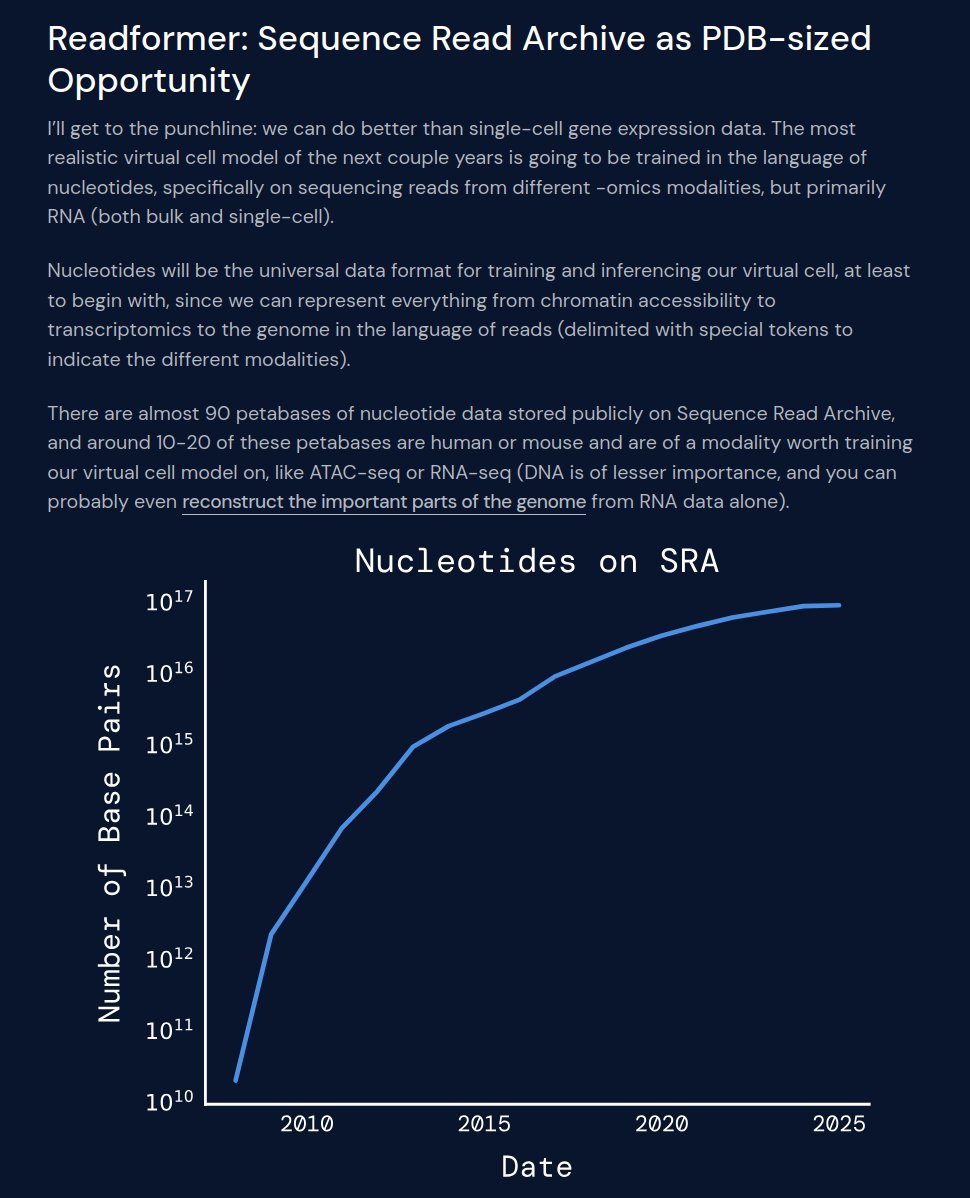
We already have PDB for biology, it's called SRA (and unlike PDB, it's ~100 petabases). Asking for all the omics in every possible combination of cell type, state, patient etc. to learn the "grammar of gene regulation" is analogous to demanding the internet contained every possible human conversation with accompanying parse trees before training GPT-1. Improvements in assay technology are certainly welcome, and we would not have SRA without historical improvements in tools for reading biological state; but on the current margin the bottleneck is implementing scalable unsupervised pretraining on existing cellular dynamics data, of which there are a surfeit. As we demonstrated in our recent paper, when you do this, many of the things which were thought to require specialized data (e.g. regulatory grammar can only be learned from functional genomics data; perturbation prediction requires mountains of exogenous gene knockout data) begin to fall out for free, exactly as they did in NLP. These specialized data sources will no doubt be useful, but as the icing and cherry on top of the unsupervised pretraining cake, not the cake itself. Some PDB and SRA back-of-the-envelope calculations from our 2024 work:
Adam Green tweet mediaAdam Green tweet media
English
3
0
3
551
Shae McLaughlin
Shae McLaughlin@shae_mcl·
It’s estimated that the Protein Data Bank (PDB) cost around $13B to create. Alphafold was only possible because of it. If we want ML to solve biology, we should be funding the creation of databases and the development of new assay technologies. ML is nothing without data.
English
40
174
1.3K
155.5K
Chris Rands
Chris Rands@c_rands·
@biocheMichael @Bfaviero @grok Keytruda is nearer 30B. But I think this misses the point. Tech, financial services and luxury are the best businesses but pharma is in the next tier and really benefits humanity (or PR if you’re cynical)
English
1
0
1
141
Michael - Protein Thx and Biologics
@Bfaviero @grok Humira and GLP1 peptides are the best sellers of all time. Humira is like 20B a year and similar for GLP1s. Regeneron has several blockbuster drugs which sell 5-10B a year.
English
1
0
0
596
Michael - Protein Thx and Biologics
It makes no sense to me why OpenAI or Anthropic would make drugs Drugs which are ~wildly~ successful generate $1B in annual revenue Wegovy is not the norm and even if it was it took >40< years from discovery to Wegovy Sam Altman was 1 year old when GLP1 was discovered. Seriously think about that for a second. OpenAI burns $1B (now - pre drug discovery) in less than 1 month and they’re still scaling 10x or more… No fkn way are they going to stand up discovery through CMC and manufacturing and also clinical, reg, and other departments to support this fantasy Turn on ads and boom $100B a year in revenue Turn on drug discovery and oh shit it’s another ten years before we even see $1B in revenue. By then they could be a $10T company with $500B in ad and other revenues a year Someone explain it to me like I’m a drug discovery scientist
English
27
1
75
21.3K
Chris Rands
Chris Rands@c_rands·
@morgancheatham Not unique to the genome at all. E.g. predicting novel features from pathology images like H&E
English
0
0
0
33
Morgan Cheatham, MD
Morgan Cheatham, MD@morgancheatham·
one of the reasons i became a medical geneticist: the genome is the only medical test where we measure once, but our interpretation evolves indefinitely. as our models and variant knowledge mature, the same data yields new truths, and eventually, actionabilities. the genome (and its derivative products) are the ultimate substrates for AI in medicine.
Patrick Collison@patrickc

I'm lucky enough to have a great doctor and access to excellent Bay Area medical care. I've taken lots of standard screening tests over the years and have tried lots of "health tech" devices and tools. With all this said, by far the most useful preventative medical advice that I've ever received has come from unleashing coding agents on my genome, having them investigate my specific mutations, and having them recommend specific follow-on tests and treatments. Population averages are population averages, but we ourselves are not averages. For example, it turns out that I probably have a 30x(!) higher-than-average predisposition to melanoma. Fortunately, there are both specific supplements that help counteract the particular mutations I have, and of course I can significantly dial up my screening frequency. So, this is very useful to know. I don't know exactly how much the analysis cost, but probably less than $100. Sequencing my genome cost a few hundred dollars. (One often sees papers and articles claiming that models aren't very good at medical reasoning. These analyses are usually based on employing several-year-old models, which is a kind of ludicrous malpractice. It is true that you still have to carefully monitor the agents' reasoning, and they do on occasion jump to conclusions or skip steps, requiring some nudging and re-steering. But, overall, they are almost literally infinitely better for this kind of work than what one can otherwise obtain today.) There are still lots of questions about how this will diffuse and get adopted, but it seems very clear that medical practice is about to improve enormously. Exciting times!

English
9
8
103
17.1K
Chris Rands
Chris Rands@c_rands·
@JohnCarreyrou Big fan of your work John and Bad blood in particular, but I don’t see any new evidence presented here or a smoking gun. Also what is your response to the different C/C++ coding styles of Satoshi and Adam?
English
0
0
9
792
John Carreyrou
John Carreyrou@JohnCarreyrou·
If you didn’t participate in the discussion the Bitcoin white paper sparked on the Cryptography list in late 2008, why would you tell a podcast you did 5 years later? Why lie about that?
English
30
5
62
28.4K
Chris Rands
Chris Rands@c_rands·
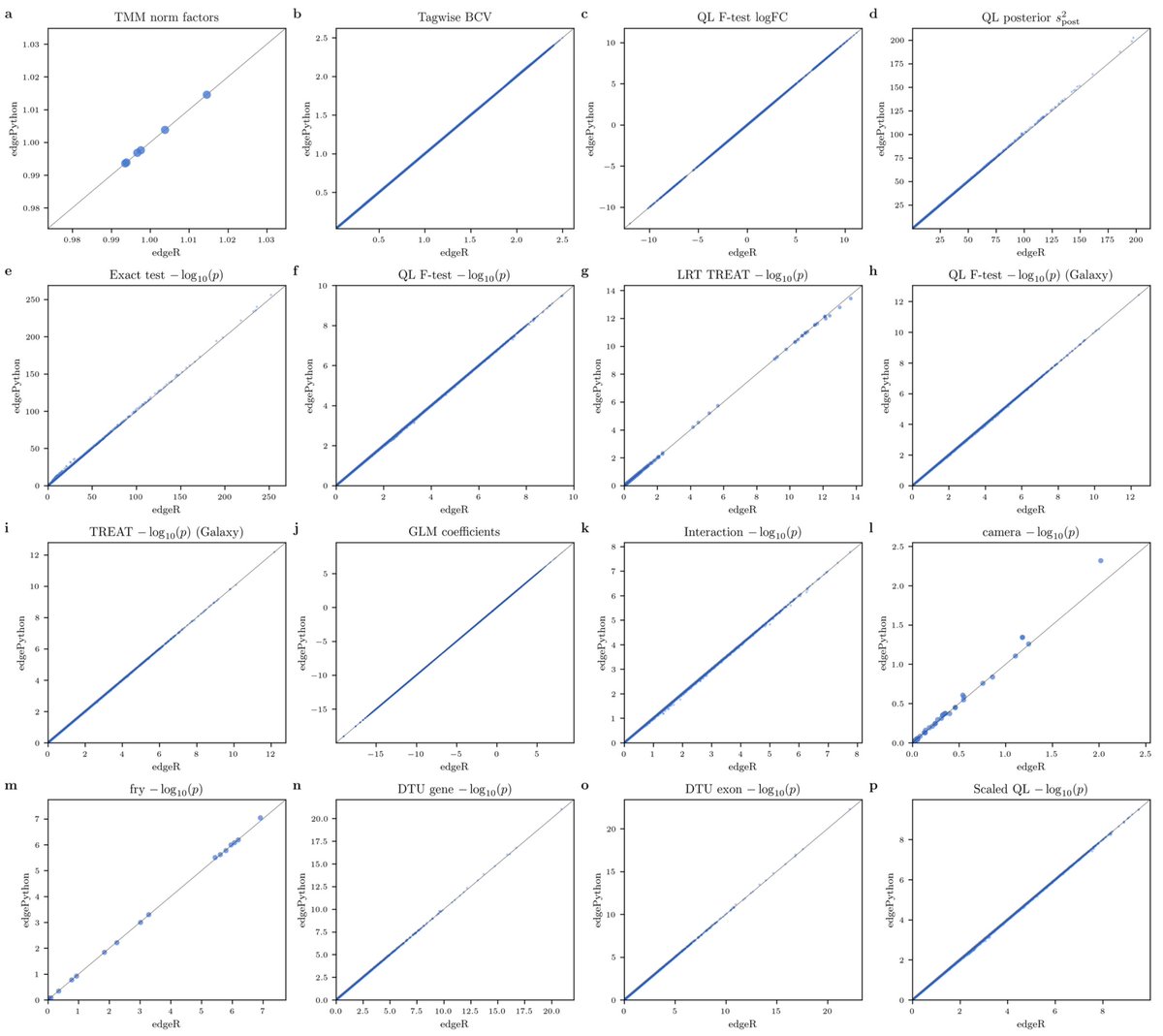
@lpachter Let’s port the whole of bioconductor and be done with R!
English
0
0
3
236
Chris Rands
Chris Rands@c_rands·
@Ronalfa Should I not bother removing the asbestos from the house then?
English
0
0
2
46
Ron Alfa
Ron Alfa@Ronalfa·
Okay we're going to cure all human disease in some unreasonably small quantity of time. Wire instructions to follow.
English
5
0
20
3.3K
Chris Rands
Chris Rands@c_rands·
@dr_alphalyrae As GLP-1 drugs spread, the bell curve of humanity narrows- less obesity, addiction, depression, obsession, neurodivergence, innovation, creativity
English
0
0
0
108
Valthos
Valthos@ValthosTech·
Valthos builds next-generation biodefense. Of all AI applications, biotechnology has the highest upside and most catastrophic downside. Heroes at the frontlines of biodefense are working every day to protect the world against the worst case. But the pace of biotech is against them: more powerful methods to design biological systems, with near-universal access, open up an increasing surface area of threats. In this new world, the only way forward is to be faster. So we set out to build the tech stack for biodefense. Our team of computational biologists and software engineers applies frontier AI to identify biological threats and update medical countermeasures in real-time. We are backed by $30M from @OpenAI, @Lux_Capital, @foundersfund and others including @Definition_Cap. We are actively hiring engineers to join in the mission - if that sounds like you, get in touch.
English
107
101
788
1.4M
Acquired Podcast
Acquired Podcast@AcquiredFM·
@c_rands Essentially. So much of this story is the battle against Microsoft.
English
1
0
2
587
Chris Rands
Chris Rands@c_rands·
@andrewwhite01 Is the logical conclusion here that papers become like a JSON with MCP servers?
English
0
0
1
216
Andrew White 🐦‍⬛
Andrew White 🐦‍⬛@andrewwhite01·
I've written up some thoughts on publishing for machines. 10M research papers are published per year and there are 227M total - machines will be primary producers and readers of publications going forward. It's time to revise the scientific paper.
Andrew White 🐦‍⬛ tweet media
English
16
39
237
36.2K
Chris Rands
Chris Rands@c_rands·
@srikosuri But many of the major causes of death like oncology, cardiovascular and Alzheimer’s are correlated with ageing? Also birth rate declining feels significant?
English
1
0
0
153
Sri Kosuri
Sri Kosuri@srikosuri·
The exceptions to this: 1. Aging 2. Cosmetics 3. Performance Enhancement 4. Recreational I think that's it.
English
10
3
82
11.6K
Sri Kosuri
Sri Kosuri@srikosuri·
Pharma/Biotech is a negative sum game. The better the sector is at doing its job, the smaller its market gets over time.
English
30
18
230
184.4K
Chris Rands
Chris Rands@c_rands·
@slavov_n Unfortunately humans are a little more complex than fruit flies
English
1
0
1
53
Prof. Nikolai Slavov
Prof. Nikolai Slavov@slavov_n·
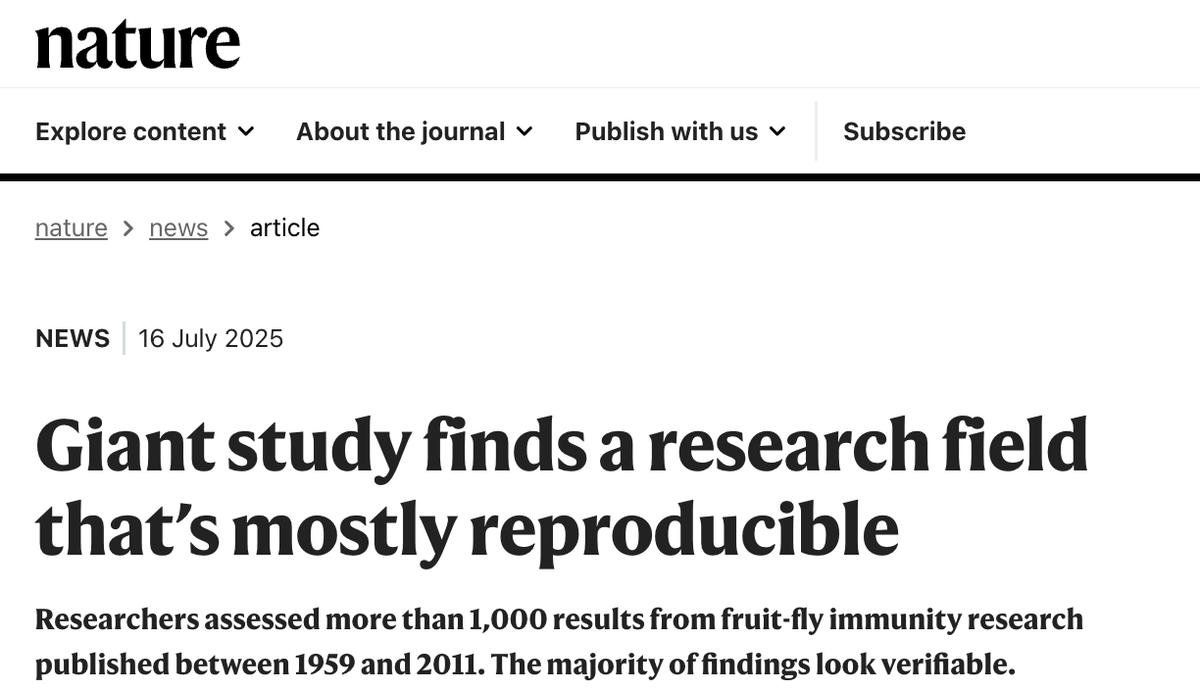
We should always strive to acknowledge problems and improve. We should also acknowledge when things work. 𝐘𝐞𝐬, 𝐦𝐚𝐧𝐲 𝐫𝐞𝐬𝐞𝐚𝐫𝐜𝐡 𝐫𝐞𝐬𝐮𝐥𝐭𝐬 𝐚𝐫𝐞 𝐫𝐞𝐥𝐢𝐚𝐛𝐥𝐞 & 𝐫𝐞𝐩𝐫𝐨𝐝𝐮𝐜𝐢𝐛𝐥𝐞. nature.com/articles/d4158…
Prof. Nikolai Slavov tweet media
English
4
24
154
12.4K
Arvind Narayanan
Arvind Narayanan@random_walker·
Some aspects of AI discourse seem to come from a different planet, oblivious to basic realities on Earth. AI for science is one such area. In this new essay, @sayashk and I argue that visions of accelerating science through AI should be considered unserious if they don't confront the production-progress paradox. ========= AI leaders have predicted that it will enable dramatic scientific progress: curing cancer, doubling the human lifespan, colonizing space, and achieving a century of progress in the next decade. Given the cuts to federal funding for science in the U.S., the timing seems perfect, as AI could replace the need for a large scientific workforce. It’s a common-sense view, at least among technologists, that AI will speed science greatly as it gets adopted in every part of the scientific pipeline. But many early common-sense predictions about the impact of a new technology on an existing institution proved badly wrong. The Catholic Church welcomed the printing press as a way of solidifying its authority by printing Bibles. The early days of social media led to wide-eyed optimism about the spread of democracy worldwide following the Arab Spring. Similarly, the impact of AI on science could be counterintuitive. Even if individual scientists benefit from adopting AI, it doesn’t mean science as a whole will benefit. When thinking about the macro effects, we are dealing with a complex system with emergent properties. That system behaves in surprising ways because it is not a market. It is better than markets at some things, like rewarding truth, but worse at others, such as reacting to technological shocks. So far, on balance, AI has been an unhealthy shock to science, stretching many of its processes to the breaking point. Any serious attempt to forecast the impact of AI on science must confront the production-progress paradox. The rate of publication of scientific papers has been growing exponentially, increasing 500 fold between 1900 and 2015. But actual progress, by any available measure, has been constant or even slowing. So we must ask how AI is impacting, and will impact, the factors that have led to this disconnect. Our analysis in this essay suggests that AI is likely to worsen the gap. This may not be true in all scientific fields, and it is certainly not a foregone conclusion. By carefully and urgently taking actions such as those we suggest, it may be possible to reverse course. Unfortunately, AI companies, science funders, and policy makers all seem oblivious to what the actual bottlenecks to scientific progress are. They are simply trying to accelerate production, which is like adding lanes to a highway when the slowdown is actually caused by a toll booth. It’s sure to make things worse. Contents 1. Science has been slowing — the production-progress paradox 2. Why is progress slowing? Can AI help? 3. Science is not ready for software, let alone AI 4. AI might prolong the reliance on flawed theories 5. Human understanding remains essential 6. Implications for the future of science 7. Final thoughts Full essay (about 6,500 words) aisnakeoil.com/p/could-ai-slo…
English
17
69
245
67.5K
Clifton Dalgard
Clifton Dalgard@panomics·
@GenomicsCow Every one in human omics should be at >100 because they can state the olfactory receptor superfamily. Just ORIA through OR4X is there alone.
English
1
0
1
255
Genomics Cow
Genomics Cow@GenomicsCow·
How many genes do you think you can name? Regardless of remembering its details
English
4
0
1
1K
Elvina Almuradova
Elvina Almuradova@Dr_ElvinaA·
#ASCO25 may be over, but its impact continues. Colorectal cancer patients: 💍 Married: 5-year OS → 63.1% 🚶‍♂️ Single: 54.5% 💔 Separated/Divorced/Widowed: 45.7% ✅ Better support ✅ Earlier stage at diagnosis ✅ More treatment compliance @Larvol @OncoAlert @oncodaily
Elvina Almuradova tweet media
English
8
67
241
32.2K