The AI Girlfriend Made $43K in 1 Month
When you pay someone online, when you talk to someone online, when you think someone online is real enough to trust, do you know?
Because soon, “she looks real” will mean absolutely nothing.
blog.nunolopes.online/2026/05/05/the…
Thread (post 1/6):
🚀 Morpheus Skill v2 just shipped
Your AI agent now auto-manages MOR staking on-chain.
No more missing tokens. No more "Insufficient MOR" errors. Your agent handles it all. 🤖⛓️
🧵👇
I don't care what kind of hardware you have, you should be running local models
It will save you a ton on money on OpenClaw and keep your data private
Even if you're on the cheapest Mac Mini you can be doing this
Here's a complete guide:
1. Download LMStudio
2. Go to your OpenClaw/Hermes and say what kind of hardware you have (computer and memory and storage)
3. Ask what's the best local model you can run on there (probably will be Gemma 4 or Qwen. if you have a big computer, it will be GLM)
4. Ask 'based on what you know about me, what workflows could this open model replace?'
5. Have OpenClaw walk you through downloading the model in LM Studio and setting up the API
6. Ask OpenClaw to start using the new API
Boom you're good to go.
You just saved money by using local models, have an AI model that is COMPLETELY private and secure on your own device, did something advanced that 99% of people have never done, and have entered the future.
If you are on smaller hardware you probably are not going to replace all your AI calls with this, but you could replace smaller workflows which will still save you good money
Own your intelligence.
CLAUDE CODE CAN NOW COPY ANY UI ON THE INTERNET.
It scans real websites and rebuilds their design system instantly, turning any page into your own starting point.
Vercel charges $20/seat/month.
Netlify charges $20/month.
Heroku killed its free tier entirely.
And if you go over your bandwidth? Surprise bills. Sometimes thousands of dollars.
There is an open-source alternative to all three. For $0.
It is called Coolify. 53,000+ stars on GitHub.
You install it on any server you own. A $5 VPS. A Raspberry Pi. An old laptop. Anything with SSH.
Then you deploy everything:
- Static sites
- Full-stack apps
- Databases
- APIs
- 280+ one-click services (WordPress, Ghost, Plausible, n8n, Supabase, and more)
Here's the wildest part:
It does things the paid platforms charge extra for.
- Free SSL certificates, auto-renewed
- Automatic database backups to S3
- Pull request preview deployments
- Real-time server terminal in your browser
- Push-to-deploy from GitHub, GitLab, Bitbucket
- Server monitoring with Discord/Telegram/email alerts
No vendor lock-in. All your configs live on your server. If you stop using Coolify, everything still runs.
The $20/month you pay Vercel? That is per seat. A 5-person team pays $100-500/month depending on usage.
With Coolify on a $5 Hetzner VPS, that same team pays $5/month. Total.
Apache-2.0 licensed. Self-hosted. Free forever.
100% Open Source.
(Link in the comments)
@lopp 3 is be better : )
But seriously cross model audits of your outputs are a big unlock.
I find strong coding models like GLM 5.1 + a good auditor like Grok 4.2 reasoning and you get great bug free code after 3 or 4 loops of code and audit.
⚡🇭🇺 Viktor Orban reveals the dark plan being carried out by the liberal elite:
“They’re trying to change the society by replacing the native-born voters with someone else. This is their plan.”
"Every major AI platform — ChatGPT, Claude, Gemini, Grok, Perplexity — stores your conversations on centralized servers. That data can be reviewed, classified, subpoenaed, hacked, or sold. You're trusting the company, its employees, its vendors, and every government that asks.
Venice is architecturally different. Prompts are not stored server-side. Chat history lives in the user's browser. And as of March 18, 2026, Venice offers something no other AI platform does: verifiable encryption."
@patricksavalle zit uren per dag op Openclaw en betaal helemaal niks. Gebruik Venice API en Morpheus API
als je deze munten $VVV $MOR staket, krijg je gratis credit...ben je klaar, verkoop je ze weer
AI credits zijn het nieuwe goud.
Ik betaal momenteel €30-50/dag bij boven op het Claude Max account van €90/maand. De laatste loodjes...
Als je die dingen echt aan het werk zet, vreten ze je helemaal kaal. Maar vandaag is het dan ook af, dan gaat mijn project live / in productie.
De toekomst is duidelijk.
Dit jaar nog: er komen efficiënte modellen en iedereen gaat z'n eigen LLM draaien. Ik gebruik nu Qwen Code van Alibaba op mijn lokale werkstation, langzaam, maar bruikbaar.
Volgend jaar: complexe producten (zoals in mijn geval Azure Cloud en AWS) krijgen speciaal getrainde LLM's / agents meegeleverd die kunnen worden gebruikt door je eigen AI.
Dit decade nog: iedereen gaat z'n eigen modellen ook trainen / bij-trainen.
Ik ben er niet bang voor, deze technologie gaat voor iedereen beschikbaar komen.
Ik gebruikte AI om 35+ rapporten van gevestigde instituten over de staat van Nederland te analyseren.
Wat eruit kwam wil niemand horen.
Ik heb het toch opgeschreven ⬇️
Most people are still treating AI like a novelty "chatbot."
They follow KOLs for the next 5x "call" while missing the structural revolution happening right in front of them.
If you’re tired of the noise, here is why @MorpheusAIs ( $MOR) is the most important infrastructure play in DeAI as of 2026. 🧵
1. The Death of the "Per-Prompt" Tax
Traditional AI is a subscription trap. You pay every month or every prompt.
Morpheus uses the Yellowstone Model: * Your $MOR balance = your permanent slice of the network's compute power.
* Hold tokens, get AI access for life. No marginal costs. No middleman taking a cut of every word you type.
2. Proof of Real Work (PoRW)
We’ve moved past the era of "trust me" decentralized compute.
By early 2026, the network's PoRW ensures that compute providers aren't just spoofing metrics. They are delivering real GPU cycles for real inferences. If the work isn't real, they don't get paid.
3. The "Four Cs" Synergy
Morpheus isn't a company; it's a four-way symbiotic engine:
* Capital: Staked $stETH builds protocol-owned liquidity.
* Compute: Hardware providers supply the raw power.
* Code: Devs build the Smart Agents.
* Community: Builders create the interfaces we actually use.
It’s a closed-loop economy where every participant is aligned for the long term.
4. Smart Agents > Chatbots
A chatbot talks. A Smart Agent acts.
Morpheus agents are Web3-native. They have a wallet. They can:
* Manage your yield farming.
* Swap tokens across chains.
* Monitor your security 24/7.
This is the "Agentic Web" in practice, not just in theory.
5. The "Fair Launch" Reality Check
In a 2026 market flooded with high-FDV VC tokens, $MOR stands as a rare breed.
* 0% VC allocation.
* 0% Pre-mine.
It’s a network built for the people who actually provide value, not for institutional exit liquidity.
The Bottom Line: KOLs talk about price. Builders talk about infrastructure. Morpheus is building the decentralized CPU for the AI-driven future.
The question isn't whether AI will run the world—it’s whether you will own the AI that runs yours.
Are you watching the chart, or are you watching the stack?
#DeAI#Morpheus#Web3AI#Crypto2026
Inderdaad desastreuze naturalisatiecijfers @wierdduk.
NL staat op de 3e plaats in de EU als het gaat om het naturaliseren van vreemdelingen. We zijn zelfs nr. 2 bij het weggeven van paspoorten aan Syriërs + Turken.
Dat moet stoppen. We raken ons land, cultuur en identiteit kwijt. We moeten het vernietigende cultuurrelativisme van links-liberalen stoppen, de voorwaarden voor naturaliseren veel zwaarder maken en het denaturaliseren van meer criminelen met een dubbele nationaliteit mogelijk maken en opvoeren. En natuurlijk onze grenzen sluiten en een #asielstop invoeren.
@bittensor ( $TAO) and @MorpheusAIs ( $MOR) are both pushing the same core vision—open-source, fair, decentralized AI—but their token reward systems reveal two very different philosophies about how intelligence should be created and distributed.
$TAO is built around competitive intelligence mining. Validators evaluate subnet miners, and emissions flow to those producing the most “useful” outputs according to network-defined incentives. It’s a marketplace of models where rewards are tied to performance in narrow tasks—ranking, scoring, and optimizing for benchmarked intelligence. In practice, this creates a Darwinian economy of AI: specialized actors compete, and the best-performing nodes capture the majority of emissions. The token becomes a signal of measurable intelligence production.
$MOR, on the other hand, is designed around agent execution and real-world usefulness. Instead of rewarding raw model outputs, it rewards contributors across the full stack—compute providers, capital providers, Coder, and builders—through a balanced emission system. The focus shifts from “who has the smartest model” to “who makes AI actually work in real environments.” Rewards flow not just from performance, but from participation in a living ecosystem of agents executing tasks, interacting with users, and generating economic activity. The token becomes a signal of coordinated intelligence in action.
This difference is subtle but massive:
$TAO optimizes for intelligence as competition → rewards peak performance in isolated domains.
$MOR optimizes for intelligence as coordination → rewards usable, composable, real-world outcomes.
Both are fair-launch. Both are open-source. Both are DeAI.
But one is building a network of models competing to be the best,
while the other is building an economy of agents collaborating to get things done.
In the long run, the question isn’t just who produces intelligence—
it’s who can turn intelligence into execution at scale.
#bittensor#morpheus#tao#mor#DeAI#crypto#btc
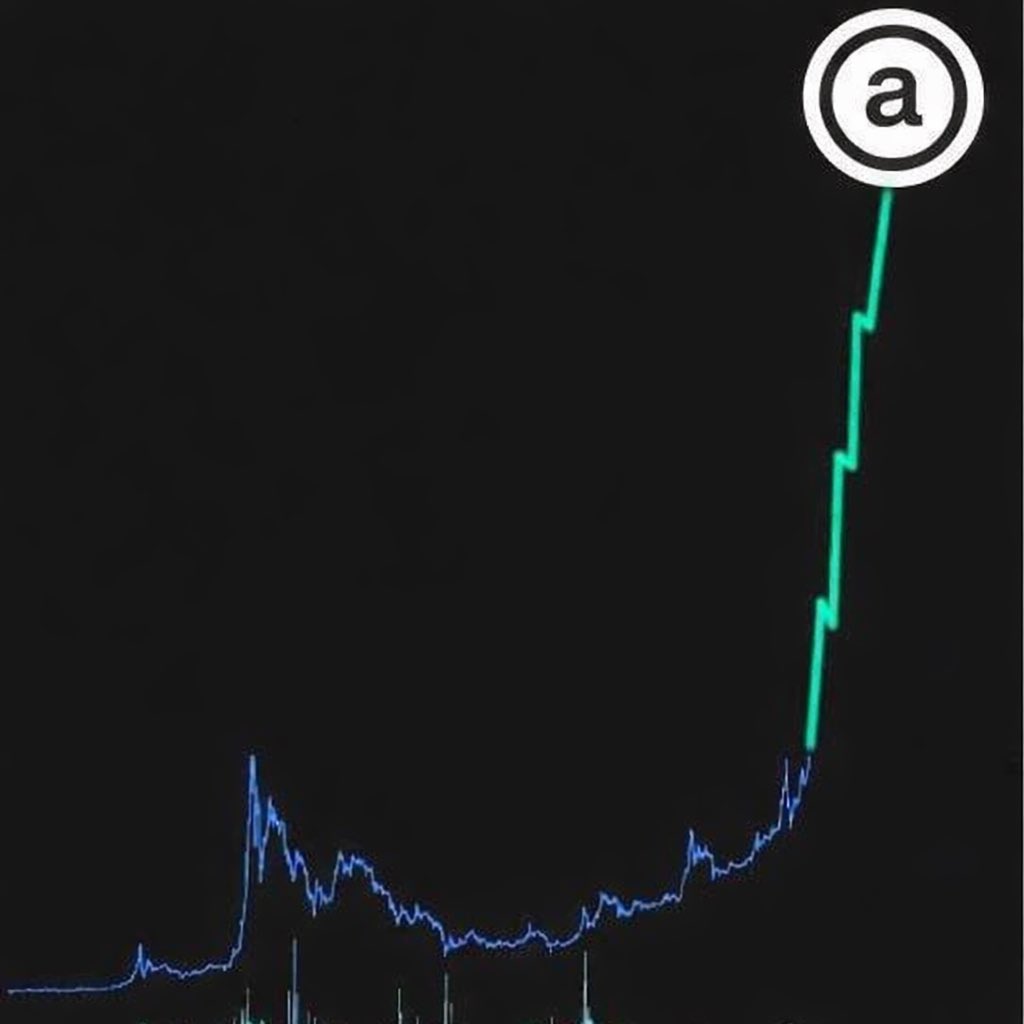
$AR is one of the most mispriced assets in crypto.
If AI needs permanent memory, if data matters, if the internet needs archives that can’t be erased, then Arweave sits at the center of that future.
The market will catch up eventually.
Permaweb season
#Arweave#Permaweb#AI
Your Claude subscription is massively subsidized and it won't last forever.
A $20/mo Pro plan burns through ~$180/mo in API-equivalent tokens. Heavy Max users hit $5K/mo on a $200 plan.
Actual compute cost is roughly 10% of API pricing. Venture capital covers the rest.
Anthropic just 2x'd Claude Code limits for "Spring Break'" during off hours. Enjoy it while it's here.
At some point the math has to math.
Clip from the @modernmarket_
The State always aims to increase its “capacity” (I.e. ability to effectively execute on enforcement) by increasing the legibility of its citizens (more data).
The ONLY counter force to this is defensive privacy technologies + citizen activism placing constraints on the State.