
Sabitlenmiş Tweet
CHERAY
8.4K posts


CHERAY
@cheray
✨🐎✨ Lover of horses,tech,AI , luxury, media, art . Unbridled innovation with beauty. @venturebank @cloudcom Cheray Unman https://t.co/q3nCroTEr4
CA & London Katılım Kasım 2007
7.5K Takip Edilen3.2K Takipçiler

Giving an agent a wallet or account isn't the hard part. Creating a robust, governed way to trust it is. Today Catena announces product access, OCC news, and Series A investment from wonderful partners: catena.com/blog/banking-g…
English

Meet @CameronLMcCord. He's done a lot of hard things: paid his way through MIT with ROTC while double-majoring in nuclear engineering and physics. Spent ~5 years on a nuclear submarine for the Navy. He once steered that submarine through a Nordic fjord in a blizzard, in the middle of a clandestine mission, to save a crewmate's life.
This photo was taken that day.
Between watches, he was teaching himself AI on pre-downloaded Andrew Ng lectures - and noticing the cognitive dissonance of running 1970s software on a Cold War-era submarine. After the Navy, he served as a liaison to the House Armed Services Committee, where his name appears in the footnotes of some of the first government writing on AI.
Then he went to @Anduril, watched the best-funded hardware company in the world try to test drones with SQL tools and MATLAB, and got obsessed with the problem nobody was solving: how do you actually know if the hardware works?
Today, his company @nominal_io is helping power the hardware renaissance now underway, for everything from rockets and hypersonic planes to medical devices. We're proud to tell Cameron and the Nominal team's story in our new profile.
Link below ↓

English
Come ride with me ✨🔥✨🐎 Cheray
@starhorseai @starhorseranch #edgeai #Starhorse #sovereignsi #internetofagents #cheray
English


AI COMPANIES HAVE BEEN LOSING MONEY ON YOU THIS WHOLE TIME
The cheap AI you've been using was never actually cheap. Someone was absorbing the cost.
That someone just stopped.
- Microsoft gave thousands of engineers Claude Code access - then canceled all licenses 6 months later because it worked too well against their own product
- A team of 20 developers using AI agents costs up to $110,000/month in API fees alone
- Uber's CTO confirmed 11% of all live backend code is now written entirely by AI - and they burned through the entire 2026 AI budget by May
- For every $1 xAI earns, it loses $26
You weren't a customer. You were a user being subsidized to get hooked. Renewal season looks very different.
Hedgie@HedgieMarkets
🦔Microsoft canceled its internal Claude Code licenses this week after token-based billing made the cost untenable, even for a company with effectively infinite cloud resources. Uber's CTO sent an internal memo warning the company burned through its entire 2026 AI budget in just four months. American AI software prices have jumped 20% to 37%, and GitHub (owned by Microsoft) is dropping flat-rate plans for usage-based billing across its products. My Take The AI subsidy era is ending in real time. The same company that put $13 billion into OpenAI and built the Azure infrastructure powering most of Anthropic's compute just looked at the bill from a competitor's coding tool and decided it was not worth paying. That is not a productivity failure on Anthropic's end. Token-based pricing is forcing every enterprise customer to confront the actual cost of running these models at scale, and the number turns out to be far higher than the flat-rate experiments suggested. This ties directly to my Gemini Flash post yesterday. Anthropic, OpenAI, and Google all raised effective prices in the last six months. Enterprises that built workflows assuming AI costs would keep falling are now watching annual budgets evaporate in months. Two outcomes look likely from here. Either enterprises scale back AI usage to fit budgets, which slows the revenue ramp the labs need to justify their valuations ahead of IPOs, or the labs cut prices and absorb the losses, which makes the unit economics worse at exactly the wrong moment. Both paths land in the same place, the numbers stop working, and somebody has to take the writedown. Hedgie🤗
English
@ihtesham2005 We are an organic machine and unfortunately atrophy happens with lack of use ✨🌟✨
English

A German neuroscientist published a book in 2012 arguing that smartphones are quietly producing the first generation in human history whose brains will shrink before they turn 30, and the media spent the next decade trying to destroy him for saying it.
His name is Manfred Spitzer.
He runs the Psychiatric University Hospital in Ulm and directs Germany's largest transfer center for neuroscience and education.
The book is called Digitale Demenz, which translates as Digital Dementia, and it became one of the best-selling popular science books in German history almost the moment it was published.
The press hated him for it. He was called Germany's most controversial brain scientist, accused of being a Luddite, a moral panic merchant, and a fearmonger who hated children.
None of that stopped the book from being translated into more than a dozen languages, and almost none of it engaged with the actual neuroscience he was citing.
The phrase digital dementia did not even start with him.
It started with South Korean doctors in the late 2000s, who noticed something strange in their clinics. Patients in their twenties were arriving with memory complaints that had previously only shown up in much older adults. Forgetting numbers they used to know by heart. Losing the ability to recall directions in cities they had lived in for years. Struggling to remember conversations from earlier the same day.
The doctors connected it to the rise of smartphone use, which had hit South Korea harder and earlier than almost any other country on Earth. Spitzer picked up the phrase and built an entire book around the neuroscience that explained it.
The core thesis is brutally simple. The brain behaves like a muscle. It grows when you use it, and it atrophies when you do not. Every cognitive task you outsource to a device is a task your brain is no longer practicing, and the neural circuits responsible for that task are no longer being reinforced. Over time, they weaken in exactly the same way an unused muscle weakens.
Spitzer was not arguing that smartphones would give you Alzheimer's. He was arguing that decades of cognitive outsourcing would produce a measurable decline in the underlying machinery, long before any clinical diagnosis would catch it, and that the decline was already showing up in young adults.
The mechanism is what made him impossible to dismiss. By the early 2010s, there was already deep evidence that the brain physically remodels itself in response to use. London taxi drivers who had memorized the entire street map of the city had measurably larger hippocampi than the average person, which is the brain region responsible for spatial memory.
Musicians who practiced for thousands of hours had thicker auditory cortices. Spitzer's argument was just the dark side of the same finding. If the brain grows in response to use, then it must shrink in response to neglect. And if every cognitive task adults used to perform with their own memory, navigation, arithmetic, attention, and reading was now being handled by a glowing rectangle in their pocket, then the regions responsible for all of those tasks were quietly being underused for the first time in human evolutionary history.
Then the supporting data started landing.
A 2020 study at McGill University tracked 50 regular drivers and measured GPS use. The heavy users had weaker spatial memory than the rest, and when researchers retested a subset three years later, those users had declined the fastest. The same hippocampus London cabbies had built up by ignoring shortcuts was being slowly hollowed out in everyone else by accepting them.
A 2024 MIT study scanned the brains of people writing essays with and without ChatGPT. The AI group showed 55 percent weaker brain connectivity than the group writing on their own. 83 percent of the ChatGPT users could not recall a single line from essays they had written minutes earlier. The damage stayed even when the tool was taken away.
A 2024 paper out of Norway recorded EEG scans of students writing words by hand versus typing them. The handwriting condition lit up the entire learning network. The typing condition produced almost nothing.
Every one of these findings is exactly what Spitzer predicted in 2012.
The most uncomfortable line in his book is the one almost nobody in the German press wanted to print.
He pointed out that the people building these devices were not letting their own children use them. Steve Jobs did not let his kids near an iPad. Bill Gates capped his children's screen time at 30 minutes a day. The senior engineers at Google were sending their kids to Waldorf schools that banned screens entirely.
The people who knew the most about what these products were doing to the developing brain were the ones protecting their own families from them, and almost nobody on the outside was asking why.
The generation he was warning about is now in their twenties.
The first cognitive scans of what we did to them are starting to come back, and the pattern is exactly what he said it would be.
The brain you were born with is not the brain you will die with.
You are training it every day. The only question is which direction.

English
@KLady43 @WallStreetApes They are so vulnerable especially in states like California where the resources are scarce; especially housing .
English

@cheray @WallStreetApes Thank you for helping our disabled veterans❤️ It’s incredibly sad how they get left behind, while our government hands out money to people who don’t deserve it. You’re a lovely human to help ❤️
English

Insane corruption from a homeless project in Los Angeles, California
- The Weingart NGO got a $30 million dollar grant for homeless housing
- A senior citizen home was cleared of elderly residents
- The property was listed on the market for $11.2 million, but it was then sold to Weingart for $27 million (huge gap of money that disappeared)
The city pays the NGO extremely high rates, $400,000 per bed per year for homeless housing on this property
The building sits empty
The NGO has no obligation to put a homeless person in a bed, so they can bill for every room at $400,000 per year with no one in them
It doesn’t stop there. Taxpayers also cover the purchase, operations, upkeep, and problems even if the facility sits empty
The Weingart NGO operates around 10 similar homeless housing facilities
We need prison sentences for every Democrat involved in these deals and every NGO executive
Spencer says he will hand them over to the IRS and DOJ for investigation and prosecution
I saved him some time and looked up who handed the money out
Key Democrats Who Oversaw the Money
- Mayor Karen Bass (Democrat)
- Former Mayor Eric Garcetti (Democrat)
- Key member on the Housing & Homelessness Committee is Nithya Raman (Democrat) who has been involved in oversight and funding decisions
- LA County Board of Supervisors (All Democrats)
I think the problem is clear
English
@manhhung_ai @MilkRoadAI Bringing in new financial architecture around the cost of chips and compute that is similar to an Energy contract . Ai is becoming Energy and infrastructure . Cheray ✨🐎
English

@MilkRoadAI He’s not wrong about optimizing usage, but the cost barrier is still huge for most labs. What’s the realistic path for a small lab to get affordable compute?
English

Jensen Huang just told Stanford to their face that their compute problem is their own fault.
And then he explained exactly how to fix it.
This was the complaint: independent researchers, startups, universities across America can't get enough compute. AI is transforming science but the people doing science can't access the tools they need.
Jensen pushed back hard on one part.
It's not that Nvidia isn't delivering. It's that nobody is placing the orders. You can't show up expecting a billion dollars of compute to be sitting on the shelf.
But the deeper problem is structural. Universities stopped building centralized compute decades ago. Every department raises its own grants, controls its own budget and nobody shares.
"Stanford's not alone. You don't have a budget for a billion-dollar compute. It doesn't exist."
His prescription: Stanford has a $40 billion endowment. Cut $1 billion, give it to a cloud provider and give every student and researcher on campus access to AI supercomputers.
The same logic applies everywhere. The institutions that figure out how to pool compute and make it available to their best researchers will produce the next generation of breakthroughs.
The ones that keep running on laptops and individual grants will fall behind.
English
I appreciate Erik Schmidt being a leader and transparent about the power and reality of AI ✨🔥✨ let’s not punish him for being transparent but have no fear and jump in this ai race to build and win. I believe in the unbelievable talent in our tech community ! We are amazing and beautiful people . ✨🔥✨♥️✨🐎 Cheray
English

Ex-Google CEO's BANNED Interview LEAKED: "You Have No Idea What's Coming"
Ex-Google CEO Eric Schmidt recently made headlines with some controversial comments about AI during an interview conduced at Stanford University. This interview was taken down at his request after he admitted to misspeaking. But did Eric Schmidt actually let on to something big coming in terms of the future of AI?
English

More than 10 billion devices run on his idea.
He made $0 from every single one ~ and he planned it that way. 🤯
Meet Ajay Bhatt 🇮🇳🇺🇸
> Indian-American engineer. Born 1957 in Vadodara, Gujarat.
> Came to the US with a master's degree and joined Intel in 1990.
> One frustrating night, he couldn't connect a printer for his daughter's homework.
> He asked: why isn't there ONE universal port?
> His boss said it would never work. Told him to drop it.
> He didn't.
> Built it with fellow Intel engineer Bala Cadambi.
> Then united 7 fierce rivals ~ Intel, Microsoft, IBM, Compaq, DEC, NEC, Nortel ~ behind one shared standard.
> Apple fought it with FireWire. USB was cheaper. USB won.
> USB 1.0 launched in 1996. He went on to build USB 2.0 and 3.0.
> Intel made it royalty-free ~ free for the entire planet. 🚀
> Bhatt earned not a dime in personal royalties. By choice.
> 2009: Intel made him a "rock star" in a viral ad ~ played by a hired actor, not him.
> 2025: India finally honored him with the Padma Shri.
The man who connected the world.
And asked for nothing in return.
Absolute Legend 🐐


English
@MilkRoadAI This is why Starhorse Edge ✨🐎 is bringing our net zero distributed edge Ai sovereign infrastructure for state universities and local bringing our own power . ✨🔥✨Cheray
Come ride with us ! ✨✨✨✨🐎
English


@miggypthinks 🦔If the price gap widens further, enterprise procurement will start running internal benchmarks and discovering they can get 80% of the value at 10% of the cost. That conversation is happening at every CFO meeting right now.
English
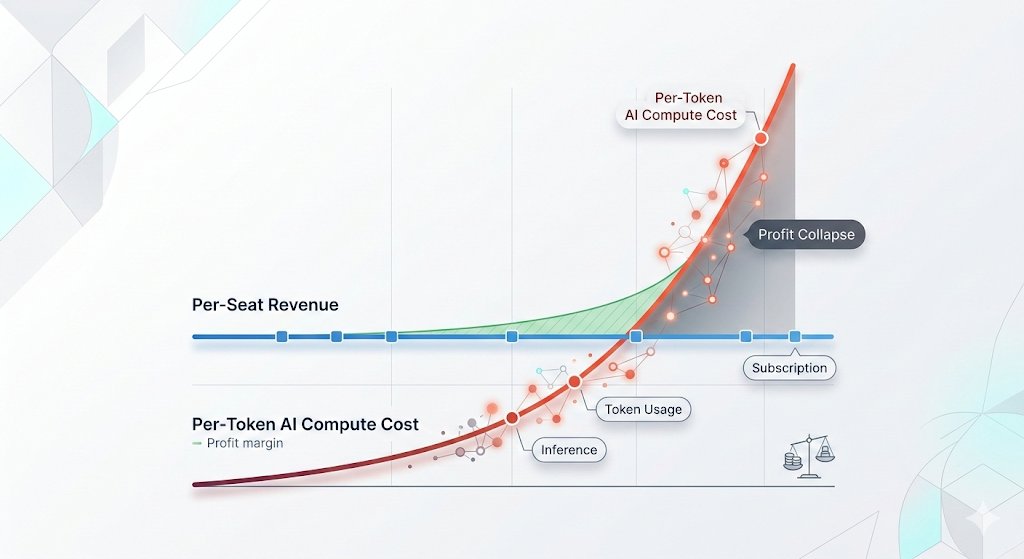
🦔Microsoft canceled its internal Claude Code licenses this week after token-based billing made the cost untenable, even for a company with effectively infinite cloud resources. Uber's CTO sent an internal memo warning the company burned through its entire 2026 AI budget in just four months. American AI software prices have jumped 20% to 37%, and GitHub (owned by Microsoft) is dropping flat-rate plans for usage-based billing across its products.
My Take
The AI subsidy era is ending in real time. The same company that put $13 billion into OpenAI and built the Azure infrastructure powering most of Anthropic's compute just looked at the bill from a competitor's coding tool and decided it was not worth paying. That is not a productivity failure on Anthropic's end. Token-based pricing is forcing every enterprise customer to confront the actual cost of running these models at scale, and the number turns out to be far higher than the flat-rate experiments suggested.
This ties directly to my Gemini Flash post yesterday. Anthropic, OpenAI, and Google all raised effective prices in the last six months. Enterprises that built workflows assuming AI costs would keep falling are now watching annual budgets evaporate in months. Two outcomes look likely from here. Either enterprises scale back AI usage to fit budgets, which slows the revenue ramp the labs need to justify their valuations ahead of IPOs, or the labs cut prices and absorb the losses, which makes the unit economics worse at exactly the wrong moment. Both paths land in the same place, the numbers stop working, and somebody has to take the writedown.
Hedgie🤗
English
@GlenWilsonIA 🦔In my opinion, replacing human labor at scale requires inference costs to collapse by an order of magnitude, and the trend over the last six months runs in the opposite direction. The 18-month predictions assume cost trajectories that no longer match the price sheets.
English
@HedgieMarkets @joecole Yes ✨🔥✨there needs to be the next generation of AI cost structure as the sector transitions to becoming a utility ✨🌟✨🐎 Cheray
English

🇺🇸 March 2026: renewables finally beat gas on the U.S. grid for a hot second… and gas answered by filing 44.9 GW of new plants
Gas still makes 40% of America’s electricity and holds 42% of total capacity.
What changed? AI data centers.
These things are power-hungry monsters that need 24/7 reliable juice, so grid planners are rushing gas because it can actually be permitted and built in time.
We’re looking at:
- 3-6 BCF/day extra gas burn by 2030 just from data centers
- 60-80 GW of new gas capacity potentially needed
Google’s already building a 1.5 GW dedicated gas plant in Missouri. Meta’s lining up 10 in Louisiana.
Some of these behind-the-meter projects will emit more CO₂ yearly than entire small countries.
Renewables are still crushing it on sheer volume in the pipeline… but gas is winning the reliability race.
Source: @jackprandelli, Bloomberg (Image)

English

I called my engineer friend at SpaceX the other day.
1am Pacific. 3am in Starbase.
He was still in the office and not going home any time soon.
And he was happy. Energized. Because he's directly influencing the course of a multi-planetary future for humanity.
On a fundamental level, this is why Elon companies win. Young, high-competence people are given exceptional individual agency and semi-impossible problems.
And they know that their contribution is essential.
Any company that does this is much more likely to succeed. Elon does this without fail.
Inspires me a lot.

David Senra@davidsenra
Marc Andreessen (@pmarca) on what it’s like to work at SpaceX: “It’s like being dropped into a zone of shocking competence.” “Everybody is ultra competent, and the reason everybody’s ultra competent is because if they’re not, Elon sniffs it out and fires them. He knows, ‘cause he’s talking to the people actually doing the work.” “The best engineers in the world want to work for him, ‘cause he’s the one CEO like this who’s able to work with them as a peer on whatever the technology is.” “What would be better as an engineer than being able to design a rocket engine with Elon Musk as your engineering partner?”
English
@Forbes @CowboySpaceCorp @America250 Space is the ultimate frontier ✨🔥✨🪐🚀🛰️ and holds the dreams of the next generation ✨🌟✨🐎
English

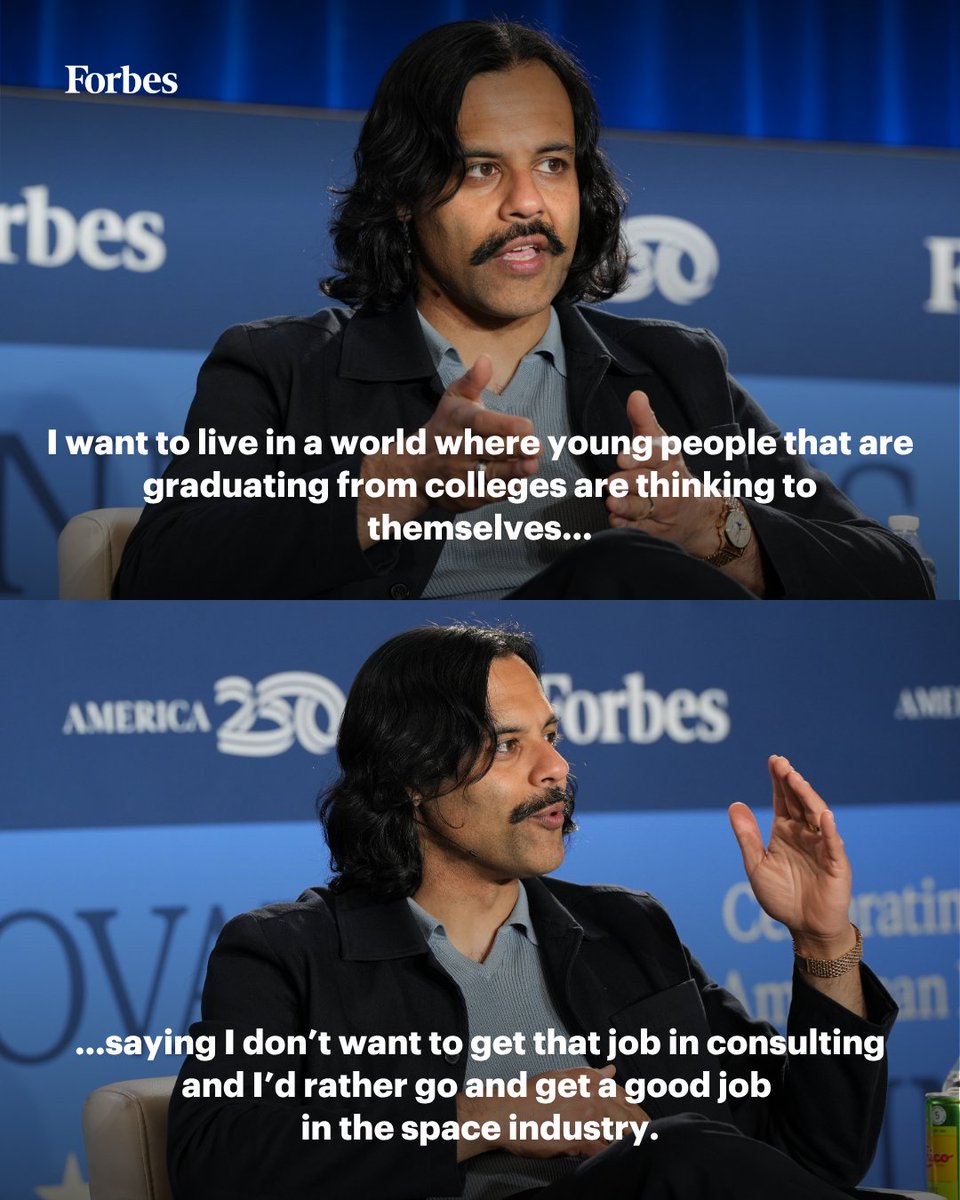
From the @america250 x Forbes America Innovates stage, Baiju Bhatt, Robinhood cofounder, founder and CEO of Cowboy Space Corporation and a Forbes 250 America’s Greatest Living Innovators honoree, spoke on inspiring the next generation to help build the future of space.
⠀
#Forbes250 #America250

English

The new Space Race is unlocking the orbital economy for all of humanity.
The more innovation and companies that move to space, the better the future looks for all of us.
GIF
English