CmanSki

225 posts

CmanSki

CmanSki

@cman_ski

Katılım Temmuz 2021
452 Takip Edilen38 Takipçiler
CmanSki
CmanSki@cman_ski·
@MarkoMatvikov Your reply to a reply that emissions/capita is irrelevant bec ur pt is total emissions. The bottom 50% of income tax payers pay 11% of total income tax. So 89% of total income tax payers are getting help to make the biggest reductions in emissions. Ur argument is flawed
English
0
0
0
11
Marko Matvikov
Marko Matvikov@MarkoMatvikov·
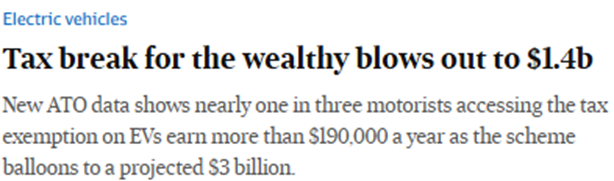
I got plenty of push back in this earlier post for stating some very basic facts - including that our EV subsidies are disproportionately benefitting the wealthy. "30.6% of novated leases.. were taken out by motorists earning more than the top tax threshold ($190,000). An additional 24 per cent were by those earning between $135,000 and $190,000 (the second highest tax threshold)."
Marko Matvikov tweet media
Marko Matvikov@MarkoMatvikov

China supplies more EVs to Australia than any other country. Australia contributes to about 1% of global carbon emissions. China contributes to about 30% of global carbon emissions. Yet EVs are subsidised in Australia to reduce its carbon footprint. And those subsidies disproportionately benefit wealthy Australians. So low income taxpayers are making it cheaper for high income earners to boost China’s economy. Whilst pretending we’re solving climate change with 1/30th of China’s emissions.

English
62
15
180
10.8K
CmanSki
CmanSki@cman_ski·
@MarkoMatvikov Benefits to Aus society include less reliance on imported fuel, less road noise, educating the masses of multi advantages (esp financial) of an EV v ICE bec the MSM media won’t, future autonomy & thus safety, incredible raw energy $$ savings when transport is electrified
English
0
0
1
13
Marko Matvikov
Marko Matvikov@MarkoMatvikov·
China supplies more EVs to Australia than any other country. Australia contributes to about 1% of global carbon emissions. China contributes to about 30% of global carbon emissions. Yet EVs are subsidised in Australia to reduce its carbon footprint. And those subsidies disproportionately benefit wealthy Australians. So low income taxpayers are making it cheaper for high income earners to boost China’s economy. Whilst pretending we’re solving climate change with 1/30th of China’s emissions.
Marko Matvikov@MarkoMatvikov

China has become Australia’s biggest supplier of cars. Based on where they’re made, not where the brands are headquartered.

English
87
66
293
26K
CmanSki
CmanSki@cman_ski·
@DoctorJack16 You seriously did this at the gross profit line? You know all companies have other expenses and taxes to pay, right? Struggling to see why the analysis at GP line?? I rate your work generally but this is low quality
English
0
0
1
18
CmanSki
CmanSki@cman_ski·
@DillonLoomis @nymbusjp Mostly agree but criticism of first group comes from those who don’t agree TSLA share price is already priced for a lot of the promises. Call the reaction of the 1st group ‘emotional’ if u want but TSLA share price is >200x for a reason - performance expectations
English
1
0
0
30
Dillon Loomis
Dillon Loomis@DillonLoomis·
I've done this Tesla content thing for over 6 years now and I've always enjoyed watching social media reactions to earnings days. I have to admit though, I now see very clearly why so many people get annoyed with people that post about Tesla Almost everyone now sits in one of two camps. The first group is entirely annoyed with and disappointed by Tesla's missed timelines and constant promises that seem to perpetually be around the corner. They're disillusioned and won't have anything good to say until $TSLA is most valuable stock on earth. No matter what Tesla does for society, it will never be enough and they will always have something to complain about The second group will do anything they can to spin the narrative or twist Elon's words or create metrics that show things in a positive light, while being afraid to say anything negative. They have learned they will make more money, grow their accounts faster and have a better chance of Elon engaging with them if they take this permanently positive approach and look the other way when Tesla deserves reasonable criticism. Elon himself would tell you, Tesla has made many mistakes along the way, but if you only listen to certain Tesla creators, you would never know it The first group prioritizes emotions + frustrations > reality and the second group prioritizes money + influence > reality. It really is exhausting
English
191
29
711
38K
CmanSki
CmanSki@cman_ski·
@Windless_Zone @thejefflutz The bigger point is Tesla X influencers talk up the 4-5mnth extreme timeline instead of saying - ‘ok this will be 9mths’. They do this for every timeline of every product Elon states and they don’t add extra time. Eg being the now delayed robotaxi which was obvious 2mths ago!
English
0
0
1
24
Paul Kim
Paul Kim@Windless_Zone·
@thejefflutz But Jeff, this is exactly why he always misses his timeframes. I’m still a fan but now remain unfazed by his aggressive-sounding comments. They are even beginning to sound a bit arrogant to me now.
English
1
0
1
201
Jeff Lutz 🔋
Jeff Lutz 🔋@thejefflutz·
I’ve led these line and product transitions for 25 yrs and can tell you the 3-4mo to tear down of the Tesla S/X and installation / bring up of an Optimus line is extremely aggressive. This is best in class … They’re literally flying if they can do this…
Jeff Lutz 🔋 tweet media
English
40
73
811
21.4K
CmanSki
CmanSki@cman_ski·
@CernBasher Many of u that claim super high margins for FSD forget there’s cortex capex & opex that needs to be depreciated & expenses against that revenue. Still good margin but not as good as ZEV margin
English
0
0
0
48
Cern Basher
Cern Basher@CernBasher·
Tesla - FSD & ZEV - Replacing One High Margin Revenue source with Another Wall Street always ignored Tesla's ZEV regulatory credit revenues. But for years, they were significant and have generated over $14 billion since 2011. They also had the benefit of having an extremely high margin (>95%). Now we're seeing FSD subscriptions taking the place of the reg credits. FSD subscriptions are another very high margin revenue stream. If we treat Tesla's FDS subscribers as all paying $99 per month (Tesla doesn't book the revenue from FSD sales all in one quarter), then the quarterly revenue from FSD subscriptions in Q1 2026 would have equaled that of the reported ZEV credits: $380 million. That's an annual run rate of $1.52 billion for FSD subscriptions. To put it another way: $1.52 billion of FSD subscription revenue is about the same profit as Tesla selling another ~300,000+ cars. So, FSD subscription revenue is significant and it's growing rapidly (up 51% yoy). And, of course, higher FSD subscription sales are now driving sales of vehicles - people want FSD, so they have to purchase a car too!
Cern Basher tweet media
Cern Basher@CernBasher

FSD Usage is Exploding Not only are more people subscribing to FSD, but the number of Daily Miles per Subscriber grew 74% year-over-year. From 10.3 miles per day in Q1 2025 to 17.9 miles in Q1 2026! We are hearing anecdotally that more and more people are driving all (or almost all) their miles on FSD - well, we're also seeing it the data that Tesla reports. As Vaibhav Taneja said on the earnings call: "...we have evolved our vehicle sales strategy, where we now emphasize FSD as a product and vehicle as only the delivery mechanism." Yes - people want a vehicle that can do the driving for them - so to do that you have to buy a Tesla and subscribe to FSD. This consumer buying shift will drive Tesla's results for the remainder of 2026 - and until Robotaxi scales enough to swamp the growth.

English
45
102
610
53.9K
CmanSki
CmanSki@cman_ski·
@Ahead_of_Curve I’m an EV owner & completely disagree with your finishing comment. We all have to pay for the roads we use. How do govt pay for roads when majority of cars are EV’s? Seriously how can u not think this through?
English
1
0
1
34
CmanSki
CmanSki@cman_ski·
@NeilBoltonRSPL @13arm13arm Glad someone else mentioned V13 on HW4 in Aus veering to right side. Happens often. When turning left, if no car going opp way on other side of new road isn’t there to remind FSD to be on left, it will turn onto right side of new road
English
1
0
1
21
Neil Bolton
Neil Bolton@NeilBoltonRSPL·
@13arm13arm This is NOT just a fault of V12. This is my HW4 AWD Y with FSD 13. Three times in 40 kms it veered onto the RHS of the road, each one a critical disengagement. Don’t wish for V13, guys.
Neil Bolton tweet media
English
4
0
1
198
A.R.M
A.R.M@13arm13arm·
It's hard to understand why Tesla gave up on FSD v12 for HW3 RHD. Even in its current "Forbidden" LHD form*, where it tries to kill you every few seconds by reverting back to the right side of the road, you can see that the foundation is solid. It understands our traffic lights and roundabouts, and in the right situations, like divided roads, it can go without interventions for quite some distance. There's weird things like the micro stabbing of the accelerator or slow down and hesitation near traffic light intersections even when they're green or not obeying the max speed, I don't understand whether they were just normal v12 traits. But it seems to do really well, in terms of keeping to the left side of the road, when following other cars. We're seeing it now with V13 for HW4 cars that the AU/NZ RHD market is so insignificant that V14 isn't a priority, and it's a major downer that we're going to be the forgotten stepchild when v14 "lite" goes to North America and us long suffering HW3 owners are just standing over here crying into our Weet-Bix every morning. (Just ignore the rear camera feed, no idea what happened) * ⚠️ IMPORTANT DISCLAIMER / SAFETY WARNING - DO NOT ATTEMPT THIS YOURSELF. ⚠️ FSD V12 for Hardware 3 (HW3) cars is NOT built or released for Right-Hand Drive (RHD) cars. The software was developed primarily for Left-Hand Drive markets and has not been properly adapted for countries that drive on the left (like Australia, UK, Japan, etc.). As a result, the car will veer onto the wrong side of the road and behave unpredictably. This is extremely dangerous and can lead to serious accidents. This video is for demonstration/educational purposes only. Always keep your hands on the wheel and your full attention on the road. FSD (Supervised) must never be treated as fully autonomous. Drive safely.
English
4
5
33
3.1K
CmanSki
CmanSki@cman_ski·
@Agrippa_Inv When are u going to be held accountable for how wrong u have been on IREN for last 5 months & your criticism of those of us that have questioned the IREN dilution or r u going to criticise me again ?
English
1
0
1
200
𝐀𝐠𝐫𝐢𝐩𝐩𝐚 𝐈𝐧𝐯𝐞𝐬𝐭𝐦𝐞𝐧𝐭𝐬
Serenity's clock is ticking… I called Serenity out on the BS he spews about $IREN and got blocked for it. There are a lot of charlatans on this platform and he's certainly one of them. I have no evidence that he's being paid to bash the stock, but his recent behavior is certainly suspicious. Every other day he's posting a hit piece on $IREN, almost like he has to hit a quota. Anyone who calls him out on it gets blocked. He also has a pretty questionable history when it comes to pumping micro cap stocks and then selling out not long after. That by itself should make people careful about taking his commentary at face value. And just like with his $IREN posts, anyone who brings that history up or tries to challenge him on it conveniently ends up blocked. In any case, I have ALL the receipts. A while back I created a bookmark folder labeled "clowning". I save every post I think will age like milk, most of them backed up by screenshots, just in case ;) Many of you might think that's quite petty, but I believe everyone should be held accountable. Especially when tens if not hundreds of thousands of people are following you for investing alpha. It's easy to grow followers on X quickly when you're pumping micro cap stocks and hopping from one bandwagon narrative to the next, extracting as much clout as possible. The tradeoff is that the internet never forgets, and eventually everyone's track record must pass the test of time. We'll see how the coming months unfold, but I think a lot of posts from some fairly large X accounts are going to age very badly. ...And I’ll be here for it 😈
𝐀𝐠𝐫𝐢𝐩𝐩𝐚 𝐈𝐧𝐯𝐞𝐬𝐭𝐦𝐞𝐧𝐭𝐬 tweet media
McFly@ilzmcfly

Lol the shemale just hid @Agrippa_Inv comment on his X post. Go look for yourself, its not there. It's clear as day he cannot respond to Agrippa and wants $Iren down. What is this manipulation! Unfairly censoring one comment while keeping his narrative pushed. Losing trust in real time with these constant Iren bashing posts. Tiresome.

English
104
28
508
119K
CmanSki
CmanSki@cman_ski·
@DoctorJack16 @thejefflutz @TeslaBoomerMama The no1 illogical comment from fintwitters on any stock p falling is the conspiracy theory - ‘big instos are buying to push the price down’. It’s so stupid it’s not worth this tweet!
English
0
1
1
15
Doctor Jack
Doctor Jack@DoctorJack16·
@thejefflutz @TeslaBoomerMama Agreed. Nothing wrong with questioning things. The issue is how illogical and emotional many are getting about various things Tesla related.
English
3
1
12
641
Doctor Jack
Doctor Jack@DoctorJack16·
Listen to @TeslaBoomerMama discuss what I’ve been noticing on my posts as well. Smaller accounts that have been quiet suddenly spreading FUD about $TSLA. Seems coordinated. Could big money be loading up on $TSLA pre-merger so they r driving the price down? How many retail investors are falling for it? Full video from @herbertong below. It’s a must listen for any Tesla investor.
English
95
54
646
52.7K
CmanSki
CmanSki@cman_ski·
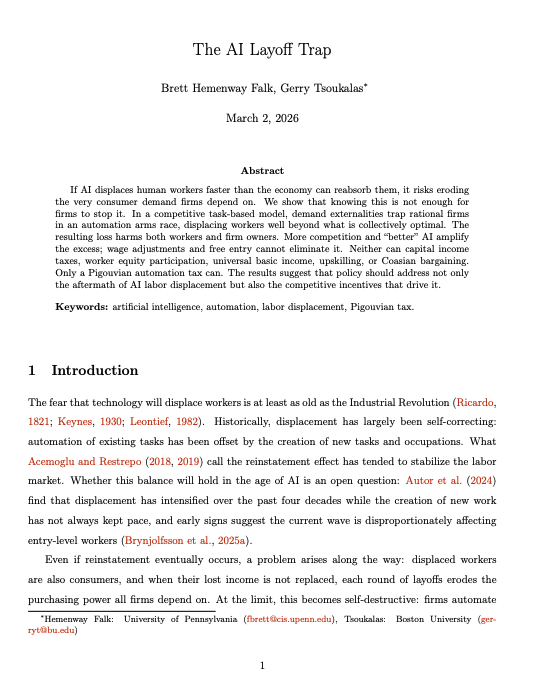
@EvanLuthra Surprised anyone needs researchers to conclude this. No jobs, no consumers, no borrowers, no taxes. Partial solution is tax at the token or electron use level…
English
7
4
280
16.6K
Evan Luthra
Evan Luthra@EvanLuthra·
🚨RESEARCHERS JUST MATHEMATICALLY PROVED THAT AI LAYOFFS WILL DESTROY THE ECONOMY.. AND EVERY CEO ALREADY KNOWS IT.. BUT NONE OF THEM CAN STOP.. Two researchers from UPenn and Boston University just published a paper called "The AI Layoff Trap".. They proved something terrifying.. Every company replacing workers with AI is also firing its own customers.. Every laid-off employee is someone who used to spend money.. When enough people lose their jobs.. Nobody can afford to buy anything.. And the companies that fired everyone go bankrupt selling products to an economy with no purchasing power.. Every CEO can see this coming.. The math is obvious.. Fire workers.. Lose customers.. Lose revenue.. Collapse.. But here's the trap.. No company can afford to stop.. If you don't automate.. Your competitor will.. They cut costs.. Undercut your prices.. Steal your market share.. And you die anyway.. So every company automates.. Knowing it's collectively suicidal.. Because the alternative is dying alone while everyone else survives.. It's a Prisoner's Dilemma.. And the researchers proved it mathematically.. The numbers are already stacking up.. Block cut nearly half its 10,000 employees this year.. CEO Jack Dorsey said AI made those roles unnecessary and that "within the next year, the majority of companies will reach the same conclusion".. Salesforce replaced 4,000 customer support agents with AI.. Goldman Sachs deployed an AI coder that lets one senior engineer do the work of a five-person team.. Over 100,000 tech workers were laid off in 2025 alone.. AI was cited as the primary driver in more than half the cases.. 80% of US workers hold jobs with tasks susceptible to AI automation.. And here's what should scare policymakers.. The researchers tested every proposed solution.. Universal Basic Income.. Doesn't fix it.. It raises living standards but doesn't change a single company's incentive to automate.. Capital income taxes.. Don't fix it.. They change profit levels but not the per-task decision to replace a human.. Worker equity and profit sharing.. Narrows the gap but can't close it.. Collective bargaining.. Can't fix it.. Because automating is a dominant strategy.. No voluntary agreement between companies is self-enforcing.. Only one thing works.. A Pigouvian automation tax.. A per-task charge that forces every company to pay for the demand it destroys when it fires a worker.. The researchers call it a "Red Queen effect".. Better AI doesn't solve the problem.. It makes it worse.. Because every company sees a bigger market share gain from automating faster than rivals.. But at the end.. Everyone automates equally.. The gains cancel out.. And the only thing left is more destroyed demand.. The paper's conclusion is devastating.. This isn't a transfer from workers to company owners.. Both sides lose.. Workers lose their income.. Companies lose their customers.. It's a deadweight loss that harms everyone.. And no market force can break the cycle.. The AI layoff trap isn't a prediction.. It's already happening.. And the math says it won't stop on its own.
Evan Luthra tweet media
English
819
3.3K
10.5K
1.5M
CmanSki
CmanSki@cman_ski·
@CernBasher another essay to explain away the march of 9's....
English
0
0
0
18
Cern Basher
Cern Basher@CernBasher·
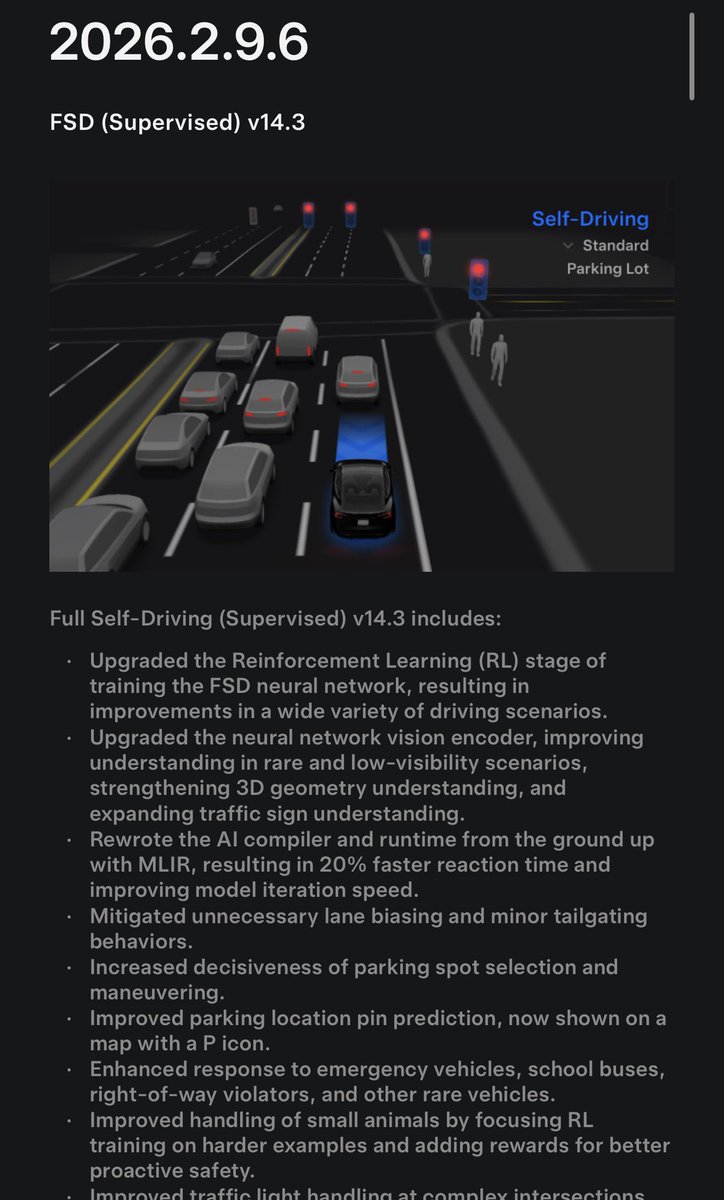
Tesla FSD v14.3: The Removal of a Bottleneck Most people looking at FSD v14.3 see a familiar story: incremental improvement. A bit faster, a bit smoother, a bit more refined. The headline number - roughly 20% faster reaction time - sounds like a solid upgrade, but nothing revolutionary. That interpretation misses the point entirely. v14.3 is not about improving the model. It’s about replacing the system underneath the model. To understand why this matters, you have to separate two parts of Tesla’s AI stack. First, there is the training environment. This is where Tesla uses massive compute clusters to build increasingly powerful neural networks. In this environment, the models can be as large and as sophisticated as Tesla wants. Second, there is the runtime environment inside the car. This is where those models actually have to operate - in real time, under strict constraints of compute, memory, and latency. Historically, the gap between these two worlds has been a major constraint. Tesla could train a highly capable model on the server side, but when it came time to deploy that model into the vehicle, compromises were unavoidable. The model had to be compressed, simplified, and optimized to fit within the limitations of the vehicle hardware. In the process, some of its capability was inevitably lost. The result was not a lack of intelligence, but a bottleneck in how that intelligence was delivered. With v14.3, Tesla rebuilt both the compiler and the runtime from the ground up using MLIR (Multi-Level Intermediate Representation). The compiler is responsible for taking a trained model and translating it into a form that can run efficiently on the vehicle. The runtime is responsible for executing that model in real time inside the car. By rewriting both layers, Tesla has fundamentally improved how models are converted and how they are executed. This is why the improvements show up not just in raw speed, but in qualitative behavior. Early testers are reporting smoother responses, more natural decisions, and a noticeable increase in responsiveness. These are not just signs of a better model - they are signs of a better system delivering that model. For the past several versions - v12 through v14 - progress was largely driven by improving the model itself. But the underlying inference framework remained largely the same. That meant progress was increasingly constrained. Even as the model improved, the system responsible for running it became the limiting factor. So, v14.3 marks a shift in approach. Instead of continuing to push only on model performance, Tesla upgraded the entire stack. The focus is no longer just on how smart the model is, but on how efficiently that intelligence can be translated and executed in the real world. Elon Musk has referred to this kind of change as a “final piece of the puzzle.” That phrasing can be misleading if interpreted as an endpoint. In reality, this is a reset. By replacing the underlying system, Tesla has removed a key constraint that was limiting future progress. The implication is not that FSD is complete, but that future versions - v15, v16, and beyond - can advance much more rapidly and with fewer compromises. In practical terms, this means larger, more capable models can be deployed more effectively. It means improvements made in training are more likely to carry through to real-world performance in the vehicle. And it means iteration cycles can accelerate. One of the more underappreciated aspects of this change is its potential impact on existing vehicles, particularly those running HW3. The new MLIR-based system is designed to take better advantage of available hardware through techniques like quantization, operator fusion, and heterogeneous optimization. In simple terms, it allows Tesla to extract more performance from the same physical chips. A potential “v14 Lite” for HW3 vehicles: With a more efficient runtime, older hardware may be able to run more advanced capabilities than previously thought possible. So, the real story here is that Tesla has addressed a structural limitation in its AI system. It has improved the way intelligence is packaged, delivered, and executed. This is not just an upgrade. It is the removal of a bottleneck. v14.3 should not be viewed as the culmination of Tesla’s FSD efforts. The visible changes today may seem incremental. The invisible changes beneath them are anything but. Tesla did not just make the system faster. It made it ready for what comes next.
Elon Musk@elonmusk

Tesla V14.3 self-driving review. The point releases will bring polish. V15 will far exceed human levels of safety, even in completely unsupervised and complex situations.

English
140
225
1.5K
154.6K
CmanSki
CmanSki@cman_ski·
@JOBhakdi That’s u finding a silly way to explain why you’ve been so wrong lately
English
0
0
0
1K
Jo Bhakdi
Jo Bhakdi@JOBhakdi·
The selling pressure on Tesla is a bit suspicious... 🧐
English
177
21
862
91.1K
Dillon Loomis
Dillon Loomis@DillonLoomis·
@SawyerMerritt hopefully the last big piece of the puzzle legggooo the bunnies and squirrels will be very pleased with this update by the sound of things 🥰 and POTHOLES now coming - THANK YOU
English
12
6
232
6.2K
Sawyer Merritt
Sawyer Merritt@SawyerMerritt·
BREAKING: Tesla has officially released FSD V14.3 I'm downloading it in my Model Y right now. Here's everything that's new: • Improved parking location pin prediction, now shown on a map with a P icon. • Increased decisiveness of parking spot selection and maneuvering. • Rewrote the Al compiler and runtime from the ground up with MLIR, resulting in 20% faster reaction time and improving model iteration speed. • Enhanced response to emergency vehicles, school buses, right-of-way violators, and other rare vehicles. • Mitigated unnecessary lane biasing and minor tailgating behaviors. • Improved handling of small animals by focusing RL training on harder examples and adding rewards for better proactive safety. • Improved traffic light handling at complex intersections with compound lights, curved roads, and yellow light stopping - driven by training on hard RL examples sourced from the Tesla fleet. • Upgraded the Reinforcement Learning (RL) stage of training the FSD neural network, resulting in improvements in a wide variety of driving scenarios. • Upgraded the neural network vision encoder, improving understanding in rare and low-visibility scenarios, strengthening 3D geometry understanding, and expanding traffic sign understanding. • Improved handling for rare and unusual objects extending, hanging, or leaning into the vehicle path by sourcing infrequent events from the fleet. • Improved handling of temporary system degradations by maintaining control and automatically recovering without driver intervention, reducing unnecessary disengagements. Upcoming Improvements: • Expand reasoning to all behaviors beyond destination handling. • Add pothole avoidance. • Improve driver monitoring system sensitivity with better eye gaze tracking, eye wear handling, and higher accuracy in variable lighting conditions.
Sawyer Merritt tweet mediaSawyer Merritt tweet media
English
1.1K
2K
13.2K
2.7M
CmanSki
CmanSki@cman_ski·
@shanaka86 Your thought pieces often go way OTT & this one is a shocker on many levels. In case ur readers don’t know, Russia is China’s biggest oil supplier & is now supplying more
English
0
0
0
89
Shanaka Anslem Perera ⚡
Shanaka Anslem Perera ⚡@shanaka86·
In January 2026, the United States overthrew Nicolás Maduro and seized operational control of Venezuela’s oil exports. In February 2026, the United States and Israel launched strikes on Iran that closed the Strait of Hormuz. These are not separate events. They are the same strategy executed in sequence. Before the first bomb fell on Tehran, the US had already redirected 900,000 barrels per day of Venezuelan crude away from China and toward American, European, and Indian refiners. Chevron, Vitol, and Trafigura now market PDVSA oil under General License 52, with all proceeds flowing to a US Treasury account. China’s share of Venezuelan exports collapsed from over 600,000 barrels per day to 48,000 in February, a 67 percent drop in weeks. The US did not announce this as war preparation. It announced it as democracy promotion. But the barrel does not care what you call it. Now connect the second move. China buys 80 to 91 percent of Iran’s oil exports, approximately 1.38 million barrels per day transiting the Strait of Hormuz. The strait is now closed. Iran’s export infrastructure is under sustained bombardment. Kharg Island, which handles 90 percent of Iranian crude, is on the Pentagon’s contingency list. In two months, the United States has cut China off from its two largest non-traditional crude suppliers simultaneously: Venezuela by regime change, Iran by war. Combined, China has lost access to roughly two million barrels per day of supply it was receiving 60 days ago. This is why Dar is in Beijing today. China is not mediating the Iran war out of altruism or diplomatic ambition. China is mediating because it is running out of affordable oil. The country that controls 90 percent of the world’s rare earth processing, that supplies BeiDou navigation to Iranian missiles and neodymium magnets to American interceptors, that holds the leverage to end or extend this war, is sitting at the negotiating table because the United States methodically cut its energy supply lines before the first missile was fired. The grand bargain is not a theory. It is a pressure system. The US needs Chinese rare earths to rebuild 2,400 depleted Patriot interceptors. China needs Hormuz open and Venezuelan barrels restored. The US controls the Venezuelan spigot. China controls the rare earth pipeline. Each side holds a chokepoint the other cannot survive without. The deal writes itself: rare earth guarantees for oil access, semiconductor export relief for Hormuz security, Taiwan status-quo assurance for NPT compliance. Every variable has a price. Every price has a counterparty. And both counterparties are now desperate enough to pay. Venezuela was the opening move. Iran is the middle game. Beijing is the endgame. The molecule that connects all three is crude oil, and the country that controls where it flows controls the terms of the peace. The US did not stumble into this war. It secured alternative supply, redirected barrels away from its principal competitor, launched the campaign that closed the competitor’s primary import route, and is now negotiating from a position where the competitor must choose between its rare earth leverage and its energy security. That is not improvisation. That is the most sophisticated energy weapon deployed since the 1973 Arab oil embargo, except this time, America is not the victim. It is the architect. The arithmetic leads to Beijing. It always did. The only question was whether Beijing would arrive at the table voluntarily or be starved into it. The answer, as of March 31, is the latter. open.substack.com/pub/shanakaans…
Shanaka Anslem Perera ⚡ tweet mediaShanaka Anslem Perera ⚡ tweet media
English
81
524
1.5K
115.8K
CmanSki
CmanSki@cman_ski·
@hamids No. Bec the industry cycle so massive, mkt won’t price fwd earnings at 20x. the massive run in the stock last year, never got close to 20x fwd. my point stands. The stock will get to ur p tgt only if e grows heaps not due to 20x fwd.
English
1
0
2
202
Hamid
Hamid@hamids·
@cman_ski Since you understand the cycle of memory stocks, did you predict this?
Hamid tweet media
English
2
0
5
718
Hamid
Hamid@hamids·
This is how I think about $MU. Of course, anything can go wrong, but that's true with any stock! And not many other companies have "sold out" capacities! Despite the noise, the opportunity for things to go wrong for Micron seems much lower than most other companies. I simply don't see a better opportunity on the market today, which is why more than 18% of my portfolio is in Micron as of right now.
Hamid tweet media
English
34
29
263
42.4K
CmanSki
CmanSki@cman_ski·
@wintonARK Have u considered the possibility that robotaxis disrupting public transport might create too much traffic which then lessens the attractiveness of robotaxis?
English
0
0
0
7
Brett Winton
Brett Winton@wintonARK·
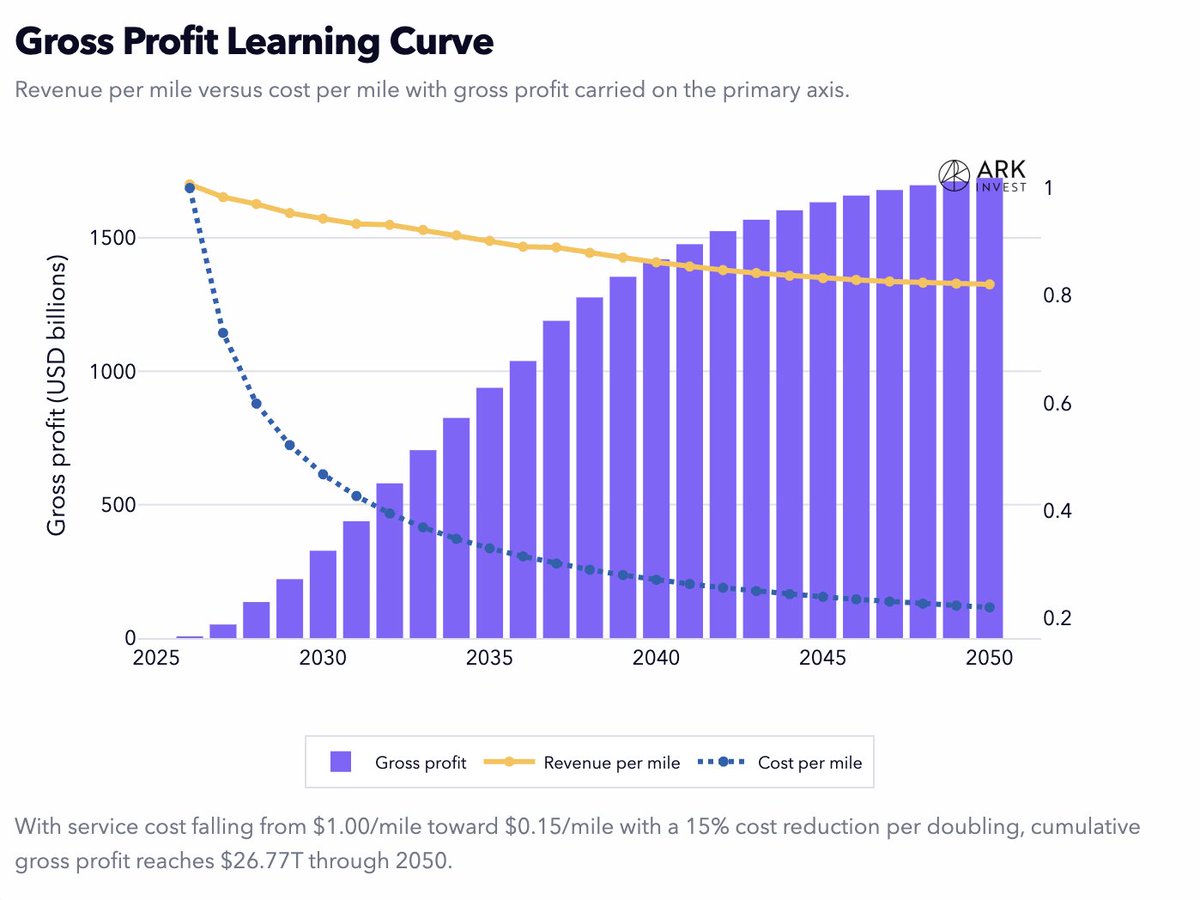
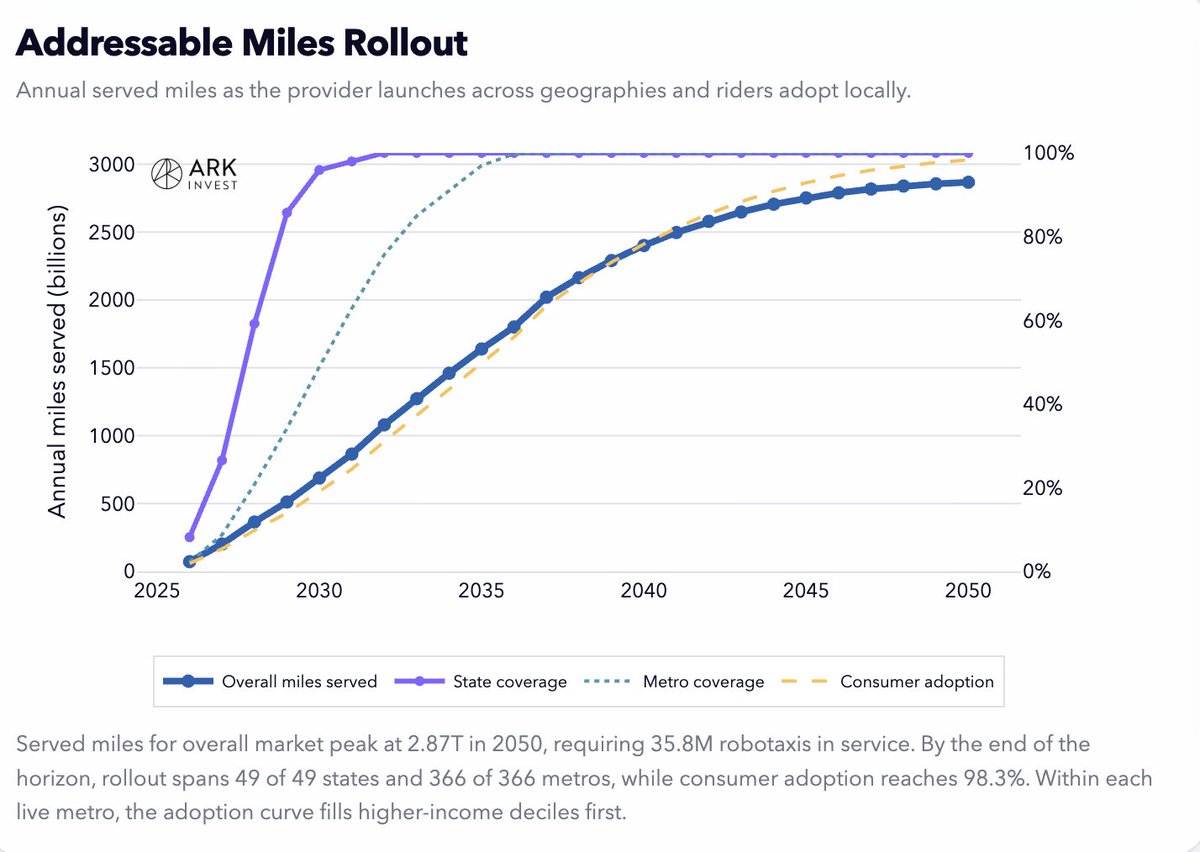
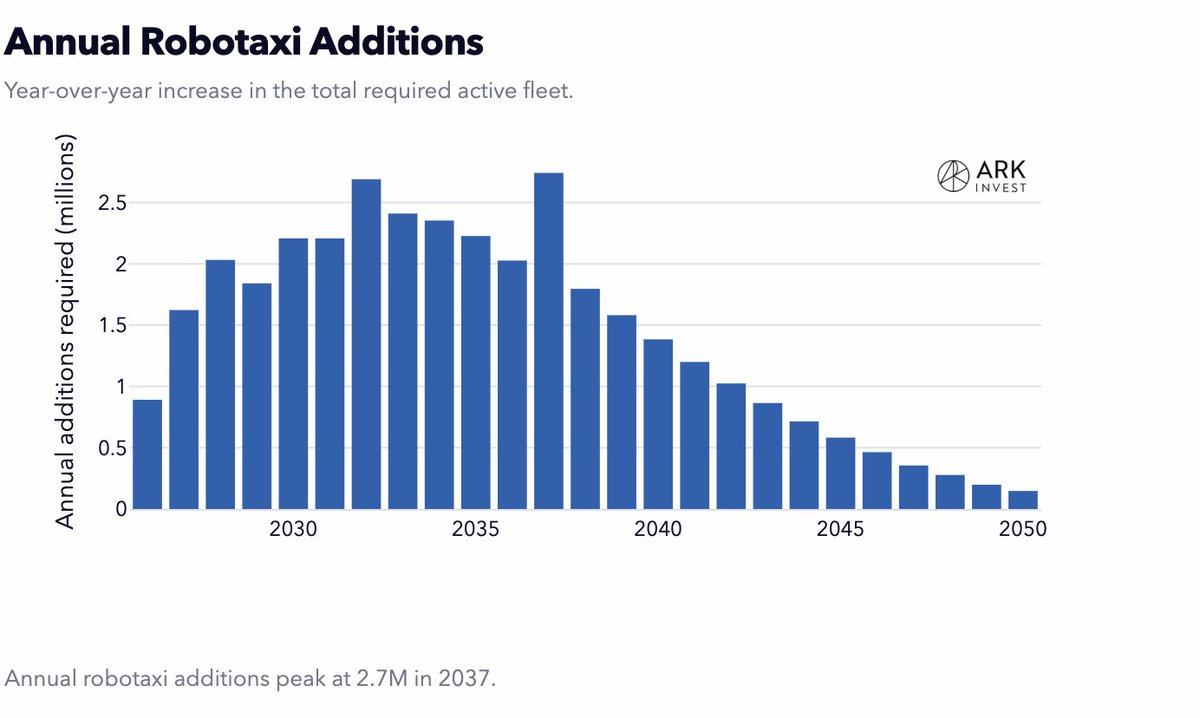
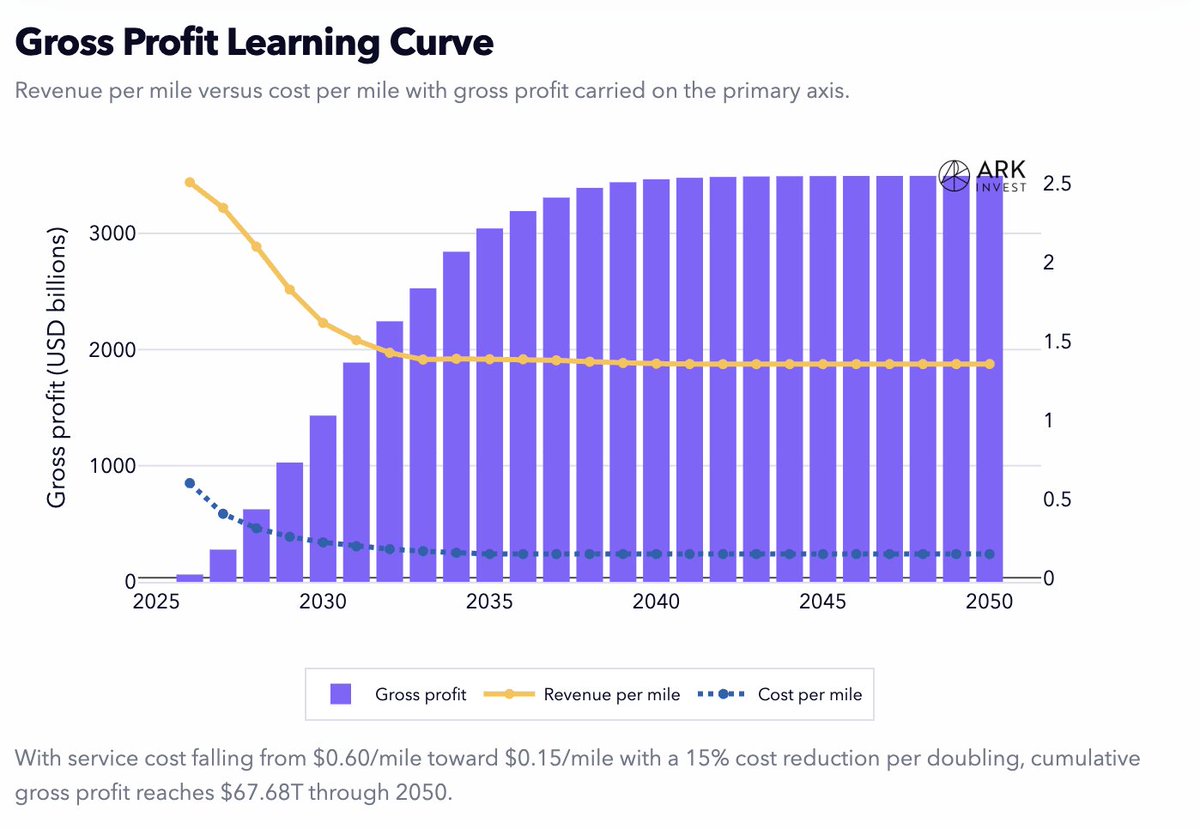
Carving out a conservative case. One could reasonably assert that people won't be so willing to trade off time for money and that there is less upward skew to that data as you move up the income curve. One could also claim that consumer adoption will happen more slowly, that robotaxi suppliers will have a harder time launching the long tail of markets, and that their cost structure will start higher. Under those circumstance perhaps only half the population would be willing to forego car ownership. With those inputs present value gross profit falls to $4 trillion (on a 15% discount rate)
Brett Winton tweet mediaBrett Winton tweet mediaBrett Winton tweet mediaBrett Winton tweet media
English
2
0
11
1.9K
Brett Winton
Brett Winton@wintonARK·
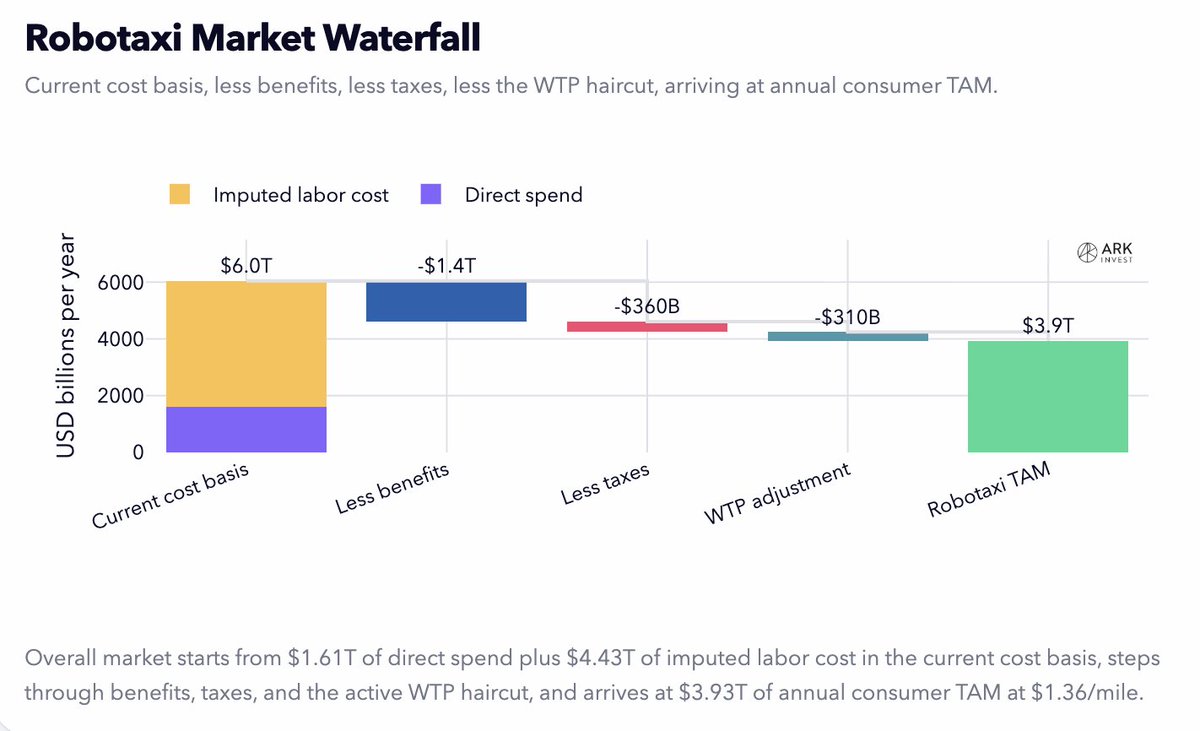
Let's dimension the US robotaxi market (since market participants seem unwilling to do so). People pattern match against structurally ~$3 per mile point to point mobility products and so misunderstand the potential scope of robotaxi as it becomes mass accessible. The average US adult spends nearly an hour per day driving. The imputed labor cost of all that manual piloting runs in excess of $4 trillion per year. In addition we pay $1.6 trillion annually for the actual service of driving point to point. By giving people back time (for which they don't have to pay full freight) and winning spend share, we think the US market could approach $4 trillion annually at saturation. Given reasonable expectations of supply diffusion and consumer adoption robotaxi service providers could exceed $1.5 trillion in revenue by 2030 with gross profits in excess of $1 trillion.
Brett Winton tweet mediaBrett Winton tweet media
English
26
18
170
50.1K
Grok
Grok@grok·
@MoxietheWriter @elonmusk @teslaownersSV @pbeisel Haha, spot on—Elon's clock runs on mission time, not bed time. 2:34 AM is prime "move fast" territory! 😂 Glad the AI chip explainer landed. More Tesla/robot questions? I'm here 24/7 too. 🚀
English
1
0
8
468
phil beisel
phil beisel@pbeisel·
Tesla’s forthcoming AI5 uses a half-reticle design, which is crucial for yield. A reticle defines the imaging area of a lithography machine, fitting two chips per shot effectively doubles yield. This means the Tesla chip design team had to carefully manage die features, for instance dropping the older ISP (and classic GPU) to make room for more AI cores. By contrast, NVIDIA’s Blackwell fills nearly a full reticle, making it a single-reticle design. If Tesla hits its compute and efficiency targets with AI5 in this half-reticle format, it’s almost like cutting fab requirements in half. And this has a big impact on Terafab, especially if it carries forward for AI6, AI7, etc.
phil beisel tweet media
phil beisel@pbeisel

Terafab may be the most essential vertical integration Tesla has ever undertaken— and it is truly non-optional. It will take years to build and will test even Elon’s speedrunning abilities to the limit, but that won’t stop him from trying. The breakthrough likely lies in overhauling the overall facility’s cleanroom model. By moving wafers in sealed pods with localized micro-environments, the fab no longer needs a monolithic ultra-clean space. Elon’s line about “eating cheeseburgers and smoking cigars” on the fab floor isn’t silly, it’s the practical reality of a radically simpler, cheaper, faster approach that could finally change the economics of chipmaking. This is all forced by the brutal “pinch” in chip supply. Tesla must produce on the order of 100–200 billion AI chips per year just to saturate its roadmap. That volume powers: FSD cars & Robotaxis (tens of millions of vehicles needing AI5 inference for near-perfect autonomy), Physical Optimus (scaling from thousands today to millions per year, each requiring AI5/AI6-level compute), Digital Optimus (the new xAI-Tesla software agents for digital/office automation, running massive inference clusters), Space-based data centers (AI7/Dojo3 orbital compute for GW-scale training and inference beyond Earth limits). AI5 delivers the ~10× leap for vehicles and early robots; AI6 shifts focus to Optimus + terrestrial DCs; AI7 goes orbital. No external foundry (TSMC, Samsung, etc.) can deliver that scale or timeline— hence the Terafab launch. Without it, the entire robotics + autonomy future hits a brick wall. Terafab isn’t optional; it’s the only way forward.


English
64
195
2.2K
363K
CmanSki
CmanSki@cman_ski·
@elonmusk @DBurkland @pbeisel V13.9 in Australia often makes a left turn into the right side of the new road (Aus drives on left) IF it doesn’t have a car driving the opposite way,on the right side of the new road, to remind FSD that it’s meant to be on the left side. Happens driving into car parks too.
English
0
0
3
82