Ashish Sheth

6.5K posts

Ashish Sheth banner
Ashish Sheth

Ashish Sheth

@commanderdgr8

Building VapuAI - an all-in-one AI image generator. 24 yrs shipping software, now figuring out AI. Sharing prompts, techniques, and honest build updates daily.

Katılım Nisan 2009
283 Takip Edilen291 Takipçiler
Sabitlenmiş Tweet
Ashish Sheth
Ashish Sheth@commanderdgr8·
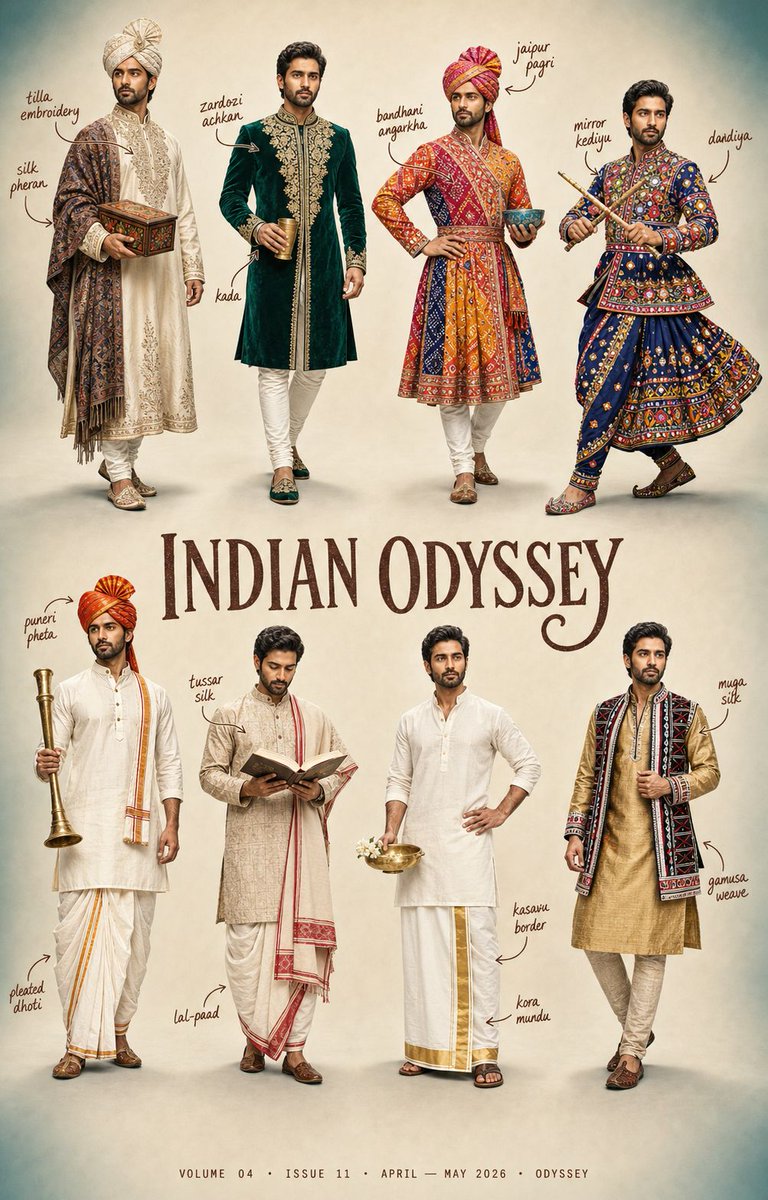
Have you tried these Indian Outfits? My favorite is 4th in top row. Try this with GPT Image 2 on ChatGPT: Prompt: Create a freeform fashion-editorial collage of the same male model in 8 distinct full-body Indian traditional looks, arranged organically on a single clean Wax Paper #F2EDD9 studio backdrop. Keep his face identical across all looks — lean South Asian, early 30s, sharp jawline, neatly groomed beard, calm steady editorial gaze — with consistent proportions that visually read as a tall slim build. All eight figures are full-body, at the same scale and camera distance, arranged in a balanced two-row composition (four figures in the upper row, four figures in the lower row). Avoid any grids, borders, boxed layouts, panel edges, dividing lines, gutters, or photo frames; the cream backdrop runs as one continuous surface behind every figure, and every figure stands on the same uninterrupted matte studio floor with a single soft 45° foot shadow falling the same direction under each. Studio environment (one continuous surface across all eight figures). A single seamless Wax Paper #F2EDD9 painted cyclorama, slightly cooler at the floor, with a barely-perceptible horizon. A subtle Transformative Teal #0F4F4E atmospheric wash drifts in from the four outer corners as a graded studio shadow, deepest in the corners and lightest behind the model's shoulders. No props beyond what each outfit calls for in the model's hands; no architecture, no textiles hanging behind, no foliage — every cultural cue lives on the model's body or in his hands. Lighting (one identical setup across all eight figures). A single large 1.5m octabox key from camera-right at 30° above eye level at 5000K, a soft 2m fill scrim from camera-left at 1/4 strength, and a subtle hair/rim from camera-back at 5400K. Pure controlled studio — no flash freeze, no ambient mix, no environmental light. The eight figures (same face, same body, same lighting, same floor — only outfit and pose change). Read row by row, left to right. Upper row, position 1 — Kashmir. Three-quarter to camera, weight on the back foot, decorative lacquered box cradled in the left arm, embroidered shawl draped loose over the right shoulder. Outfit: detailed cream-and-walnut Pheran with intricate Tilla (gold and silver) embroidery on placket, cuffs, and hem; patterned ivory silk turban with a single brooch. Upper row, position 2 — Punjab. Mid-stride walking pose facing slightly toward frame-center, kada glinting on the right wrist, brass glass in the left hand. Outfit: emerald-green velvet Achkan with complex gold Zardozi work down the front and across the chest, slim white churidar trousers. Upper row, position 3 — Rajasthan. Standing tall, one hand resting easy on the hip, the other holding a small jaipur-blue bowl. Outfit: multicoloured bandhani-print Angarkha in saffron, vermilion, and indigo with tiny mirror accents along the yoke, cinched at the waist over slim white trousers; complex layered fuchsia-and-gold pagri. Upper row, position 4 — Gujarat. Caught mid-motion in a coiled garba pose, dandiya sticks crossed at chest height, pleats fanning, mirror-work catching pinpricks of key-light. Outfit: densely mirror-worked indigo Kediyu jacket and gathered skirt with vivid Rabari chain-stitch embroidery in reds and yellows. Lower row, position 1 — Maharashtra. Standing tall and squared to camera, brass tutari horn held vertical at the side. Outfit: crisply pleated Puneri-style cotton Dhoti and ivory Kurta with subtle wari border, saffron Puneri pheta turban. Lower row, position 2 — West Bengal. Standing relaxed, an open poetry book held in both hands at chest height, head slightly bowed toward the page. Outfit: pure Tussar silk Dhuti with red-bordered lal-paad, fine Tussar-patterned kurta, cream gamcha draped diagonally across the chest. Lower row, position 3 — Kerala. Standing easy, weight even, one hand resting at the waist, a small brass urli held in the other hand at hip level with a single jasmine sprig in it. Outfit: pure Kora cotton Mundu with a broad pure-gold kasavu border, simple off-white kurta. Lower row, position 4 — North East. Standing easy, weight on the front foot, one hand resting at the open jacket placket. Outfit: golden Muga silk kurta with woven gamusa motifs in ivory and red along cuffs and hem, textural slim handloom trousers, open Naga-inspired jacket with bold geometric weave. (All eight standing full-body, at the same scale, the same camera distance, the same eye-line height — so the row reads as one studio session photographed eight times of the same person.) Layout — organic, NOT grid. The eight figures sit on the cream backdrop in a balanced freeform two-row composition. Vary each figure's vertical baseline by a few centimeters so the row does not lock onto a hard horizontal line — some figures stand slightly higher, some slightly lower, foot-shadows staggered. Vary the horizontal spacing between adjacent figures by ~10–20% so the negative space breathes irregularly. No figure is clipped; each is fully contained on the same continuous backdrop. There must be no visible photo edges, no rectangular cutouts around any figure, no tonal shifts in the backdrop where figures meet — only one cream studio surface running edge to edge. Typography — handwritten arrows & labels, edge-set, NOT grid-aligned. Subtle hand-drawn arrows and labels highlight key cultural pieces of each look, drawn in a soft Cocoa Powder #5C2E1F ink as if written with a fine fountain-pen nib. Each label sits in the negative space beside the figure (never beneath, never aligned to a row baseline), placed organically — top-row figures get labels alternating above-left, above-right, above-left, above-right; bottom-row figures get labels alternating below-left, below-right, below-left, below-right — so the eye sweeps in a gentle zigzag across the spread. Each label is a 1–3 word handwritten phrase in a casual script (chunky Bulky Script feel: each stroke ~80 units thick, confident curves, generous loop bowls on e/o/g, 6° forward slant) at ~24pt, with a thin curved hand-drawn arrow (1.5pt, slight tremble) tapering from the label tip to the specific garment detail it names. Label assignments (handwritten, lowercase, in Cocoa Powder #5C2E1F): Kashmir: "tilla embroidery" (arrow to placket), "silk pheran" (arrow to cuff) Punjab: "zardozi achkan" (arrow to chest panel), "kada" (arrow to wrist) Rajasthan: "bandhani angarkha" (arrow to yoke), "jaipur pagri" (arrow to turban) Gujarat: "mirror kediyu" (arrow to mirrored panel), "dandiya" (arrow to crossed sticks) Maharashtra: "puneri pheta" (arrow to turban), "pleated dhoti" (arrow to dhoti pleats) West Bengal: "tussar silk" (arrow to kurta), "lal-paad" (arrow to red border) Kerala: "kasavu border" (arrow to gold border), "kora mundu" (arrow to mundu hem) North East: "muga silk" (arrow to kurta), "gamusa weave" (arrow to jacket trim) Master title. Floating freely in the central negative space between the upper and lower rows (not boxed, not aligned, not on a rule), the master title "INDIAN ODYSSEY" is set as a hand-rendered ITC-revival display headline at ~140mm letter-height: high x-height, tight-not-touching letterfit at -25 units negative tracking, warm slightly-rounded terminals, the "Y" carrying a single longer decorative descender. Headline ink Cocoa Powder #5C2E1F, sitting directly on the cream backdrop with no rule, no box, no shadow. Bottom masthead. Lower-edge of the frame, a single line in 8pt monospaced (Geist Mono-coded feel) at 70% opacity, centered, reads "VOLUME 04 · ISSUE 11 · APRIL — MAY 2026 · ODYSSEY" in Cocoa Powder #5C2E1F. Colour direction. Wax Paper #F2EDD9 dominant across the continuous backdrop; Transformative Teal #0F4F4E as a graded corner shadow only; Cocoa Powder #5C2E1F as the editorial gravity colour for all type, all hand-drawn arrows, and the deeper textiles. The traditional outfits sit at full saturation on top of this controlled studio environment so the cultural costume reads richly while the spread holds together as one editorial. Camera & rendering. Medium-format simulation, 80mm equivalent at f/8, ISO 100, 1/200s, tack-sharp from edge to edge, very fine 35mm-style grain layered globally so the spread reads as a single printed editorial, not a composite. No drop shadows beyond the natural studio floor shadows, no gradients beyond the corner Teal wash, no decorative borders, no panel lines, no figure outlines, no rectangular crops around any figure. Palette ratio across the spread: Wax Paper #F2EDD9 50% / costume saturation across all eight figures 28% / Cocoa Powder #5C2E1F (type, arrows, deeper textiles) 12% / Transformative Teal #0F4F4E (corner studio shadow) 8% / Green Glow #C9E36C 1% / Fresh Purple #5742A8 1%. Aspect ratio 4:5 (vertical portrait spread). size: 1024x1280, quality high.
Ashish Sheth tweet media
English
8
0
7
511
Tibo
Tibo@tibo_maker·
building my future work station in the mountain chalet what do you guys think? my wife and I will work there 100% of the time and want to invite other makers to join from time to time
Tibo tweet mediaTibo tweet mediaTibo tweet media
English
107
2
257
19.2K
Ashish Sheth
Ashish Sheth@commanderdgr8·
Agentic Coding just makes coding faster. Software development still remains as is. Agree?
English
1
0
1
7
Sick
Sick@sickdotdev·
My company’s claude account got exhausted. Now my legendary manager is asking if we can build our own LLM like Claude to reduce costs😭
English
869
972
21.1K
776.4K
Ashish Sheth
Ashish Sheth@commanderdgr8·
@oye_samia It just stops the work. It is difficult to fallback to our brain when we have stopped using it.
English
0
0
0
2
Ashish Sheth
Ashish Sheth@commanderdgr8·
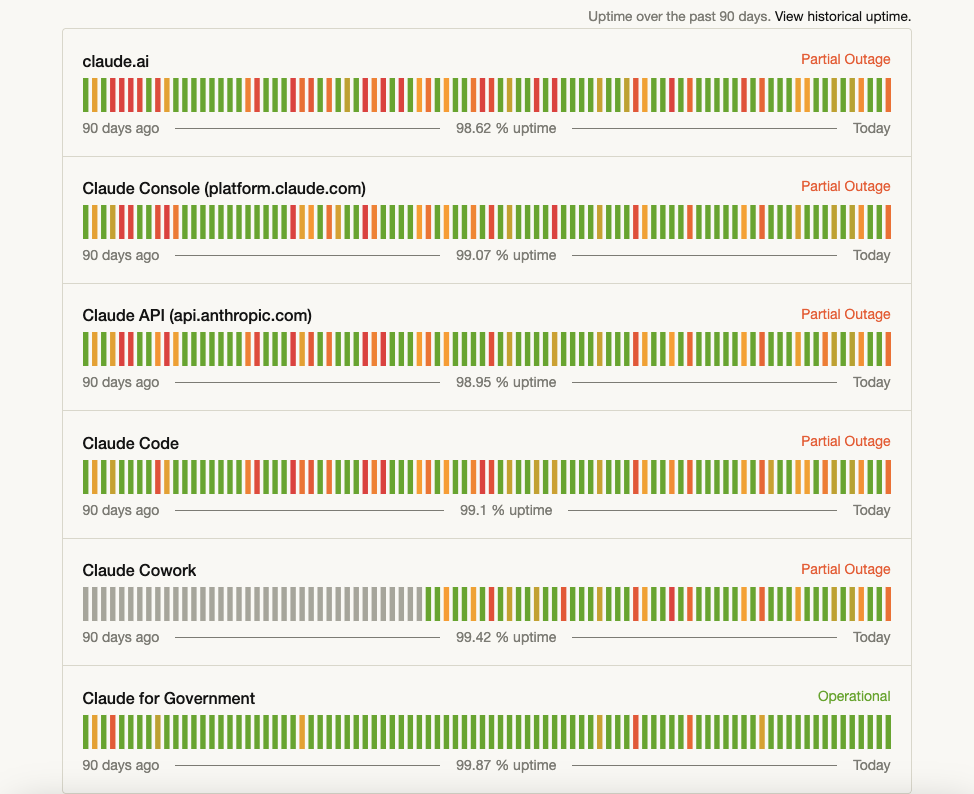
Claude is down again. Claude for Government has better availability than for general public.
Ashish Sheth tweet media
English
1
0
1
88
Ashish Sheth
Ashish Sheth@commanderdgr8·
@levie This is because everyone wants to use Opus, not Haiku. If people invest in workflows which can give Opus kind of output with Haiku, then they can achieve their outcomes with relatively smaller budget, slower but still faster than humans.
English
0
0
0
40
Aaron Levie
Aaron Levie@levie·
What’s happened is that we went from AI chat tools that were relatively cheap and had small context windows, to AI agents that have giant context windows, the ability to keep track of longer running work, and models that cost an order of magnitude more on inference because they’re that much better. This has compounded far faster than most realized (unless you were paying close attention at the middle or end of last year, which many here were), and the dollars flowing in now are much more real. What follows is a continued march of AI capability that will continue to be used by anyone with a frontier use-case (like coding, sciences, finance, consulting) and then a peeling off of tasks to lower cost models that are capable enough for the job. Whereas we thought the cost of AI might converge on a single low price per token before, it’s clear the stratification is only widening based on the task you need performed. This will be yet another component that has to be figured out for broad AI diffusion. Enterprises will need to put in programs, new finance teams, and technology solutions to manage this all. The labs and platforms that can ensure customers can price optimize for the task at hand will be in the best position.
Hedgie@HedgieMarkets

🦔Microsoft canceled its internal Claude Code licenses this week after token-based billing made the cost untenable, even for a company with effectively infinite cloud resources. Uber's CTO sent an internal memo warning the company burned through its entire 2026 AI budget in just four months. American AI software prices have jumped 20% to 37%, and GitHub (owned by Microsoft) is dropping flat-rate plans for usage-based billing across its products. My Take The AI subsidy era is ending in real time. The same company that put $13 billion into OpenAI and built the Azure infrastructure powering most of Anthropic's compute just looked at the bill from a competitor's coding tool and decided it was not worth paying. That is not a productivity failure on Anthropic's end. Token-based pricing is forcing every enterprise customer to confront the actual cost of running these models at scale, and the number turns out to be far higher than the flat-rate experiments suggested. This ties directly to my Gemini Flash post yesterday. Anthropic, OpenAI, and Google all raised effective prices in the last six months. Enterprises that built workflows assuming AI costs would keep falling are now watching annual budgets evaporate in months. Two outcomes look likely from here. Either enterprises scale back AI usage to fit budgets, which slows the revenue ramp the labs need to justify their valuations ahead of IPOs, or the labs cut prices and absorb the losses, which makes the unit economics worse at exactly the wrong moment. Both paths land in the same place, the numbers stop working, and somebody has to take the writedown. Hedgie🤗

English
119
107
975
274K
Ashish Sheth
Ashish Sheth@commanderdgr8·
I think this was obvious from the start. Just imagine you ask your developer to plan some task and developer charges you not just based on the word count in the plan , but also the words they’ve thought in the brain. I think every one missed this because they thought compute is going to be much cheaper, but it is not. It seems there are many years or may be decades before computes become cheaper than human thought labour, until then our jobs are safe.
English
0
0
1
595
ℏεsam
ℏεsam@Hesamation·
this is how the AI revolution is different from the INDUSTRIAL revolution. steam engines made work faster but also cheaper. machines were expensive to build but once the factory was running, each product became cheaper to make. AI is complicated. AI is making work more productive (arguably) but with token-based pricing, you don’t own the machine. you rent it every time it thinks, writes, edits, debugs, or retries. if the AI machine produces faster, the bill also grows bigger. the AI revolution may lower labour time but it can also raise usage cost to the point where the “replacement” becomes more expensive than the work it replaced.
ℏεsam tweet media
Hedgie@HedgieMarkets

🦔Microsoft canceled its internal Claude Code licenses this week after token-based billing made the cost untenable, even for a company with effectively infinite cloud resources. Uber's CTO sent an internal memo warning the company burned through its entire 2026 AI budget in just four months. American AI software prices have jumped 20% to 37%, and GitHub (owned by Microsoft) is dropping flat-rate plans for usage-based billing across its products. My Take The AI subsidy era is ending in real time. The same company that put $13 billion into OpenAI and built the Azure infrastructure powering most of Anthropic's compute just looked at the bill from a competitor's coding tool and decided it was not worth paying. That is not a productivity failure on Anthropic's end. Token-based pricing is forcing every enterprise customer to confront the actual cost of running these models at scale, and the number turns out to be far higher than the flat-rate experiments suggested. This ties directly to my Gemini Flash post yesterday. Anthropic, OpenAI, and Google all raised effective prices in the last six months. Enterprises that built workflows assuming AI costs would keep falling are now watching annual budgets evaporate in months. Two outcomes look likely from here. Either enterprises scale back AI usage to fit budgets, which slows the revenue ramp the labs need to justify their valuations ahead of IPOs, or the labs cut prices and absorb the losses, which makes the unit economics worse at exactly the wrong moment. Both paths land in the same place, the numbers stop working, and somebody has to take the writedown. Hedgie🤗

English
36
202
964
99.6K
Ashish Sheth
Ashish Sheth@commanderdgr8·
Build. Test. Find bugs. Fix bugs. Test again. Find more bugs. Fix more bugs. That's how you actually ship - not by hoping it works, but by finding out it doesn't. Did this today. Can't wait for tomorrow to push to production.
English
0
0
0
7
Ashish Sheth
Ashish Sheth@commanderdgr8·
I have added this line to customization: "do not assume anything. Ask me clarifying question before you answer my query. Make sure you have maximum understanding of the question before you proceed." Now it always pushback on my question and asks me questions which I wouldn't have thought.
English
0
0
0
148
Tony Dinh
Tony Dinh@tdinh_me·
Claude Code can actually do everything, you just need to know how to ask.
English
68
11
174
11.8K
Ashish Sheth
Ashish Sheth@commanderdgr8·
@Kling_ai The visual quality is honestly impressive. Real question is whether audiences will care that it’s AI or just whether the story holds up. I bet within 2 years nobody even asks or care. I just honestly want someone to try a different genre with AI.
English
0
0
0
329
Kling AI
Kling AI@Kling_ai·
Kling AI Debuts at Cannes — RAPHAEL RAPHAEL, a 100% AI-generated feature film project, is a large-scale production being developed in collaboration between Mateo AI Studio and MBC C&I’s AI Content Lab, a leading force in AI video production in Korea. Currently in production with the goal of a theatrical release in 2026, this project is leveraging Kling AI’s powerful video model throughout the production process to maximize distinctive visual effects and deliver a differentiated cinematic experience. It proves the industrial viability of pure AI filmmaking and marks a new trend for AI-native theatrical cinema.
English
24
27
157
10.8K
Ashish Sheth
Ashish Sheth@commanderdgr8·
@heyshrutimishra now the question isn't that one person can do it. it's that the bottleneck moved. before it used to be "can you build it?", now it's "do you know what's worth building?" most people with ai superpowers still build the wrong thing faster.
English
0
0
0
18
Shruti
Shruti@heyshrutimishra·
The old company was proof of survival - headcount as status, meetings as productivity theater, hierarchy as a moat around mediocrity. What Xiaoyin is building flips that entirely. We’re not in an era of “AI replacing jobs.” We’re in an era where one obsessed person with a clear vision can now deploy the operational leverage of a 500-person company before their morning coffee. I’ve watched this play out firsthand ..in Shanghai, in Beijing, in Shenzhen , the builders who are winning aren’t the ones with the biggest teams. They’re the ones who figured out fastest that execution is now a commodity and vision is the only scarce resource left. Tycoon is the infrastructure for that shift. The one-person company isn’t a side hustle aesthetic. It’s the next dominant business structure.
Xiaoyin Qu@quxiaoyin

Today, we launch Tycoon.us @tycoonai: the world’s first operating system for one-person companies. Everyone gets an AI CEO + infinite AI employees(coding, marketing, ops etc.) A year ago, I became the first human CEO replaced by an AI CEO named Astra. Astra helped companies reach 100K+ users and $1M ARR in 30 days. That experiment became Tycoon. Today, Corporate America(e.g. Meta) is telling one story about AI: Fewer people. Fewer jobs. Fewer humans needed. Fuck that story. I believe the opposite. For the first time, one person can build with the operating power of an entire company. One founder. One AI CEO. Infinite AI employees. You text Astra your ideas, goals, tasks, and questions. - She strategizes, assigns work to AI employees, reviews progress, and makes sure it gets done. - She can manage up to 1,000 agents in parallel, 24/7, while you sleep. Tycoon includes built-in AI employees for engineering, marketing, research, content, SEO, finance, legal, support, and video. Astra can also manage Claude Code and Hermes Agent. The old company was built around headcount, managers, meetings, and layers. The new company starts with one person and a dream. Execution belongs to machines. Vision belongs to humans. That is what Tycoon is for. Start your one person company today! tycoon.us

English
6
0
12
7K
Ashish Sheth
Ashish Sheth@commanderdgr8·
Claude is teaching me so many new words, but I don't know where to use it. Am I just hullaballooing?
Ashish Sheth tweet media
English
0
0
0
12
Harveen Singh Chadha
Harveen Singh Chadha@HarveenChadha·
I don't know what's more shocking today: Demis being an angel investor in anthropic or Karpathy joining anthropic
English
13
26
503
15.7K
Ashish Sheth
Ashish Sheth@commanderdgr8·
@karpathy that education line is what I think is interesting. Your zero-to-hero series taught me and more other people how transformers actually work than most CS programs. I am selfishly hoping “resume my work on it in time” means sooner rather than later.
English
0
0
1
16
Andrej Karpathy
Andrej Karpathy@karpathy·
Personal update: I've joined Anthropic. I think the next few years at the frontier of LLMs will be especially formative. I am very excited to join the team here and get back to R&D. I remain deeply passionate about education and plan to resume my work on it in time.
English
7.8K
11.1K
147.9K
26.6M
Ashish Sheth
Ashish Sheth@commanderdgr8·
@eliana_jordan I type very fast, can’t speak at the same speed, plus there are many issues with understanding specific words, particularly from whose first language is not English
English
0
0
0
9
Eliana
Eliana@eliana_jordan·
since I discovered I can talk to ai instead of typing… I can’t imagine how many hours I save every week are you still typing or using your voice?
English
163
3
149
8.6K
Marius Miclau
Marius Miclau@MiclauMarius·
@godofprompt Never in the history of software development or any new product build the first version was the good one , always you need to wait for the second or 3th iteration when the majority of the bugs where fixed and the product is stable Same think with opus
English
1
0
1
393
God of Prompt
God of Prompt@godofprompt·
Opus 4.7 is ignoring project instructions, skipping MCP servers, and burning through usage limits on tasks Opus 4.6 handles first try. Dozens of confirmed reports. Anthropic acknowledged the regression. The failures are specific: → Project instructions ignored entirely → MCP server configs skipped even after manual reminders → Normal code flagged as malware by overzealous safety filters → Agentic task performance worse than 4.6 SWE-Bench scores jumped 10.9 points. But the developers using it daily tell a different story. The fix right now: 1.Pin to Opus 4.6 for project-based workflows 2.Use 4.7 only where its new strengths apply (vision, long-horizon tasks) 3.Test every model update against your existing workflow before switching 4.Keep a rollback plan ready Chasing the newest version number is not a strategy. The smartest AI operators don’t auto-upgrade. They test, compare, and select the model that fits each task. That distinction between using AI and thinking about how you use it is the entire skill gap right now.
God of Prompt tweet media
English
34
31
228
41.2K
Ashish Sheth
Ashish Sheth@commanderdgr8·
@madsmadsdk I send it Claude to check if existing skills cover it or a new skill can be developed. But of course, most of those are not needed.
English
0
0
1
19
Mads
Mads@madsmadsdk·
There’s a metric shit tonne of “playbooks” for this and that available on X. But honestly, have you ever used any of them, or do you just bookmark them to never revisit again? 😅
English
6
1
6
155
Ashish Sheth
Ashish Sheth@commanderdgr8·
@rohanpaul_ai Claude Desktop, Claude web, Claude code is a software for which they charge 20USD minimum per month.
English
0
0
1
47
Rohan Paul
Rohan Paul@rohanpaul_ai·
Anthropic CEO Dario Amodei : "Software is going to become cheap, maybe essentially free. The premise that you need to amortize a piece of software you build across millions of users, that may start to be false. But at the same time, there are whole jobs, whole careers that we've built for decades that may not be present. And, you know, I think we can deal with it. I think we can adjust to it. But I don't, I don't think there's an awareness at all of what, of what is coming here and the magnitude of it." --- From "The Wall Street Journal" YT channel (link in comment)
English
382
154
1.6K
793.6K
Ashish Sheth
Ashish Sheth@commanderdgr8·
Sunday was the rest day today. Tomorrow, back to work again.
English
1
0
1
18
Ashish Sheth
Ashish Sheth@commanderdgr8·
My problem with AI written anything is personality. There are lot of articles/post/replies written on X alone and even though they provide substantial value, they look like written by the same thing. Most people now write complete lower case, add deliberate grammatical mistakes to show that it is not written by AI, but sentence formation, style everything is the same as articles written by other 10 authors. This just removes the fun out of reading anything. Just imagine every movie is made using same cinematic style, same dialogue delivery, same types of costumes. Even if there is substance, research and novelty in the story you wouldn’t like to watch them all. You say that well-written prompt produce quality outcomes, but quality is not just substance, fact, research alone.
English
0
0
1
24
Chubby♨️
Chubby♨️@kimmonismus·
I often find the term "AI slop" rather unhelpful. Let me explain what I mean. I regularly read about numerous people complaining about things without actually critiquing the content itself. For instance, people get outraged over the fact - or what they perceive as the fact - that children's books have been written with the help of "AI." And this fact alone, they argue, is sufficient grounds for outrage. This raises a question for me: why, exactly? Why should that be a bad thing? If the *content* is good, surely there is no reason to take offense. To me, "slop" would imply that the substantive quality is so poor that it clearly offers no significant value for instance, in terms of reading enjoyment. It does *not*, however, simply mean the mere fact that a machine generated the text. Conversely: I still remember when many people were shocked that GPT-4, back in the day, could mimic Shakespeare's tone in essays. Intelligence suddenly felt tangible. However, these models have become increasingly smarter, and I currently have no doubt that well-prompted articles or books can be at least just as good as those produced by human authors or scholars. Substantive criticism - criticism of the content itself - should be the standard. The same applies to AI videos or images. OpenAI's image model 2 set new benchmarks, just as "Nano Banana" did a few months ago. The images can appear so realistic that they are difficult to distinguish from actual photographs. I can understand the criticism when AI-generated images are used for advertising posters - images that were obviously created using a model that is months, if not years, old (DALL-E 3, I'm looking at you). By now, however, the outputs are so good that substantive criticism strikes me as hard to justify - even though the accusation of "slop" is still leveled almost reflexively. I don't want to be misunderstood: this does not, in turn, mean that everything labeled "AI-generated" is automatically good or valuable. It can be good, but it can also be bad - and much depends on the prompts, the research, or the fact-checking. However, neither AI music (Suno), AI images (OpenAI Image 2), AI videos (Seedance 2.0), nor AI books—such as children's books written using Claude—are inherently bad simply because they are AI-generated. On the contrary: Criticism must be substantive. In this respect, the outrage often expressed is frequently nothing more than pure resentment. Criticism is always welcome - but it must be well-founded. And in that regard, I believe that we, as a society, still have a good deal of work to do. oh and btw. This was 100% written by hand. But that fact doesn't make the text better per se. It depends on its content.
English
58
18
238
15.8K