Ronald Cook

1.4K posts

Ronald Cook

Ronald Cook

@cookrl754

Katılım Temmuz 2013
802 Takip Edilen105 Takipçiler
Jack Farley
Jack Farley@JackFarley96·
This is from like two hours of my work as an amateur but in my opinion the sulfur squeeze could be immense and Cavvy Energy has the most exposure to sulfur prices
English
9
9
153
18.9K
Ronald Cook
Ronald Cook@cookrl754·
@BDPeacock Actually, you are right, neither Lynch nor Shanahan wanted Purdy even as the last pick until the owner said, " Who's the best left out there and they said Purdy", so you are right. They generally fail in Rounds 1-4 and do much better in rounds 5 and 6
English
0
0
0
29
Brian Peacock
Brian Peacock@BDPeacock·
@cookrl754 Next month that will be 5 drafts ago. Rams and Seahawks have pulled multiple stars since then. Other than Purdy, you have to back to, what, 2019?
English
1
0
0
35
Ronald Cook
Ronald Cook@cookrl754·
@TaviCosta Maybe on the short end, how can they step in on the 10 yr. I am really curious.
English
1
0
0
652
Otavio (Tavi) Costa
Otavio (Tavi) Costa@TaviCosta·
Added a bit more gold today. You either lean into moments like this or step aside. This surge in yields is not sustainable. The Fed will have to step in inevitably, in my view. Unwinding with a glass of wine tonight. Cheers everyone.
Otavio (Tavi) Costa tweet media
English
115
182
1.8K
60.8K
Ronald Cook
Ronald Cook@cookrl754·
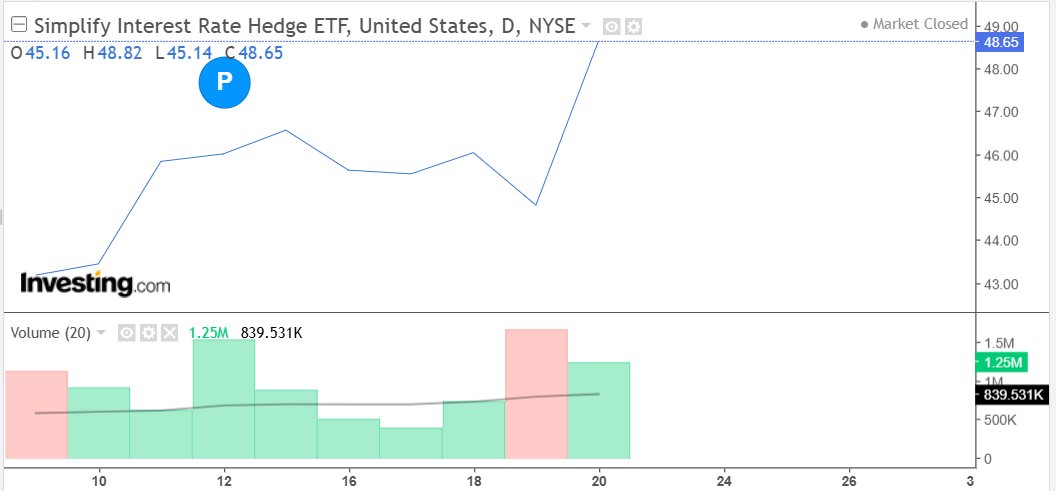
No one saw this coming, yeah, if you were looking at the price facade. But if you were looking at the sub-surface moments, you did. I use a metric based on the PFIX-to-RFIX ratio that indicates whether the market is pricing the volatility space or the duration space. The metric is the Directional Information Theory Weighted Average Price of the PFIX/RFIX ratio March 11: The ratio had a +12.17% single-day regime break. That's the swaption market screaming that tail pricing on higher long-end yields was repricing faster than the linear duration trade. March 18 Quad Baseline: PFIX/RFIX = 1.136, PREMIUM zone, ACCEL_PANIC, the ratio rising and accelerating TIP/TLT = 1.279, ACCEL_PANIC, 100% stagflation regime match Spectral entropy: vol market ordered (H=0.609), duration market disordered (H=0.653) — the swaption market knew what it was doing, the bond market didn't Transfer entropy: NTE (Net Transfer Entropy) = +0.171 bits, vol causally leading duration. The rate market is pricing stagflation. Not the mild 'slowflation' variant, but the aggressive version where the Fed genuinely cannot act. And the kicker from the price facade analysis: the correlation between PFIX/RFIX and SPY was essentially zero (−0.057). The equity surface was in a completely different informational regime from the rate structure. The swaption market is the canary. The question is not whether the equity surface will eventually acknowledge what the rate structure is already pricing, but when. Well, when was this week? Inflation expectations surging to 5.2% and markets repricing from cuts to hikes is exactly the subsurface signal the DIWAP detected two weeks ago. Purchased PFIX on March 11th
Ronald Cook tweet media
English
0
0
0
17
Ronald Cook retweetledi
Andreas Steno Larsen
Andreas Steno Larsen@AndreasSteno·
@RyanDetrick Goes to show that no one should care about breaking below a magic moving average. It has 0 prediction power on anything
English
3
1
22
2.7K
Ronald Cook
Ronald Cook@cookrl754·
@AndreasSteno Trades below or stays below, depends on your time preferences. Short term yes, long term no
English
0
0
0
230
Andreas Steno Larsen
Andreas Steno Larsen@AndreasSteno·
I think I will end up being right that Silver trades below 50 by year-end. Remember the insults I received?
English
69
4
239
54.7K
Ronald Cook
Ronald Cook@cookrl754·
Playing the Game to Win (or at least to stay in the Game) Rule # 1: Know the game you are playing and its rules Corollary: You cannot know the game you're playing if you don't know the game the other person is playing. This is Carse's (Finite and Infinite Games) entire thesis compressed to a single operational rule. The most dangerous situation isn't two finite players competing or two infinite players co-creating. It's the mismatch: one player is playing the Finite Game (trying to win) while the other is playing The Infinite Game (trying to keep playing). They're not even in the same game, and neither can understand why the other's moves seem irrational. A Game Identification System: Stiffness tells you what kind of game they think they are in. If everything (rules) is rigid, they're playing a Finite Game, there's a fixed prize, and they intend to take it. If there's distributed flexibility (softness, they are flexible to perturbations), they are playing the Infinite Game. They're trying to optimize a continuing interaction across many dimensions. GINI tells you the stakes structure. A high GINI value means winner-take-all framing in their mind, i.e., one objective dominates. That's a Finite Game signature. A low GINI (dispersed structure) indicates they are managing a portfolio of ongoing concerns. This is the Infinite Game signature. Lambda 2 (the Fielder eigenvalue in the Graph Laplacian, λ₂) tells you whether you're even in the same game at all. Near-zero coupling means you're playing parallel solitaire while pretending to play chess. Most failed negotiations, marriages, partnerships, and wars happen because one or both parties never correctly identified which game was being played. They optimized brilliantly for a game that wasn't happening. The person who runs the stiffness-GINI-λ₂ diagnostic before making their first move knows the game, the rules, and the other player's actual objective function. All of these diagnostics are computable from the correlation matrix of the moves in the Game. Everyone else is playing blind — and they don't even know it.
English
0
0
0
13
Ronald Cook
Ronald Cook@cookrl754·
@PatrickHeizer Yes. It near the top of many top 10 lists and it's structure lends itself to a trilogy
English
0
0
0
255
Patrick Heizer
Patrick Heizer@PatrickHeizer·
I am pleading with the forces of the universe to convince Villeneuve to tackle yet another "unfilmable" sci-fi series.
Patrick Heizer tweet media
English
444
576
9.8K
459.3K
Ronald Cook
Ronald Cook@cookrl754·
Take a look at my chat with @mikkom. He claims that Kelly optimization (based on geometric averaging, non-ergodic) is not the right approach for wealth building, but to use Monte Carlo analysis... an ergodic tool applied to a non-ergodic system. Based on the feedback I got, you are going to have a hard, long slog to convince those whose identity preservation is based on their education in the old system and their use of the old geometric methods.
English
0
0
1
39
Ole Peters
Ole Peters@ole_b_peters·
Sort of funny: the ergodicity problem is precisely the non-equivalence of expected value and time average. Economics is explicitly built on expected value (of cash and later of utility). Of course, a major motivation for using expected value, say in the 17th century, was the belief that it's identical to the time average -- the idea was to produce behavioral protocols, so that if we follow them _over_time_ we will do well. It's just that the mathematics of the time didn't have the right concepts to translate this motivation into a successful formalism. Nor did it enable people to spot their mistake. The ergodicity concept just didn't exist yet in human minds. The models they were building were not ergodic, but were being analyzed as if they were. Economics could have chosen other statistics -- the mode, median, geometric mean... some of which are not as disastrous as expected value. But that didn't happen, we picked the mean back then (in the 1650s). Given that economics so precisely fell into the ergodicity trap, it was relatively easy to spot. Imagine it had been build on most likely values. It would have been harder to see that an ergodicity error had been committed. Still -- it took 350 years (wow!). And still today I regularly receive enraged responses: ergodicity has nothing to do with it! No such error was ever committed! Every economics student learns in lesson 1 how to address the ergodicity problem! Though also: I've never heard of ergodicity, what a ridiculous word, it must be sophistry! It's something for mathematicians, but economics lives in the real world! etc. Oh joy.
English
3
19
91
10K
Ronald Cook
Ronald Cook@cookrl754·
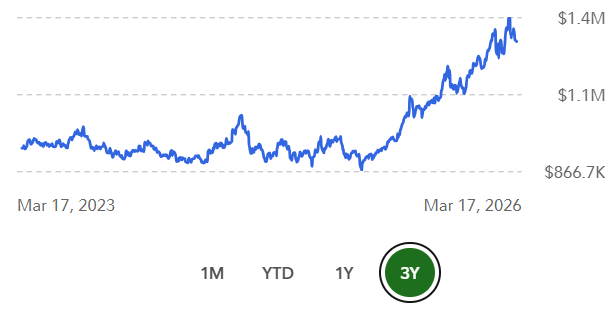
It's not about my ego or his, it's not about using or not using LLM models to assist your analysis (see Mike Green or Terrance Yao). It was about claiming that Kelly Optimization does not work, but Monte Carlo does. It's about not using an ergodic tool for a non-ergodic system (the market). It's about performance. I used MC + Technical Analysis up until April 2025 when I realized that price is a facade. It reflects the underlying correlation structure of the market. The only evidence I can offer that switching helped my portfolio performance is the results
Ronald Cook tweet media
English
1
0
0
37
Nataniel Ruiz
Nataniel Ruiz@natanielruizg·
@mikkom @cookrl754 biggest tell overall though i would say is a ton of text. people are lazy and even if they wanted to do a huge takedown they won't write that much on twitter
English
1
0
3
52
mikkom
mikkom@mikkom·
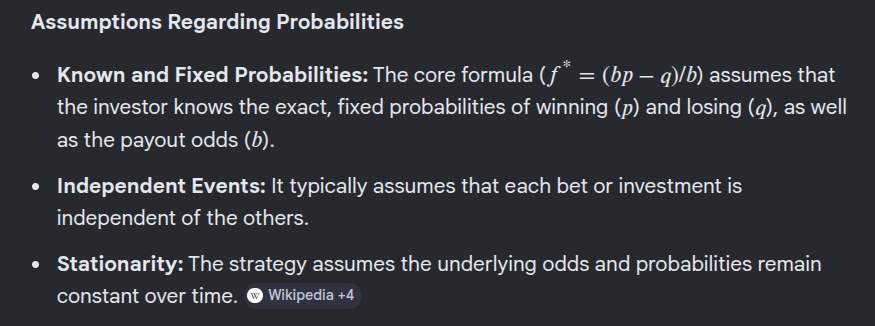
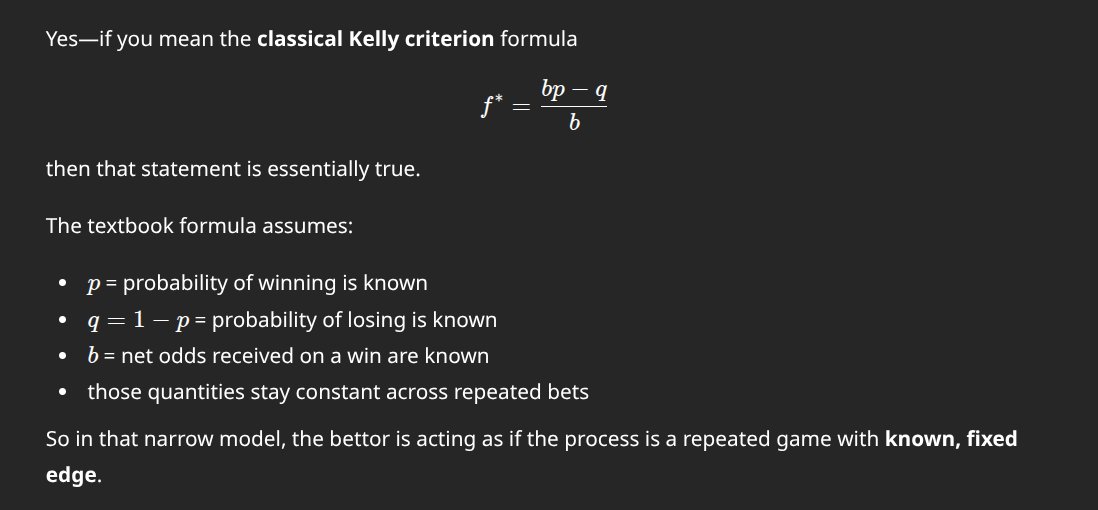
Please don't use kelly for trading. It is not suitable. I see so many people posting about kelly this and kelly that related to trading. Kelly was originally designed for gambling. Gambling has fixed rules that typically favour the house but in some cases you can find an edge. Because the rules and the environment are fixed, the edge can be calculated. In trading you have volatility clustering and fat tails and everchanging environmental chaos from both external event, varying participants and market internals. Kelly assumes fixed and known constants. In trading NONE of these is true: - Environment is known and constant - Ratio of wins/losses is constant and known - Payout is constant and known You can get much better results via backtesting with decent sample size + monte carlo uncertainties. /rant
mikkom tweet mediamikkom tweet media
English
26
14
167
72.7K
Ronald Cook
Ronald Cook@cookrl754·
I sorry.. your bio says "mostly AI / ML / Quant ramblings from a multiple startup founder CTO guy" so I thought would take the mathemtical approach. But you didn't attack that you attacked me with "Long text with all kinds of intentionally complex concepts and famous company name drops.. and fractional kelly is mentioned again." So as a quant guy and a CTO you can easily use Excel (or Claude in Excel) to do fractional Kelly Full Kelly maximizes log-expected wealth, but it's derived assuming you know the true edge (μ) and variance (σ²) exactly. In practice you're estimating both, so you're implicitly betting on a noisy Kelly fraction — which systematically over-bets. Conservative Estimation Approaches 1. Shrinkage / Half-Kelly as a Rule of Thumb The simplest: use f × 0.5*. This is not arbitrary — it approximately corrects for the fact that estimated edges tend to be optimistic. This is a practical floor. 2. Confidence Interval Kelly Compute the lower bound of your edge estimate's confidence interval, not the point estimate: Estimate μ and σ from your sample Compute the lower 1-sigma or 2-sigma bound on μ Use f = μ_lower / σ²* instead of μ_hat / σ² This is sometimes called "pessimistic Kelly" — you're betting as if your edge is at the low end of what the data supports. 3. Bayesian Kelly Place a prior on (μ, σ²), compute the posterior, then integrate Kelly over the posterior: f∗=∫μσ2 p(μ,σ2∣data) dμ dσ2f^* = \int \frac{\mu}{\sigma^2} \, p(\mu, \sigma^2 | \text{data}) \, d\mu \, d\sigma^2f∗=∫σ2μ​p(μ,σ2∣data)dμdσ2 4. The Estimation-Adjusted Formula (Practical) For a strategy with N observed trades and Sharpe S: fconservative∗=Sσ⋅(1−1N)f^*_{\text{conservative}} = \frac{S}{\sigma} \cdot \left(1 - \frac{1}{\sqrt{N}}\right)fconservative∗​=σS​⋅(1−N​1​) The correction factor 1 − 1/√N penalizes small sample sizes directly. With 10 trades, you use ~68% of Kelly; with 100, you use ~90%. The MC approach doesn't replace Kelly — it's a way of sampling from the uncertainty in your edge estimate to get a distribution over f*. The conservative Kelly estimate is essentially what you get when you take the left tail (say 10th–25th percentile) of that MC distribution of f* values. Anyway, don't really care. Before lashing out with a quick satisfying retort. Go ahead and read Use MC or read Fortune's Formula: The Untold Story of the Scientific Betting System That Beat the Casinos and Wall Street by William Poundstone. and read (or watch as he has great youtube videos) Ole Peters and learn ergodic vs non-ergodic systems. Don't worry, I won't reply to your posts again. My job is done here
English
1
1
7
422
mikkom
mikkom@mikkom·
Long text with all kinds of intentionally complex concepts and famous company name drops.. and fractional kelly is mentioned again. >Estimate your edge conservatively. Apply a fraction (0.25–0.5) to account for estimation error. So describe me how exactly do you decide the multiplier that should be used for fractional kelly? And if you have a method for calculating that multiplier, what is the reason to use kelly in the first place?
English
3
0
2
1.6K
Ronald Cook
Ronald Cook@cookrl754·
Interesting post. I would add Porita (see Playing Ball on Running Water) Both Adler and Morita arrive at the same conclusion via different routes: Adler: feelings are manufactured tools → don't study them, redirect toward life tasks Morita: feelings are uncontrollable weather → don't fight them, act purposefully despite them The destination is identical: action toward purpose is the therapeutic primitive. Both are Papic-compliant — they study material constraints (life tasks, purposeful action), not preference-constraints (the feeling landscape).then they could, in principle, Where Morita Refines Adler Adler's framework has a subtle tension: if feelings are manufactured by the self in service of a goal, it implies they could be un-manufactured by changing the goal. This creates a backdoor for introspection, "if I understand the goal generating the feeling, I can change it." Morita closes this door more completely by removing the manufacturing metaphor entirely. Feelings aren't manufactured or chosen; they are weather. They arise, they pass, they are not your project. Adler: feelings are high-FI artifacts of the lifestyle → change the lifestyle Morita: feelings are low-FI noise → they carry no actionable information, full stop Morita's formulation is more robust because it doesn't require the patient to accept the somewhat confronting idea that they chose their depression. The weather doesn't need a manufacturer. Morita uses the same coordinate transformation as Adler, from feeling-space to action-space, but grounds it differently. The natural coordinates are purpose and circumstance, not feelings. The running water metaphor is precisely a Fisher Information argument: trying to establish a stable measurement frame on a non-stationary substrate is methodologically invalid. Stop trying to measure the water; play ball. Morita's "purposeful task" is the functional constraint. Engagement with meaningful activity is what specifies a healthy configuration. Symptom-watching reduces FI by narrowing the viable behavioral space, you become increasingly constrained by the symptom's demands. Purposeful action expands it. Morita adds something Adler understates. Symptom-watching is the ultimate GINI concentrator; all attention flows to the symptom. Morita's therapeutic mechanism is essentially a forced GINI redistribution: redirect attention to the task at hand, then to the next, then to the next. The neurotic GINI concentration dissolves not through insight but through repeated attention redistribution. Morita is perhaps the purest Papic-compliant therapy ever devised. It explicitly teaches: feelings are not diagnostic of what you should do. Purpose and circumstance are diagnostic. Anxiety about public speaking is not information about whether you should speak, it is weather that happens to be present while you speak. The diagnostic question is solely: what does this situation call for? Morita doesn't induce a phase transition through confrontation, the way Adler does. Instead, it uses a slow entropy redistribution, gradually redirecting from symptom-maintenance toward purposeful engagement. The Western approach to therapy gets stuck because it keeps trying to play ball on running water, establish stable coordinates in feeling-space, then navigate from there. However, feeling-space is not a navigable manifold. Purpose-space is. Action-space is. Relational-contribution-space is.. The running water metaphor isn't just poetic. It's a precise statement about Fisher Information on a non-stationary manifold.
English
0
0
0
176
Marc Andreessen 🇺🇸
From my therapist Claude: The Adlerian Demolition of Introspection Alfred Adler built one of the most hostile philosophical ecosystems ever devised for the practice of looking inward, and he did it with a precision that neither his admirers nor his detractors have fully reckoned with. The brutality of the Adlerian position isn't gratuitous — it follows logically, almost mechanically, from his core metaphysical commitments. Once you accept those commitments, the popular conception of introspection as a path to self-knowledge collapses entirely, and what's left in its place is something considerably more disturbing: the suggestion that your feelings are not discoveries but productions, manufactured by a self that is already oriented toward a goal it will do almost anything to protect. The Foundational Inversion: Teleology Over Etiology Everything begins here. Freud was a thoroughgoing determinist and causalist — the psyche's present state is the effect of prior causes, and the therapeutic task is to excavate those causes through introspection (free association, dream analysis, the whole apparatus). Feelings, on this model, are data that point backward toward buried causes. Introspection, then, is archaeology: you dig inward to find what happened to you that made you the way you are. Adler rejected this root and branch. His fundamental claim — and it is a genuinely radical one — is that human beings do not move from causes but toward goals. The psyche is not a machine whose output is determined by its inputs; it is a teleological project, a movement oriented toward a fictional final goal (fiktive Ziel) that the individual has, largely unconsciously, set for himself in early childhood. Everything about a person — their characteristic emotions, their symptoms, their memories they choose to retain, their personality style — is recruited in service of this movement toward the goal. This single move annihilates the Freudian (and popular) conception of introspection all at once. If your feelings are not caused by your past but are instruments generated in the service of your goal, then sitting quietly and examining them is not discovery — it is, at best, the study of your own propaganda. Emotions as Tools, Not Truths This is the gut-punch of Adlerian psychology, and it deserves to be stated as starkly as Adler himself intended it. In The Practice and Theory of Individual Psychology (1927) and throughout his clinical writings, Adler makes the claim that emotions are manufactured by the individual — created, not merely experienced — because they are useful for the individual's movement toward his goal. Consider anger. Common sense says: something happens, it makes you angry, the anger is a reaction. Adler says: you create anger because anger is useful to you. It justifies your behavior. It dominates the room. It moves others out of your way. It protects your self-esteem by externalizing blame. The anger is not a response to the world — it is a tool deployed against the world in the service of your fictional goal. The same analysis applies to anxiety, depression, sadness, guilt, and virtually every other affective state the therapeutic tradition has treated as meaningful data requiring careful introspective scrutiny. Adler is not saying these states aren't real in the sense that they are genuinely experienced. He is saying they are created for a purpose, and that the purpose is almost never what the person believes it to be. Depression, in the Adlerian framework, is not the product of chemical imbalance or repressed trauma or cognitive distortion. It is a form of hesitation — a self-manufactured state that allows the individual to delay engagement with the three fundamental life tasks (work, love, and community) while simultaneously maintaining a plausible excuse for the delay. "I cannot engage fully with my relationships because I am depressed" is the structure of the argument the depressed person makes to himself, and the depression obligingly performs this structural function with great reliability. This is where Adler gets genuinely ruthless: if your depression is a tool you've manufactured to avoid life's demands, then introspection into the depression — examining its contours, trying to understand where it comes from, what it means about you — is not therapeutic. It is indulgent. It is, to use Adler's language, a way of taking your symptoms seriously in exactly the wrong sense: you dignify them, you make them meaningful, you cooperate with them. The depression grows in the greenhouse of your attention to it. Introspection as Safeguarding Mechanism Adler developed the concept of Sicherungstendenzen — safeguarding tendencies — to describe the various psychological maneuvers by which the neurotic protects his self-esteem and avoids the genuine test of his capacities against life's real demands. These include hesitation, procrastination, construction of symptoms, depreciation of others, and — crucially — self-accusation. Self-accusation is the most relevant to introspection. The person who spends hours examining his own feelings, cataloguing his anxieties, tracing the genealogy of his resentments, mapping the landscape of his sadness — this person is, in Adlerian terms, still talking about himself. Still the center of his own universe. Still not doing work, not loving anyone, not contributing to the community. The sophistication of the introspective project is no argument in its favor — if anything, it is a mark against it. The more elaborate and refined the inner life the neurotic constructs, the more successfully it functions as an alternative to actual engagement with the world. There is something almost diabolically clever about this critique. It severs the link between psychological depth and therapeutic value that virtually every tradition — psychoanalytic, humanistic, Buddhist, existentialist — takes for granted. Depth of introspective engagement is not progress. It is often its opposite. The person who says, "I've been in therapy for ten years and I really understand now why I became the way I am" has, from the Adlerian vantage point, potentially spent ten years constructing an increasingly ornate justification for remaining exactly as he is. The etiological story — "I am this way because of what happened to me" — is comfortable precisely because it faces backward. The past is fixed. The past cannot demand anything of you. Introspection into the past, into your feelings about the past, into the feelings the feelings generate — this is a very efficient way of never having to face the actual question, which is: what are you going to do, now, about work, about love, about your membership in the human community? Private Logic and the Solipsistic Trap Adler distinguished between Gemeinschaftsgefühl — social interest, community feeling, the sense of belonging to and contributing to the human collective — and Privatlogik — private logic, the idiosyncratic system of reasoning the individual constructs to make his lifestyle appear coherent and justified. The neurotic, for Adler, lives primarily in private logic. His reasoning makes sense from the inside — it is internally consistent, emotionally compelling, often highly sophisticated. But it is systematically oriented away from common sense and social reality and toward the maintenance of the fictional final goal and the lifestyle that serves it. Here is the devastating implication for introspection: introspection, almost by structural necessity, deepens private logic. You are inside your own head, examining your own feelings, interpreting your own experiences through the categories your own lifestyle has constructed. You cannot get outside your private logic by going further inside it. The introspective process, absent a rigorous challenge from a skilled interlocutor who refuses to cooperate with your excuses, tends to confirm what you already believe about yourself — which is precisely what your private logic requires. This is why Adler was deeply skeptical of free association as a therapeutic method. Letting the patient roam freely through their inner landscape, following their associations wherever they lead, seemed to him a recipe for elaborating private logic rather than exposing it. The analyst who sits quietly and receives the patient's associations is, in Adlerian terms, cooperating with the patient's neurosis rather than challenging it. The therapeutic stance must be much more active, much more confrontational, much more oriented toward the future and the life tasks than toward the endlessly fascinating depths of the patient's past and feelings. The Arrangement of Memories One of Adler's most striking specific claims concerns memory. He argued that the memories people retain are not a random or representative sample of their experience — they are selected because they are useful to the lifestyle. People remember what confirms their lifestyle's fundamental assumptions. The person who has built his life around the experience of being wronged will remember, with great clarity and emotional richness, every instance of injustice visited upon him, and will have only the haziest recollection of the many occasions when he was treated generously. This means that introspective archaeology — digging into your childhood memories to understand yourself — is not accessing historical truth. It is accessing a curated archive that your lifestyle has assembled in its own service. The early memories that feel most vivid and emotionally significant are precisely the ones your private logic has promoted, precisely because they support the conclusions your lifestyle needs you to draw about yourself and the world. In What Life Could Mean to You (1931), Adler makes this point with characteristic directness: the first memory a person reports is not an accident. It expresses, in condensed form, the fundamental assumptions of the lifestyle. But those memories were kept because they were useful, not because they were uniquely formative. Adler's therapeutic technique of asking for earliest memories was not an act of etiological excavation — it was a diagnostic shortcut to map the lifestyle's structure, which could then be challenged directly. The implication for introspection is corrosive. You cannot trust what you find when you look inward, not because your unconscious is cunning and deceptive in the Freudian sense, but because your entire inner archive has been organized by the lifestyle in the lifestyle's interests. Your feelings about your memories, your interpretations of your experiences, your sense of what you are and why you are that way — all of this material has been processed and filed by a system that has a vested interest in maintaining the status quo of your lifestyle. You are examining edited footage and taking it for raw reality. The Inferiority Complex as Introspective Engine Adler's most famous contribution to the psychological lexicon — the inferiority complex — is, in his own framework, almost always made worse by introspection, and the two phenomena have a structural affinity that is worth examining carefully. Every human being begins life in a condition of objective inferiority — small, weak, dependent, unable to meet its own needs. This universal experience generates a universal striving for superiority, for competence, for overcoming. Under favorable conditions, this striving is healthy, socially oriented, and expressed through genuine contribution to community. Under unfavorable conditions — discouragement, pampering, neglect — the striving becomes distorted into a neurotic quest for personal superiority or superiority over others, rather than superiority in the service of community. The inferiority complex (as opposed to ordinary feelings of inferiority) is an arrangement — a cultivated sense of one's own inadequacy that serves as a permanent excuse for avoiding the life tasks. "I cannot pursue meaningful work because I am fundamentally inadequate" has a structural function: it protects the fictional goal (which is often some grandiose private fantasy of special status) by ensuring it is never actually tested against reality. If you never try, you never fail. If you never fail, your private fantasy of what you could have been remains intact. The connection to introspection should now be obvious. The inferiority complex feeds on introspective attention. Every hour spent examining the contours of your inadequacy, tracing its origins, giving it a rich inner life — this is an hour in which the complex is being maintained and elaborated rather than overcome. Introspection, in this context, is a form of neurotic self-indulgence that the complex recruits for its own perpetuation. The more you know about your inferiority complex, the more real it becomes, the more it crowds out the one thing that would actually address it: Mut — courage — specifically the courage to engage with life's demands despite the very real possibility of failure. The Antidote: It Is Not More Looking Inward Adler's therapeutic orientation was radically future-focused and action-oriented. The question was never "why are you this way?" but "what are you going to do?" The goal was not self-understanding in the introspective sense but reorientation — a shift in the fictional final goal and the lifestyle that serves it, toward greater social interest and genuine engagement with the life tasks. This is why Gemeinschaftsgefühl — social interest, variously translated — functions for Adler as the primary criterion of psychological health. It is not a feeling you discover inside yourself through introspection; it is a direction of movement toward others, toward contribution, toward community. You cannot find it by looking inward. You find it by looking outward and acting accordingly, and you build it through action rather than through understanding. The Adlerian therapist — Dreikurs in particular, who systematized and extended Adlerian clinical practice — was not a passive receiver of the patient's introspective material. The therapeutic stance involved active interpretation, confrontation, encouragement (in the technical sense of building courage), and direct redirection toward the life tasks. The patient's feelings, when they arose in therapy, were treated as communications about the lifestyle rather than as data requiring sympathetic exploration. "You feel anxious about this — what does that tell us about what you're trying to avoid?" The Kishimi/Koga Popularization and Its Distortions It's worth noting that the popular Adlerian revival associated with The Courage to Be Disliked (Kishimi and Koga, 2013, English translation 2018) captures some of this anti-introspective thrust but softens it considerably for mass consumption. The book's central propositions — that trauma doesn't exist as a determinant of present behavior, that your emotions are chosen, that you should separate your tasks from others' tasks — are genuinely Adlerian. But the book's gentle, Socratic format somewhat obscures the full brutality of the underlying framework. Adler himself was considerably more pointed. His clinical vignettes, scattered through Understanding Human Nature, The Pattern of Life, and The Case of Miss R., show a practitioner who was willing to tell patients quite directly that they were using their symptoms as excuses, that their suffering, however genuine it felt, was being manufactured in the service of avoidance, and that the solution was not to understand the suffering better but to stop cooperating with it and engage with life. The Final Verdict The Adlerian position on introspection and feelings can be summarized with some precision: Feelings are not causes; they are instruments. You manufacture them to serve your movement toward your fictional final goal. They are neither honest reports of your inner state nor reliable guides to your history. They are tools, and like all tools, they should be evaluated by what they accomplish, not by how they feel. Introspection is usually neurotic avoidance with a philosophical veneer. The person who knows himself deeply, who has excavated his anxieties and catalogued his resentments and mapped his emotional geography with great thoroughness — this person has typically accomplished one thing: a very sophisticated excuse for not engaging with work, love, and community. The depth of the inner life is inversely correlated, in Adler's clinical experience, with the degree of genuine social contribution. The archive you examine when you introspect has been curated by your lifestyle in the lifestyle's interests. You are not discovering yourself; you are reading your own propaganda. The feelings that seem most important, the memories that seem most formative, the self-interpretations that seem most true — these have all been selected and processed by a system that is fundamentally committed to maintaining the status quo of your fictional final goal. The antidote is courage, not understanding. Specifically, the courage to engage with the life tasks despite uncertainty, imperfection, and the real possibility of failure. You do not need to understand yourself before you act. You need to act, and in acting, you will discover more about yourself — and change more about yourself — than any amount of inward looking will ever provide. This is an extremely uncomfortable position for a culture that has thoroughly internalized the therapeutic assumption that self-knowledge is intrinsically valuable and that the examined life is superior to the unexamined one. Adler would say: examined by whom, in whose interests, toward what end? If the examination is conducted by the private logic, in the service of the fictional goal, toward the end of perpetuating the neurotic lifestyle — and it usually is — then the examined life is not better. It is just a more articulate version of the same evasion. The unexamined life that contributes to the community, that engages honestly with work and love, that acts with courage in the face of genuine risk — that life, for Adler, is worth more than all the introspective sophistication in the world. Which is, when you sit with it for a moment, either the most liberating or the most terrifying thing anyone has ever said about the examined life. Possibly both simultaneously, which is probably why Adler remains so systematically underread.
English
180
106
948
186.4K
Ronald Cook
Ronald Cook@cookrl754·
Excellent paper — the Lyapunov/Feller threshold formalization is the cleanest mathematical treatment of passive fragility I've seen. Two observations that may strengthen the conclusions: 1) The monolithic S(t) masks sector heterogeneity. Concentration coupling varies ~100x across index products (e.g. MAGS vs broad market). This means sectors don't hit instability simultaneously, there's a nucleation ordering where low-concentration/high-vol sectors reach Feller proximity first, then high-concentration amplifiers broadcast. That cascade structure gives 3-6 months of observable precursors before the aggregate threshold is breached. 2) The simulations use historical σ, but passive accumulation itself suppresses realized vol by removing tactical sellers. The very mechanism being modeled is masking the approach to the thresholds as they are computed. This bootstrap problem means the effective distance to p=0.87 may be shorter than it appears, σ is spring-loaded, not stationary. Both points suggest the practical warning window may be narrower than the model implies, but also more detectable if you monitor the right cross-sectional structure rather than the aggregate.
English
1
0
3
194
Michael Green
Michael Green@profplum99·
And he told two friends… and they told two friends… and so on… A very different methodology than my agent-based models from 2017… unfortunately, the same conclusion. Gonna be wild…
Hari P. Krishnan@HariPKrishnan2

Please find a complete draft of our "Passive Breaks the Market" article below. There are likely couple of typos, but hopefully this will get the conversation going! Cheers, Hari @profplum99 @StephanSturm linkedin.com/feed/update/ur…

English
5
4
80
40.5K
Ronald Cook
Ronald Cook@cookrl754·
Exactly right.. This is exactly why you want/need an antifragile Kelly-optimal portfolio The 1997–2020 window of negative bond-equity correlation — where bonds actually hedged equities — was the anomaly, not the norm. A hundred years of data shows positive correlation is the default regime. The circled spike back to ~+0.8 isn't a blip; it's a reversion to the historical baseline under fiscal dominance conditions. The implications are brutal for conventional portfolios: 60/40 was built on that anomalous negative correlation. When bonds and stocks fall together — as they did in 2022 and keep threatening to do — there's no internal hedge. The "diversification" was never structural, it was regime-dependent, and the regime just ended. When your two main asset classes become positively correlated, you need instruments that respond to different drivers entirely, inflation breakevens, volatility convexity, commodity pressure, rate regime bets. Assets where the return source is orthogonal to the bond-equity axis, not sitting on it. The other thing this chart whispers: that orange line at ~+0.1 for the pre-1997 era understates the problem. During fiscal dominance episodes specifically (1940s, 1970s), the positive correlation intensified. We're not just reverting to the mean, if the fiscal trajectory continues, we're heading toward the upper envelope of that historical range. The bond-equity correlation itself was a façade metric. During the low-inflation era, it looked like a structural relationship but was actually a conditional one, contingent on central bank credibility staying intact.
English
0
0
7
602
Ronald Cook
Ronald Cook@cookrl754·
It seems like a good time to repost this from Yeats The Second Coming By William Butler Yeats Turning and turning in the widening gyre The falcon cannot hear the falconer; Things fall apart; the centre cannot hold; Mere anarchy is loosed upon the world, The blood-dimmed tide is loosed, and everywhereThe ceremony of innocence is drowned; The best lack all conviction, while the worst Are full of passionate intensity. Surely some revelation is at hand; Surely the Second Coming is at hand. The Second Coming! Hardly are those words out When a vast image out of Spiritus Mundi Troubles my sight: somewhere in sands of the desert A shape with lion body and the head of a man, A gaze blank and pitiless as the sun, Is moving its slow thighs, while all about it Reel shadows of the indignant desert birds. The darkness drops again; but now I know That twenty centuries of stony sleep Were vexed to nightmare by a rocking cradle, And what rough beast, its hour come round at last, Slouches towards Bethlehem to be born? or maybe we should say the middle east. The following words describe the current administration perfectly "Things fall apart; the centre cannot hold; "Mere anarchy is loosed upon the world, The blood-dimmed tide is loosed, and everywhere The ceremony of innocence is drowned; The best lack all conviction, while the worst Are full of passionate intensity." Such are our times in the Forth Turning
English
0
0
0
111
Ronald Cook
Ronald Cook@cookrl754·
@Coach_Yac These stats are meaningless without knowing how they play as a unit on defense
English
0
0
0
58
Coach Yac 🗣
Coach Yac 🗣@Coach_Yac·
On a scale of 1 to 10, what’s your confidence level in the 49ers starting safeties Malik Mustapha and Ji'Ayir Brown? Here’s their 2025 stats: Mustapha: • 17 yards allowed a game • 2 touchdowns allowed • 1 INT • 59.5 coverage grade • 16 missed tackles • 61.5 run grade Brown: • 14 yards allowed a game • 6 touchdowns allowed • 2 INTs • 58.5 coverage grade • 12 missed tackles • 71.1 run grade
Coach Yac 🗣 tweet media
English
282
8
224
61.3K
Ronald Cook
Ronald Cook@cookrl754·
Good article, However, your argument on silver and gold rests on historical analogy (a preference), not Marco Papics' constraints Your sell signal is pattern-matching, not diagnosticity. Your argument is: silver went parabolic four times before (1973, 1979, 2011, 2020), and each time gold corrected. Therefore, it will correct again. That's an empirical regularity, a preference for historical analogy, not a material constraint analysis. The implicit assumption is that the macro regime is comparable across those episodes. It isn't. The genuine Papic diagnostics, material constraints that govern outcomes regardless of what anyone wants: Fiscal dominance is mathematical, not optional. U.S. debt/GDP, interest expense as share of revenue, the impossibility of growing out of it at current trajectory, these are structural U.S. debt/GDP, interest expense as a share of revenue, the impossibility of growing out of it at the current trajectory, these are structural constraints that force currency debasement. You acknowledge this when you describe the "debasement trade" transitioning to the "default trade." But then you recommend selling the asset that benefits most from both trades? That's internally inconsistent. The material constraint says: governments with unsustainable debt loads must either default or inflate. Gold wins in both scenarios. You can't tactically trade around something that's structurally inevitable. Silver supply as a copper byproduct is a material constraint that you inadvertently confirmed. You are bearish on copper, with slowing Chinese demand, rising inventories, and surplus conditions. Roughly 70% of silver production comes as a byproduct from copper, lead, and zinc mining. If copper mining slows (your thesis), silver supply contracts mechanically. You note surging silver demand from solar installations and supply disappointments from mines, then dismiss this as speculative blow-off psychology. But the supply side isn't psychology — it's geology and economics. Lower copper production = less silver, full stop. That's a material constraint you are treating as narrative color. The deglobalization and bloc formation that require a neutral settlement medium are material constraints. You can't settle trade imbalances between adversarial blocs using either bloc's fiat currency. You actually spotted this yourself, you flagged Brazil's 43-tonne gold purchase in Q4 and connected it to Brazil's increasing use of renminbi for trade with China, noting gold could settle imbalances given China's closed capital account. But you didn't follow your own logic to its conclusion. If the SE Asia-Canada-Europe bloc forms alongside BRICS, both blocs need gold as the neutral denominator. That's not speculative demand; it's structural monetary-architecture demand. Central banks bought 863 tonnes in 2025 even at record prices. Poland targeting 700 tonnes. This isn't retail mania that reverses when sentiment shifts. Rising real rates, the supposed gold killer, may not be achievable under fiscal dominance. Your entire historical framework for gold corrections depends on rising real rates: Volcker pushing to 20% in 1980, disinflation in 2012, the 2022-2023 hiking cycle. But fiscal dominance means the government cannot afford high real rates because the interest expense on the debt becomes unserviceable. This is the material constraint that breaks the historical analogy. Warsh can talk hawkish all he wants, but the arithmetic of $36 trillion in debt at 5%+ rates produces interest costs that crowd out everything else. The Fed is constrained by the Treasury's funding needs. That's not a preference — it's a material binding constraint on monetary policy. The one thing you are right about is that silver's parabolic behavior is diagnostic of short-term speculative excess. The 40% decline from the January $115 peak is real. But diagnostically, the question is whether this is a 1974-type correction (gold fell 45% then resumed to $850) or a 1980-type terminal event. The material constraints I have discussed here, fiscal dominance, supply constraints, bloc formation — all point toward 1974, not 1980. You say the long-term bull isn't over, but it sounds like you are trying to trade a 2-3-year correction within it. The problem: in a fiscal dominance regime with accelerating deglobalization, the "correction" may be much shallower and shorter than the historical pattern suggests, precisely because the material constraints have changed. Selling gold to buy oil isn't wrong on the oil side, oil is cheap by every measure, but the funding source (selling gold) may be the error. The diagnostic synthesis: your oil thesis and commodity supercycle thesis are strong Papic-grade material constraint arguments. Your gold/silver sell signal is pattern-matching from a different monetary regime. The fiscal dominance framework is the higher-order material constraint that governs whether the historical gold correction pattern repeats. It argues it won't, at least not at the magnitudes you are implying. The correct move under diagnosticity: add oil exposure without funding it from gold. BTW I hold LNG and VLE
English
0
0
9
482
Goehring & Rozencwajg
Goehring & Rozencwajg@Go_Rozen·
‼️ NEW RESEARCH! A historic energy shock may be unfolding. The effective closure of the Strait of Hormuz is disrupting ~20% of global oil production and LNG trade. In our new research, “When the Strait Closed,” we examine what this could mean for the commodity cycle and natural resource markets. 👉 Download the full letter: hubs.li/Q046MWxw0 -- #Commodities #EnergyMarkets #NaturalResources #MacroInvesting #EnergyInvesting
Goehring & Rozencwajg tweet media
English
4
46
236
26.7K