couchpotato

962 posts

couchpotato

couchpotato

@couchpotato_eth

$TSLA long term investor since 2015

Katılım Eylül 2011
973 Takip Edilen323 Takipçiler
couchpotato retweetledi
Ryan Wang 🇹🇼
Ryan Wang 🇹🇼@ryanwang·
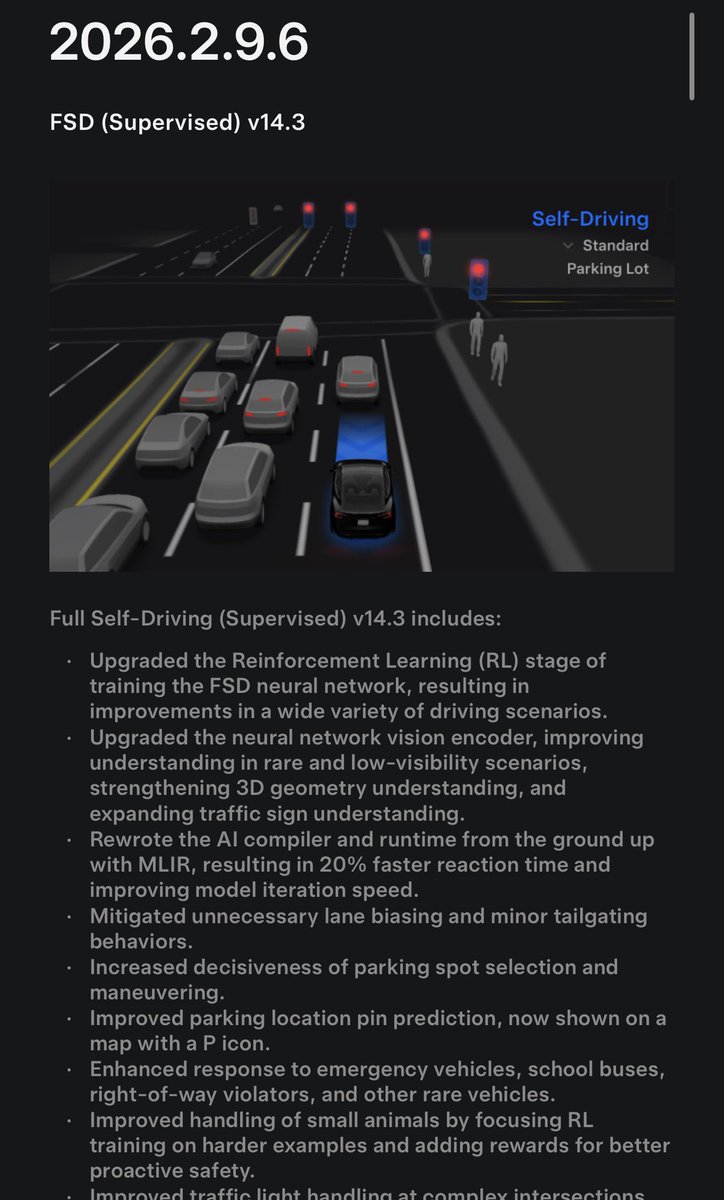
The release of FSD v14.3 and discussions from insiders have given me a clearer picture of why Tesla is not rushing to deploy a 10x larger parameter model with version 14. Under the hardware constraints of existing HW4, Tesla’s engineering team must make a trade-off between MPI (Miles Per Incident, a safety metric) and inference latency. By thoroughly overhauling the underlying technical architecture—including a full MLIR rewrite of the compiler and runtime, along with upgrades to RL training—they are attempting to shift the entire “autonomous driving efficiency curve” outward, rather than simply moving along the existing curve. Increasing model size (Large Model) typically improves MPI (theoretically making the system safer with fewer incidents). However, on fixed hardware, a larger model often increases inference latency (slower response). If latency rises too much, even if MPI gets better, overall real-world safety may actually decline—because delayed reactions can allow small errors to compound into serious problems. Simply forcing a Large Model would likely push the curve toward “higher MPI but significantly higher latency,” which in practice would be a poor trade-off. The essence of v14.3 is to achieve an “outward shift of the curve.” It is not just about making the model bigger or smaller. Instead, through the MLIR reconstruction of the entire compiler and runtime, Tesla enables the same HW4 hardware to deliver higher performance at lower latency. At the same time, they use RL to optimize for hard examples, improving MPI without a noticeable increase in latency. This effectively pushes the entire “MPI–Latency efficiency curve” up and to the right—achieving a better trade-off.
Elon Musk@elonmusk

@Chansoo Our rate of advancement with the small model has been so fast that the large model has not yet caught up. V15 will be the large model.

English

43
53
614
76.7K
couchpotato retweetledi
Sawyer Merritt
Sawyer Merritt@SawyerMerritt·
BREAKING: Tesla has officially released FSD V14.3 I'm downloading it in my Model Y right now. Here's everything that's new: • Improved parking location pin prediction, now shown on a map with a P icon. • Increased decisiveness of parking spot selection and maneuvering. • Rewrote the Al compiler and runtime from the ground up with MLIR, resulting in 20% faster reaction time and improving model iteration speed. • Enhanced response to emergency vehicles, school buses, right-of-way violators, and other rare vehicles. • Mitigated unnecessary lane biasing and minor tailgating behaviors. • Improved handling of small animals by focusing RL training on harder examples and adding rewards for better proactive safety. • Improved traffic light handling at complex intersections with compound lights, curved roads, and yellow light stopping - driven by training on hard RL examples sourced from the Tesla fleet. • Upgraded the Reinforcement Learning (RL) stage of training the FSD neural network, resulting in improvements in a wide variety of driving scenarios. • Upgraded the neural network vision encoder, improving understanding in rare and low-visibility scenarios, strengthening 3D geometry understanding, and expanding traffic sign understanding. • Improved handling for rare and unusual objects extending, hanging, or leaning into the vehicle path by sourcing infrequent events from the fleet. • Improved handling of temporary system degradations by maintaining control and automatically recovering without driver intervention, reducing unnecessary disengagements. Upcoming Improvements: • Expand reasoning to all behaviors beyond destination handling. • Add pothole avoidance. • Improve driver monitoring system sensitivity with better eye gaze tracking, eye wear handling, and higher accuracy in variable lighting conditions.
Sawyer Merritt tweet mediaSawyer Merritt tweet media
English
1.1K
2K
13.1K
2.7M
couchpotato retweetledi
Elon Musk
Elon Musk@elonmusk·
@imPenny2x AI4 by itself will achieve self-driving safety levels very far above human. AI5 will make the cars almost perfect and greatly enhance Optimus. AI6 will be for Optimus and data centers. AI7/Dojo3 will be space-based AI compute.
English
668
1.2K
11.4K
1.4M
couchpotato retweetledi
jimmah
jimmah@jamesdouma·
No, this is not competition for FSD anymore than LEGO releasing a Space Shuttle kit is competition for the Falcon 9. Nvidia has released multiple generations of ADAS development kits and tools for developing ADAS systems. These are not ADAS systems, they are tools to help get started developing an ADAS system. Nvidia has also produced multiple generations of hardware kits that can help a developer get started building the compute framework for an ADAS system using Nvidia silicon. An ADAS demo can be put together pretty quickly using these kits, but a production system cannot - the kit gets you 0.01% of the way to concept for a production system and it doesn't include most of the difficult to understand parts - it just shows what is possible. This latest kit apparently includes the a VLA as the core software architectural component. Using a VLA provides a lot of development advantages but VLAs are compute intensive and not, in their simple form, suitable for a production system. It would be a good thing for the world if companies picked up these tools and started making a serious attempt to develop ADAS systems and I hope they do. If they were wildly successful they might start fielding them in 5 years and that could help Tesla to displace the billion plus human driven vehicles ten years from now. We need lots and lots and lots of autonomous capable vehicles and Tesla can't build all of them in any reasonable period of time. There is no scenario in which a company building on top of this new development kit will even slightly dent Tesla's Robotaxi market opportunity. I wish it were that easy - building an FSD like system is still a technically challenging, resource intensive, and commercially fraught task. It's kind of a miracle that any company did it once. It's the thing I'm most grateful to Tesla for.
English
2
490
3.4K
340.2K
couchpotato retweetledi
Andrej Karpathy
Andrej Karpathy@karpathy·
I took delivery of a beautiful new shiny HW4 Tesla Model X today, so I immediately took it out for an FSD test drive, a bit like I used to do almost daily for 5 years. Basically... I'm amazed - it drives really, really well, smooth, confident, noticeably better than what I'm used to on HW3 (my previous car) and eons ahead of the version I remember driving up highway 280 on my first day at Tesla ~9 years ago, where I had to intervene every time the road mildly curved or sloped. (note this is v13, my car hasn't been offered the latest v14 yet) On the highway, I felt like a passenger in some super high tech Maglev train pod - the car is locked in the center of the lane while I'm looking out from Model X's higher vantage point and its panoramic front window, listening to the (incredible) sound system, or chatting with Grok. On city streets, the car casually handled a number of tricky scenarios that I remember losing sleep over just a few years ago. It negotiated incoming cars in tight lanes, it gracefully went around construction and temporarily in-lane stationary cars, it correctly timed tricky left turns with incoming traffic from both sides, it gracefully gave way to the car that went out of order in the 4-way stop sign, it found a way to squeeze into a bumper to bumper traffic to make its turn, it overtook the bus that was loading passengers but still stopped for the stop sign that was blocked by the bus, and at the end of the route it circled around a parking lot, found a spot and... parked. Basically a flawless drive. For context, I'm used to going out for a brief test drive around the neighborhood to return with 20 clips of things that could be improved. It's new for me to do just that and exactly like I used to, but come back with nothing. Perfect drive, no notes. I expect there's still more work for the team in the long march of 9s, but it's just so cool to see that we're beyond finding issues on any individual ~1 hour drive around the neighborhood, you actually have to go to the fleet and mine them. Back then, I processed the incredible promise of vehicle autonomy at scale (in the fully scaleable, vision only, end-to-end Tesla way) only intellectually, but now it is possible to feel it intuitively too if you just go out for a drive. Wait, of course surround video stream at 60Hz processed by a fully dedicated "driving brain" neural net will work, and it will be so much better and safer than a human driver. Did anyone else think otherwise? I also watched @aelluswamy 's new ICCV25 talk last week (x.com/aelluswamy/sta…) that hints at some of the recent under the hood technical components driving this progress. Sensor streams (videos, maps, kinematics, audio, ...) over long contexts (e.g. ~30 seconds) go into a big neural net, steering/acceleration comes out, optionally with visualization auxiliary data. This is the dream of the complete Software 1.0 -> Software 2.0 re-write that scales fully with data streaming from millions of cars in the fleet and the compute capacity of your chip, not some engineer's clever new DoubleParkedCarHandler C++ abstraction with undefined test-time characteristics of memory and runtime. There's a lot more hints in the video on where things are going with the emerging "robotics+AI at scale stack". World reconstructors, world simulators "dreaming" dynamics, RL, all of these components general, foundational, neural net based, how the car is really just one kind of robot... are people getting this yet? Huge congrats to the team - you're building magic objects of the future, you rock! And I love my car <3.
English
950
2.8K
27.7K
17.9M
couchpotato retweetledi
Cern Basher
Cern Basher@CernBasher·
Tesla's FSD chips: Integer vs. Floating-point At Tesla's shareholder meeting Elon said that, "integer operations are fundamentally more efficient than floating-point operations...integer is much more power efficient, much more silicon efficient, but you actually have to train for integer inference - everyone else is training for floating-point - that's a niche technical detail, but it's actually very important." So what does he mean? Well, imagine you’re driving a Tesla, and the car’s “brain” has to think really fast to decide what to do every second: - Is that a shadow or a pothole? - How far away is that car? - Can I make this turn safely? All of that happens millions of times per second - like a giant video game running in real life. Two Ways the Car’s Brain Can Do Math Computers think using numbers, and there are two main kinds of math they can use: Floating Point (“fancy math”) – handles decimals like 3.14159 → Super accurate, but slower and more energy-hungry. Integer (“simple math”) – handles whole numbers like 3 or 4 → Slightly less precise, but way faster and more efficient. Why Tesla Likes Integer Math Tesla’s Full Self-Driving (FSD) chip in the car runs AI models that turn camera video into driving decisions. To make this happen in real time, Tesla needs speed and efficiency more than perfect decimals. Here’s the trick: The AI doesn’t need to know if something is 3.14159 meters away. It just needs to know it’s about 3 meters away - that’s good enough to brake safely. So instead of wasting power on floating-point math, it uses integer math, which is like rounding to the nearest whole number. That’s enough precision for driving, and it makes everything run faster. What Happens Inside the Chip Think of the chip like a big army of tiny workers (transistors). Integer math: the workers do simple, quick jobs - they don’t get tired and don’t need much energy. Floating point math: the workers do harder, more detailed jobs - they need more space, more time, and more power. Tesla’s chip uses millions of small, efficient workers (integer units) that can handle tons of simple math at once - kind of like having a million fast-thinking ants instead of a few slow geniuses. The Result Because Tesla uses integer math: - The car reacts faster (less delay between seeing and acting). - The computer uses less energy, so there’s more battery power for driving. - The chip costs less to make and runs cooler. - Tesla can process huge amounts of video data cheaply in its training supercomputer.
Cern Basher tweet mediaCern Basher tweet media
English
120
172
1.6K
163K
couchpotato retweetledi
Brian Roemmele
Brian Roemmele@BrianRoemmele·
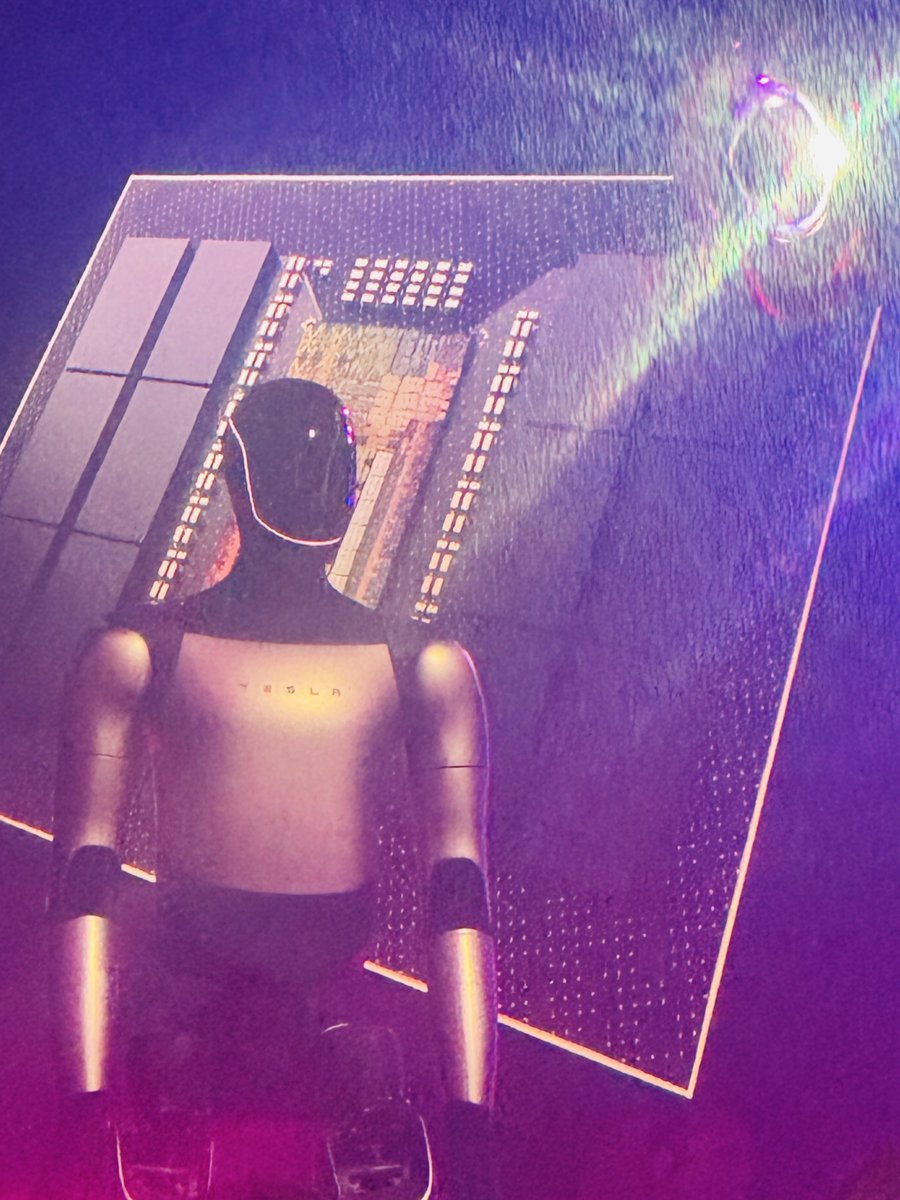
The new Tesla AI5 chip In-house design 40× faster 8× compute 9× memory 5× bandwidth Code paths shrunk to ~5 10× cheaper per inference than Nvidia 3× more efficient per watt Built by Samsung with lithography by TSMC all performed in Texas and Arizona. Production 2026. It is a big deal.
Brian Roemmele tweet media
English
262
677
5.4K
1.2M
couchpotato retweetledi
will depue
will depue@willdepue·
took my first robotaxi tonight, seems like tesla is going to win. they manufacture the cars, pure vision model stack, and the network to deploy them.
English
58
60
1.4K
459.5K
couchpotato retweetledi
Tesla
Tesla@Tesla·
FSD Supervised V14.1 now rolling out Highlights include – Arrival Options You can now select where FSD Supervised should park at the end of your trip: parking lot, on the street, driveway, parking garage or curbside – Driver Profile Sloth 🦥 Lower speeds & more conservative lane changes compared to Chill You should also notice overall improvements in smoothness & confidence
Tesla tweet media
English
1.5K
2.3K
15.9K
8.7M
couchpotato retweetledi
Bankless
Bankless@Bankless·
“Getting famous is amazing. Being famous is okay. Losing fame is the most miserable feeling.” – Will Smith. @morganhousel applies it to money: “Getting rich is awesome… being rich is merely okay… losing wealth is mortifying.” Why? “Dopamine doesn’t care how much you have—it just wants more.” That’s why “the upward slope” feels good—and why satisfaction keeps moving.
English
10
3
20
5.7K
couchpotato retweetledi
Noah Smith 🐇🇺🇸🇺🇦🇹🇼
If you're a European guy who has never done anything technical, and you're sneering at Chinese technical talent because white people invented the telephone and the steam engine, you're climbing into the dustbin of history and closing the lid over your head.
English
69
222
3.5K
129.2K
couchpotato retweetledi
Andrej Karpathy
Andrej Karpathy@karpathy·
Agency > Intelligence I had this intuitively wrong for decades, I think due to a pervasive cultural veneration of intelligence, various entertainment/media, obsession with IQ etc. Agency is significantly more powerful and significantly more scarce. Are you hiring for agency? Are we educating for agency? Are you acting as if you had 10X agency? Grok explanation is ~close: “Agency, as a personality trait, refers to an individual's capacity to take initiative, make decisions, and exert control over their actions and environment. It’s about being proactive rather than reactive—someone with high agency doesn’t just let life happen to them; they shape it. Think of it as a blend of self-efficacy, determination, and a sense of ownership over one’s path. People with strong agency tend to set goals and pursue them with confidence, even in the face of obstacles. They’re the type to say, “I’ll figure it out,” and then actually do it. On the flip side, someone low in agency might feel more like a passenger in their own life, waiting for external forces—like luck, other people, or circumstances—to dictate what happens next. It’s not quite the same as assertiveness or ambition, though it can overlap. Agency is quieter, more internal—it’s the belief that you *can* act, paired with the will to follow through. Psychologists often tie it to concepts like locus of control: high-agency folks lean toward an internal locus, feeling they steer their fate, while low-agency folks might lean external, seeing life as something that happens *to* them.”
Garry Tan@garrytan

Intelligence is on tap now so agency is even more important

English
2K
9.3K
49.9K
11.2M
couchpotato retweetledi
James Stephenson
James Stephenson@ICannot_Enough·
Long term $TSLA investors:
English
141
350
4.3K
956K
couchpotato
couchpotato@couchpotato_eth·
Chuck is right. I drove it last night and it was incredible.
Chuck Cook@ChuckCook

I don't do posts like this very often.. just read it please. Since I have been home after my redeye flying all night from PHX .. My @Cybertruck and Model Y had received Supervised FSD v13.2.1 while parked, over the air cellular (OTA) for free. I got in my Cybertruck dead tired from flying all night, and it drove me home 30 minutes on Interstate 95 and Interstate 10 and merged, weaved, passed, and navigated to my driveway without me needing to touch the steering wheel or accelerator pedal at all. Later in the day, I drove both vehicles to the car wash, to do a side by side comparison. Both vehicles navigated 20 minutes each way without a single intervention or disengagement. The Model Y is smoother and more mature, the Cybertuck is a bit fatter and slow, but just as smooth. There are a few small issues to continue and work, but this release is serious. It is not just another wide release. Many will drive this and say .. whoa. when did this happen at Tesla. For those of you that look to me for signal or noise. This is signal. @Tesla_AI deserves a lot of credit for the work they have put in to achieve this goal. @aelluswamy is killing it with his leadership style technical expertise. @elonmusk gets the most credit for putting it all in motion to allow the creators to create. Thank you for doing it.

English
0
0
1
80