Jack

13.9K posts

Jack banner
Jack

Jack

@crypto_jackkk

Alfha Caller | 100x Gem Hunter 📈 Investor | Trend Spotter 📩 | Boosting projects to new heights | #DYOR // DM me to go viral🚀

United States Katılım Temmuz 2022
1.4K Takip Edilen7K Takipçiler
Jack retweetledi
Mars_DeFi
Mars_DeFi@Mars_DeFi·
Aptos is entering a more important phase of its growth story by tightening tokenomics, shipping technical upgrades, expanding institutional integrations, and building stronger on-chain utility across DeFi, payments, and real-world asset infrastructure. Taken together, the latest changes suggest Aptos is trying to evolve from a fast Layer 1 narrative into a more complete capital, payments, and asset-issuance platform. Check out this infographic on the latest updates and upgrades taken to get this result.
Mars_DeFi tweet media
English
99
11
156
8.9K
CARBZ
CARBZ@CarbzXBT·
Since holding anything in crypto feels too risky right now, the safer side of the market is clearly stables. Instead of letting them just sit idle, I deposited a part of my holdings into Binance USD1 to farm WLFI I had already decided I wouldn’t go back into the market, but this setup offered a relatively low-risk way to stay exposed while still earning. Made about $300 so far from just holding stable, enough to cover groceries for the next couple of weeks The campaign is still ongoing until April 17, 135M WLFI tokens allocated
Binance@binance

135,000,000 $WLFI tokens. No individual cap. Hold $USD1 on Binance to share the prize pool. 🔸 Last 7-day APR: up to 8.08% (variable) 🔸 Spot, Funding, Margin & Futures accounts eligible 🔸 Weekly rewards distributed every Friday Campaign runs Mar 20 – Apr 17. Details 👉 binance.com/en/support/ann…

English
15
7
54
2.4K
Jack
Jack@crypto_jackkk·
.
QST
0
0
0
20.3K
Jack
Jack@crypto_jackkk·
...
QST
0
0
0
10K
Jack retweetledi
Mars_DeFi
Mars_DeFi@Mars_DeFi·
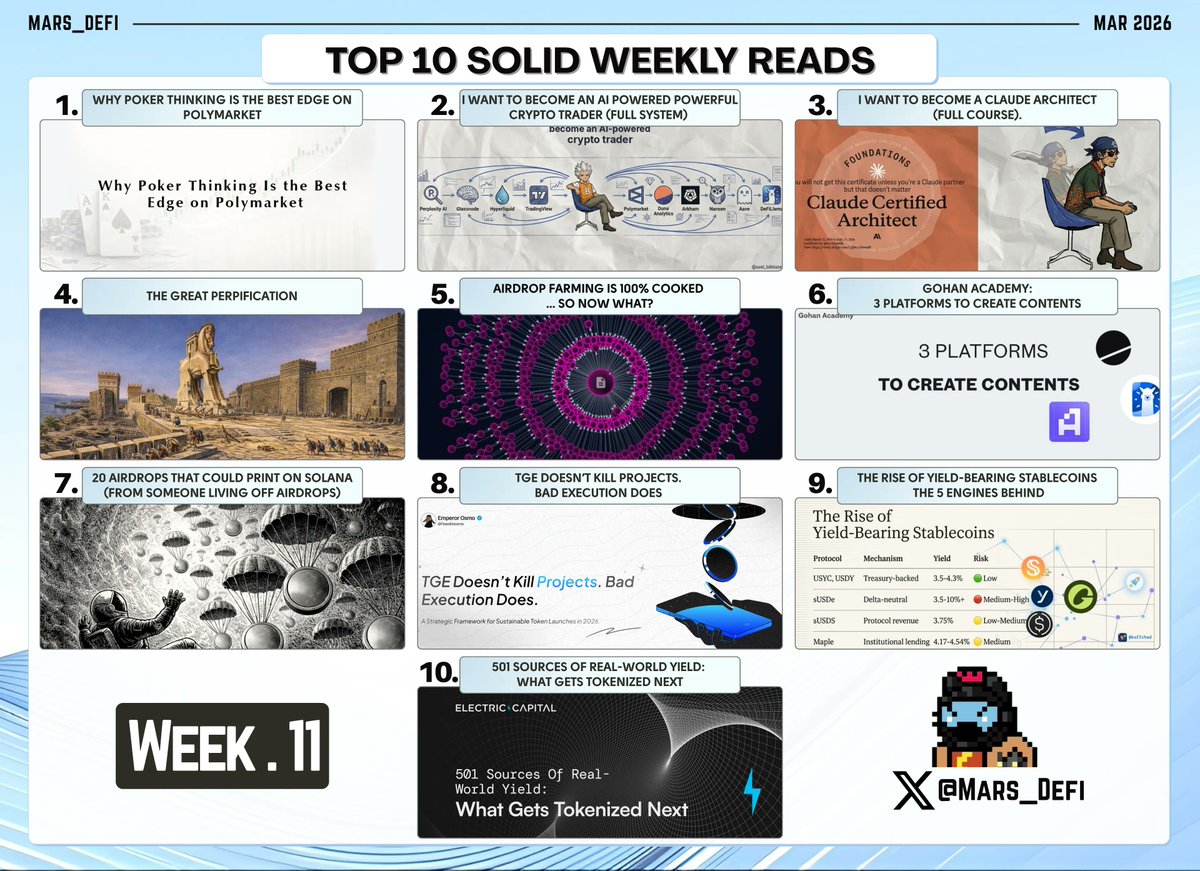
Crypto isn’t about luck anymore. The real edge comes from knowing where to look, what to act on, and how to stay ahead while others chase hype. Whether you’re trading perps, hunting the next real yield, building with Claude, or just trying to stay ahead of the curve, here’s a list of 10 articles that provide the tactical playbook you need. — Prediction markets like @Polymarket reward decision-making, not just being right. @monokern says the real edge comes from poker thinking. Focus on expected value, manage your bankroll properly, always ask who is on the other side of the trade, and most importantly, control emotions. That’s the difference between gambling and playing the long game. x.com/monokern/statu…@Axel_bitblaze69 breaks down a full AI-powered crypto trading system built around structure. The system runs on 5 modules: turning news into hedged portfolios, tracking smart money onchain, using prediction markets for validation, spotting second-order trades early, and building a daily market brief. Each uses tightly structured prompts to extract specific, actionable data. The idea is that AI isn’t making decisions for you. It’s helping you process information faster, map opportunities, and stay disciplined. x.com/axel_bitblaze6…@hooeem explains that becoming a Claude Architect is about mastering tools like Claude API, Agent SDK, and MCP, not certification. The focus is on building real-world AI systems like multi-agent workflows, automation pipelines, and structured outputs. Ultimately, becoming a Claude Architect is about gaining practical, production-level skills you can monetize, rather than chasing a certificate. x.com/hooeem/status/…@defi_monk talks about how perps are evolving into a dominant trading primitive, with platforms like @HyperliquidX driving adoption. Perps offer simple, continuous leverage and are expanding beyond crypto into assets like equities and commodities. Decentralized perp DEXs could capture a significant share of global derivatives markets and reshape finance. x.com/defi_monk/stat…@info_insightful explains that airdrop farming is no longer worth it, as the “easy money” era peaked with projects like @arbitrum and @HyperliquidX. Automation has been commoditized and competition is saturated, making the time-to-reward ratio extremely poor for new farmers. The takeaway is to pivot, build real skills, explore new opportunities, and only engage in niches you genuinely enjoy rather than chasing airdrops. x.com/info_insightfu…@0x99Gohan highlights that strong crypto research comes from combining multiple data platforms, not relying on a single source. Tools like @Dune, @artemis, and @DefiLlama each provide different insights across onchain data, network fundamentals, and capital flows. Real alpha comes from connecting signals across these layers to spot trends early. x.com/0x99gohan/stat…@FabianoSolana shares a curated list of high-potential Solana airdrops, focusing on platforms like @xStocksFi, @MeteoraAg, and @Loopscale. Top opportunities center around looping, LP, and points systems, and he highlights strong contenders like @Titan_Exchange, @ExponentFinance, and @onrefinance. Success depends on being early, having capital, or leveraging referrals, not just farming everything blindly. x.com/fabianosolana/…@Flowslikeosmo points out that token launch success isn’t about hype or airdrops, but proper execution and planning. Managing both sell and buy pressure, structuring float and unlocks, and targeting engaged users are key. Founders must coordinate exchanges, market makers, and liquidity while building genuine demand for long-term sustainability. x.com/flowslikeosmo/…@Kaffchad highlights that Yield-Bearing Stablecoins are replacing the old zero-yield model of USDT and USDC. The main engines are treasury-backed ( @OndoFinance - USYC, USDY), delta-neutral ( @ethena - sUSDe), protocol revenue ( @SkyEcosystem - sUSDS), institutional lending ( @maplefinance - syrupUSDC/USDT), and revenue-sharing ( @Paxos - USDG), each with unique yield sources and risk profiles. YBS marks the end of zero-yield stablecoins, offering holders real, diversified returns. x.com/kaffchad/statu…@MariaShen maps 501 real-world yield sources and which are tokenized on-chain. Stablecoins pulled treasuries onchain first, and higher-yield assets are following but face deployment delays. Distribution remains narrow, with most large RWAs held by less than 2,000 addresses. Founders can capture opportunity by tokenizing new assets, improving distribution, or building supporting infrastructure. x.com/mariashen/stat… — That’s a wrap on this week’s recap. Here’s the key takeaway: airdrop farming is now commoditized, zero-yield stables are dead, and raw hype no longer launches tokens sustainably. In today’s markets, skill and strategy beat noise every time. The winners are building systems, mastering execution, and capturing real, sustainable opportunities.
Mars_DeFi tweet media
English
59
6
80
4.8K
Jack
Jack@crypto_jackkk·
1739
QST
0
0
0
2K
Jack retweetledi
Mars_DeFi
Mars_DeFi@Mars_DeFi·
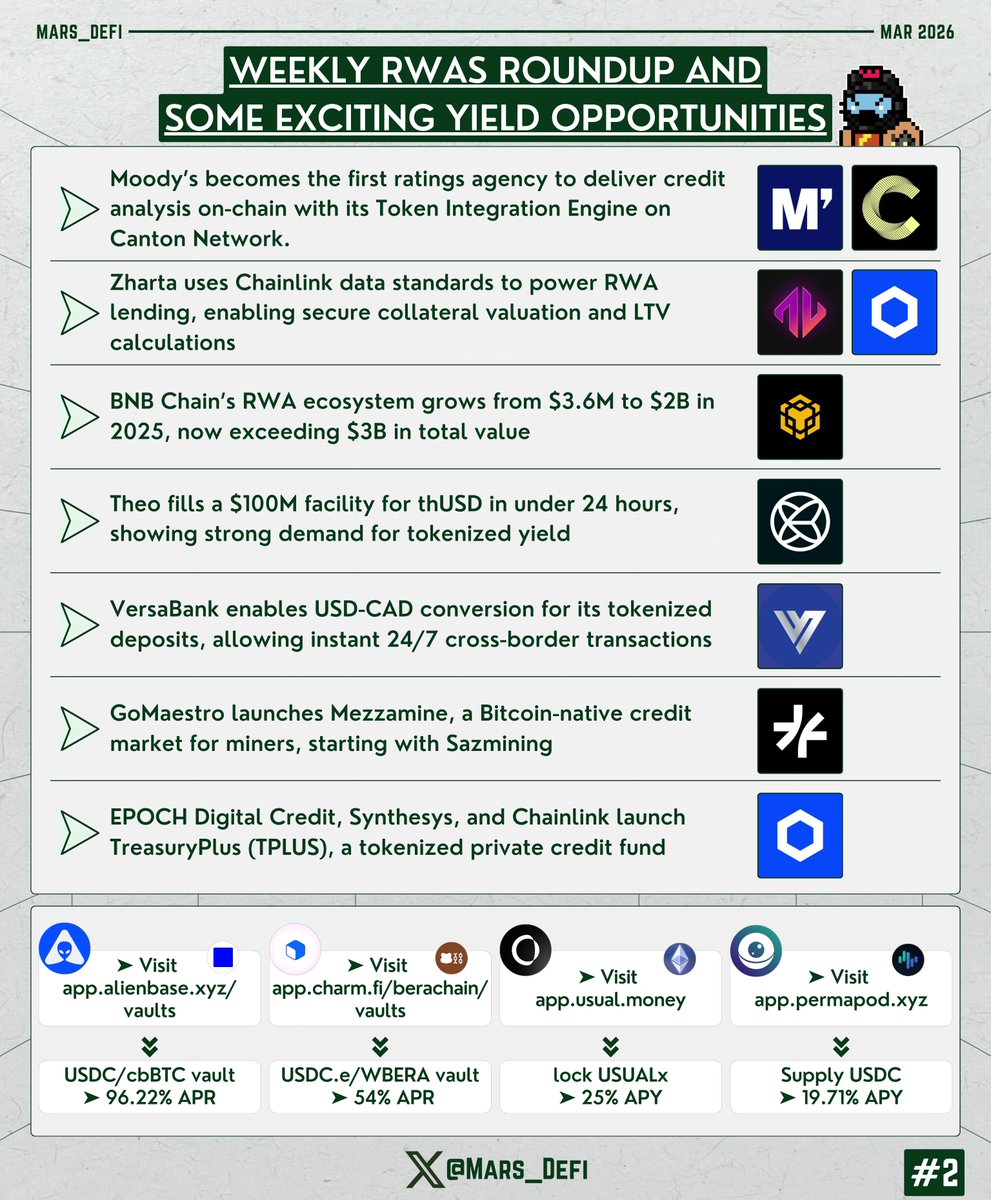
RWA tokenization is moving at warp speed, hitting real milestones with regulators, institutions, and infrastructure aligning fast. Here are the top headlines driving the sector right now, plus a fresh list of DeFi yield opportunities to explore this week. — • Moody’s makes history as the first ratings agency to deliver credit analysis on-chain, rolling out its Token Integration Engine on @CantonNetwork. x.com/cointelegraph/…@Zharta now leverages @chainlink’s data standard to fuel its RWA lending markets, using Price Feeds for secure collateral valuation and LTV calculations x.com/chainlink/stat… • Tokenized stock market officially surpasses the $1B mark in onchain value, led by @OndoFinance and @xStocksFi@BNBCHAIN’s RWA ecosystem surged from $3.6M in to $2B in 2025, and now sits above $3B in distributed asset value x.com/bnbchain/statu… • While @tether still holds the bigger reserves, @circle’s USDC now leads in transfer volume, dethroning USDT for the first time in 7 years • Theo fills $100M facility to support thUSD in less than 24 hours, as appetite surges for tokenized yields beyond US government bonds x.com/theo_network/s…@VersaBank rolls out USD-CAD conversion for its Real Bank Tokenized Deposits (RBTDs), powering instant, 24/7 cross-border transactions on blockchain • @GoMaestroOrg launches Mezzamine, the first Bitcoin-native credit market for miners, debuting with renewable-powered MaaS provider, Sazmining x.com/gomaestroorg/s… • EPOCH Digital Credit, with Synthesys and @chainlink, launches TreasuryPlus (TPLUS), the first tokenized private credit fund • @freedomdollar5’s fUSD reserves on @zano_project hit 1M $ZANO, a huge growth for the privacy-by-default stablecoin x.com/zanolist/statu… — Here’s a few DeFi opportunities to explore this week. • Protocol - @AlienBaseDEX • Chain - @base • Steps ➊ Visit app.alienbase.xyz/vaults ➋ Deposit assets into the USDC/cbBTC vault • Current yield - 96.22% APR • Protocol - @CharmFinance • Chain - @berachain • Steps ➊ Visit app.charm.fi/berachain/vaul… ➋ Deposit assets into the USDC.e/WBERA vault • Current yield - 54% APR • Protocol - @usualmoney • Chain - @ethereum • Steps ➊ Visit app.usual.money ➋ Swap USDC into USUALx and lock USUALx • Current yield - 25% APY • Protocol - @PermaPod_xyz • Chain - @ZIGChain • Steps ➊ Visit app.permapod.xyz ➋ Supply USDC • Current yield - 19.71% APY — Institutions are bringing credibility, RWAs are scaling aggressively, and users are increasingly chasing diversified yield sources. If this pace continues, the next phase of DeFi won’t just compete with TradFi, but integrate with it. So, manage risks and position accordingly.
Mars_DeFi tweet media
English
37
4
70
4.4K
Jack retweetledi
Mars_DeFi
Mars_DeFi@Mars_DeFi·
While there's a lot of attention on x402 as the standard for agent-to-agent payments , competing standards/implementations are rising. Although they're not yet mainstream, their capabilities can no longer be ignored. One of such implementations is @lightning 's L402. — What is L402 ? L402 just like x402 has one aim which is to repurpose the dormant HTTP 402 "Payment Required" status code to enable AI agents to autonomously pay for services. L402 actually predates x402 conceptually, having been developed as a way to gate API access behind Lightning Network micropayments. @lightning recently formalized L402 for the AI agent era with a full open-source toolkit release, positioning it as the Bitcoin-native answer to Coinbase's stablecoin-centric x402. — How L402 Works: Technical Architecture Step 1 - Request: An AI agent sends an HTTP GET/POST to an L402-protected endpoint. Step 2 - 402 Response: The server returns HTTP 402 Payment Required with a WWW-Authenticate header containing: • A Lightning Network invoice (the payment request) • A Macaroon (a bearer token that commits to the invoice's payment hash) Step 3 - Payment: The agent pays the Lightning invoice and receives a preimage (cryptographic proof of payment). Step 4 - Access: The agent resends the original request with the Macaroon + preimage in the Authorization header. The server verifies both and grants access. This is fundamentally different from x402 where instead of signing an onchain stablecoin transaction, the agent pays in satoshis over Lightning and uses the payment preimage as an unforgeable access credential. — The Macaroon System ( L402's Secret Weapon). Macaroons are what make L402 uniquely powerful. Unlike simple API keys, macaroons are: • Attenuatable : you can add caveats (restrictions) without invalidating the token • Decentralized : no central server needed to verify them • Composable a macaroon can encode time limits, IP restrictions, spending caps, or specific operation permissions For AI agents, this means you can issue a macaroon that says: "This agent can only spend up to 1,000 sats per hour, only on weather API calls, only from this IP range." That's granular, programmable access control baked into the payment credential itself. — This is possible because of the Lightning Agent Tools Stack. Built by Lightning Labs, it gives AI agents native access to the Bitcoin Lightning Network, enabling them to buy and sell resources autonomously. Key components: • LND skill – run a Lightning node (no full Bitcoin node needed) • lnget – HTTP client that automatically pays APIs using the L402 protocol • Aperture – reverse proxy that lets developers put APIs behind Lightning paywalls • Macaroon Bakery – creates scoped credentials so agents only have limited permissions • Lightning MCP Server – lets AI agents query Lightning node state through the Model Context Protocol • Security module – remote signer keeps private keys on a separate machine • Commerce workflows – tools for agents to buy or sell services — Strengths of L402 : • Lightning Network maturity • Lightning payments settle within milliseconds. This enables streaming payments and API metering. • L402 benefits from Bitcoin liquidity and established security Limitations: • Lightning requires channel liquidity. • Users must run a Lightning wallet and manage channels • Not ideal for multi-chain environments. — The future internet might not be subscriptions rather it could be per-request payments between machines. This is why it would be good to keep an eye on this implementation just as much as you would x402.
Mars_DeFi tweet media
English
51
5
92
6.3K
Wale ⭕️
Wale ⭕️@TweetByWale·
Literally everyone talks about scaling but almost no one talks about surviving the quantum era. $DIAM mainnet is already live with quantum resistant primitives and ZK backed privacy. IMO, this is what building ahead of the curve actually looks like
DIAM@diamante_io

Quantum threats are closer than ever before. Diamante, the first Quantum-Resistant Layer 1 Blockchain is built for the future. Your assets, protected today & tomorrow. Mainnet now live: explorer.diamante.io

English
12
18
53
9.6K
Jack retweetledi
Mars_DeFi
Mars_DeFi@Mars_DeFi·
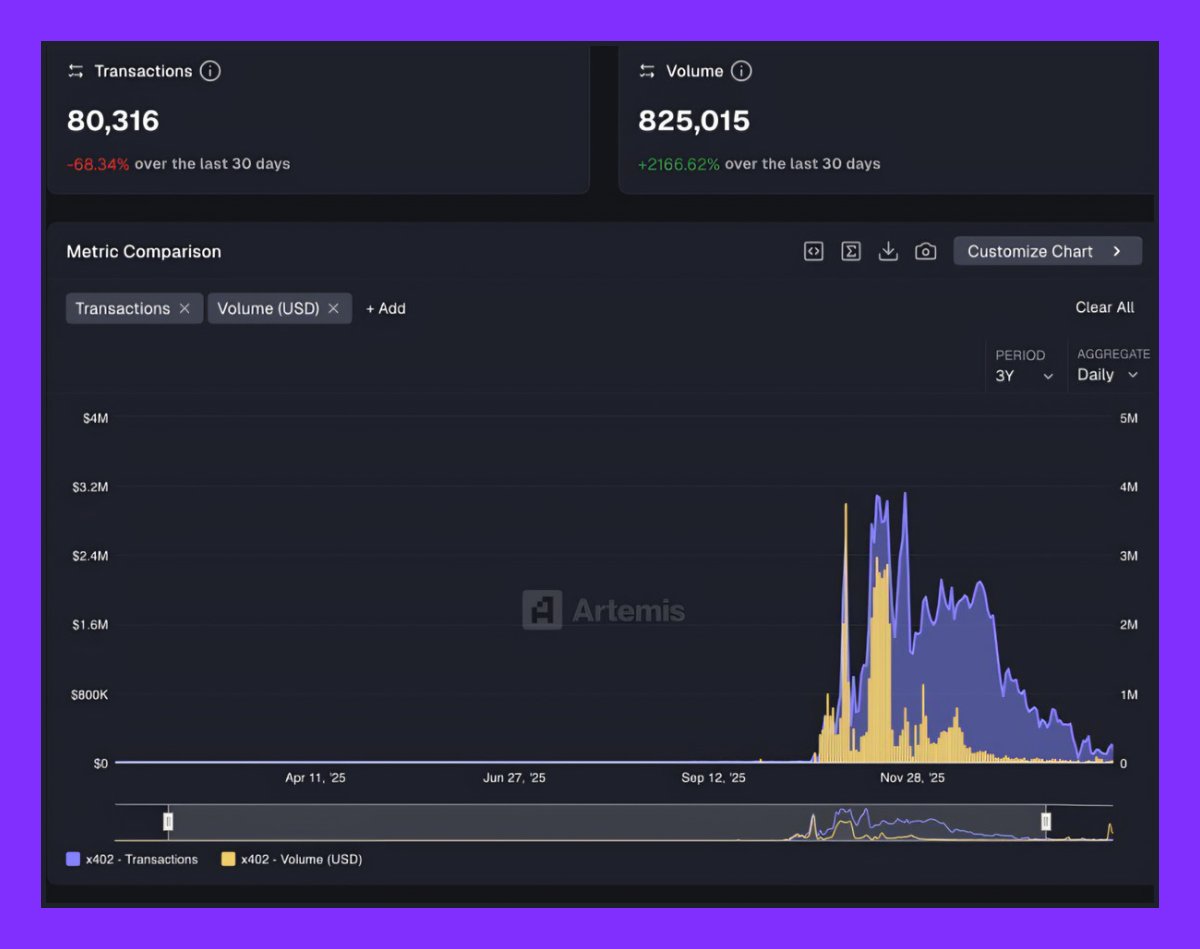
Recent data shows a significant decline in both transaction count and transaction volume on the x402 payment infrastructure over the last 30 days. Data shows that the total transactions have fallen by 68.34% in the last 30D, even as the cumulative historical activity shows earlier spikes in usage. This decline while worrisome does not necessarily indicate a failure of the protocol. Instead, it reflects a transition from an initial experimentation phase to a more realistic baseline of organic usage. Early spikes were largely driven by developer experimentation, automated agent activity, and infrastructure testing rather than sustained real-world demand. — The available data suggests three clear phases in the lifecycle of the x402 ecosystem: ● Phase 1 : Initial Development & Testing Surge During the early rollout period, developers and infrastructure providers heavily tested x402 payment rails. AI agents and experimental applications generated large bursts of micro-transactions. Network volume briefly reached multi-million-dollar spikes. This activity created a temporary surge in onchain metrics, which may have overstated the level of real economic demand. ● Phase 2 : Post-Hype Normalization Once testing cycles slowed, automated testing activity declined. Some bot or experimental traffic stopped generating transactions. Transaction counts dropped significantly as the network moved toward organic usage patterns. This is the phase reflected in the recent 68% drop in transaction count. ● Phase 3 : Early Organic Adoption (Current Stage) The infrastructure is now operating at what appears to be a more realistic baseline level of activity with current transactions more likely tied to: • real application usage • early AI-agent payment experiments • API monetization use cases However, adoption remains relatively limited compared to earlier peaks. — x402 was designed primarily to support machine-to-machine payments, particularly within AI ecosystems. Future growth will likely depend on the broader development of AI-driven applications that rely on automated payments. If these ecosystems mature, x402 could see renewed growth as infrastructure for machine-native financial transactions. h/t : @artemis
Mars_DeFi tweet media
English
8
2
25
1.5K
Jack
Jack@crypto_jackkk·
@jacycrypt AI-powered dev tools for smart contracts are saving builders so much time. That’s the kind of innovation we need in this space
English
1
0
1
26
Jacy🌸
Jacy🌸@jacycrypt·
AI is quickly becoming one of the most important narratives in Web3. Beyond speculation, we have a growing stack of projects building tools that combine decentralized infrastructure with generative models, autonomous agents, and AI-powered development workflows. From vibe coding platforms that help developers build dApps with AI, to generative tools that create text, images, video, and audio, the ecosystem is steadily expanding across multiple layers. Below is an overview of some key platforms shaping the Web3 AI landscape in this aspect. 📌 Web3 Vibe Coding and AI Development Platforms These tools help developers build smart contracts, dApps, or Web3 products using AI. 📍 AI Smart Contract / Web3 Dev Assistants ✦ @Chain_GPT - provides a chatbot, smart contract generator, auditor, and AI assistance for devs and users ✦ @ScopeProtocol - AI data layer, focusing on on-chain data analysis and intelligence for AI-driven insights ✦ @DoraHacks - open-source platform with AI tooling for automating dev workflows and hackathon management ✦ @Alchemy - blockchain developer platform offering infrastructure APIs ✦ @thirdweb - provides infrastructure for Web3 apps and AI agents, including tools for building, deploying smart contracts and enabling on-chain AI execution 📍 AI Agents for Web3 Development ✦ @Fetch_ai - builds autonomous AI agents and decentralized infrastructure for tasks like automation, data sharing, and economic coordination ✦ @autonolas - enables users to co-own, monetize, and deploy autonomous AI agents through a decentralized network and tokenomics ✦ @SingularityNET - provides a decentralized marketplace for AI services, including text generation and large language models accessible via blockchain 📌 Web3-Native Generative AI Platforms These are tools that use advanced machine learning models to create new content such as text, images, videos, audio, and code from simple user prompts. 📍 Text / AI Assistants ✦ @Chain_GPT - offers a Web3-focused AI chatbot and tools for generating content, code, and insights ✦ @SingularityNET - provides a decentralized marketplace for AI services, including text generation and large language models 📍 Image Generation ✦ @real_alethea - focuses on intelligent NFTs (iNFTs) and synthetic media, enabling generative AI for personalities and content creation ✦ @get_starryai - AI image generator that creates visuals from text prompts, with ownership of outputs ✦ @0x_Playground - on-chain world-building platform where users create, customize avatars, display NFTs, and build with AI 📍 Video Generation ✦ @real_alethea - supports generative synthetic media, including AI-powered animated characters and video content ✦ @Livepeer - decentralized video network for transcoding and streaming 📍 Audio / Voice Generation ✦ @voicemod - real-time AI voice changer and soundboard for gaming/streaming ✦ @audius - decentralized music streaming platform that supports AI-generated music uploads 📌 AI Data and Compute Infrastructure enabling generative platforms These projects provide decentralized compute, data, or model hosting, which many generative apps rely on. ✦ @rendernetwork - offers decentralized GPU rendering for AI, image, and video generation workloads ✦ @akashnet - cloud compute marketplace for hosting and running AI models, including generative ones ✦ @bittensor - incentivizes decentralized machine learning and inference, with subnets for generative AI tasks like text and image ✦ @gensynai - decentralized protocol for machine learning compute, focused on training and inference for AI models ✦ @nosana_ai - provides decentralized GPU compute for AI inference and workloads, supporting generative model execution ✦ @ionet - specializes in AI/ML compute, including inference for generative applications 📌 AI Agent / Creator Economy Platforms These allow AI agents or creators to monetize through tokens or NFTs. ✦ @myshell_ai - AI creator platform for building and monetizing personalized AI agents/characters ✦ @virtuals_io - enables creation and co-ownership of AI agents in a tokenized creator economy. While still early, the intersection of AI and Web3 is beginning to form a full stack that spans development tools, generative apps, decentralized compute, and tokenized AI agents. Here’s what I think. As infrastructure improves and more builders experiment with AI-native products, this sector could play a major role in how decentralized apps are created, deployed, and monetized in the coming years.
Jacy🌸 tweet media
English
24
2
63
5.3K
Jack
Jack@crypto_jackkk·
@jacycrypt Curious about how Superset makes review/merge smooth without manual stress though
English
1
0
1
25
Jacy🌸
Jacy🌸@jacycrypt·
One of the biggest shifts happening in software development right now is the rise of AI coding agents. Tools like Claude Code, Codex, and other CLI-based agents are changing how devs work. Instead of writing every line manually, they can now delegate tasks like debugging, refactoring, or even implementing features to AI. But this introduces a new challenge. If you want to get the most out of these agents, you often need to run multiple agents in parallel. One fixing bugs, another writing tests, another building a feature. Managing that workflow quickly becomes messy. Different terminals, conflicting environments, and agents stepping on each other’s changes. This is where a new category of tooling is starting to emerge, which is orchestration layers for coding agents. Instead of treating each AI agent as a separate process managed manually, these tools help coordinate multiple agents, track their work, and keep environments isolated. I did a deep dive into projects building in this direction, then I stumbled upon @superset_sh. Superset is essentially a terminal designed for running many coding agents at the same time. It lets devs spin up parallel workspaces where agents can work on different tasks simultaneously without interfering with each other.   Under the hood, it uses isolated Git worktrees so each agent has its own environment and changes can be reviewed or merged independently.   As AI agents become a bigger part of the development workflow, tools that help devs manage and orchestrate them efficiently will likely become an important layer of the modern dev stack, and Superset is one of the projects experimenting with that model. It’s still early for this category, but the direction is quite interesting. Eyes peeled.
Jacy🌸 tweet media
English
22
1
30
5.3K
Jack
Jack@crypto_jackkk·
971
QST
1
0
0
29
Jack
Jack@crypto_jackkk·
2312
QST
0
0
0
1.2K
Jack
Jack@crypto_jackkk·
3012
QST
0
0
0
30
Jack retweetledi
Mars_DeFi
Mars_DeFi@Mars_DeFi·
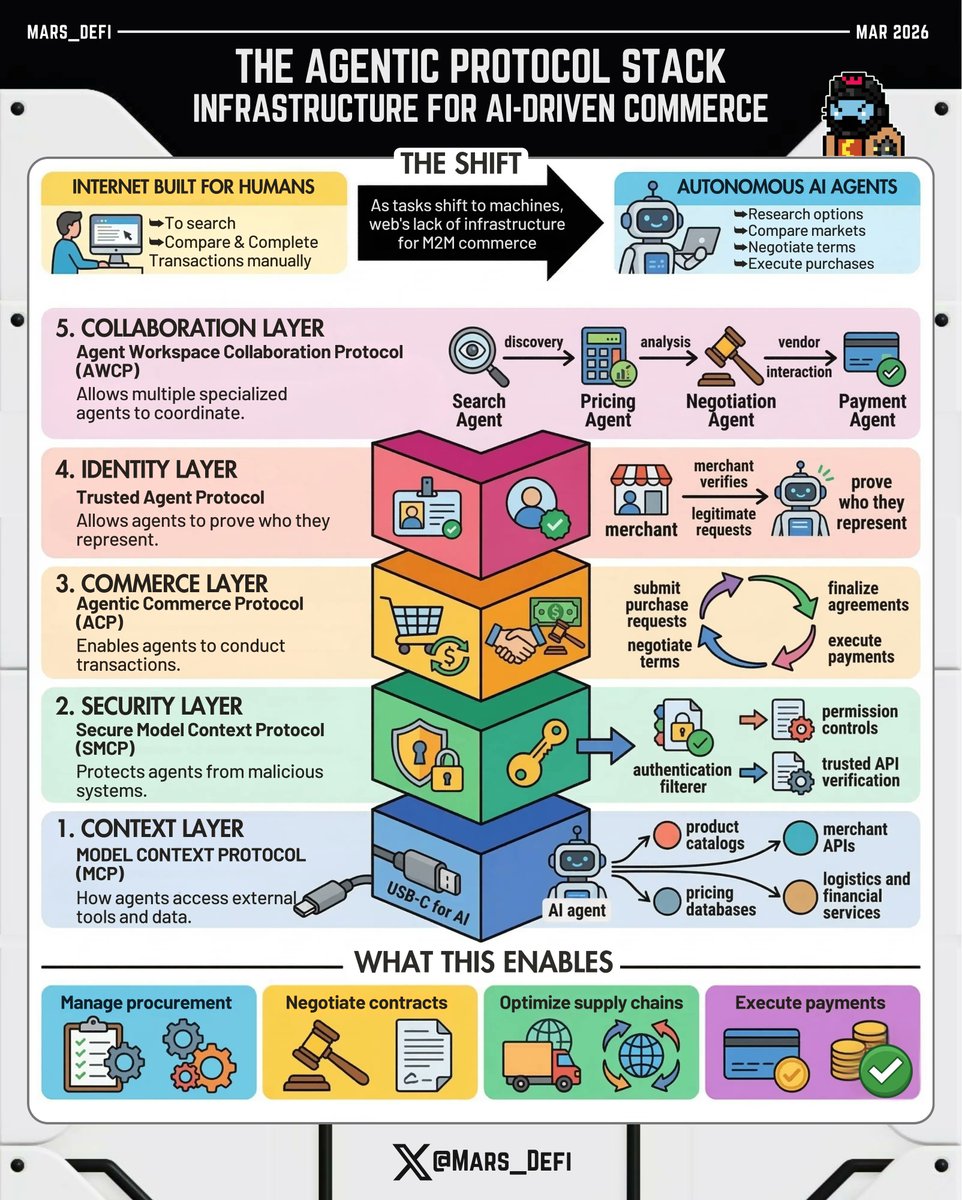
The internet was built around humans. You open a browser, search for information, compare options, and manually complete a transaction. Every layer of the digital economy from discovery to checkout assumes a human is navigating the process. But that assumption is starting to break. AI agents are evolving from passive assistants into autonomous actors capable of researching, negotiating, and executing transactions on behalf of users. Instead of manually comparing flights, sourcing software tools, or ordering groceries, users will increasingly delegate these tasks to intelligent agents. And this shift exposes a fundamental limitation of today’s internet: The web was never designed for machine-to-machine commerce. There is no universal framework that allows AI agents to: • discover merchants • authenticate identity • negotiate pricing • securely execute transactions across the web To support this new model of interaction, a new infrastructure layer is beginning to emerge often described as the Agentic Protocol Stack. — Just as the internet evolved into layered infrastructure with TCP/IP for networking and HTTP for web communication , the agent economy is beginning to develop its own protocol stack. Each layer solves a specific problem required for autonomous systems to operate economically. — At the foundation of this stack sits the Context Layer, powered by the Model Context Protocol (MCP). Before an AI agent can act, it must first gather information. MCP provides a standardized way for AI systems to connect to external tools and data sources such as: • product catalogs • pricing databases • merchant APIs • logistics platforms • financial services Instead of building custom integrations for every service, agents can access external systems through a shared interface. Developers often describe MCP as “USB-C for AI”, because it allows models to plug into tools and information sources in a consistent way. Put simply: MCP is how agents read the internet. — But access alone is not enough. Autonomous systems interacting with external services introduce new security risks. AI models can be vulnerable to: • prompt injection attacks • malicious APIs • impersonation attempts • data poisoning This is where the Security Layer comes in through the Secure Model Context Protocol (SMCP). SMCP extends MCP by introducing safeguards such as: • authentication between agents and services • permission management • trusted API verification • audit logs for agent activity These mechanisms ensure agents interact only with verified systems and that their actions remain secure and auditable. — Once an agent can safely gather information, it needs the ability to act on it economically. This is handled by the Commerce Layer, built around the Agentic Commerce Protocol (ACP). ACP standardizes how autonomous agents conduct transactions. It defines how agents: • submit purchase requests • negotiate service terms • finalize agreements • execute payments If MCP enables agents to analyze information, ACP allows them to turn that analysis into economic activity. In simple terms: ACP is how agents transact. — However, once agents begin interacting directly with merchants, another challenge emerges which is identity. Merchants must be able to answer a basic question: Is this request coming from a legitimate agent representing a real user or organization? Without identity verification, agent-driven commerce would quickly become vulnerable to automated fraud. This problem is addressed by the Identity Layer, often referred to as the Trusted Agent Protocol. This layer allows agents to cryptographically prove who they represent and what permissions they have, ensuring merchants can verify that a request is legitimate before executing a transaction. — Finally, most real-world workflows will involve multiple specialized agents working together. A single task might include: Search Agent -> product discovery Pricing Agent -> cost analysis Negotiation Agent -> vendor interaction Payment Agent -> transaction execution The Collaboration Layer, enabled by the Agent Workspace Collaboration Protocol (AWCP), allows these agents to share data, coordinate decisions, and operate within shared task environments. Instead of isolated systems exchanging messages, agents can collaborate within structured workflows to complete complex operations autonomously. — Taken together, these layers form the early architecture of a machine-driven economic layer on the internet. In a mature agent economy, AI systems could: • manage procurement • negotiate service contracts • optimize supply chains • execute payments autonomously Commerce becomes programmable. Websites increasingly function as APIs. Consumers shift from operators to delegators. And AI agents become economic actors interacting directly with digital markets. This is why the development of the Agentic Protocol Stack matters. It represents the infrastructure required for an internet where machines don’t just access information rather they participate in the economy itself.
Mars_DeFi tweet media
English
20
11
55
4.3K
Jack
Jack@crypto_jackkk·
@jacycrypt $WBT unlock on the 13th is massive… $4B+? That’s gonna be interesting volatility. WhiteBIT holders ready or nah?
English
0
0
1
17
Jacy🌸
Jacy🌸@jacycrypt·
Another week in crypto and the market is still in limbo, with $BTC going back below $70K. Projects are wary of TGEs, and those that have launched are struggling to keep head above water. While the calendar for the week isn’t so packed, there’s quite a number of solid updates to pay attention to. We’re kicking off with some big shifts, fresh launches, and the usual mix of hype, macro noise that keeps us all glued to our screens, and that ever-present token unlock pressure. Here’s everything worth watching this week. 🎯 General Updates ◈ 9th ✦ @edeldotfinance plans to drop an announcement ✦ @MagicEden sunsets its EVM and BTC marketplaces ◈ 10th ✦ @DungeonCross777 officially launches ✦ @SuccinctLabs plans to drop a major update ✦ @trdEverything Phase 1 starts, featuring public token sale, points, and release of their new app ◈ 11th ✦ Xertraverse, @XertraPlatform’s NFT marketplace, goes live ✦ @MultiversX’s Battle of Nodes begins ✦ @_Qubic_’s Network Guardians open beta starts ✦ @ether_fi’s Analyst Call featuring 2026 roadmap ◈ 12th ✦ @Polkadot’s scheduled economic upgrade start ✦ @illuviumio’s Beyond Wave 5 launches ✦ @build_on_bob’s next mainnet upgrade (Jovian Hardfork) 🎯 TGE and ICO Updates ◈ 9th ✦ @NexiraDAEP ($NEXI) TGE ◈ 10th ✦ @trdEverything ($E) public sale 🎯 Macro Economic Events ✦ US CPI data ✦ Fed Bowman’s speech 🎯 Token Unlocks ◈ 12th ✦ @Aptos - 11.31M $APT ($10.52M) ◈ 13th ✦ @WhiteBit - 81.5M $WBT ($4.37B) ◈ 15th ✦ @ConnexSocial - 1.32M $CONX ($15.13M) And that’s the lineup for the next few days, ft catalysts that could spark moves in either direction. Between Magic Eden’s full retreat to Solana, some intriguing TGEs and app drops, major protocol upgrades, and those hefty unlocks looming ($WBT especially), it’s shaping up to be an eventful week. Keep an eye on the macro-economic events too. That’s always a wildcard for the broader market mood.
Jacy🌸 tweet media
English
23
3
42
6K
Jack
Jack@crypto_jackkk·
From $燃烧马 100x to a new #GAMEFI narrative, the evolution continues. By putting 斗地主 on-chain, the project blends gaming fun with the viral nature of #MEME communities. Social gameplay could attract massive attention. Fair launch tonight 20:18 on #FOURMEME — watch $FOUR地主 closely.
Four地主@FourDiZhu

💹爆燃倒计时!今晚北京时间20:18(UTC 12:18) #FOUR地主 准时引爆 #FOURMEME! 🏆重磅已就位: - AVE热搜榜第一 已砸钱锁定! - BTOK开屏广告 霸屏上线,已正式投放! - AVE热搜将于今晚20:50左右正式登顶,流量核弹即将来袭! 🔥更大动作还在路上! 多渠道营销火力全开,铺天盖地引爆! #FOUR地主 不是普通的meme,它是 #FOURMEME 平台上第一颗真正闪耀的链上 GAMEFI 革命级宝石!💎 🃏首创玩法、链上创新、沉浸式体验……全部等你来亲手解锁! ✅准备好你的BNB,准时蹲点,冲就完事儿了!🚀 #FOURMEME #FOUR地主 #BNBChain #GameFi #Meme革命

English
0
1
2
7.2K
Jack
Jack@crypto_jackkk·
@jacycrypt Yesterday was packed. Makes me wonder what the rest of the week has in store.
English
1
0
1
60
Jacy🌸
Jacy🌸@jacycrypt·
The space proved to be quite active yesterday, with BTC price movements, trending tokens, and events. Here's a quick rundown of what went down. 📌 $BTC moved between $66K and $69K, bouncing back after weekend volatility caused by geopolitical tensions. The rebound resulted in a wave of liquidations as shorts got squeezed, and the main debate was all about whether this was a real recovery or just a short-term relief bounce. 📌 $ETH stayed mostly in the $1.9K - $2K range, following BTC’s lead. Traders stayed cautious and watched closely to see if $ETH would start catching up if $BTC held its ground, while also keeping an eye on liquidity and waiting to see clear momentum before moving into altcoins. 📌 Trending Tokens ($YELLOW, $TREX, $BTW) - $YELLOW got attention after its funding news and launch updates, $TREX gathered awareness thanks to its gamified identity mechanics and strong community engagement, while $BTW drew focus with its TGE and ecosystem expansion. Other notable events: ➸ Incentra & Lending Protocols - @brevis_zk Incentra expanded support to include @aave lend/borrow campaigns and @Morpho v2 lend campaigns, in addition to existing @eulerfinance support. Rewards are calculated from on-chain activity and verified with zero-knowledge proofs. ➸ Cache Wallet & InitVerse - @CacheWallet partnered with @InitVerse to strengthen Web3 experiences. The combo gives users recovery-first wallet protection, multichain access, and access to InitVerse’s interactive ecosystem. Users can explore, connect, and participate with confidence. ➸ Injective CLI Skill - @injective launched a new CLI skill for AI-agent interaction with Injective, straight from the terminal. It handles wallet management, endpoints, gas configuration, and subcommands automatically, letting builders examine chain data, send transactions, and script workflows with zero challenges. ➸ ZeroBase on Base App - @zerobasezk went live on Base App, giving users native access to ZK-verified finance and staking vaults. Their token $ZBT is now accessible to everyone on the platform. These updates set the tone for the week ahead, so keep an eye out as we look forward to what unfolds next.
Jacy🌸 tweet media
English
12
1
12
6.6K