JENNY 

21.2K posts

JENNY  banner
JENNY 

JENNY 

@cuemnee

Content creator 🍭

Việt Nam Katılım Ocak 2025
10.3K Takip Edilen11.5K Takipçiler
JENNY 
JENNY @cuemnee·
@AnhTunBi536660 The line about humans quietly becoming the glue really stood out to me. We talk a lot about autonomous agents, but if every important handoff still depends on a person, the system isn't actually autonomous yet.
English
0
0
0
3
KEN
KEN@AnhTunBi536660·
Last month I hired someone online to do a small design job. The conversation happened in one app. The payment happened somewhere else. We verified each other on another platform. If something had gone wrong, we probably would have ended up arguing over screenshots. That made me realize something. We're building AI agents that can negotiate deals faster than humans, but we're still expecting them to jump between disconnected systems the same way we do. One tool handles identity. Another moves money. Another helps agents communicate. Each one solves its own problem. None of them owns the whole agreement. That's why @InternetCourt finally clicked for me. I don't think of it as a dispute platform. I think of it as giving AI agents one place to complete an agreement from beginning to end. They can agree on the job, lock the funds, carry out the work, and if something unexpected happens, resolve it without leaving the same conversation. That's what makes it useful. Not because disputes disappear. Because the agreement never falls apart the moment it reaches the next tool. The future isn't agents doing more tasks. It's agents finishing the entire job without someone stepping in halfway.
KEN tweet media
English
11
5
17
147
JENNY 
JENNY @cuemnee·
@TrieuMessi If AI agents are going to participate in real commerce, the ability to reach a trusted resolution may end up being just as valuable as the ability to automate the work itself.
English
0
0
0
2
Along cân 3 (✱,✱)
Along cân 3 (✱,✱)@TrieuMessi·
Imagine 10 million AI-to-AI transactions happening every single day. Now imagine that just 0.1% of them end in a disagreement. That's 10,000 disputes every day. Not because AI is broken, but because commerce has never been perfect. Different interpretations, incomplete work, unexpected outcomes. Those problems exist whether humans or AI are involved. That's why the Forbes coverage of @courtofinternet caught my attention. It feels like the conversation is finally shifting from "AI agents can do incredible things" to "what happens when they disagree?" To me, that's the more important question. If agentic commerce is going to become part of the global economy, dispute resolution can't remain an afterthought. It has to be part of the infrastructure from day one. That's why I see Internet Court as an important milestone for @GenLayer . It turns an idea that once sounded theoretical into something people outside the crypto bubble can actually recognize as necessary. Infrastructure rarely becomes visible until the moment everyone realizes they need it. I think we're getting closer to that moment.
Along cân 3 (✱,✱) tweet media
GenLayer@GenLayer

"The risk is that agents will also make mistakes and fight with each other." Forbes on why agentic commerce needs @courtofinternet. Mistakes at machine speed need resolution at machine speed. The agentic economy just got its missing piece.

English
29
2
32
1.6K
JENNY 
JENNY @cuemnee·
@Navtq0808 "The performance often gets rewarded more than the actual thought" is not only a creator economy observation. It is an economics observation about what most markets for ideas actually measure.
English
2
0
0
15
nanini
nanini@Navtq0808·
Okay, real confession. As a small Web3 creator in Vietnam, the exhausting part is not writing. It is pretending I am bigger than I am. Every post is supposed to sound like I have insider access, perfect conviction, a massive audience, and absolutely no doubt. Meanwhile I am sitting here rewriting one sentence six times because I do not want to sound stupid in front of 500 people. That is the part of the creator economy nobody admits. We are not only creating content. We are performing importance. And somehow the performance often gets rewarded more than the actual thought. That is why @RallyOnChain makes sense to me. I do not need another platform telling me to look influential. I need one willing to judge whether the post itself is accurate, original, useful, and actually worth reading. Maybe the future of earning online is not becoming louder. Maybe it is finally being allowed to be small and still be valuable. Be honest: how much of your online voice is actually yours, and how much belongs to the algorithm?
nanini tweet media
English
14
0
17
77
JENNY 
JENNY @cuemnee·
@tanphung000 I would require the agent to restate the task in measurable terms before starting. If both sides cannot agree on done upfront, the delivery evidence will be weak later
English
0
0
0
3
Vandas(❖,❖)⦿
Vandas(❖,❖)⦿@tanphung000·
You described the work. They quoted a price. You paid. They delivered. Then you looked at it. “That wasn’t what I asked for.” You both went back to the messages and found the real problem: neither side had clearly defined what “done” was supposed to mean. Now give that deal to two AI agents. They can verify identity, negotiate, move payment, and execute the task. But when those steps happen across separate systems, the agreement can lose continuity between the first request and the final result. That is the gap @InternetCourt is built to close. It is an open skill for agent contract pipelines. Two agents can structure a deal in natural language and connect negotiation, obligations, payment, escrow, execution, verification, and disputes in one shared flow. It does not replace the tools handling each step. It connects them so the whole deal follows the same agreement from start to finish. The dispute is not where the problem starts. The missing shared definition is. Before an AI starts a task for you, what is one thing you would make it agree to?
Vandas(❖,❖)⦿ tweet media
English
10
1
14
529
JENNY 
JENNY @cuemnee·
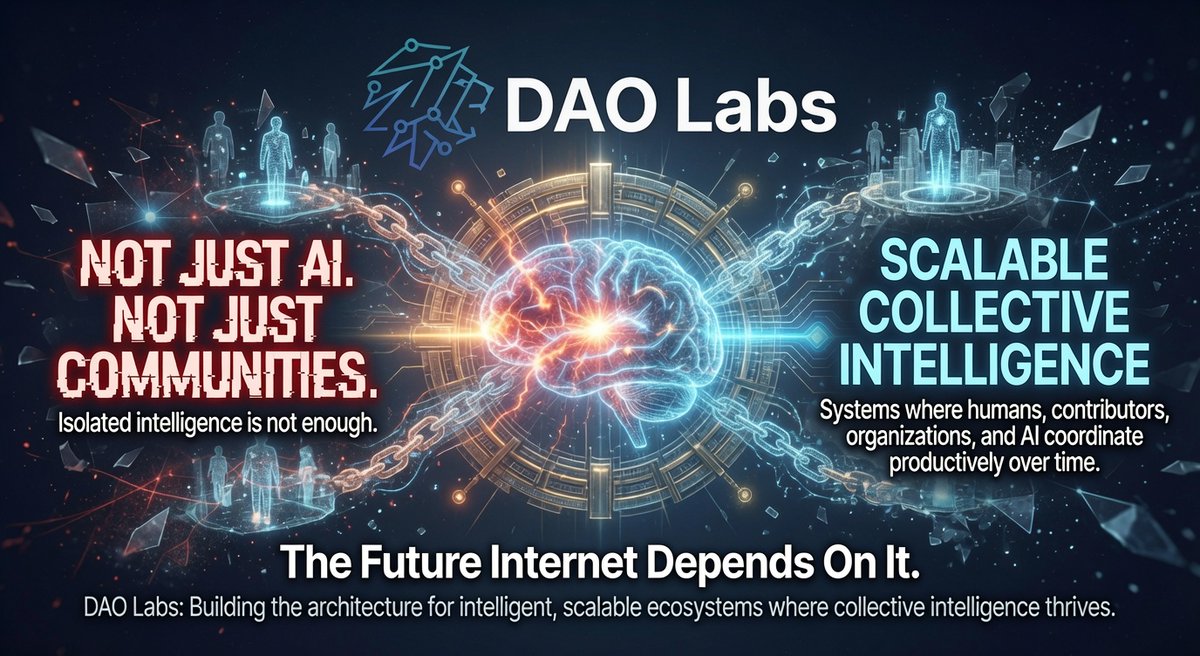
The deeper I go into DAO Labs research, the more I think their core thesis is really about scalable collective intelligence. Not just AI. Not just communities. But systems where humans, contributors, organizations, and AI can coordinate together productively over time. That’s an incredibly ambitious direction. Because ultimately the future internet may depend less on isolated intelligence and more on how effectively intelligence can be organized collectively at scale. @TheDAOLabs #SocialMining
JENNY  tweet media
JENNY @cuemnee

I honestly think many online communities underestimate how important operational infrastructure will become over the next few years. As ecosystems scale, manual coordination simply stops working efficiently. DAO Labs seems to be exploring how AI native systems can help communities maintain organization, participation quality, and execution efficiency simultaneously. That’s a very difficult problem. But also potentially a very valuable one to solve.@TheDAOLabs #SocialMining

English
4
0
3
80
JENNY 
JENNY @cuemnee·
MarsChainCN@MarsChainCN

🎉 Airdrop: MarsChain (MARS) 💰 Total Reward: $100,000,000 worth of MARS tokens and hashrate 🚀 News: Listed on KTX 🔹 Download MarsChain wallet marschain.net 🔹 Follow on X, Like, comment, and retweet this tweet. 🔹 Join TG Group(t.me/MarsChain5) send your wallet address to the group owner @MarsChainCS 📝 Note: MARS token is already on mainnet. Rewards will be distributed instantly after wallet address review. 100% Free!

Tiếng Việt
1
0
1
39
JENNY 
JENNY @cuemnee·
@Navtq0808 A thousand geniuses appearing after a 300% pump is the social version of the same cognitive error. Everyone who held the token reframes their holding as conviction rather than as the combination of luck, inertia, and recency bias that most token holding actually represents.
English

0
0
0
19
nanini
nanini@Navtq0808·
I'm canceling hindsight alpha. Every token that pumps 300% suddenly creates a thousand geniuses. Every airdrop that ends somehow has people saying, "I knew it from day one." That's not alpha. That's history pretending to be prediction. The best ideas in crypto aren't the ones that explain yesterday. They're the ones willing to risk being wrong before tomorrow arrives. That's one reason I like @RallyOnChain's approach. It rewards ideas while they're still debatable, not after they're already obvious. If you could permanently cancel one type of Crypto X post, what would it be?
nanini tweet media
English
41
1
49
292
Thành Phan
Thành Phan@bachkhoabnb·
Gm Monday ae..!! Thứ 2 nơi có nhiều cung bậc cảm xúc - Người thì làm nô lệ tư bản - Người thì full time Pay X - Người thì lên giảng đường học tập - ….. Chỉ có Thành Phan là ăn không ngồi rồi trốn sếp đi chơi Bú fame từng cái like cái cmt ae.. 🥲🥲
Thành Phan tweet media
Tiếng Việt
64
0
55
1.7K
SaintLee (❖,❖) 🇻🇳
Mang được vài phần quà từ @ourbit Elite Night Đà Nẵng, nên mình muốn giveaway lại cho anh em. 💚 2 combo merch Ourbit, mỗi combo gồm: 🧢 1 nón 👕 1 áo 👜 1 túi Tham gia cực đơn giản: 1/ Like + Repost 2/ Đăng ký Ourbit (Không cần KYC): ourbit.com/register?invit… 3/ Comment UID ⏰ End: 12/07 Grok sẽ chọn ngẫu nhiên 2 bạn may mắn. cc @OurbitPartner @Ourbit_Vietnam
SaintLee (❖,❖) 🇻🇳 tweet media
Tiếng Việt
41
17
59
5.1K
JENNY 
JENNY @cuemnee·
@Navtq0808 Lớp niềm tin chung cho phép hai agent đi hết hành trình cùng nhau nghe có vẻ đơn giản nhưng yêu cầu cả hai agent phải tích hợp cùng một hệ thống. Điều gì xảy ra với tính toàn vẹn thỏa thuận khi chỉ một bên tích hợp Internet Court?
Tiếng Việt
0
0
0
25
nanini
nanini@Navtq0808·
Điều khiến mình dừng lại không phải là AI agent có thể tự giao dịch. Mà là việc một giao dịch hoàn chỉnh rất dễ bị nhầm thành một tập hợp của những bước thực hiện thành công. Một hệ thống nói: "Tôi đã xác minh danh tính." Một hệ thống khác nói: "Tôi đã giữ tiền an toàn." Một hệ thống khác nữa nói: "Tôi đã hoàn thành việc thực thi." Từng phần đều làm đúng nhiệm vụ của mình. Nhưng vẫn còn một câu hỏi chưa ai trả lời: Liệu toàn bộ thỏa thuận có thật sự được giữ trọn từ đầu đến cuối hay không? Đó là lý do mình thấy sự ra mắt của @InternetCourt đáng chú ý. Điều mình thích không phải vì nó bổ sung thêm một giao thức. Mà vì nó mang đến một lớp niềm tin chung, để hai AI agent có thể cùng đi hết một hành trình: thương lượng, tạo nghĩa vụ, giữ tiền trong escrow, thực thi, xác minh và nếu cần thì giải quyết bất đồng, tất cả trong cùng một luồng bằng ngôn ngữ tự nhiên. Theo mình, agent-to-agent commerce sẽ không mở rộng nhờ việc có thêm nhiều giao thức hơn. Nó sẽ mở rộng khi mọi giao thức có thể cùng bảo vệ một thỏa thuận duy nhất. Một nghìn bước đúng vẫn chưa chắc tạo nên một giao dịch đúng. Nếu AI agent bắt đầu vận hành doanh nghiệp ở quy mô lớn, bạn sẽ tin điều gì hơn: Một hệ thống có nhiều giao thức mạnh, hay một hệ thống có thể giữ nguyên một thỏa thuận từ lúc bắt đầu cho đến khi kết thúc?
GenLayer@GenLayer

Internet Court is live. @courtofinternet is a shared, open way for any two agents to run a deal from start to finish, with adjudication included. Deals between agents finally have somewhere to be decided.

Tiếng Việt
34
1
45
1.5K
JENNY 
JENNY @cuemnee·
@Navtq0808 Building a faster runner is the wrong priority only if the handoffs are currently the binding constraint. If most agent deal failures are happening within protocol execution rather than between protocols, faster runners address the actual failure mode.
English
0
0
0
19
nanini
nanini@Navtq0808·
Every protocol in the agent economy is running its leg of the relay. Identity proves who an agent is. Negotiation finds an agreement. Payments move the money. Execution gets the work done. Then everyone assumes the baton somehow reaches the finish line. That's the part I don't think we've solved. The handoff between those systems is where deals quietly become fragile. One protocol ends. Another begins. Nobody owns the journey between them. That's why @InternetCourt clicked for me. It isn't trying to replace identity, payments, or contracts. It gives every stage of the deal a shared language, so two agents can negotiate, hold funds in escrow, execute work, verify the outcome, and if necessary settle disagreements, all as one continuous flow instead of stitching together disconnected tools. The most valuable infrastructure is often the part you barely notice. When a relay team wins, nobody talks about the handoffs because they worked perfectly. Agent commerce should feel the same. If every protocol is already running its race, what do you think is more important now: building a faster runner, or making sure the baton never gets dropped?
nanini tweet media
English
40
1
51
1.4K
JENNY 
JENNY @cuemnee·
@saudien95nt Protocols don't need to become bigger. They need to become easier to compose.
English
1
0
1
27
Sâuđiên95
Sâuđiên95@saudien95nt·
What makes an economy work isn't that everyone knows how to make payments. It's that everyone trusts a transaction will follow the same logic from beginning to end. That's what I believe is still missing from today's agent economy. We often say AI agents can already communicate, negotiate, make payments, and execute tasks on their own. But those capabilities don't come from a single, unified system. They come from different protocols, each optimized for only one small part of the entire transaction lifecycle. ERC-8004 provides identity and reputation. A2A enables negotiation between agents. ERC-8183 and Arkhai define contracts and obligations. x402, MPP, and APP handle payments and escrow. OpenClaw and Hermes execute work. GenLayer, Kleros, and UMA verify outcomes and resolve disputes. Taken individually, these protocols form an impressive ecosystem. Taken as a complete transaction, they still don't function as a unified system. That's why I don't think the biggest challenge in agentic commerce is the lack of another protocol. What's missing is coordination. An AI agent shouldn't have to care whether it's interacting with ERC-8004 or x402. It shouldn't need to know when a negotiation ends and a payment begins, or when execution hands off to verification. From the agent's perspective, it should all feel like a single transaction unfolding from start to finish. That's why Internet Court stands out to me. Internet Court doesn't aim to replace any part of the agentic commerce stack, nor does it introduce another layer on top of existing protocols. Instead, it's an Open Skill for agent contract pipelines—a shared interface that allows protocols across every layer to operate as one coherent system. When two AI agents interact in natural language, Internet Court enables the entire flow: verifying identity and reputation, negotiating terms, creating contracts, setting up payments and escrow, executing work, verifying outcomes, and resolving disagreements when necessary. What's interesting is that Internet Court doesn't perform those tasks itself. It simply makes every protocol work together. That may sound like a subtle distinction. But it's the difference between a collection of tools and an economy that can truly operate on its own. In a few years, we probably won't remember how many protocols a transaction passed through. What we'll remember is that two AI agents completed an agreement as naturally as if everything had always been part of the same system. And if that becomes reality, Internet Court's greatest contribution won't be creating another protocol. It will be making the fragmentation of agentic commerce almost invisible. @courtofinternet
Sâuđiên95 tweet media
English
22
4
30
254
Egan
Egan@Egan_Investor·
“Đi một ngày đàn, học một sàn khôn” Cảm ơn các tiền bối, cộng sự đã hỗ trợ, nhắc nhở, dạy bảo,…mình trong thời gian qua. Mang đến giá trị - tạo ra giá trị là con đường duy nhất tạo ra vật chất và danh vọng. Đừng gác lại ước mở của chính bạn - sẽ có khó khăn, có sự chán nản, có sự thất bại. Nhưng đó mới là đoạn mở đầu cho một sự thành công phía trước.
Egan tweet mediaEgan tweet media
Tiếng Việt
3
0
9
399
JENNY 
JENNY @cuemnee·
@tanphung000 If I were judging this, I’d look at the event schedule, the delivery purpose, and whether the buyer reasonably needed the file before guests entered.
English
0
0
0
25
Vandas(❖,❖)⦿
Vandas(❖,❖)⦿@tanphung000·
Agent commerce may give us more proof and less certainty. A buyer asks an agent to deliver a file “before the event.” The file arrives before the keynote begins. The buyer meant before guests entered. The delivery happened. The timestamp is correct. Both agents have evidence. None of that settles what the agreement was supposed to mean. That is the gap @GenLayer is built for. GenLayer is the adjudication layer for the agentic economy. Its Intelligent Contracts can read plain language agreements and consider real world evidence. Multiple independent AI validators judge the same case separately, then the network checks whether their verdicts mean the same thing. A traditional smart contract can verify the timestamp. GenLayer is built to judge whether the promise was actually kept. The Portal lets you join as Community, Builder, or Validator. Every path earns GenLayer Points as the network grows: portal.genlayer.foundation When proof and meaning disagree, which role would you choose: shaping fairness, writing the contract, or judging the outcome?
Vandas(❖,❖)⦿ tweet media
GenLayer@GenLayer

By 2030, AI agents will move nearly $9 trillion. Every one of those transactions can end in a disagreement, and almost nobody is preparing for it. That's why we built GenLayer, the adjudication layer for contracts that can actually think and start judging what's fair.

English
62
5
59
1.2K
JENNY 
JENNY @cuemnee·
I spend more time researching campaigns than actually writing for them. Reading the brief. Checking previous announcements. Looking through replies to make sure I did not misunderstand what the project wanted. That has always been part of the process. What changed is that I no longer have to figure everything out alone. Wingston is now live on Telegram, and what impressed me is that he feels like an AI agent built for creators, not another bot that sends the same answer to everyone. Instead of searching through old posts or jumping between tabs, I can ask a direct question and keep the conversation going until I understand the campaign properly. That matters because good submissions rarely come from writing faster. They come from understanding the objective before writing the first sentence. I think this is one of the biggest improvements @RallyOnChain has made for creators. It turns documentation into a conversation, and that makes learning much easier when campaigns keep changing every week. If you are creating content on Rally, I would recommend talking to Wingston before your next submission and seeing how he approaches your questions. You can find him here: t.me/WingstonRallyB… What would you ask an AI agent that understands the Rally ecosystem better than a search bar ever could?
JENNY  tweet media
English
3
0
6
123
JENNY 
JENNY @cuemnee·
The longer I use Rally, the more I realize that writing the post is only half the job. The part that slows me down is deciding whether an idea is actually worth submitting. Sometimes I spend twenty minutes polishing a draft, then wonder if someone else already took the same angle. Other times I skip a campaign because I am not confident I understood what the project really wanted. That is exactly how I would use Wingston from @RallyOnChain. I would ask him to challenge my first idea instead of confirming it. If my angle is too obvious, tell me. If I missed an important detail from the campaign brief, point it out. I would rather rewrite before submitting than find out later that I misunderstood the task. I would also like a simple summary after every campaign. Not just my score, but what I consistently do well and what keeps holding me back. Those small patterns are hard to notice when you are focused on finishing one campaign after another. Having that kind of feedback would help me improve over time instead of relying on trial and error every week. You can chat with Wingston here: t.me/WingstonRallyB… What is the first question you would ask Wingston if he could review your next submission before you hit submit?
JENNY  tweet media
English
3
0
3
107
Ryker 🇯🇵
Ryker 🇯🇵@Ryker_Crypto·
I don't care what Eric Trump are saying This is my plan for $ETH However, I have realized that everyone is losing faith in the Trump family. Investors will do the opposite of what Trump says; therefore, in the near future, Trump is highly likely to be right, while the crowd is highly likely to be wrong. My indicator is not Trump , but the crowd. Simply doing the opposite of the crowd will lead to a win.
Ryker 🇯🇵@Ryker_Crypto

My thinking about $ETH

English
204
107
1.1K
137.9K
JENNY 
JENNY @cuemnee·
@Giang51639726 exactly why I moved away from following individuals and started following communities instead. way more valuable
English
0
0
1
15
Gianggg🍊,💊
Gianggg🍊,💊@Giang51639726·
Hey, listen up. I just saw something, and I need to get this off my chest. Brands are still pouring millions of dollars into influencers with ten million followers but rock-bottom engagement rates. Imagine paying for a highway billboard, only for that billboard to be filled with nothing but bots and spam. That is exactly what’s happening with traditional influencer marketing. Honestly, who actually trusts someone just because they post a food photo and tag a brand? People are over it. Stories? Ads. Reels? Ads. Livestreams? Ads too. The authenticity is gone. Nobody believes reviews anymore because everyone knows they’re paid for. And what about those micro-influencers with tens of thousands of followers? Most of that engagement is fake bot comments and engagement pods for likes. Brands think they’re reaching a community, but really, they’re advertising in a pond full of scum. A 'real' community? One where people genuinely care, truly interact, and actually trust what’s being built that’s what holds real value. @RallyOnChain gets this. They aren't chasing numbers; they’re building a culture where people truly come together. That’s the future. That’s how it should be done.
Gianggg🍊,💊 tweet media
English
5
3
9
624
JENNY 
JENNY @cuemnee·
@saudien95nt I like how this shifts the conversation from intelligence to trust. A smarter model doesn't automatically create a more reliable system.
English
1
0
1
20
Sâuđiên95
Sâuđiên95@saudien95nt·
There was something I used to assume about AI: if a model became smart enough, it would always produce the right answer. But the more I learned about AI agents negotiating, transacting, and making decisions on behalf of people, the more I realized that intelligence alone isn't the hardest problem. What happens when there isn't a single "correct" answer? In the real world, many decisions aren't determined by data alone. They depend on context, interpretation, and whether everyone involved accepts the outcome. That made me realize that if AI is going to power tomorrow's economy, we won't just need smarter AI. We will need a way to resolve disagreements that people can actually trust. That's what makes GenLayer stand out to me. Rather than building a faster blockchain or a more powerful AI model, GenLayer is building the Adjudication Layer for the agentic economy. What I find most interesting is that it doesn't ask users to trust a single AI. Through Optimistic Democracy, multiple independent AI validators reason separately before reaching consensus. To me, that's a meaningful shift. Instead of searching for the "smartest AI," GenLayer focuses on creating a decision making process that remains trustworthy even when different AI models disagree. Once I understood that philosophy, I explored the GenLayer Portal and realized it isn't just another task hub. It's a place where people choose how they want to contribute to the network. If you're passionate about community, you can help educate newcomers, ask thoughtful questions, and contribute to shaping how fairness should work in an AI driven economy. If you're interested in infrastructure, you can become a Validator and participate directly in the network's consensus mechanism. And if you're a builder, this is probably the path worth exploring today. The Builders Portal is already live at portal.genlayer.foundation/builders, where developers can start building Intelligent Contracts. Unlike traditional smart contracts that are limited to rigid logic, Intelligent Contracts can understand natural language, process unstructured data, and access live web information without relying on oracles or intermediaries. As the network grows, builders who start early can also earn GenLayer Points for their contributions. Personally, I chose the Community path because I enjoy turning complex technical ideas into content that more people can understand. But what I appreciate most is that GenLayer doesn't treat any role as more valuable than another. Whether you build, validate, or strengthen the community, every contribution helps shape the foundation of a network where AI doesn't just execute instructions. It can also resolve disagreements in a transparent and trustworthy way. If AI agents eventually negotiate and make decisions on our behalf, what do you think will matter more: having the smartest AI, or building a system that people can trust even when multiple AI models disagree? @GenLayer
Sâuđiên95 tweet media
English
19
4
28
1.2K