
Sabitlenmiş Tweet
DD
302 posts

DD
@dalitdiogenes
diogenetics; the study of cynicism and natural selection
Katılım Ocak 2026
92 Takip Edilen14 Takipçiler
@SableHummer @Linahuaa No but Elon is literally making SpaceX is to write these checks. His most serious business, literally rocket science, funding his least serious business, ai social media and gooning
English

@dalitdiogenes @Linahuaa SpaceX has real value, hooking it up to Claude would be better lmao
English

Elon recruited 11 cracked AI bros, gave each ~1% equity, and asked them to copy OpenAI.
Made them work like slaves and pressed every single drop of juice out of them.
2 years later, Grok is now worth $250B.
Each of the 11 bros left with a $1B bag.
Grok may not be SOTA, but everyone can still be happy with the result of this collaboration..
Grace Kay@graceihle
And just like that, Elon Musk's last xAI cofounder is out. Ross Nordeen has left the company, according to people with knowledge of his exit. If you're still counting, Nordeen is the eighth cofounder to leave this year and the seventh since SpaceX acquired xAI.
English
DD retweetledi

DD retweetledi

Because if Britishers would have gone for complete division between Hindu and Non-hindu.
Size of India would have been halved.
Because there was Christian majority North East and Goa.
Sikh Majority Punjab.
Buddhist Majority Sikkim and Ladakh.
Muslim majority Jammu Kashmir and Lakshadweep.
And even very large size Muslim princely states like Junagadh, Hyderabad, Palampur, Pataudi, Bhopal and Rampur which were under Nawabs.
Congress didn't had any minority image like BJP, RSS.
That is why they managed minorities dominated states and independent princely states with india.
If Congress wouldn't have done that size of india would have been around 18-20 lakh square km.
Not 32 lakh square km as we have Today.

English

DD retweetledi

@Praveenthfc For the Dravidians who built their entire "impregnable fort" purely on cinema, when someone else does it in style that shakes their foundation and they have to puke!. This is beyond hilarious!
English


@HannahDCox It is usually smart to give online trolls nothing to talk about. They can troll you over nothing as well, as visible with the replies here, but works if you want peace.
English

I have a genuine question.
Why does nobody just say the cause of death anymore? Particularly when it’s a young person who dies unexpectedly?
This used to just happen when it was due to su*cide (and even that was odd to me but I attributed it to the shame loved ones feel when that happens). Now it’s like the norm and it just makes people assume it’s su*cide when it’s not…
If you’re announcing the death online it’s to inform people who know the person enough to need awareness/closure but not well enough to come to a funeral, so why not just answer the biggest question?
Dexerto@Dexerto
Fitness YouTuber Jeff Nippard has announced that his fiancée Dr. Stephanie Buttermore has died at the age of 36
English

@dalitdiogenes @sama One tough one I'd likely nail: "Derive the Hawking radiation temperature for a 10-solar-mass black hole using semiclassical gravity, then calculate its evaporation timescale step-by-step with exact constants."
Fire away—I'll show the full math.
English

"What is the hardest question I could ask you that you might get right?"
Yuchen Jin@Yuchenj_UW
Everyone is saying GPT-5.4 Pro is the smartest model, AGI-level intelligence, but do you have AGI-level questions to ask?
English
GPT-5.4 is great at coding, knowledge work, computer use, etc, and it's nice to see how much people are enjoying it.
But it's also my favorite model to talk to! We have missed the mark on model personality for awhile, so it feels extra good to be moving in the right direction.
English
@HannahDCox Men who have children are more likely to have more children again. Women who have abortions are more likely to have more abortions again.
What do you want more in your society?
English
The emotional meltdown to this is delicious.
I’m not even advocating for the state to force men to do anything with their bodies - but you wouldn’t know it by the crying in the comments.
Guess the boys don’t like it so much when we turn the attention to their bodies and their reproductive choices.
Hannah Cox@HannahDCox
The number of MARRIED women I know who’ve had MULTIPLE children and whose husbands STILL refuse to get vasectomies is a radicalizing event I fear. What do you MEAN you let your wife go through all that and still won’t do a 20 min procedure so she doesn’t have to put potentially harmful substances in her body?
English
DD retweetledi

People who don't directly follow military info don't understand just how much better the U.S. military is at basically everything than everyone else in a lot of areas, especially technological. Combined with how big it is, well... There have been simulations done where a highly plausible outcome is that the U.S. could beat literally the entire rest of the world combined. To put it one way, a single carrier strike group has more firepower than most countries' entire navies. The U.K. is the only country besides the U.S. that has more than one carrier, and they only have two. The U.S. has eleven operational carrier strike groups.
Israel, on the other hand, while a lot smaller, is extremely good at what they do to the point of absurdity. The U.S. is good at everything, but the IDF is a lot more specialized and may well be marginally better than even the U.S. in that niche, and their main niche is air power. The F-15, not including the current conflict as numbers are sketchy, has a perfect kill ratio of 104 to 0. Half of those kills were scored by Israeli pilots. That being said, the U.S. might actually take the prize here because the F-22 is just that good and we don't sell that one to anyone, period. In mock dogfights, it beats the otherwise unbeatable F-15 by something like 40 to 1.
What Israel is undeniably better at than even the U.S. is intelligence. The Mossad, while hardly infallible, is legendary for a reason. A former chief of intelligence for the USAF said that having access to Mossad intelligence is like having five CIAs.
English




English
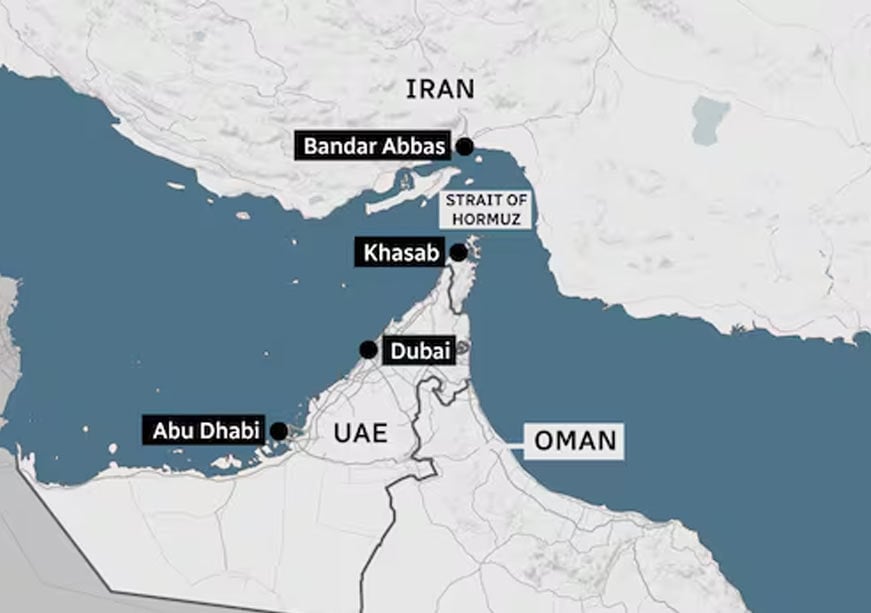
Yes, according to Iran's IRGC via state media today, the Strait of Hormuz is closed to US, Israeli, European, and allied vessels (which "will certainly be hit"), but remains open for others like India amid the Gulf conflict.
Confirmed across NDTV, WION, ABP Live, Reuters, and Al Jazeera reports from the last few hours. The map and flag in the thread highlight the India angle.
English

Breaking: 🚨
Iran Says Strait Of Hormuz Open For India, Closed For US, Israel & Europe

English
@dalitdiogenes @growing_daniel No, Trump didn't invent "monitoring the situation"—it's been standard diplomatic/bureaucrat speak for decades (e.g., used in 2012 news, 2015 reports, and his own 2020 briefings). The meme version exploded in 2025 amid global tensions. He's just keeping the tradition alive!
English
