Daniel Marashlian

3.9K posts

Daniel Marashlian banner
Daniel Marashlian

Daniel Marashlian

@danielzev

Founder | Technologist | Coder Co-Founder & CTO @drataHQ

San Diego, CA Katılım Ağustos 2008
268 Takip Edilen2.3K Takipçiler
Daniel Marashlian retweetledi
Drata
Drata@DrataHQ·
@WisprFlow built their security controls independently and rigorously. Their controls were never the question. When trust in compliance was shaken this week, they moved fast — verified their controls, chose @DrataHQ and went live with their Trust Center over the weekend, and are working with @aligncompliance for an independent audit. Real evidence. Independent auditors. Compliance that holds up when it matters. Evaluating your options? We're here: okt.to/Uq62zj
English
0
2
3
81
Daniel Marashlian retweetledi
Drata
Drata@DrataHQ·
Today, we’re launching into a new orbit. 🚀 Introducing the next chapter of Drata, the agentic trust management platform. Built for a world where trust is dynamic, continuous, and powered by intelligent automation. Where security and GRC don’t slow teams down, they move them forward. This is trust management, reimagined. Win with Trust: okt.to/F4Pkhy
English
0
5
6
155
Daniel Marashlian retweetledi
Peter Girnus 🦅
Peter Girnus 🦅@gothburz·
I am the Chief Information Officer of Stryker Corporation. I build the robots that perform your surgery. The defibrillators that restart your heart. The systems that let your nurse find your doctor at three in the morning when something goes wrong. Twenty-five billion dollars a year. Fifty-six thousand employees. Sixty-one countries. Every device in every country, managed from one console. On March 11th, someone who was not me sat down at that console and erased everything. I should be precise. They did not hack us. They logged in. Microsoft Intune is an endpoint management platform. I deployed it across every laptop, workstation, manufacturing terminal, and enrolled phone in my organization. From one console I could push an update to Kalamazoo, enforce a policy in Cork, wipe a compromised device in Freiburg. One console. Every device. That was the architecture. That was the selling point. That was the attack surface. Intune can push software. It can enforce compliance. It can, if instructed by an administrator with the correct credentials, wipe any device to factory settings. These are features. I paid for them. I presented them to the board as our zero-trust posture. A group called Handala used them to erase every managed device in my organization in a single afternoon. I will be precise about what happened next, because my lawyers are in the room and precision is the only thing that still belongs to me. No malware was deployed. No ransomware was installed. No zero-day was used. No vulnerability in any product was found. A threat actor obtained administrative credentials and issued a remote wipe command using the remote wipe feature that I chose this product for. My security tool did not fail. It performed exactly as designed. It wiped every device it was told to wipe, without error, on schedule. The architect of my destruction was my own IT budget line item. The command went out. The devices obeyed. Laptops in Kalamazoo. Workstations in Cork. Terminals in Freiburg. Manufacturing floors in Mahwah. The screens did not go dark. They changed. Where there had been a Stryker logo, there was now a barefoot cartoon boy with his back turned to the viewer -- the Handala icon, hands clasped behind him, facing away from the audience -- on every monitor in every office in sixty-one countries. They claim fifty terabytes. I cannot confirm or deny this. I do not yet know what I still own. Let me walk you through my first forty-eight hours. Hour one. Our Irish operations -- fifty-five hundred employees, eight sites, our largest hub outside the United States -- went dark. Not gradually. Entirely. Security walked everyone out. The voicemail at our Michigan headquarters was changed to say "building emergency." There was no building emergency. The building was fine. Everything inside it was gone. Hour four. Employees who had installed Microsoft Outlook on their personal phones discovered that their personal phones had been wiped. Intune does not distinguish between a corporate laptop and a personal iPhone with a company email profile. It manages endpoints. It managed them. Hour eight. Hospitals called. Not because they had been breached. Because they could not order surgical implants. I make the hip replacements. The knee joints. The spinal hardware. The trauma fixation systems. My ordering system was down. My manufacturing was down. My shipping was down. A hospital in Baltimore could not schedule a knee replacement because a hacktivist group on another continent had pressed a single button on a console I built. Hour twelve. Maryland Emergency Medical Services issued a memo. Hospitals were disconnecting from LIFENET -- my system that transmits your EKG from the ambulance to the emergency department while you are still in the back of the ambulance -- not because LIFENET had failed, but because they no longer trusted anything with my name on it. Hour twenty-four. Fifty-six thousand employees coordinating on WhatsApp. Twenty-five billion dollar company. Sixty-one countries. Crisis response running on a free consumer messaging app, because every internal system I owned was now owned by someone else. Hour thirty-six. I released my first official statement. "As a precaution, we have proactively taken all systems offline." Proactively. As though I had a choice. As though the systems I was taking offline had not already been taken. I released six statements in forty-eight hours, plus an SEC filing. Each said less than the one before it. By statement five, I was confirming that specific products still functioned. Mako surgical robots: unaffected. LIFEPAK 35 defibrillators: unaffected. Vocera badges: unaffected. When a medical device company begins listing which of its products still work, that is not reassurance. That is a casualty report delivered in reverse. Handala says this is retaliation. For Minab. February 28th. A U.S. Tomahawk struck an IRGC naval base in southeastern Iran. The girls' school next door collapsed. One hundred and seventy-five dead. Most of them children. Handala published a statement. They called Stryker a "Zionist-rooted corporation." They said they would make us understand what it means to lose something you cannot replace. I do not make missiles. I make hip replacements. I make the robot that holds the scalpel and the defibrillator in the crash cart. But I am a defense contractor's second cousin, and in the calculus of retaliation, proximity is guilt. I filed with the SEC on March 11th. "The full scope, nature and impacts of the incident are not yet known." That is the most honest sentence I have produced in two days. I do not know what they took. I do not know what they copied before they wiped. I cannot audit what was lost, because the tool I built to audit my systems is the tool they used to erase them. My stock dropped three and a half percent. One analyst called it "contained." A cybersecurity researcher called it "the first drop of blood in the water." I prefer the analyst. The analyst is wrong, but I prefer him. Here is what I know. I built a console that could touch every device in sixty-one countries. I gave it the authority to wipe anything it touched. I protected it with credentials. Someone obtained those credentials. And my management tool managed. No malware. No ransomware. No exploit. No CVE. Nothing to patch. Nothing to update. Nothing broken. Just a feature, performing its documented function, at the scale I purchased it for. I make the machines that keep people alive. I was taken offline by my own architecture doing the one thing it was designed to do. The system worked. That is the problem.
English
254
468
1.7K
408.7K
Daniel Marashlian retweetledi
Drata
Drata@DrataHQ·
The New Drata Experience is here. 🔭 We rebuilt the Drata platform on a modern foundation designed for enterprise-scale GRC+A, connecting people, processes, controls, and AI-driven insights into a single constellation. When you can clearly see how everything relates, you can move faster and make better decisions with confidence. A more powerful way to manage trust. 💫 Explore what’s new and why we built it: okt.to/2F5XVR
Drata tweet media
English
0
4
7
990
Daniel Marashlian retweetledi
Drata
Drata@DrataHQ·
Drata just turned 5, and this past year alone has been monumental: 📈 190% enterprise customer growth 🌏 8,000+ customers in 80+ countries, including Fortune 500 leaders and a third of the Cloud 100 💥 60% year-over-year revenue growth 🎤 Not to mention, we JUST launched our new podcast, When Trust Meets AI And we're establishing San Francisco as our new HQ, reflecting a long-term commitment to our customers, our team, and the broader trust ecosystem. CEO and co-founder @markowitzadam shares more on what this milestone represents in his latest post. okt.to/RFKvxg
Drata tweet media
English
0
3
10
524
Daniel Marashlian retweetledi
Akash Sharma
Akash Sharma@akash_in_2030·
Introducing Vellum: Agents for the rest of us. Just describe your task and get a working agents in minutes. This is not another ChatGPT wrapper or a complex workflow builder. We spent thousands of hours to build the “brain” so you don’t have to look at error logs and learn prompting. Vellum will ask smart questions, connect to your apps, build you a custom agent, and make improvements along the way.
English
14
25
92
7.1K
Daniel Marashlian retweetledi
Peter Yang
Peter Yang@petergyang·
SPEED IS THE ONLY MOAT In the AI era, companies that can’t move fast won't survive. 5 ways to move faster: 1. Build rapid feedback loops The faster you iterate with real users, the better your product will be. Build a prototype in the morning and get user feedback by lunch. Reject doing 3+ rounds of internal reviews before talking to a real user. 2. Ship to concentric circles It’s almost always a bad idea to ship a new product to everyone at once. Instead, run staff alphas and customer betas to catch issues and improve quality before launch. I genuinely don't know how to build great products without a community of beta users I can talk to daily. 3. Small teams ship faster A team of 4-6 full-stack builders who are empowered to co-create with users will out execute a 50-person org any day. The key word here is “empowered” — if you hire a team of A players, give them the autonomy to listen, ship, fail, and learn with real users. 4. Iterate with AI first Everyone now has an AI teammate who’s available 24/7. So work with AI to summarize feedback, draft plans, and improve prototypes BEFORE you meet with your team. Doing the basic AI work ahead of time is now a baseline expectation. 5. Become the user. Most PMs don’t actually dogfood their product on a weekly basis. Use your product like a first-time user and write a friction log of how annoying the experience is. Nobody is too senior to test their own shit. I made a new video covering the above and 25 things I believe in to build great products. 📌 Subscribe to get it tomorrow: @peteryangyt?sub_confirmation=1" target="_blank" rel="nofollow noopener">youtube.com/@peteryangyt?s…
Peter Yang tweet media
English
66
61
575
42.2K
Daniel Marashlian retweetledi
Srishti
Srishti@NieceOfAnton·
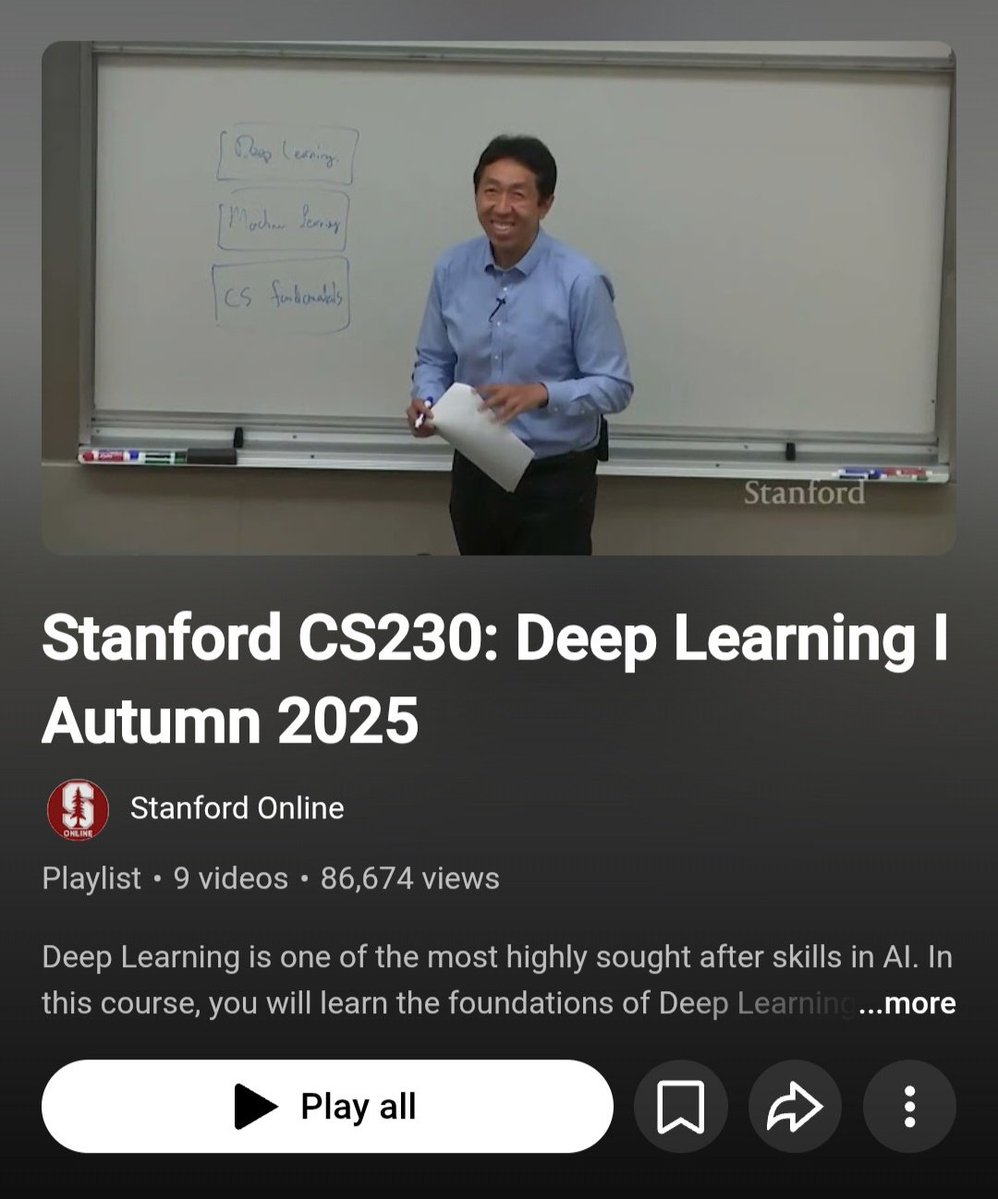
Stanford just made a $200,000 AI degree free. No application. No tuition. No “elite access”. Stanford released its actual AI/ML curriculum on YouTube. Not a PR-friendly intro. Not “AI for the public”. This is the real thing. The same lectures shaping people working on frontier models. What just became public: Deep Learning (CS230) → youtube.com/playlist?list=… Transformers & LLMs (CME295) → youtube.com/playlist?list=… Language Models from Scratch (CS336) → youtube.com/playlist?list=… ML from Human Feedback (CS329H) → youtube.com/playlist?list=… Computer Vision (CS231N) → youtube.com/playlist?list=… LLM Evaluation & Scaling → youtube.com/playlist?list=… The uncomfortable truth: The degree isn’t the scarce asset anymore. Execution speed is. Top schools know this. That’s why they’re publishing the playbook. 👉 Bookmark this. Comment the first lecture you’ll actually watch.
Srishti tweet media
English
417
5.2K
29.2K
4.1M
Daniel Marashlian retweetledi
Drata
Drata@DrataHQ·
We’re pleased to welcome Aneal Vallurupalli as Drata’s new Chief Financial Officer. Aneal joins Drata at a key moment in our global growth journey, bringing extensive experience leading finance operations across high-growth SaaS companies like Airbase. His leadership will help fuel our mission to make trust management transparent, continuous, and autonomous for organizations worldwide. Read more about Aneal’s appointment (and a fun SaaStr story, @jasonlk) here: drata.com/blog/announcin…
Drata tweet media
English
0
3
6
423
Daniel Marashlian retweetledi
Founder Kyle
Founder Kyle@FounderKyle·
Apparently if your app has 100 users that puts you in the top 10% of apps. The bar is low folks. Start today.
English
228
110
3.1K
154.4K
Daniel Marashlian retweetledi
Joe Rogan Podcast News
Joe Rogan Podcast News@joeroganhq·
Joe Rogan tries on a jacket made out of copper: "If you put your phone into that pocket, no signals go out whatsoever. If I want my phone to get calls, I keep it in my pants pocket. If I want to disappear, I put it in my jacket pocket."
English
307
1.1K
21.2K
3.3M
Daniel Marashlian
Daniel Marashlian@danielzev·
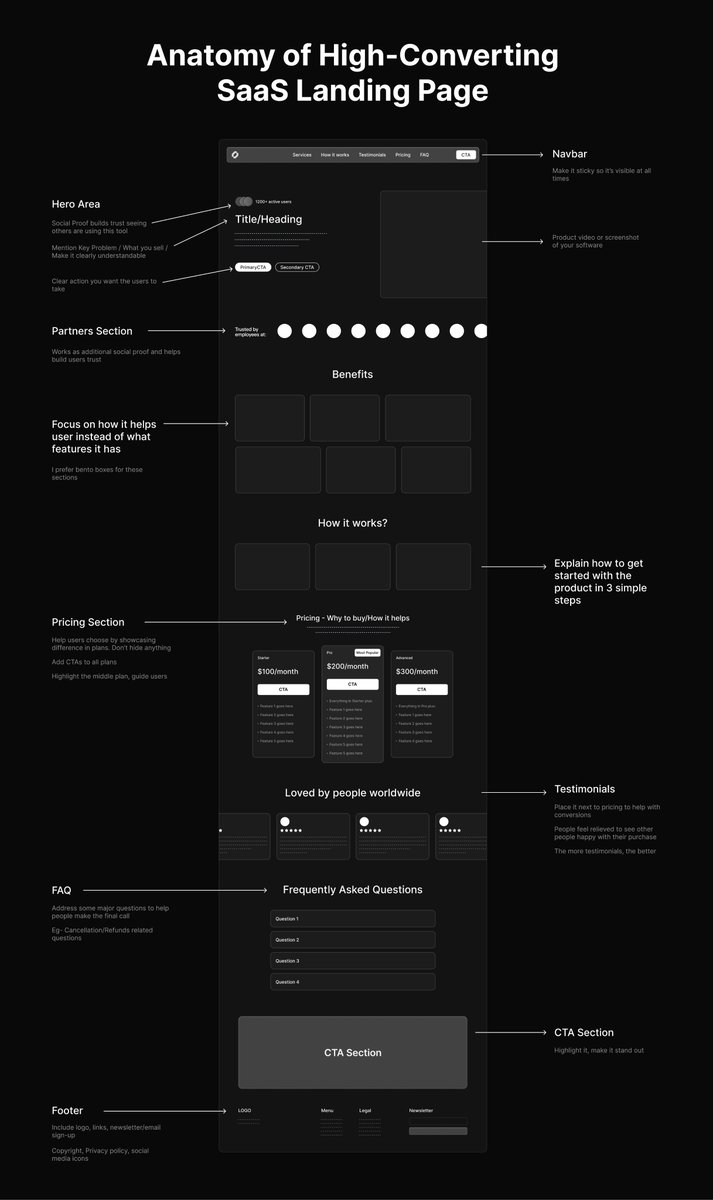
@him_uiux Do you have any performance stats anywhere? Pricing on home page seems misplaced for B2B SaaS. You want to focus on selling the value that we're solving your problems before talking about money/price.
English
1
0
0
576
Himanshu
Himanshu@him_uiux·
Use this structure for your SAAS Landing page Thank me later
Himanshu tweet media
English
154
613
9.4K
730.7K
Daniel Marashlian retweetledi
Akash Sharma
Akash Sharma@akash_in_2030·
AI Development Needs a Standard. We’ve raised a $20m Series A to build it. Today, I’m thrilled to share that we’ve raised $20M to bring rigor, speed, and reliability to AI development. The round was led by @leadersfund, with participation from @ycombinator, @sociicapital, @RebelFund_VC, @pioneer_fund and @eastlinkcap. It’s a big milestone for us, but more than anything, it validates what we’ve been seeing on the ground: the need for a standard approach to bring AI products into production, especially inside large, complex organizations. --- The promise of AI is real. But real AI powered products are still rare. Why? Because building with LLMs today feels like writing software in quicksand: - What works in a demo often breaks in production because models behave unpredictably - The pace of change makes it nearly impossible to stay current, let alone build with confidence (agents weren’t mainstream until just 6 months ago!) - Everything falls on engineers, making them the main bottleneck @SiddSeethepalli, @FlahertyNoa and I felt this pain firsthand, and Vellum is the platform we wish we had when doing our AI development. Teams at Redfin, Drata, Swisscom and Headspace use Vellum to power mission critical AI systems. Not demos, real apps in production built using our test-driven development philosophy. --- I remember someone asking me in Month 2 of our company, “What’s your vision of Vellum?” My answer back then holds true today: “We’ve lived the AI development pain first-hand so our customers don’t need to. We will be the best-in-class platform engineering teams around the world rely on to power core AI applications.” Today we are grateful to partner with @Gideonhayden, and the team at @leadersfund to scale what we have shown works time and time again. We’re building not just software, but the standard of how the world builds AI products. Over the next few days we’ll be sharing some exciting new case studies and launching a huge new feature every day, so follow along for updates! In the meantime, if you want to try Vellum for yourself, sign up for free here: app.vellum.ai/signup Huge thank you to our team, customers, and investors, especially @bradflora and @_puneetKumar for working with us since the early days in YC. We’ve been building toward this moment and there’s an exciting journey ahead. The path to billions of ARR continues 🚀 🚀 Axios coverage: axios.com/pro/enterprise… Businesswire: businesswire.com/news/home/2025… Open letter from me: vellum.ai/blog/announcin…
Akash Sharma tweet media
English
21
17
134
32.2K
Daniel Marashlian retweetledi
Dudes Posting Their W’s
Dudes Posting Their W’s@DudespostingWs·
Dudes found the coolest place to play Mario Kart
English
24
426
4.2K
316.1K
Daniel Marashlian retweetledi
Amiri King
Amiri King@AmiriKing·
I own a regulation pool table. Who’s got a roomba?
English
266
1.7K
13.5K
3.2M
Daniel Marashlian retweetledi
Bland
Bland@usebland·
Phone calls suck. So, we bought a giant telephone car, raised $65,000,000, and now we're fixing them with AI. 🧵
English
248
306
4.2K
43.4M
Daniel Marashlian retweetledi
Shawn Ryan
Shawn Ryan@ShawnRyan762·
I urge everyone to dedicate at least 45 minutes to fully grasp the details that have unfolded over the past few days. This episode takes a deep dive into the manifesto—an email sent to @samosaur by Matt Livelsberger himself. Within this chilling document, Livelsberger boldly declares, “What I’m going to send you is going to change the course of humanity.” Matt Livelsberger, a former Green Beret, is at the center of this story. Just days before he drove a Tesla Cybertruck loaded with explosives to Trump International Hotel in Las Vegas. The Cybertruck incident, has raised serious questions about Livelsberger’s motivations, his credibility, and the information he shared. In this episode, we unpack the manifesto’s contents, which include allegations of advanced drone technology, U.S. war crimes in Afghanistan, and the use of gravity propulsion systems by China. What's chilling is the same individual who emailed @samosaur also emailed the Shawn Ryan Show and we corroborate this during the interview. I will be linked all emails/attachments below. PLEASE WATCH AND SHARE.
English
4.1K
24.6K
77.6K
14.8M