

Daniel Novy
482 posts

Daniel Novy
@dnovy
“To be in the game, you have to endure the pain”
Katılım Mayıs 2009
1.2K Takip Edilen669 Takipçiler

In my view, the only route forward, the only way to get back to the place where we are exposed to each others' humanity is to get the fuck out.
To stop letting an algorithm decide who and what we give our attention to.
If we don't do that, it's only going to get worse.
English
A probably unpopular take, but I'm going to say it anyway, because I think it's important to be conscious of... 📱
Social media bears much of the blame for what happened to Charlie Kirk. 1/x 👇
English
@Justin_Bons This is a fundamental flaw in your argument (if I’m right) because is the base for the spiral effect.
English

WARNING: BTC's security model is broken; doomed to collapse within a decade! ⚠️
The coming "bank run" will prevent most from exiting once the crisis begins, trapping them in a death spiral
From 51% attacks, splits & breaking the 21M limit!
This is the story of how BTC dies: 🧵
BTC's code & math do not lie, as this can all be independently verified by looking at the source code on your own full node
Mining will continue to decline as it has for the past four years, that is, until the double-spend & censorship attacks inevitably begin. That is what will force Core to increase the inflation rate beyond the "sacred" 21M limit!
Splitting the chain & sowing further chaos; as a perfect storm is brewing, & the forecast predicts a maximum timeline of 7 to 11 years!
This looming crisis is going to hurt countless innocent people, as once the crisis begins, they will be unable to exit the system. Due to BTC's limited capacity, that is the "bank run" that will trap them in an inescapable death spiral as the network inevitably collapses! 💀
BTC will die, not with a whimper, but with a bang:
Bank Run
If only a fraction of current BTC holders attempted to move their coins today, the system would cease to function. That is why this is a "bank run" type situation, as people are piling into a system that can in no way accommodate a timely exit
Even according to the most conservative estimates, if every current BTC user only did one transaction, the queue would be several months long! The math supporting this claim is covered in the third chapter
BTC cannot actually support such long queues, making it extremely unreliable during congestion. In effect, most people's TXs would get stuck & eventually drop after a few days...
That is how, for most people, the BTC network would effectively cease to function!
We can debate semantics all day, but from a user perspective who cannot move their funds while the price crashes, the experience is the same, even if there is no bank involved in this "bank run"
Panic can quickly exacerbate the situation as people rush for an exit that cannot accommodate the demand, thereby inflating the strain on the network as people desperately start "spamming" TXs in an attempt to be included, clogging the system up even more...
This crisis could even be triggered early, before the exact 7-11 year timeline predicted here. The reason why we have a specific maximum timeline for the collapse is that the "bank run" threat is compounded by another serious threat: BTC's failing security budget
We are, in fact, facing a type of "perfect storm". Since when BTC's security fails in 7-11 years. It is very likely to trigger this "bank run" situation as well, on top of the failing security model! Which, on its own, will make BTC vulnerable to attack, forcing an inflation increase beyond the 21M limit...
A course of events so dramatic that it is not hard to imagine that this could cause a fraction of BTC holders to attempt to move their coins, triggering the "bank run"
We cover the specifics of BTC's failing security model in far more detail in the fourth chapter, "Broken Security Model"
Death Spiral
A death spiral can occur when all of these failures, from 51% attacks, to "bank runs", chain splits & inflation increases (happening simultaneously) in 7-11 years from now leads to a sudden drop in price, as it is not so outrageous to think that such extreme events could have a negative effect on price
The problem is that a sudden drop in price could also result in a sudden drop in the hash rate, as some miners would no longer be profitable, forcing them to shut down. However, due to how BTC's difficulty adjustment algorithm works; which has a 2-week readjustment interval (measured in block time). A sudden drop in hash rate can severely affect the speed & capacity of the network. If half the miners left, for instance, block time would also drop in half, & the readjustment period could take up to a month!
A unique quirk of BTC's design, which on its own might not have been so harmful, however, when combined with BTC's current limited capacity, it is a recipe for disaster, because of the compounding spiraling effects
So, we could see a situation where a 3-month backlog turns into a 6-month backlog, & then a 1-year backlog, very quickly
As the panic would cause the price to crash, which in turn causes more miners to shut down, which in turn slows the chain down even more, causing even more panic & the price to crash again & even more miners shutting down, etc, etc; ad infinitum...
Causing a repeating downward negative pattern/cycle. That is known as a vicious cycle in game theory, also referred to as a death spiral! 💀
Bank Run Math
I kept all the numbers & assumptions extremely conservative in favor of BTC, as they assume zero network activity outside of these on-chain users exiting. I did this just to make a point. To drive home how bad this situation really is!
The figure for on-chain BTC holders was taken from @glassnode's analysis on March 2023
The TPS calculation is based on Max Theoretical TPS: (Block size (1.66MB)/Transaction size (374B)) / Block time (10M) = TPS (7.75)
We use the P2PKH TX format with 2 inputs & 2 outputs, to better represent an "average user"
Even though Segwit allows for 4MB blocks, this cannot all be filled with TXs. Historically, the largest BTC block filled with TXs was 1.66MB, so we will use that number
(1740636.16/374) / 600 = 7.75 TPS (rounding down to 7 as BTC cannot execute partial TXs)
7x60 (minutes) = 420x60 (hours) = 25200x24 (Days) = 604,800x30 (Months) = 18,144,000 (Monthly TXs)
33000000 (On-chain Users) / 18,144,000 (Monthly TXs) = 1.818 (months)
Broken Security Model
As it stands now, BTC must double in price every four years for a century or sustain extremely high fees. Only to maintain the present level of security...
That is because each halvening exponentially lowers the security budget until it is practically nothing. If you have a basic understanding of economics & exponential functions, then you should know that this is entirely impossible! As it would exceed global GDP within decades. That is why BTC's security is doomed!
Fees will also never reach sustained extremes due to the ratcheting effect of the fee market. Paying hundreds of dollars for a single TX is not realistic in a competitive free market. When fees spike, users leave, all due to unnecessary & arbitrary capacity limitations
This means that BTC's long-term security is unsustainable without extremely high transaction fees... Fees that have so far failed to materialize, with the exceptions of fee spikes, which are insufficient for sustained long-term security
That is why the security of BTC will inevitably continue to decrease until it becomes profitable to attack. This is also how we know the approximate timeline for this collapse (7-11 years) as it is based on the halvening cycle. In other words, BTC will collapse within 2-3 halvenings from now!
However, this crisis could also be triggered before that time period, especially as what I am explaining here becomes more widely known. Other parties are likely going to attempt to front-run this disaster as well, making any attempt to time this a very dangerous game
Measuring Security
This chart of miner revenue shows that BTC's security is actually lower now than it was four years ago! Proving the decline of BTC's security, as it shows how miner revenue (block reward), not hash rate, is down:
Hashrate does not equal security; most bitcoin influencers do not understand how PoW works, leading to a profound public misunderstanding of BTC's failing security model
That is because hashrate is a mostly meaningless metric in regard to calculating security, as miner revenue can go down while hashrate goes up. This is because, as hardware improves, it costs less to produce these same hashes. That is why we cannot simply count hashes to determine the security budget!
Because it is not these hashes that secure BTC: It is the cost that goes into producing these hashes that secures BTC! In other words, what matters is the cost of attacking BTC, which is not determined by hashrate! It is instead determined by an attacker's cost/benefit calculation
In other words, the security budget of BTC is best measured by how much is being paid out to the miners (block reward), as we would expect a Nash Equilibrium to form based on this direct economic incentive. So that covers the "cost", the "benefit" is based on what is to be gained from attacking BTC:
Attacking BTC
Crypto-economic game theory relies on punishment & reward, carrots & sticks. This is why miner revenue determines the cost of an attack. When it comes to the reward side of the calculation:
Double spending, with 51% attacks targeting exchanges, is a highly realistic attack vector due to the massive potential rewards
An attacker could make billions from such an attack, especially as they could target multiple exchanges, defrauding them of at least $100M+ each. Especially, if we also include simultaneously carrying out "exploits" on decentralized protocols that would also be vulnerable once such double-spending starts to occur
The basic premise is that if an attacker sends their own BTC to an exchange, trades it for another asset, & then sends that back to themselves. The attacker is then able to roll back the chain (due to 51% control of the hashrate), at which point they would regain their BTC, & whatever they traded it for, effectively doubling their money, & defrauding the exchange in the process!
This puts the lowest threshold of attack at a few million dollars per day. Something that can easily be reached within this 7-11-year timeframe. By taking the current security budget ($50M) & dividing it by 8 (2-3 halvenings), we get to $6M!
This also means that in this scenario, a blockchain network worth over $2T can be taken down with a $1B investment. This might even be a worthwhile endeavor for a statist competitor or even a crypto competitor. Especially considering that this would even be a profitable venture. Granted, there are a bunch of assumptions here, but this theoretical scenario still proves the point
Hypothetically, for example, it would be quite a blow if China were to wreck the US's BTC reserve in this way, as from a cost-benefit analysis perspective, that would make a lot of sense!
Keep in mind that the more prominent BTC is by this time, the more profitable such an attack becomes... As the below chart also demonstrates, the security budget relative to market cap is falling off a cliff:
This means that BTC can never be too big to fail, as long as it fails to generate fee revenue to sustain its own security budget; in fact, this attack only becomes more viable, not less, with increased adoption!
An Impossible Choice
So what does this all mean? This means that BTC's long-term security is in deep trouble. Without extremely high TX fees, the security of BTC will inevitably continue to decrease. Until it drops so low that the network becomes profitable to attack, rendering BTC insecure!
At which point, there will only be two choices left:
1. Increase BTC's supply inflation beyond 21M!
2. Allow the network to come under attack with double-spend attacks & censorship attacks!
BTC is between a pet rock & a hard place; think about it & also consider who else is saying this:
The writing is on the wall: Bitcoiners will have to make this hard choice or watch BTC's security fall right before their very own eyes
Both @ercwl & @gametheorizing agreed on the existence of this dilemma in our debates on the topic. Even top Core developers, such as @peterktodd, agree! Even as in the case of Peter Todd, going so far as to advocate for a future inflation increase!
As a BTC critic, I do not think BTC will be able to solve this dilemma in time. The "solution" is an inflation increase, as a block size increase is off the table politically. However, this inflation increase "solution" overturns BTC's primary touted benefits, thereby betraying the promise or "social contract" of Bitcoin. The bitcoiners who support a supply increase obviously do not believe this. However, their position is at least consistent, so I can respect the bitcoiners who speak this truth. As they are doing all they can to preserve BTC's provenance
The bitcoiners who deny this only exacerbate the situation by promising people that BTC will always have a 21M supply limit. Damaging trust, & setting them up for disappointment & a feeling of betrayal, rightfully so! As they are misleading people into supporting BTC based on false pretenses!
Crisis & Chaos
The most likely outcome is that in 7-11 years from now, both of the options I described above occur simultaneously
Splitting the network in half again & causing even more chaos in the process. One version of BTC with inflation, the other without, & both even more vulnerable to attack, as the hashrate is now shared between the two, & price drops in response to the crisis will most likely worsen security even more...
Ideally, we all gradually move away from BTC before the catastrophe hits. However, as time goes on & certain parties double down on BTC, this becomes less & less likely. So we'd better prepare for the worst & hope for the best
If you must hold BTC, avoid self-custody, as that is the trap that will get most wrecked, all with a flair of ironic tragedy!
Raison D'être
The root cause behind all of this can be traced back to the block size wars, where BTC was effectively captured by a small group, who ended up pivoting BTC away from its original design, despite the wishes of BTC's founder, Satoshi Nakamoto, to quote the man himself:
"The existing Visa credit card network processes about 15 million Internet purchases per day worldwide. Bitcoin can already scale much larger than that with existing hardware for a fraction of the cost. It never really hits a scale ceiling" - Satoshi Nakamoto
The evidence for this really is indisputable; you can disagree with Satoshi, but please do not attempt to rewrite history. Read "Hijacking Bitcoin" for a more in-depth exploration of this history, as it does a great job of exposing how BTC was captured & perverted along the way
The great tragedy here is that BTC's original design might have worked! As BTC is actually capable of achieving massive scale while preserving decentralization. With some relatively minor code optimizations that are present in some of BTC's forks, such as BCH. BTC is totally capable of supporting VISA scale on a decade-old laptop now! As Satoshi thought was already the case in 2013... The threat of supporting bigger blocks is totally exaggerated, especially in 2025!
This is one of the reasons why Bitcoin's original & intended design was so brilliant & not at all so incredibly flawed & broken as the BTC that we all know today
The truth is that BTC has completely pivoted its purpose, economics, & vision since that time, breaking what was once a great chain, all because of the block-size wars. Contrary to popular belief, not increasing the blocksize limit was clearly a major departure from the original vision & purpose of Bitcoin
The original design, conceivably, might have worked, as attempting to service a massive number of TXs, each paying a small fee, is a far more realistic path to long-term sustainability. As opposed to a few TXs paying an extremely high fee, which is unrealistic in a free market & serves no utilitarian purpose
In the former case, if BTC followed its original roadmap, it would be providing invaluable utility to billions of people today...
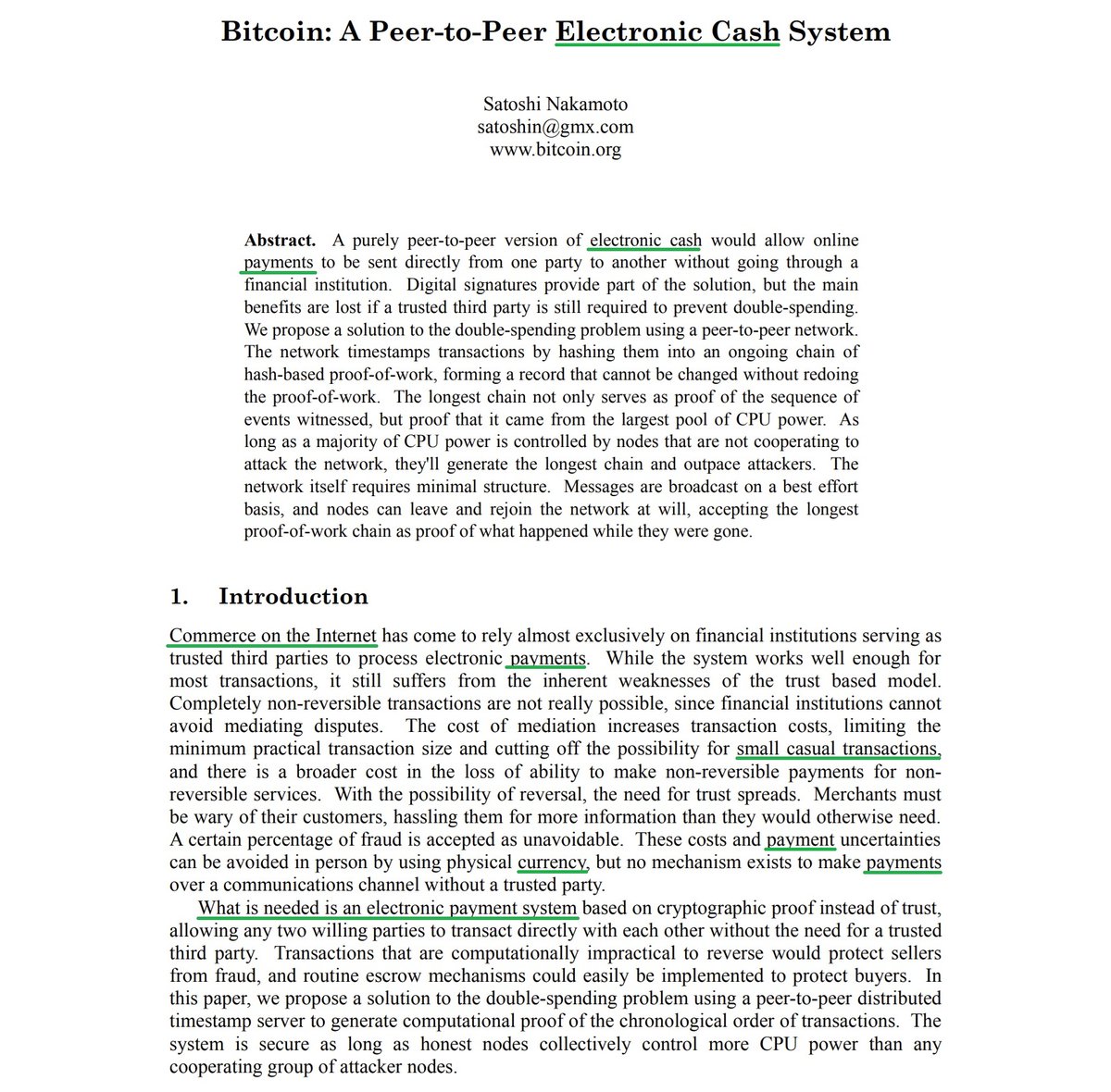
This is also clearly what BTC was always intended to do, based on all of Satoshi's writings & as he even clearly stated on the first page of the Bitcoin whitepaper. Allowing BTC to actually be money was taken away from us by the powers that be:
Usage has literally been capped! This is why BTC cannot & will not ever be for payments, as the Bitcoin Whitepaper so clearly described was Bitcoin's purpose. This is what makes widespread & significant usage of BTC technically impossible. All contrary to the project's original roadmap & the founders' clearly stated wishes...
Even mass self-custody is impossible on BTC now: Since even if everyone in the world wanted to only do one transaction, the queue would be more than 32 years long!
(7T (On-chain Users) / 18,144,000 (Monthly TXs) = 385 (months) / 12 = 32 (years!))
There are literally ZERO use cases that can be supported by 7 Transactions Per Second, making BTC by definition purely speculative. Unable to effect any real change in the world by virtue of it literally being useless!
This makes today's BTC a poor & uncompetitive Store of Value, as this limitation means there is zero real utility; even mass self-custody is off the table, this is what makes it such a terrible SoV...
If BTC had been allowed to become money by scaling the L1, as was originally intended. It might have been a great SoV, as a foundation in utility provides the best possible security for long-term value creation & preservation. Today, BTC is reduced to being a mere meme coin instead
Being forced to choose between security & scarcity is not a good choice at all. Especially, when BTC's competitors can offer security, scarcity, capacity, & speed combined! All while still preserving decentralization, as was always intended originally!
Governance Mythos
The myth of BTC is that it is a decentralized meritocracy where the best ideas rise to the top...
The truth is that the dominant client, “Bitcoin Core” Has effectively achieved centralized control over BTC development. Turning it into a one-party system, with Core as a gatekeeper of all change!
My original 2013 thesis for investing in BTC was destroyed by the very people we trusted to maintain it. There also lay the problem; what we witnessed was a failure of governance:
BTC's history of power struggles & civil wars is a symptom of this failure; that is why Bitcoin Core, in practice, has disproportionate power to make any changes, even controversial ones, such as RBF & not raising the blocksize limit today!
While kicking out anyone who disagrees with them, such as @gavinandresen, Mike Hearn, & @jgarzik during the block size wars, & calling that consensus...
Political Reality
In practice, there is an extreme degree of centralization of decision-making power, where a small group of Core developers can act as gatekeepers to all changes
The block size civil wars are the perfect example of this, as the majority of miners wanted an increase & so did the majority of companies, stake & users... The fact that Core still got their way instead, passing SegWit & blocking a blocksize increase to this day, is one of the strongest pieces of historical evidence for massive governance centralization in BTC. The anti-governance narrative serves only as a shield, allowing them to deflect responsibility through the use of "decentralization language". When in reality they are effectively in charge
A bit like the wizard of Oz, who controls his empire behind the curtains, pretending to be something he is not
Currently, there are only six people who hold the keys to the empire, literally! (commit access to Bitcoin Core)
BTC is governed in the same way most software projects are governed on GitHub; essentially a type of dictatorship...
Like all dictatorships, there are limits to their power. Yet, this is still a total perversion of the very idea of decentralization that BTC was supposed to represent
Another far-reaching consequence of the block-size wars was that they suppressed competing clients in favor of a "monolithic network". That is why Bitcoin Core now makes up 98% of the full nodes on the network. This is what prevents all efforts to solve the security dilemma today!
Creating a competing client that meaningfully opposes Core is still seen as an "attack on Bitcoin" to this day. That is part of the ever-so-harmful cultural legacy of the block size wars. That is how the same people remain in charge, literally. In part because the failed revolution actually reinforced their position
Due to demographic shifts over the last decade, within the Bitcoin community. There is nowhere near the level of support for change compared to the time of the blocksize wars. All of those rebels have since left for greener pastures, while the people who agree with the new status quo remained!
Like other cryptocurrencies, BTC's demographics are self-reinforcing!
BTC has effectively been captured, a clear failure of decentralized governance design. A subject I explored in far more depth in my "theory on Bitcoin governance" on Medium & other articles here. As the focus for this thread remains on the security model & the coming resulting crisis:
The big takeaway here is that governance is the reason why there is no hope for change left, at least not until the crisis forces change; but by then, it will be too late!
Conclusion
The story of Bitcoin is one of a beautiful early hope
A wonderful positive vision for the world, that most are buying into, not realizing the bait & switch that has occurred, as BTC cannot deliver on the vision people are being sold now
The Bitcoin dream on BTC was crushed by the very people we entrusted to uphold the vision. There lay the problem as trust led to betrayal & deceit. False promises followed by broken promises. Forever moving the goalposts to the point of infallibility...
The rejection of "on-chain" governance only gave us the worst of "off-chain" governance; Plain old school realpolitik, something BTC's leadership was not ready or equipped for, making BTC incredibly vulnerable to capture, corruption, & perversion. The social scientist in me should not be surprised by this outcome; it really was inevitable
It is shocking & unbelievable, yet it is the truth. From censorship, cybercrime & conflicts of interest. Core gained effective control over BTC's decision-making process. That is what is leading BTC toward its inevitable downfall now & is what annihilates any hope for change
That is why BTC is certainly doomed to dramatically collapse within the next 7-11 years, as there are no viable paths for change within this urgent timeline. That is what makes the coming crisis of BTC's security budget so inevitable today
So, please take this as a warning, from someone who loves Bitcoin's original vision & wants it to thrive. BTC now only holds back that original cypherpunk dream, & it is setting up a scenario where countless innocent people are going to get seriously hurt
Exiting the BTC chain will become almost impossible once the collapse begins!
Trapping countless people into a potentially inescapable death spiral. A disaster at a scale we have not even seen in crypto yet, we can avoid becoming victims by rejecting the lies & accepting the truth now
Spreading this message can also help mitigate the damage that will be done. Both directly to innocent people & to the progression of the cryptocurrency revolution, movement & industry as a whole
Crypto can provide people with scarcity & security at scale, while preserving decentralization right now! BTC represents a horrible compromise we do not even need to make. Another reason why BTC is a band-aid that is better pulled off sooner rather than later
As our beautiful experiment is now teaching us its most important lessons through its failure ♥️
There is, however, much hope left on the horizon for cryptocurrency as a whole. As the industry has evolved by leaps & bounds beyond the original tech & BTC. Solving all of these key problems & far more
That is why Bitcoin's original vision now thrives in its children instead! 🕊


English
Daniel Novy retweetledi

An undergrad student broke a 40-year-old belief in computer science.
Since 1985, it was believed that hash tables, when nearly full, must check many spots to find or add data.
Andrew Krapivin discovered a new way to organize data inside a hash table that avoids this slowdown.
Instead of checking slots randomly or in order, his method uses a more efficient structure to guide the search.
This reduces the worst-case time from O(n) to (log n)² steps, even when the table is almost full.

English
Daniel Novy retweetledi


Daniel Novy retweetledi

Separate from people who are easily offended by offending them early.
English
Daniel Novy retweetledi

"The darkest places in hell are reserved for those who maintain their neutrality in times of moral crisis."
Dante Alighieri
English
Daniel Novy retweetledi
Daniel Novy retweetledi

Have you ever heard of these places in Brazil?
A Thread 🧵

English
Daniel Novy retweetledi
The world is a large theater with a small exit door. The definition of the sucker is someone who focuses on the size of the theater, not the size of the door.
English
Daniel Novy retweetledi

Hacking time to recover $3m worth of lost Bitcoin.
Sounds crazy, right?
This is how two white hackers cracked an 11 year old password behind this massive fortune.. 🧁
English
Daniel Novy retweetledi

Your brain consumes 20 W of power. A single GPU consumes a kilowatt. A data center has tens of thousands of them, and is still not as powerful as your brain. Chew on that before you say AGI is imminent.
English
Daniel Novy retweetledi


Daniel Novy retweetledi

With the recent launch of @Aavegotchi Wearable Rentals going live on our marketplace, the ability to lend and borrow NFTs has never been easier!
But how do you accept NFT Rental offers for wearables?! 😲
Here's Partnership Lead @nofuture going through the process 🚀
English
Daniel Novy retweetledi

“Wooow! What a huge library you have! How many of these books have you read?”
Buy more books than you can read. The more unread books you have, the better.
Nassim Taleb (@nntaleb) confessed in The Black Swan he was mesmerized by Umberto Eco’s erudition.
THREAD

English
Daniel Novy retweetledi

“There’s something you don’t know yet.”
If a business opportunity seems obvious and nobody has done it, there’s a reason for it.
You just don’t know it yet.
I’ve learned you must keep searching until you find it.
This can be asking experts, customers, or others who failed.
English
Daniel Novy retweetledi
I reviewed my notes from the business mentoring I did over the last year.
I noticed I gave the same advice repeatedly.
Here are the top 11: 🧵
English
Daniel Novy retweetledi


Daniel Novy retweetledi
We did a quick run through of the process of renting an @aavegotchi wearable at the Buildr Cafe at #ETHDenver2024
Here is a video of @ernani_eth walking @nofuture through the process 🚀🚀
English
Daniel Novy retweetledi

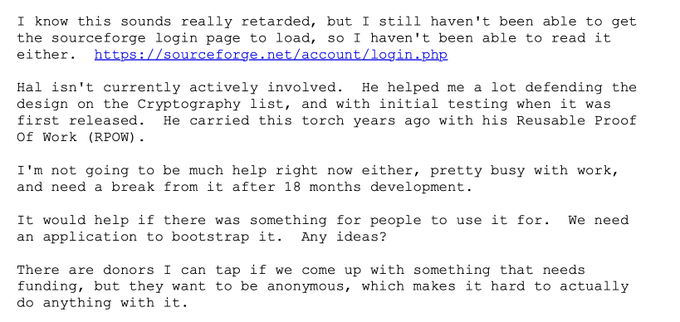
1/25
I've always thought that Hal Finney was the main person behind Satoshi Nakamoto (Supported by 1 or 2 other minor characters)
And I think the new emails help back that up overwhelmingly:



English