Rapha Ventresca

1.4K posts

Rapha Ventresca banner
Rapha Ventresca

Rapha Ventresca

@drinkwithrapha

Wine is the vehicle. Discernment is the destination. 11 years as a sommelier → now teaching you to trust your own palate. Newsletter 👇

Houston, TX Katılım Ekim 2020
340 Takip Edilen665 Takipçiler
Sabitlenmiş Tweet
Rapha Ventresca
Rapha Ventresca@drinkwithrapha·
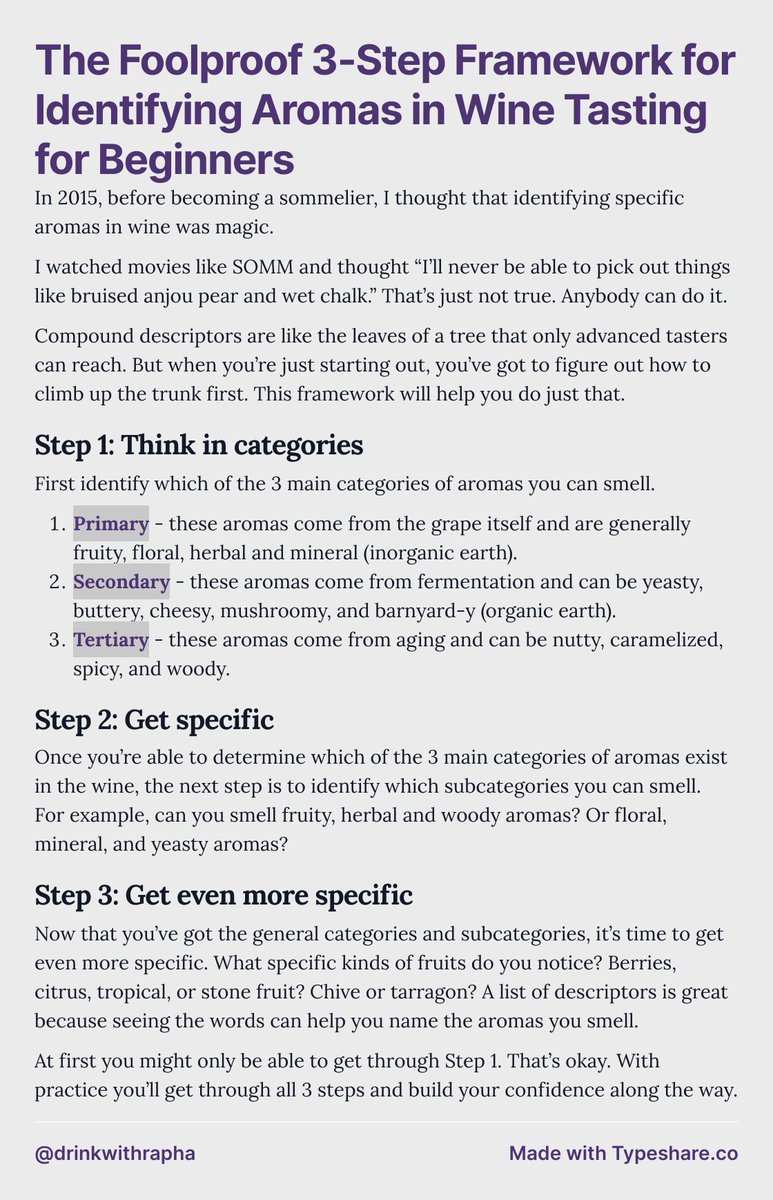
Have you ever wondered how sommeliers can identify the specific aromas in a glass of wine? I did too.
Rapha Ventresca tweet media
English
1
4
22
3.1K
Rapha Ventresca
Rapha Ventresca@drinkwithrapha·
🍷 Q1 complete: The Sovereign Sip 12 weeks of foundations: • Acidity, texture, structure, balance • The Resonance Method • Comparison over isolation • Less is more You can describe what you value now. That's sovereignty. Full issue at the link in bio.
English
0
0
0
10
Rapha Ventresca
Rapha Ventresca@drinkwithrapha·
Q1 review of The Resonance Method is live. Biggest surprise after 11 weeks: curiosity beats curriculum every time. Biggest honest admission: I still can't tell you how long each stage takes. Link in bio.
English
0
0
0
20
Rapha Ventresca
Rapha Ventresca@drinkwithrapha·
The Inner Compass is the real work. Wine became my vehicle for teaching it. Most people collect opinions instead of building taste. The moment you stop asking "what should I like?" and start asking "what do I actually experience?" everything changes. That reader got it. That's the work that matters.
English
0
0
0
5
Lawrence Yeo
Lawrence Yeo@moretothat·
I still can't believe the impact that The Inner Compass has had on readers. I got this email a few days ago, and I'm not even sure how to respond. Please write that book you've always wanted to write. You just don't know who can benefit from your words.
Lawrence Yeo tweet media
English
1
2
5
602
Rapha Ventresca
Rapha Ventresca@drinkwithrapha·
This hit me hard in wine education. Spent thousands on courses and certifications. Then I started traveling to regions, sitting with winemakers, tasting hundreds of bottles with intention. That's when everything changed. Your palate and confidence are the only assets that compound forever. The certifications are just costume.
Sahil Bloom@SahilBloom

I wasted so much money on clothes in my 20s that I should have just invested in my own health. Getting fit is worth more than any style makeover. A fit person looks better in jeans and a white tee than an unfit person in a $2000 designer outfit.

English
0
0
1
27
Rapha Ventresca
Rapha Ventresca@drinkwithrapha·
"Organic wine" sounds like a virtue signal. But here's what's actually happening: Without synthetic herbicides, vine roots go from 2 feet deep to 12 feet deep. Deeper roots = different minerals = more site expression. The sustainability part is a byproduct. The goal is terroir expression.
English
0
0
0
28
Rapha Ventresca
Rapha Ventresca@drinkwithrapha·
The best wine I ever had was $28. Barbera. Tuesday night. Pizza on the couch. It tasted like strawberries and summer rain. I've had $300 Burgundies that felt like homework. That $28 bottle? I remember it five years later. Balance > prestige Context > credentials Timing > everything Stop chasing points. Start chasing resonance.
English
1
0
2
277
Rapha Ventresca
Rapha Ventresca@drinkwithrapha·
This is the whole wine industry in one tweet. The best winemakers, sommeliers, importers are not hiding. Most people just never reach out. A DM, a question at a tasting, a comment on their newsletter. Access isn't gated. Effort is.
Sahil Bloom@SahilBloom

The older I get, the more I realize most people aren’t out of your reach, they’re just out of your effort. Send the cold email. Walk up to the stranger. Ask for help. Access is closer than you think, but only for those with the courage to ask. Closed mouths don't get fed.
English
0
0
0
46
Rapha Ventresca
Rapha Ventresca@drinkwithrapha·
Your first 50 wine tastings will be confusing. You won't know what you're looking for. You'll wonder if you're doing it wrong. Then around rep 75, something clicks. You start recognizing patterns. Oak vs. fruit. Structure vs. alcohol. The reps aren't the skill. They're what reveals the skill was always there.
English
0
0
0
15
Dickie Bush 🚢
Dickie Bush 🚢@dickiebush·
Reminder to self: Your 50 reps of anything will be terrible. It does not matter what you start. You will look back and cringe at all of them. And that's the point. Quantity, then quality.
English
72
9
107
4.8K
Rapha Ventresca
Rapha Ventresca@drinkwithrapha·
Most careers plateau at 30 years. Wine writing compounds forever. The longer you taste, the more connections you can draw. A Burgundy from 2010 teaches you about 2024. A technique from Champagne shows up in California. 15 years in, I'm just getting started.
Nicolas Cole 🚢👻@Nicolascole77

The real reason I picked writing as a career: Most careers have ~30 year time horizons or less. Doesn't matter the field, but it's very rare to see a CEO over the age of 65. But I can write until I'm dead. That's an extra ~20 years of mastery!

English
0
0
0
64
Rapha Ventresca
Rapha Ventresca@drinkwithrapha·
Same pattern in luxury consumption. We inherit the idea that 'refined taste' means expensive taste, so we chase price tags instead of developing actual discernment. Most wine education perpetuates this. Teaches you what to buy, not how to evaluate. Taste sovereignty requires the same unlearning as career sovereignty: stop outsourcing your judgment.
English
0
0
0
27
Paul Millerd
Paul Millerd@p_millerd·
we collectively see the job as the core human adult activity hence we continuously create more jobs. AI will be just like any other era. I don't see us abandoning the job anytime soon most government "waste" is just job creation by other means because we like jobs
English
6
2
16
1.4K
Rapha Ventresca
Rapha Ventresca@drinkwithrapha·
This is exactly what wine education should be doing but mostly isn't. Balcetis shows how visual perception training creates real behavioral change. Same principle in wine: you're not learning to 'appreciate' wine, you're training your perception to notice what was always there. Most wine courses teach vocabulary. The Resonance Method teaches you to see differently, just like her work with distance perception and motivation. Optimization isn't just about what you do. It's about upgrading how you experience what you do.
English
0
0
2
613
Rapha Ventresca
Rapha Ventresca@drinkwithrapha·
The parallels between traditional publishing and traditional wine education are striking: Both built their authority on controlling access to expertise. Both told people "you need us to tell you what's good." Both created gatekeeping mechanisms (agents/editors vs. sommeliers/critics) that kept everyday people from trusting their own judgment. And both are being disrupted by the same shift: people realizing they can develop their own discernment without permission. Substack for writers. The Resonance Method for wine drinkers.
English
0
0
0
104
David Perell
David Perell@david_perell·
Jon Yaged runs Macmillan, one of the five biggest publishers in the world, so I asked him to explain the book publishing industry to me. My main question: why should authors work with a traditional publisher, especially when self-publishing is taking off? What I got was a full tour of how book publishing works. Everything from how authors make money, to how publishers choose which books to back, to the traditional vs. self-publishing debate. Timestamps: 2:01 Consolidation in book publishing 4:01 Celebrity books 7:57 The scale of the publishing industry 9:48 How to get your book published 14:15 New York 16:25 Using data to find great books 29:33 How to work with a publisher 31:11 The economics of a book deal 36:42 How sequels work 42:21 Children's books 48:42 Books in Europe vs. America 50:25 Should writers use AI? 1:00:57 How printing works 1:04:52 Book marketing advice 1:09:48 What a publishing CEO does 1:11:06 Audiobooks 1:15:17 Are people getting stupider? 1:18:20 The publisher business model 1:19:08 Macmillan I've shared the full interview with Jon Yaged below. If you'd rather watch or listen to the interview somewhere else, check out the first reply tweet where I've linked to the interview on YouTube, and also on Apple / Spotify. Enjoy!
English
21
29
186
399.5K
Rapha Ventresca
Rapha Ventresca@drinkwithrapha·
This is why wine cellars exist. It's the one shelf your spouse can't reorganize. Though I've found the real test of a relationship is when you open a bottle you've been aging for years, and they say "it tastes the same as the £8 one." That's when you learn if you married someone who respects your discernment... or someone who's about to file your favorite bottles under "clutter."
English
0
0
1
46
Rory Sutherland
Rory Sutherland@rorysutherland·
I'd pre-order this book, but my wife would just put it back on the shelf when I was half way through reading it, hide it in a cupboard, put it underneath some other books, or just randomly move it around so I can't find it. amzn.eu/d/02GyK7t7 #Amazon via @Amazon
English
12
10
81
9.4K
Rapha Ventresca
Rapha Ventresca@drinkwithrapha·
This parable nails the wine industry's biggest problem. Someone wants to learn about wine, and instead of just tasting and tracking what resonates, they get hit with: - Varietal characteristics to memorize - "Proper" tasting note vocabulary - Expert scores to internalize - Regional hierarchies to respect Meanwhile, the poison arrow (pretension, gatekeeping, intimidation) keeps them from actually enjoying wine. Pull the arrow out first. Taste the wine. Notice what you like. Build from there. The rest is just noise.
English
0
0
0
52
Sahil Bloom
Sahil Bloom@SahilBloom·
Everyone should read this story... Imagine someone is struck by a poisoned arrow. A doctor is called to remove the arrow, but the man stops him. "Not so fast! Before you remove it, I want to know who shot me. What town or village does he come from? What kind of wood was his bow made from? Was it a crossbow or a longbow?" While he asks the questions, the poison takes hold and he dies. Like the man in the story, we occasionally get shot with the poisoned arrows of life. But ruminating too much on the nature of those arrows is unlikely to help. This is a trap we all fall into: We think we need more information to solve our problems, when all we really need is more action. The trap is becoming more challenging to avoid in a modern era where information is abundant. We've become conditioned to get our dopamine from information gathering. But you see, dopamine from information gathering is a dangerous drug. It convinces you that information alone is enough. That it's sufficient. That it's all you need. But information alone is never enough. Information is nothing without action. The information meant to push you forward can quickly start to hold you back. Struck with the poison arrow, you feel a surge of satisfaction from learning that your attacker was from a nearby village, that his bow was made from oak, and that it was a longbow. And then, you're dead, because the information you wanted had become a distraction from the action you needed. This is what I call the Poison Arrow Principle: Never allow information-gathering to get in the way of action-taking. The next time you're in an overthinking loop, ask yourself: Do I really need more information, or do I simply need to act on the information I already have?
English
87
99
617
57.3K
Rapha Ventresca
Rapha Ventresca@drinkwithrapha·
This applies perfectly to wine education too. Most people avoid the actual work of tasting blind, tracking what resonates, and building their own reference points. They want the shortcut: "just tell me what's good." But there is no shortcut to discernment. You have to taste the wines. Notice what resonates. Follow your curiosity into the weird bottles. Have the difficult conversation with your own palate when it disagrees with the experts. The people who do this work end up with something better than expert validation; they end up with their own taste.
Sahil Bloom@SahilBloom

Nobody tells you this: You can win by just embracing what most people avoid. Wake up early. Focus. Move your body. Eat real foods. Obsess over one thing. Read old books. Be present. Listen intently. Change your mind. Have difficult conversations. The recipe for a good life.

English
0
0
0
40
Rapha Ventresca
Rapha Ventresca@drinkwithrapha·
At wine tastings, professionals spit. Because alcohol destroys perception faster than anything else. If you want to remember what you tasted, don't swallow it. Counterintuitive but true.
English
0
0
0
33
Rapha Ventresca
Rapha Ventresca@drinkwithrapha·
This is why borrowed taste is so exhausting. You're performing for an audience that isn't watching. Ordering wine you don't actually like because you think someone's judging your choice. Same dynamic James describes here, just at the dinner table instead of your goals. Most people aren't paying attention. The ones who are? They respect honesty more than performance.
James Clear@JamesClear

Nobody is rooting for you to fail. Maybe you’ll succeed. Maybe you’ll fail. For the most part, nobody cares one way or the other. This is a good thing! The world is big and you are small, and that means you can chase your dreams with little worry for what people think.

English
0
0
0
45
Rapha Ventresca
Rapha Ventresca@drinkwithrapha·
Most people stop developing taste around 35. They build an identity, like "I'm a Burgundy person". Then their brain filters everything to confirm it. Taste development looks like language acquisition: Rapid growth, then a plateau most people mistake for mastery. The plateau is where the real work begins.
English
0
0
0
42
Rapha Ventresca
Rapha Ventresca@drinkwithrapha·
"Do you taste the minerality?" Everyone at the Chablis tasting nodded. "Definitely. So mineral." I tasted lemon, oyster shell, bright acid. But here's the thing: there's no scientific evidence minerals from soil end up in your glass. What you're tasting is real. The explanation is a story. Taste what's in the glass, not what the label told you to expect.
English
0
0
0
46
Rapha Ventresca
Rapha Ventresca@drinkwithrapha·
This is the wine industry's core delusion. "We made our supply chain 12% more efficient!" (Translation: We automated away the human touch customers actually valued.) Real efficiency in wine: - Helping someone find what they like in 2 min vs 20 - Explaining why a wine works without jargon - Making luxury feel accessible instead of gatekept Efficiency for you ≠ better experience for them.
English
0
0
2
228
Rory Sutherland
Rory Sutherland@rorysutherland·
Simple business tip. It doesn't really count as an increase in efficiency if you are making your customer pay the price.
English
16
24
269
20.2K