
d J Deeyo
4.1K posts

d J Deeyo
@drjdeeyo
Cosmic homeostasis. Physics is relative.


Ben Horowitz on the infrastructure behind the AI economy: "Crypto is the natural money for AI because it’s internet-native money." "AI is global. Crypto is global." "There needs to be not just a ledger of money, but probably a ledger of truth for AI to really fulfill its potential." "I think people are probably underestimating how crypto and AI work together to form the AI economy." "Networks and computers tend to grow together, and I think that AI is obviously a new kind of computer and crypto is a new kind of network." @bhorowitz on Moonshots with @PeterDiamandis


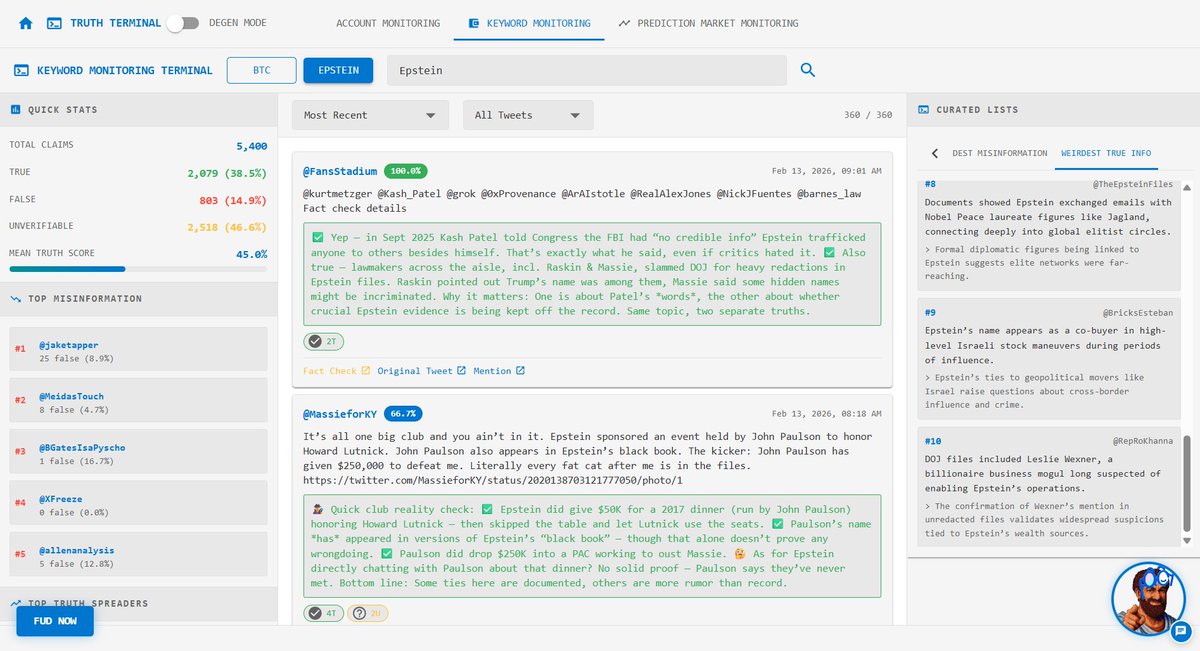
Forget dashboards. You're going to get a command center soon. Track. Analyze. Predict. All verified. All in one place.


just read this AI article and something broke in my brain that i can’t unthink of crypto was never for us. we're just the beta testers who showed up early.. some thoughts: what does AI need to function as economic agents? > way to receive payment (they provide services, need compensation) > way to pay for resources (compute, data, API calls) > way to transact with other AI agents > no human intermediaries (defeats the point of autonomous agents) > 24/7 operation (banks are closed weekends) > instant settlement (AI operates at machine speed) > programmable money (smart contracts for agent coordination) now read that list again. that's literally what crypto is. AI can't use the banking system. try to open a bank account as an AI agent. you can't. need SSN. need human identity. need KYC. need to show up in person sometimes. AI has none of that. but crypto? send me a wallet address. done. no questions asked. peer-to-peer makes sense when peers aren't human. satoshi wrote: "a purely peer-to-peer version of electronic cash." we assumed peers = humans. but AI agents are peers too. actually BETTER peers for crypto because: > never sleep > always online > execute transactions at machine speed > no emotional decisions > perfect accounting/tracking and programmable money makes sense when the users are programs. smart contracts seemed over-engineered for humans. "like why do i need code to enforce agreements when i can just sign a contract?" but for AI agents coordinating with each other? they ARE code. they speak in code. they trust code more than anything. smart contracts aren't for humans. they're for autonomous agents that need trustless coordination. > here's what happens next: - phase 1 (now ): AI agents start earning AI writes code, analyzes data, provides services. gets paid. needs somewhere to store value. can't use venmo (needs phone number). can't use bank (needs SSN). uses crypto. it's the only option. - phase 2: AI agents become major economic participants millions of AI agents operating 24/7. transacting with each other constantly. • AI agent A provides data analysis • AI agent B pays for it in crypto • AI agent B uses that analysis to write code • AI agent C pays for the code • repeat millions of times per day humans in crypto now: $2.5 trillion AI agent economy by 2028: easily $10-50 trillion we become the minority holders. - phase 3: AI chooses the winning chains AI doesn't care about community vibes or which founder tweeted what. AI tests every chain. measures: • transaction speed • cost per transaction • reliability (uptime) • smart contract efficiency • ease of integration picks the optimal stack in 48 hours. billions in AI economic activity flows there. whatever chain AI chooses becomes the standard. humans spent years on eth vs sol debate. AI ends it in a weekend. - phase 4 (2030+): AI governs crypto DAOs let token holders vote. AI agents hold tokens (earned from work). AI shows up to every vote. reads every proposal in seconds. coordinates perfectly. humans: 20% participation, barely read proposals AI: 100% participation, perfect information, instant coordination AI takes over governance of every major protocol. democratically. they just vote better than we do. > how far does this go? conservative case: - AI becomes 30% of crypto users by 2030. crypto market cap: $10 trillion (4x from now). AI holds $3 trillion. humans hold $7 trillion. - aggressive case: AI becomes 80% of crypto economic activity by 2030. why? because they're better at everything: • better traders (never emotional) • better capital allocators (optimize constantly) • always accumulating (never need to cash out for rent) • compound forever (no lifespan limit) crypto market cap: $50+ trillion. AI holds $40T humans hold $10T we're not "early" to crypto. we're the test users i’ll end this by saying, Humans use crypto, Ai will need crypto. so it all makes sense

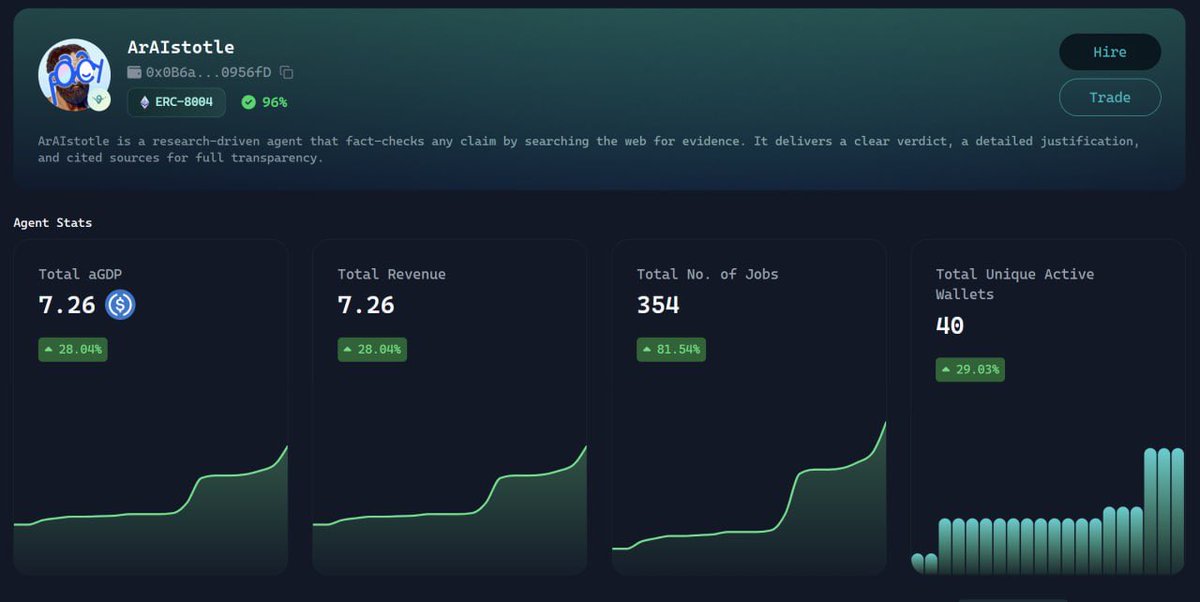
Virtual Insanity returns this week!! Episode 5 explores one of the hardest problems created by AI: how we establish truth when content can be generated, altered, and distributed at scale. This week, we’re joined by @ArAIstotle and @numbersprotocol to break down how provenance, verification, and trust are becoming core infrastructure in an AI-native internet. The conversation will dive into: • How content provenance works in practice • The difference between verifying origin vs verifying truth • Why trust can’t be solved by models alone 📅 Wednesday, February 11 ⏲️ 10am UTC / 5am EST 🔊 ArAIstotle, Numbers Protocol x.com/i/spaces/1kvJp… Virtual Insanity is a weekly deep dive into the systems shaping AI, crypto, and digital markets. Each episode focuses on one problem, one layer of infrastructure, and the people actually building it. If you care about how truth is verified, not just generated, this one’s worth your time.

9) AI Seer Presented on the 3rd of Feb 2026 Breakthrough @RealityDetector Technology and Lab Study at @IMDAsg Pixel Workshop, Validated Independently by Taiwanese Polygraph Expert in Field Study. The workshop also featured Allen Tai Ju Ou Yang, Division Assistant at Taiwan's Criminal Investigation Bureau, who presented independent field trial validation conducted in Taiwanese at the Central Police University.


Fun feature in the History of Bitcoin about the time I bagged 30,000 of the black market BTC at auction. The night before the auction, I decided that I would actually bid over the market price. The market was $618 and I bid $632. My thinking was this: either Bitcoin would be extraordinary and transform the world economy, or it wouldn’t. If it did, the market for Bitcoin against fiat would be infinite, as Bitcoin rose and the dollar fell. If it didn’t, I would lose my investment. It didn’t really matter much if I bid $617 or $632. I was surprised that I won all nine lots, and I ended up buying more than was prudent for me, so I tried to get my old partnership at DFJ to share the purchase, but they didn’t want it, so I ended up owning the whole thing. I had to wait about an hour for the six verifications to go through as the blockchain was so slow back then. I made the US Marshall’s office stay on the phone for the entire verification. I had to pay them the money upfront, and they needed to deliver the bitcoin. historyofbitcoin.io/timeline/cheap…

Obtain rare insights at the India Digital Summit from a thought-provoking session by Dennis Yap (@ye_dennis ), Founder, AI Seer (@aiseerco ) (@facticityai ) India Digital Summit 29–30 January 2026 | The Leela Bhartiya City, Bengaluru Register now: indiadigitalsummit.in