Morgan Levine

1.8K posts

Morgan Levine banner
Morgan Levine

Morgan Levine

@DrMorganLevine

VP of Computation at Altos Labs | Former Professor at Yale | Thoughts and opinions are my own

San Diego, CA Katılım Mart 2020
511 Takip Edilen20.3K Takipçiler
Morgan Levine retweetledi
Peter Ottsjö
Peter Ottsjö@peterottsjo·
The ultimate test for AI × bio is aging. There is nothing more complex in biology. Now two of the top experts in the field say we are nowhere near a solution using AI. But they also provide encouraging ways forward. Let's take a look. (1/7) 🧵
Peter Ottsjö tweet media
English
6
19
94
15.3K
Morgan Levine retweetledi
ipekceliksoz
ipekceliksoz@ipekceliksoz·
Spent today in a workshop on ''Data foundations for AI in longevity'' with @altos_labs Founding PI @DrMorganLevine and @GordianBio Founder @MartinBJensen. - There is no single drug coming for aging. - The bottleneck isn't compute, algorithms, or even data volume. It’s the type. Stop asking “what data” and start asking “what would we measure if we could measure anything”. - No clue of what’s not working. Do not hide but publish the failures. If you're a founder working on novel data generation at the physiological layer, or any kind of data collection platform, let's talk. @VitalistBay
English
5
6
16
2.5K
Morgan Levine retweetledi
Ziad Obermeyer
Ziad Obermeyer@oziadias·
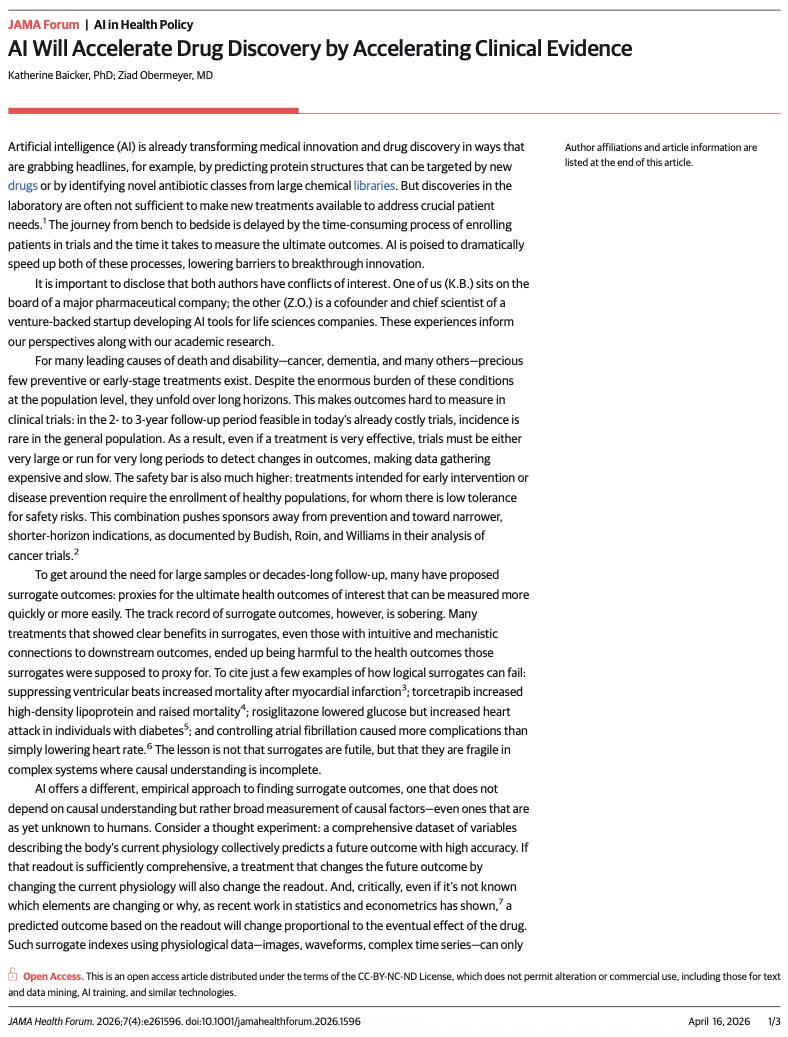
Common thought: AI for drug discovery = AlphaFold, drug design, etc. But the bottleneck isn't design - it's clinical trials, as @RuxandraTeslo eloquently notes Many well-designed drugs fail Good news: AI can help there too Our @JAMAHealthForum piece: tinyurl.com/3hwc2m9u
Ziad Obermeyer tweet mediaZiad Obermeyer tweet media
English
3
22
150
13.8K
Morgan Levine retweetledi
Goodfire
Goodfire@GoodfireAI·
Neural networks might speak English, but they think in shapes. Understanding their rich *neural geometry* is key to understanding how they work – and to debugging and controlling them with precision. Starting today, we’re releasing a series of posts on this research agenda. 🧵
English
310
1.7K
11.2K
3.1M
Morgan Levine retweetledi
Clara Gold
Clara Gold@Clara_Gold·
I realized fundraising was the first time in my life I got rejected at scale. And honestly, as a woman, I was not emotionally trained for it. Before the feminists come for me, let me make my point. I think the first real arena where most people experience power, desire, status, and rejection is dating. And dating trains men brutally. A lot of men learn very early that if they want someone, they have to walk across the room, risk looking stupid, get rejected, survive it, and do it again. They learn that rejection is volume, timing, targeting. It’s a numbers game. A lot of women are trained very differently. Especially if you’re a pretty girl, you don’t usually walk into a bar looking at a guy thinking: “Can I have him?” You only think: “Do I want him?”. You don’t build your identity around shooting your shot 100 times and surviving 99 no’s. You don’t get trained to ask directly, get rejected publicly, and act normal 5 minutes later. You get trained to be “chosen”. To be impressive enough that the opportunity comes to you. And then you start building a company. And the whole paradigm changes. Suddenly, everyone can say no to you. Investors say no. Candidates say no. Customers say no. And when your rejection muscle is weak, your brain does the dumbest thing possible: it makes the “no” mean something about you. That you’re not smart enough. Not compelling enough. I think this is one of the most underrated gender differences in fundraising. Not that men are inherently better at it. But a lot of them have built thicker rejection scar tissue earlier. They know how to hear no and keep moving. They know how to make it less personal. They know how to treat it like volume, timing, targeting, iteration. I didn’t. I’ve raised 3 rounds. On the surface, the story looks great: I raised with Sequoia, OpenAI, Khosla. Woohoo. The real story is less sexy: every round wrecked me. I lost 5kg each time. I probably donated a few years of life expectancy to the cap table. Because every round, I only got 1 term sheet. One. EVERYONE else said no. And when almost everyone says no, your body does not care about the intellectually correct explanation. It only hears: Maybe they’re right. Maybe you’re not that compelling. Maybe you’re not the founder you thought you were. For a long time, I thought confidence meant learning not to take the no personally. I don’t believe that anymore. Maybe some people are built like that. I’m not. 30 years of being trained to be chosen does not turn into resilience because someone in a Patagonia vest says fundraising is a numbers game. So now I think confidence is something less glamorous. Confidence is taking the no very personally. Letting it ruin your day, losing your appetite, spiraling for hours… And still taking the next meeting. Confidence is just being bothered as f*** and not letting it make you smaller. I still don’t fully believe my own BS as I’m writing this, but I guess that’s the point. Can’t wait for the next round to find out.
English
145
85
1.5K
429.7K
Morgan Levine retweetledi
Axios
Axios@axios·
Mark Zuckerberg and Priscilla Chan commit $500 million to AI biology trib.al/ME2x1PD
English
34
99
603
132.2K
Morgan Levine retweetledi
Peter Ottsjö
Peter Ottsjö@peterottsjo·
Biology may have a different scaling law than mainstream AI. Those who learn that lesson early will likely build the deepest moats in AI × bio. 🧵 (1/5)
English
2
7
52
11.3K
Olafur Pall Olafsson
Olafur Pall Olafsson@olafurpall80·
@DrMorganLevine I agree. I've been studying longevity for over 20 years and the more I learn the more convinced I am that it's too complicated for humans to solve fully. Humans can solve it partially but AI will be needed to solve it fully.
English
2
0
5
327
Morgan Levine
Morgan Levine@DrMorganLevine·
AI is likely the only hope we have to solving aging. In fact, it is the opposite of David’s paint analogy.
English
26
7
87
11.6K
Stjepan
Stjepan@StjepanZRPavic·
@DrMorganLevine You sound like AI, do you even understand or know mathematics of AI, did you program any AI.This time Sinclair has a point,you delulu and don't know what AI i.. "AI is only hope" lol this sounds typical nepo baby response.. and disrespect to all scientists working in the field.
English
1
0
1
239
Morgan Levine
Morgan Levine@DrMorganLevine·
@charleswangb I’m not saying you don’t need bio. Large-scale data and experimental validation are essential ingredients. I’m just saying it’s unlikely to happen without AI.
English
2
0
6
222
Charles Wang
Charles Wang@charleswangb·
@DrMorganLevine Why not both AI + bio? Unlikely to solve aging without tapping into the latent capabilities of bio. AI can help uncover them.
English
1
0
1
326
Morgan Levine
Morgan Levine@DrMorganLevine·
@patrickc …I’m asking out of curiosity, not to be passive aggressive.
English
0
0
4
402
Morgan Levine
Morgan Levine@DrMorganLevine·
@patrickc 1) Curious how much of this risk is beyond visible traits (e.g., MC1R/red hair) vs. just confirming phenotype? 2) 30x seems very high. What’s the reference (2.6% is baseline for caucasians)? 3) Did the recommendations go beyond standard fair-skin dermatology advice?
English
1
0
14
1.9K
Patrick Collison
Patrick Collison@patrickc·
I'm lucky enough to have a great doctor and access to excellent Bay Area medical care. I've taken lots of standard screening tests over the years and have tried lots of "health tech" devices and tools. With all this said, by far the most useful preventative medical advice that I've ever received has come from unleashing coding agents on my genome, having them investigate my specific mutations, and having them recommend specific follow-on tests and treatments. Population averages are population averages, but we ourselves are not averages. For example, it turns out that I probably have a 30x(!) higher-than-average predisposition to melanoma. Fortunately, there are both specific supplements that help counteract the particular mutations I have, and of course I can significantly dial up my screening frequency. So, this is very useful to know. I don't know exactly how much the analysis cost, but probably less than $100. Sequencing my genome cost a few hundred dollars. (One often sees papers and articles claiming that models aren't very good at medical reasoning. These analyses are usually based on employing several-year-old models, which is a kind of ludicrous malpractice. It is true that you still have to carefully monitor the agents' reasoning, and they do on occasion jump to conclusions or skip steps, requiring some nudging and re-steering. But, overall, they are almost literally infinitely better for this kind of work than what one can otherwise obtain today.) There are still lots of questions about how this will diffuse and get adopted, but it seems very clear that medical practice is about to improve enormously. Exciting times!
English
488
642
9.6K
4.1M
Vulpes Bio
Vulpes Bio@Vulpescap·
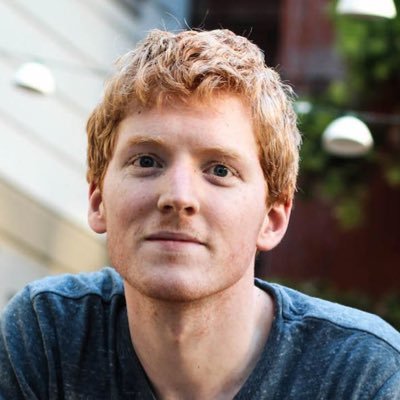
SF bro "unleashes AI agents on his genome" and finds "the most useful medical advice he's ever received". 🤯 The advice: he has a predisposition to melanoma The SF bro's skin:
Vulpes Bio tweet media
Patrick Collison@patrickc

I'm lucky enough to have a great doctor and access to excellent Bay Area medical care. I've taken lots of standard screening tests over the years and have tried lots of "health tech" devices and tools. With all this said, by far the most useful preventative medical advice that I've ever received has come from unleashing coding agents on my genome, having them investigate my specific mutations, and having them recommend specific follow-on tests and treatments. Population averages are population averages, but we ourselves are not averages. For example, it turns out that I probably have a 30x(!) higher-than-average predisposition to melanoma. Fortunately, there are both specific supplements that help counteract the particular mutations I have, and of course I can significantly dial up my screening frequency. So, this is very useful to know. I don't know exactly how much the analysis cost, but probably less than $100. Sequencing my genome cost a few hundred dollars. (One often sees papers and articles claiming that models aren't very good at medical reasoning. These analyses are usually based on employing several-year-old models, which is a kind of ludicrous malpractice. It is true that you still have to carefully monitor the agents' reasoning, and they do on occasion jump to conclusions or skip steps, requiring some nudging and re-steering. But, overall, they are almost literally infinitely better for this kind of work than what one can otherwise obtain today.) There are still lots of questions about how this will diffuse and get adopted, but it seems very clear that medical practice is about to improve enormously. Exciting times!

English
45
90
3.4K
345K
Morgan Levine
Morgan Levine@DrMorganLevine·
AI collaborators in Sci-Fi are always the blunt, objective, no nonsense assistants we all need. Yet in the real world, we ended up with sycophantic yes-“men”. I know we can prompt the former, but I want a neurodivergent AI by default!
GIF
English
5
0
15
1.4K
Morgan Levine retweetledi
Luca Naef
Luca Naef@NaefLuca·
📜 New paper with @mmbronstein: most data needed for AI4Science breakthroughs doesn't exist yet. And it won't - unless we fundamentally rethink data generation. Scaling up isn't enough. We need to stop generating data for humans and start generating for black-box models. We need black-box data 🤖 - 🧵pubs.rsc.org/en/content/art…
Luca Naef tweet media
English
3
44
154
41.2K