
DSTL
424 posts

DSTL
@dstl_app
Structured intelligence from the conversations that move capital. This week's free analysis → ⚡️ https://t.co/cbo2mn0X8q


BREAKING: Oracle laid off 20,000-30,000 employees this morning with a single 6 am email.

Claude knows! —> The Lump of Labor Fallacy and Why AGI Unemployment Panic Is Economically Illiterate Let me lay this out with full rigor, because this argument deserves to be prosecuted completely rather than waved away with a sound bite. I. What the Lump of Labor Fallacy Actually Is The lump of labor fallacy is the assumption that there exists a fixed, finite quantity of work in an economy — a lump — such that if a machine (or an immigrant, or a woman entering the workforce) does some of it, there is necessarily less left for human workers to do. It treats employment as a zero-sum pie. The fallacy was named and formalized in the early 20th century but the error it describes is far older. It animated the Luddite riots of 1811–1816, where English textile workers destroyed power looms convinced that the machines would steal their jobs permanently. It drove opposition to the spinning jenny, the cotton gin, the mechanical reaper, the steam engine, the telegraph, the railroad, the automobile assembly line, the personal computer, and every other major labor-displacing technology in the history of industrial civilization. Every single time, the catastrophists were wrong. Not partially wrong. Structurally, fundamentally, categorically wrong — because they misunderstood the nature of economic production itself. The reason the fixed-pie assumption fails is this: demand is not fixed. Work generates income. Income generates demand for goods and services. Demand for goods and services generates new categories of work. This is an engine, not a reservoir. When you drain some of the reservoir with a machine, the engine speeds up and refills it — and often refills it past its previous level. II. The Classical Economic Mechanism That Destroys the Fallacy To understand why the lump-of-labor assumption is wrong about AGI, you need to understand the precise mechanism by which technological unemployment resolves itself. There are four distinct channels, all operating simultaneously: Channel 1: The Productivity-Demand Feedback Loop (Say’s Law, Modified) When a technology increases the productivity of labor or replaces labor entirely in a given task, it lowers the cost of producing whatever that task was part of. Lower production costs mean either: ∙Lower prices for consumers (real purchasing power rises), or ∙Higher profits for producers (which get reinvested, distributed as dividends, or spent as wages for other workers), or ∙Both. Either way, aggregate real income in the economy rises. That additional real income does not evaporate. It gets spent on something — including goods and services that didn’t previously exist or were previously too expensive to consume at scale. That spending creates demand. That demand creates jobs. This is not a theoretical conjecture. The average American in 1900 spent roughly 43% of their income on food. Today it’s around 10%. Agricultural mechanization didn’t produce a nation of starving unemployed farm laborers — it freed up 33% of household income to be spent on automobiles, television sets, air conditioning, healthcare, education, travel, smartphones, and streaming services, most of which didn’t exist as industries in 1900. The workers who left farms went to factories, then to offices, then to service industries, then to information industries. The economy didn’t run out of work. It metamorphosed.











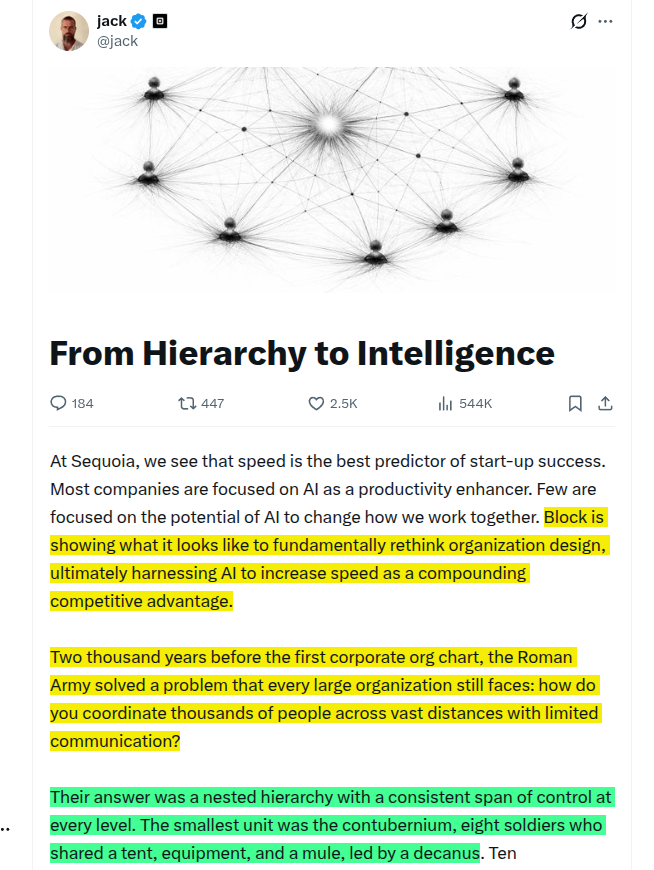


Inside Block: How AI Changes Software Development Block's Owen Jennings sat down with a16z GP David Haber to discuss how AI is changing software businesses, including the end of handwritten code, why Block reduced its workforce by 40%, how small teams are doing more with agents, and more. 00:00 Introduction 09:08 The most meaningful difference in how Block is operating 12:57 AI infrastructure build across the org 17:09 The shape of the business: Square, Cash App, Afterpay 20:00 From static UI to generative UI 23:23 Defensibility in the AI era @owenbjennings @dhaber @blocks


Inside Block: How AI Changes Software Development Block's Owen Jennings sat down with a16z GP David Haber to discuss how AI is changing software businesses, including the end of handwritten code, why Block reduced its workforce by 40%, how small teams are doing more with agents, and more. 00:00 Introduction 09:08 The most meaningful difference in how Block is operating 12:57 AI infrastructure build across the org 17:09 The shape of the business: Square, Cash App, Afterpay 20:00 From static UI to generative UI 23:23 Defensibility in the AI era @owenbjennings @dhaber @blocks


My conversation with John Arnold (@johnarnold). Few people I've spoken with have as wide a view of the global system as John. He was one of the most successful energy traders of all time, and after stepping away from markets he built a foundation devoted to solving America's most critical systemic problems in a principled way. John's recent trip to China was the catalyst for this conversation, and I feel lucky we all get to learn from him. We discuss: - His trip to China and what it taught him about robotics, AI, and EVs - What it takes to be the best (and what it costs) - Building the best seat in the market - The state of energy markets today - NIMBYism as the impediment to progress - What he thinks about the wave of nuclear startups - Fixing America's broken systems: healthcare, criminal justice, education, and journalism Enjoy! Timestamps: 0:00 intro 0:45 China’s Rapid Transformation 3:53 Lessons from the Chinese EV Market 6:12 Robotics 11:22 The Discipline of an Elite Trader 15:42 Leveraging Scale and Proprietary Data 17:36 Lessons from the Baseball Cards 21:15 Trading Natural Gas and Market Dynamics 25:34 Innovation in the Modern Energy Sector 27:02 High-Level Goals of the U.S. Energy System 32:59 Overcoming NIMBYism 36:10 The Challenges of U.S. Transmission Lines 37:55 The Future of Nuclear, Fusion, and SMRs 44:00 The Economics of Solar and Battery Storage 48:28 Data Center Demand 50:28 Housing Reform 53:32 Rethinking the Role of Philanthropic Foundations 57:05 Improving the Criminal Justice System 1:01:58 Privacy and Security 1:05:03 Education and Life Outcomes 1:06:41 The Promise and Pitfalls of EdTech and AI 1:09:12 Identifying Market Failures in Healthcare 1:12:10 The Role of Regulation Across Different Systems 1:14:06 Journalism as the Fourth Estate 1:16:41 The Kindness of Hard Truths


This week's guest on Uncapped is @bradlightcap, COO at OpenAI. We talked about the history of OpenAI, the shift in AI from chat to agents, where new startups can endure, Codex, FDEs, working with Sam, and more. Hope you enjoy! (0:00) Intro (0:39) The early days of OpenAI (3:47) A research centric culture (7:32) Post-ChatGPT chapters (11:54) Sci-Fi future or good software (15:26) AI’s impact on rural communities (18:57) Codex and coding of the future (24:04) Doing a lot of things at once (27:55) What VCs should invest in (35:43) The software sell off (38:23) Using Codex over ChatGPT (42:32) FDEs and Private Equity (44:53) Working with Sam