Martin Dubuc

820 posts

Martin Dubuc banner
Martin Dubuc

Martin Dubuc

@dubucmar

Passionate about pioneering across #leadership, #innovation, #healthcare and #technology.

Paris, Ile-de-France Katılım Mayıs 2011
305 Takip Edilen545 Takipçiler
Martin Dubuc retweetledi
Om Patel
Om Patel@om_patel5·
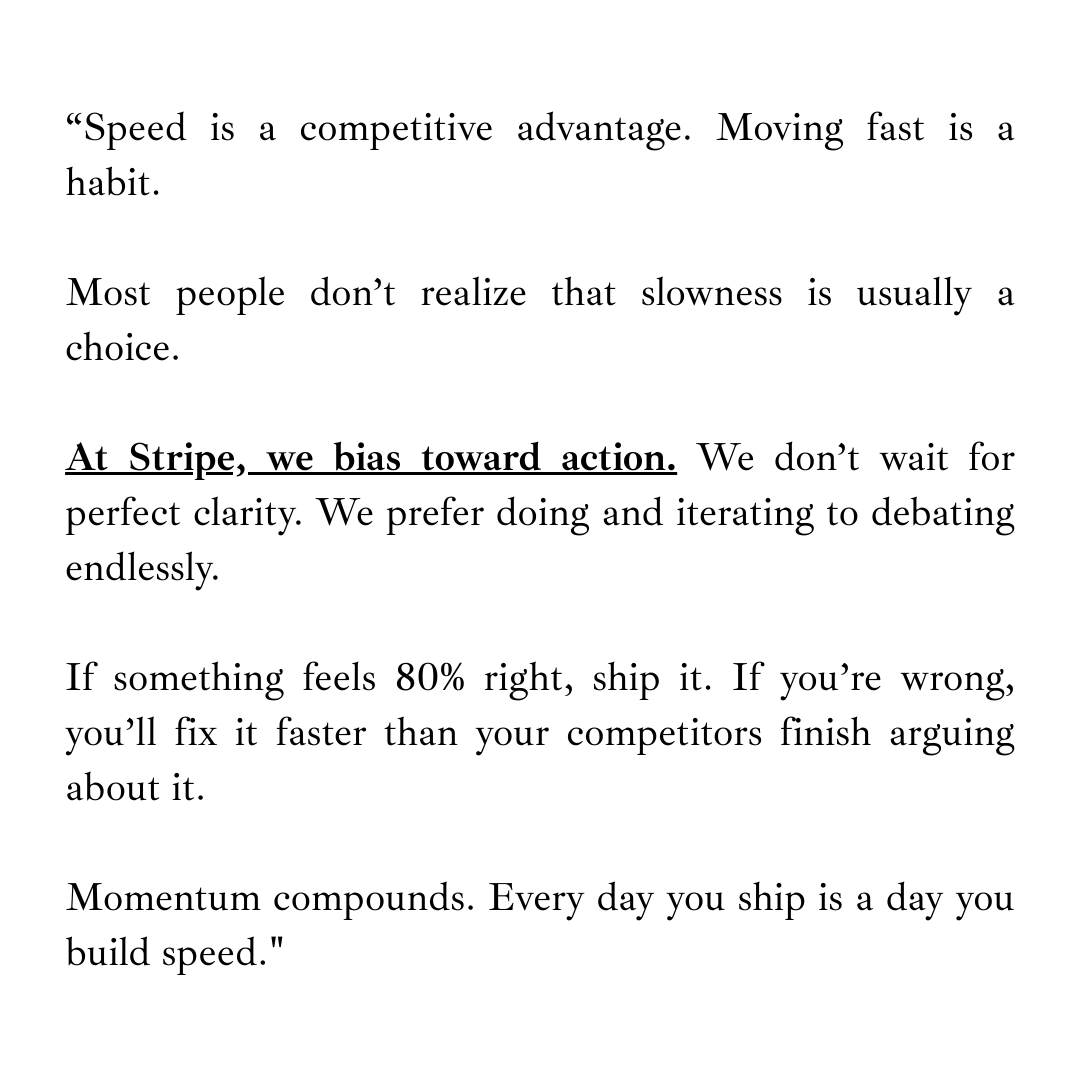
stripe's CEO explains how to move fast
Om Patel tweet media
English
61
368
3.3K
294K
Martin Dubuc retweetledi
Jeffrey Snover
Jeffrey Snover@jsnover·
WELCOME TO THE ROOM: Satya Nadella's Lesson in Executive Accountability Most people treat a senior promotion as a destination; in reality, it is an invitation to a higher level of pressure where excuses are considered a form of professional failure. In "The Room," the distance between a "theory of success" and "actual success" is measured by one thing: Intellectual Honesty. If you are waiting for more resources, more time, or more favorable conditions to win, you aren't leading—you’re whining. True leadership is the act of "manufacturing success" within the constraints of reality. It requires the scientific rigor to align your resources to your theory, the telemetry to admit when that theory is failing, and the courage to pivot before the runway disappears. The Bottom Line: You are either a generator of clarity or a creator of confusion. If your "dots don't connect" from your current headcount to the final result, you are just managing decline. Stop talking, get the telemetry, and operationalize the win. Anything else is just noise. jsnover.com/blog/2026/02/0…
English
22
97
900
96.6K
Martin Dubuc retweetledi
Daily Stoic
Daily Stoic@dailystoic·
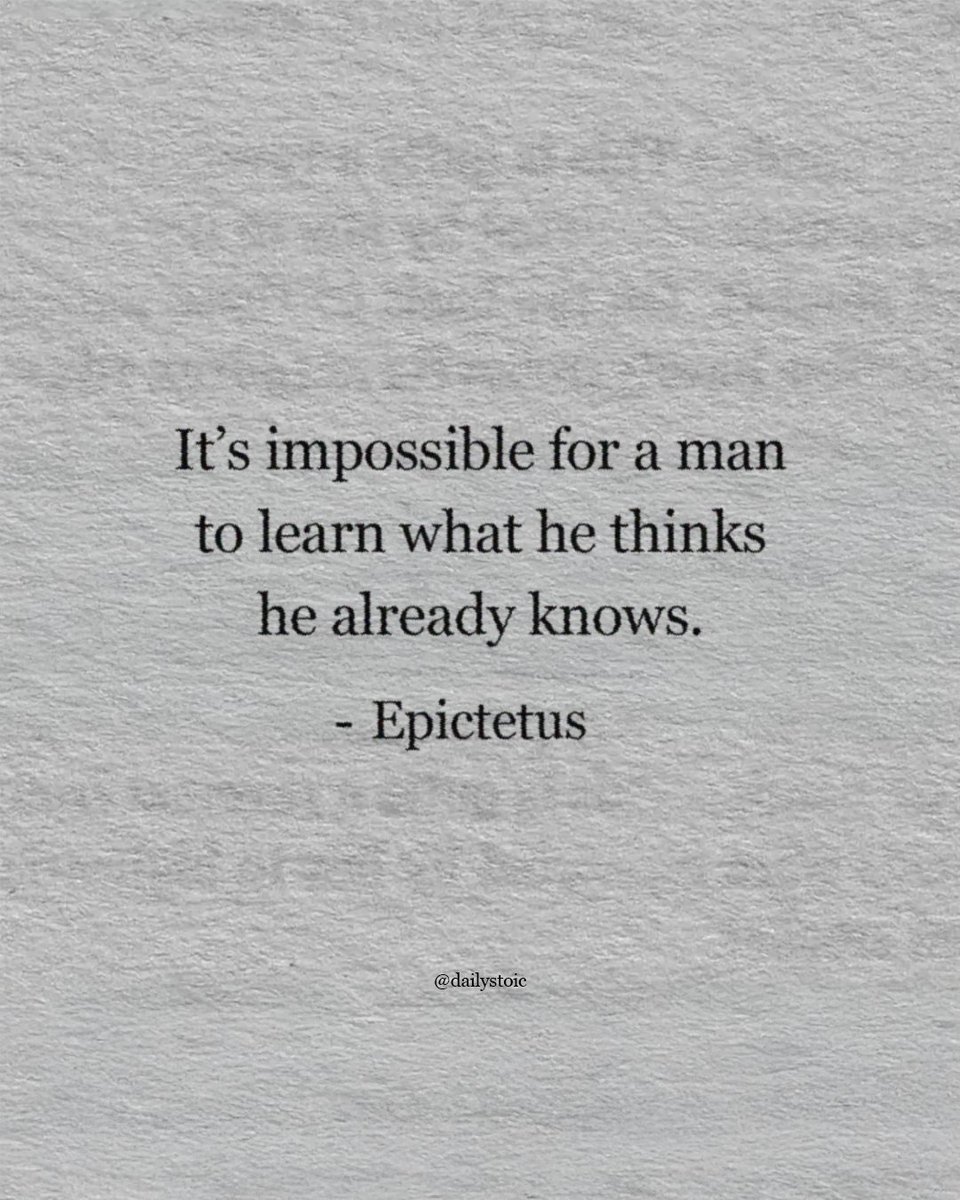
"It's impossible for a man to learn what he thinks he already knows." - Epictetus
Daily Stoic tweet media
English
21
106
788
25.7K
Martin Dubuc retweetledi
Chris Hoffmann
Chris Hoffmann@STLChrisH·
Favorite excerpt from Brent Beshore's annual letter: What CEOs Are and Aren’t Most people think of a CEO as the person at the top. That’s true in the same way it’s true that the windshield is “at the front” of the car. Technically correct. Also, misses the point. The windshield isn’t the engine. It isn’t the wheels. It doesn’t move anything. But it does determine what the driver can see, what they ignore, and what they slam into at 70 miles an hour. When done well, the CEO job is an arbiter of truth. The CEO stands at the border between the outside world and the inside world, between company mythology and competitive reality. That sounds obvious, but it’s not. I’d argue the norm is delusion, where organizations create realities disconnected from truth, complete with alternate headlines, villains, and heroes, all proclaimed with a shocking level of certainty. So the CEO’s job starts with a basic question: What’s true? Not what’s comforting. Not what’s politically convenient. Not what our dashboards can measure. What’s true? And what should we do about it? But deciding what to do and then doing it, requires a blend of rare attributes. The CEO must be confident enough to pick a direction and humble enough to change it. Optimistic enough to inspire and paranoid enough to prepare. Warm enough to build trust and hard enough to make calls that disappoint people they like and care about. We need to strip away the mystique. In practice, the CEO allocates three things: Attention: If you want to understand a CEO, ignore their strategy deck and read their calendar. Where attention goes, energy flows. Where energy flows, money follows. And where money follows, the organization slowly becomes something different, usually without anyone noticing until it’s obvious. This is why the CEO’s attention is so expensive. It’s why it’s so easy to waste. There are a thousand “important” meetings that are actually just elaborate ways to avoid the one meeting that matters. There are a thousand “urgent” problems that are actually just the company asking the CEO to temporarily soothe anxiety. A CEO’s attention is the company’s flashlight. Point it at the right things and companies transform. Point it at the wrong thing long enough and the wrong thing becomes the thing. People: The CEO builds the team that builds the team. I’ve learned that a healthy company isn’t built by a heroic CEO. It’s built by a great team operating with clarity, trust, speed, and accountability. The CEO’s role is to create that environment, protect it, and, when necessary, make the painful personnel decisions that preserve it. This sounds straightforward until you live it. Then you realize you’re not moving boxes on an org chart. You’re messing with people’s dignity, livelihoods, and families. You’re also messing with the morale of everyone who stays. Every hire is a bet. Every promotion is a signal. Every tolerated behavior becomes a de facto policy. The CEO becomes, whether they like it or not, the embodiment of culture. It’s not what they say they value, but what they practically reward, punish, ignore, and allow. Money: This is the CEO’s most difficult job because it’s often the one they’re least trained for, that seems the most glamorous, and is extremely impactful over time. Most CEOs come up through some form of excellence in sales, operations, engineering, or product. Then one day they wake up and realize the biggest decisions they make are capital allocation decisions: reinvest or distribute, grow or consolidate, buy or build, add headcount or automate, bet on the future or play it conservative. Capital allocation is where strategy stops being a noun and becomes a verb. It is where vision gets an audit. And it’s also where a CEO can quietly ruin a business while looking busy. It’s remarkably easy to confuse action with progress, and reinvestment with wisdom. Oftentimes the best capital allocation decision is painfully boring: Do fewer things, do them better, and keep your powder dry. But, that’s not what gets applause. In our world, with long-term owners, permanent capital, and no forced exit timetable, this is where the CEO job gets simpler. We don’t need theater. We don’t need growth for growth’s sake. We don’t need to hit a narrative for the next fundraising cycle or quarterly call. We can play offense when the opportunity is real and defense when it isn’t. We can say “not now” without pretending it’s “never.” This brings me to what might be the most misunderstood part of the CEO role: The CEO is the Chief “No” Officer. Every yes is a no to something else. Every strategy is a pile of exclusions. Every commitment is a tradeoff. The organization will always ask for more: more initiatives, more products, more meetings, more hires, more exceptions, more complexity. Increasing complexity is the default setting of life, and companies are not exempt from natural order. A CEO has to become comfortable being the person who disappoints people in the short term so the company doesn’t disappoint everyone in the long term. This is where I’ve personally struggled, both as a leader and as an owner. I want to be helpful, agreeable, and liked. I can easily slip into short-term people pleasing at the expense of leading well. Sometimes I’ve confused my progress anxiety for insight. I’ve wandered into decisions too early because “someone should do something.” I’ve also learned slowly and painfully that a CEO can add enormous value simply by refusing to add noise. Clarity is kindness, but often feels like inaction to busy people. A lot of CEO work is invisible. It’s pressure management. It’s absorbing emotion without spreading it. It’s knowing what you think and how to say it with grace. It’s carrying the weight of uncertain outcomes while still asking the team to move forward decisively. This is why, in our portfolio, we care less about a CEO’s charisma and more about their character and judgment. We’ve found that the best CEOs have a rare combination of humility and intensity. They don’t need to be the smartest person in the room, but they do need to be the clearest. They don’t need to have all the answers, but they do need to be willing to make the hard call.
English
53
93
884
177.6K
Martin Dubuc retweetledi
Startup Archive
Startup Archive@StartupArchive_·
Jeff Bezos explains the “releasing the work” framework he used to build Amazon In the early days of Amazon, Jeff Bezos had too many ideas. Then Jeff Wilke, a new Amazon executive at the time, told his boss, “Jeff, you have enough ideas to destroy Amazon.” “This was just a shocking idea for me,” Bezos recalls. “As a founder, I had the great luxury of always being able to hire my tutors. I would hire these experienced, senior executives . . . And I would listen to them and they would teach me.” When Bezos asked Wilke what he meant by this, Wilke responded, “You have to release the work at the right rate so that the organization can accept it.” Bezos reflects on this point: “Every time I released an idea, I was creating a backlog of work in process. And because it was just stacking up, it was adding no value. In fact, it was creating distraction . . . This sounds so obvious, but it was not obvious to me at the time. And this was a profound insight for me. So I started prioritizing the ideas better, keeping lists of them, and keeping ideas to myself until the organization was ready for the ideas.” He continues: “I also started figuring out how to build an organization that can be ready for more ideas. That’s about having the right senior team and leadership and giving those people the executive bandwidth so they could do more ideas per unit of time. And that is what we built. We built a company that’s very good at inventing and doing more than one thing at a time. And as the company gets bigger, you do want to be able to do more than one thing at a time. But that idea of ‘releasing the work’ was very profound for me. It made us operationally more effective while still being inventive.” Video source: @Reuters (2025)
English
72
607
5.9K
674.7K
Martin Dubuc retweetledi
Z Fellows
Z Fellows@zfellows·
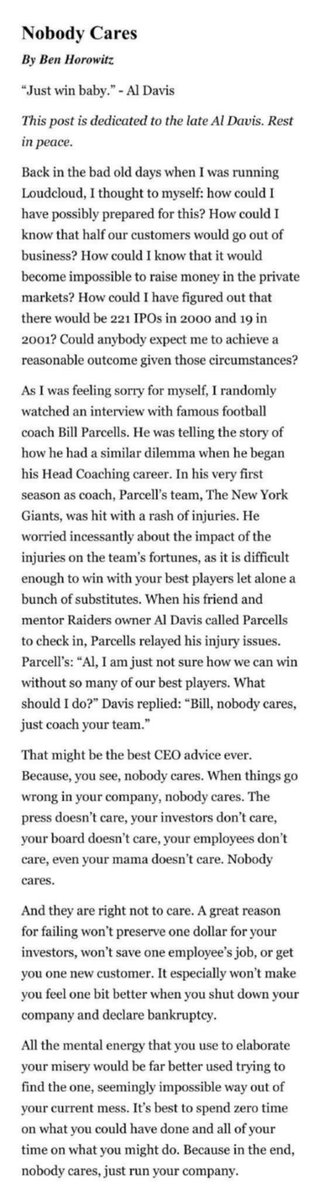
Andreessen Horowitz Co-founder on a hard truth: "Nobody Cares"
Z Fellows tweet media
English
15
126
1.2K
95.8K
Martin Dubuc retweetledi
pdawg
pdawg@prathamgrv·
this image has singlehandedly saved me from so much overthinking
pdawg tweet media
English
133
2K
26.4K
1M
Martin Dubuc retweetledi
Sam Shank
Sam Shank@samshank·
Don’t start with the product. Start with distribution. I give this advice to entrepreneurs all the time because distribution is the hardest part of building a company. “Build it and they will come” almost never works. And even if you expect distribution to be hard—it’ll be 10× harder. HotelTonight started with a distribution insight. In 2009, we saw that the App Store about to become a massive channel. Billion-dollar companies would be built there, and early movers could earn free distribution before the competition showed up. From that insight, we worked backwards to the product: - A use case uniquely suited to mobile: last-minute hotel booking - Designed to win App Store ranking and retention: beautiful UI, lightning-fast 8-second bookings - Clear, curated choices and amazing deals that fit the mobile moment That combo—a unique distribution edge + a product tailored to it—powered our growth. As you think about your next company, begin with your edge in distribution. Maybe you are an expert at selling into a specific vertical. Maybe you're great at creating authentic content. Maybe you’ve spotted an emerging channel before anyone else. Only then decide what to build—the product that best amplifies your distribution advantage. At speedrun, we’re seeing teams win with GEO, founder-led content, and high-intent launch videos. So I’ll leave you with a prompt: What’s your unique approach to distribution—and what product could you build that maximizes it? If you’re working on this, I’d love to hear from you. Apply to @speedrun at sr [dot] a16z [dot] com.
English
125
308
2.6K
328.2K
Martin Dubuc retweetledi
Roberto Ferraro
Roberto Ferraro@FerraroRoberto·
"The master has failed more times than the beginner has even tried." - Stephen McCranie
Roberto Ferraro tweet media
English
1
14
69
3.5K
Martin Dubuc retweetledi
Mustafa Suleyman
Mustafa Suleyman@mustafasuleyman·
We're taking a big step towards medical superintelligence. AI models have aced multiple choice medical exams – but real patients don’t come with ABC answer options. Now MAI-DxO can solve some of the world’s toughest open-ended cases with higher accuracy and lower costs.
Mustafa Suleyman tweet media
English
139
493
2.9K
544.9K
Martin Dubuc retweetledi
Paris Saint-Germain
Paris Saint-Germain@PSG_inside·
Après tant d'années, ce tweet dont on a tant rêvé : CHAMPIONS D'EUROPE !! 🏆❤️💙
Paris Saint-Germain tweet media
Français
1.4K
20.3K
77.8K
4.6M
Martin Dubuc retweetledi
Roberto Ferraro
Roberto Ferraro@FerraroRoberto·
Failing to try is the only real failure.
Roberto Ferraro tweet media
English
2
12
120
5.3K
Martin Dubuc retweetledi
Chris Hladczuk
Chris Hladczuk@chrishlad·
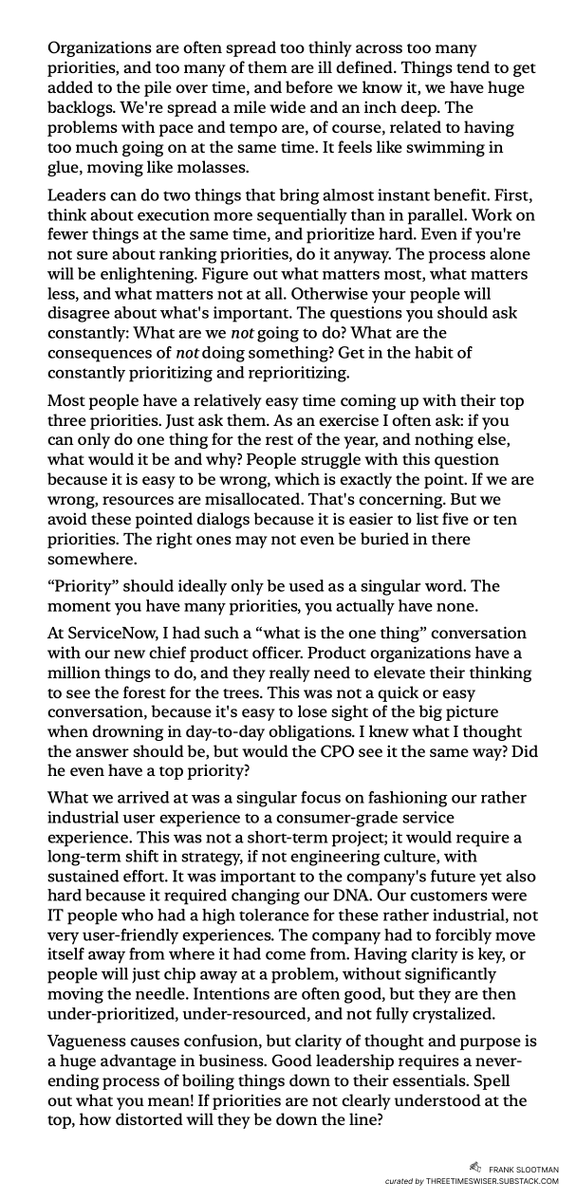
Snowflake CEO Frank Slootman telling the hard truths.
Chris Hladczuk tweet media
English
114
624
6.2K
1.5M
Martin Dubuc retweetledi
SeqOne
SeqOne@seqonegenomics·
🎯 Proud to announce that the SeqOne Platform has achieved IVDR certification as a Class C medical device! 🚀 This landmark certification from GMED marks a crucial milestone in our mission to advance precision medicine through trusted genomic analysis. As one of the first bioinformatics platforms to achieve this certification, we're setting new standards in clinical genomics. 🔬 Why this matters: • Class C certification represents one of the highest risk classifications for diagnostic software • Built on our ISO 13485-certified Quality Management System • Enables laboratories to confidently transition from RUO to certified clinical solutions For our partners and clients, this certification means enhanced confidence in delivering precise genomic insights for oncology and rare disease diagnostics, backed by a platform that meets the most stringent regulatory requirements. We want to thank our incredible team for their relentless dedication to excellence, our partners for their trust, and our customers for continuously pushing us to innovate while maintaining the highest quality standards. 🔗 Read the full announcement: seqone.com/news/seqone-pl… #PrecisionMedicine #Genomics #IVDR #Innovation #HealthTech #ClinicalDiagnostics #NGS #RareDiseases #Oncology #QualityFirst #RegulatoryExcellence
SeqOne tweet media
English
0
1
1
145
Martin Dubuc retweetledi
ₕₐₘₚₜₒₙ
ₕₐₘₚₜₒₙ@hamptonism·
obsession over everything.
ₕₐₘₚₜₒₙ tweet media
English
76
1K
12.3K
571.8K
Martin Dubuc retweetledi
Kpaxs
Kpaxs@Kpaxs·
Sharpen your focus by Frank Slootman, former CEO of Snowflake.
Kpaxs tweet media
English
20
210
2.1K
401.5K