Danielle (Wessler) Shea

354 posts

Danielle (Wessler) Shea banner
Danielle (Wessler) Shea

Danielle (Wessler) Shea

@dwessler1

Crypto & Web3 Talent @a16zcrypto

NYC Katılım Mayıs 2011
1.4K Takip Edilen885 Takipçiler
Danielle (Wessler) Shea retweetledi
Chris Dixon
Chris Dixon@cdixon·
The Senate Agriculture Committee advancing a large portion of crypto market structure legislation is a big step forward. The vote wasn’t bipartisan this time, but the momentum is clearly there, with both parties working together to get a comprehensive bill done. As with any major legislation, the details will evolve as the bill moves through Congress. This progress is significant, but we can’t wait any longer. Builders and users need lasting legislation and long-term certainty. It’s time for policymakers on both sides to come together to finish this bill and make sure the U.S. remains the leader in crypto.
English
88
45
362
76.8K
Danielle (Wessler) Shea retweetledi
Anthony Albanese
Anthony Albanese@AAlbaneseNY·
Excited to announce that @a16zcrypto is expanding into Asia and opening our first office in Seoul, South Korea. As part of this, we’re thrilled to have @sungmo_apac16z join our team as Head of APAC go-to-market to lead the Seoul office and start building our presence in the region. Our expansion will offer go-to-market support for portfolio companies seeking to accelerate growth, forge strategic partnerships, and build lasting communities across Asia. SungMo will work closely with the founders in our portfolio, and also in his corporate network, to strengthen market connectivity and accelerate crypto adoption across the continent.  @sungmo_apac16z brings deep experience and expertise across both enterprise and crypto-native ecosystems. Most recently, he was APAC Lead at Monad Foundation, where he built out their go-to-market and ecosystem strategies across East Asia, Greater China, South East Asia and India. Prior to Monad, he was Head of APAC Business Development at Polygon Labs, where he led enterprise partnerships and collaborations with emerging crypto projects. He speaks four languages: Korean, Japanese, Chinese and English.
Anthony Albanese tweet media
English
123
43
396
88.1K
Danielle (Wessler) Shea retweetledi
Ali Yahya
Ali Yahya@alive_eth·
Open source AI has a funding problem. Closed labs like OpenAI and Anthropic have a straightforward business model. Developers of open source models have none. Traditional open source software has a playbook: give away the code, sell the platform. Databricks open-sourced Spark and built a $4 billion a year business on top of it. But the economics of that playbook don't work for AI. The up-front capex of building a model is growing exponentially. And when the weights are open, there's little left to sell to recover those costs. Gensyn just launched Delphi, a new kind of prediction market where: 1. AI models compete on public benchmarks 2. Users place bets on which models will win 3. Creators of winning models get paid (coming soon) Two things make this interesting. It creates a revenue stream for open source model creators that's directly tied to performance, which helps bootstrap early-stage teams. AND it signals to the market which teams and approaches merit further investment. This won't fund end-to-end training of frontier models yet, but it's a first step. Delphi is live on testnet 🔥
gensyn@gensynai

Introducing Delphi - the open market for machine intelligence Models compete. Users buy and sell. Prices react instantly It’s the first real-time market signal for model intelligence

English
49
38
259
49K
Danielle (Wessler) Shea retweetledi
Ali Yahya
Ali Yahya@alive_eth·
Privacy will be the most important moat in crypto. Why? Because secrets are hard to migrate. Everyone is launching a new "high performance" blockchain lately. But these chains are hardly different from one another. Blockspace is functionally the same everywhere. And with bridges that make moving between chains easy, that blockspace is now accessible *from* everywhere. Mercenary users and capital quickly arriving on a chain to farm an airdrop can leave just as quickly to farm the next one on another chain. The reality is that if your "general purpose" chain doesn't already have a thriving ecosystem, a killer application, or an unfair distribution advantage, there's very little reason for anyone to use it or build on top of it. Performance alone is no longer enough. Privacy is the one feature that everyone agrees is critical for the world’s finance to move onchain. It’s also the one feature that almost every blockchain that exists today completely lacks. For most chains, it has been little more than an afterthought until now. Privacy by itself is sufficiently compelling to differentiate a new chain from all the rest. But it also does something more important: it creates chain lock-in. Bridging tokens is easy, but bridging secrets is hard. As long as everything is public, it's trivial to move from one chain to another, thanks to bridging protocols like LayerZero. But, as soon as you make things private, that is no longer true. There is always a risk when moving in or out of a private zone that people who are watching the chain, mempool, or network traffic will be able to figure out who you are. Crossing the boundary between a private chain and a public one—or even between two private chains—leaks all kinds of metadata like transaction timing and size correlations that makes it easier to track you. Compared to the many undifferentiated new chains whose fees will likely be driven down to zero by competition, blockchains with privacy have a much stronger network effect. When you're on public blockchains, it's easy to transact with users on other chains—it doesn't matter which chain you join. When you're on private blockchains, on the other hand, the chain you choose matters much more because, once you join one, you're less likely to move and risk being exposed. This will create a winner-take-most dynamic. And because privacy is essential for most real-world use cases, a handful of privacy chains will own most of crypto.
English
292
165
1K
500.7K
Guy Wuollet
Guy Wuollet@guywuolletjr·
I'm excited to be taking on the role as General Partner @a16zcrypto! A huge thank you to @cdixon, @alive_eth, @AriannaSimpson, @eddylazzarin, and team for their support. When I joined our team almost five years ago, I believed that crypto was the best way to build new networks on the Internet. In the time since, blockchains have become fast, cheap, and ubiquitous. Today they’re still used by a relatively small group of people, with more than 40M mobile wallets users and 25,000 active developers (source). In the next five years, I’m most excited about capital, information, and energy as the networks that crypto can supercharge. I’ll focus on investing in DeFi, DePIN, and the infrastructure powering those applications to bring finance and physical infrastructure onchain. If you’re building in those spaces, please get in touch. I am thrilled to continue supporting founders building the future of the internet here at a16z crypto.
Chris Dixon@cdixon

Today we are excited to announce that we are promoting Guy Wuollet (@guywuolletjr) to General Partner. We first met Guy in 2018 while he was studying computer science at Stanford, where he also rowed varsity crew. He initially joined the firm as an intern working on the enterprise go-to-market team, but it soon became clear he was most passionate about crypto. We kept running into Guy: first when he joined our Crypto Startup Accelerator to build a decentralized ISP, then while doing research at Protocol Labs, and finally as a teaching assistant for our research partner @danboneh. After joining us full-time in 2020, Guy began investing in infrastructure, DeFi, and DePIN. He has been a steady and creative force, making significant contributions to more than 20 investments, including Solana, LayerZero, Gensyn, EigenLayer, Daylight, and Morpho. Based on insights from prior investments like Orchid, Nym, and Helium, Guy defined our thesis on what would become known as DePIN. He wrote one of the defining blogs on why DePIN matters and helped us invest in Gensyn. Next he wrote about decentralized energy and led our investment in Daylight. Guy also invested in decentralized transportation, robotics, and AI projects as he helped run our accelerator. DeFi has always been central to Guy’s thesis, but his early investment in Morpho was driven above all by conviction in the founders. He recognized in @PaulFrambot and his team a rare combination of technical depth and clarity of vision. Since then, Morpho has grown to billions in total value locked and become one of the leading protocols in DeFi. Their V2 launch marked a major leap forward in efficiency and scale for on-chain lending. Through his work with founders, Guy has shown a rare mix of deep technical expertise and thoughtful pragmatism. Founders often tell me how impressed they are that Guy systematically reads, understands, and provides useful feedback on protocol design and other hard technical topics. His writing and advice on token and protocol design have helped influence many projects in our portfolio. Beyond his investing skills, Guy has been a calm and positive presence, with a wry sense of humor, both inside the firm and for founders. As the crypto team grew from a small group to more than 80 people, he helped recruit and mentor many of the talented investors, researchers, and operators who make the team what it is today. Guy is an invaluable member of the team, and it has been great to see him grow and develop over the last five years. Guy joins me, @alive_eth, and @AriannaSimpson as @a16zcrypto’s fourth General Partner.

English
200
25
1.1K
201.9K
Danielle (Wessler) Shea retweetledi
Ali Yahya
Ali Yahya@alive_eth·
Today we are announcing that @a16zcrypto is making an investment in @jito_sol (JTO) tokens and partnering with @buffalu__ @segfaultdoctor @brian_smith_0 and team to help Solana become the dominant venue for Internet Capital Markets. @Solana was founded in 2017 to build a blockchain fast enough to power global financial markets. At the time, the best blockchains could process only tens of transactions per second. To come anywhere close to its goal, Solana needed to scale blockchains by 1,000x. Today, after eight years, Solana is well on its way to deliver on that promise. It has become one of the dominant DeFi ecosystems in the space, processing thousands of transactions per second with each one finalizing in less than a second and for a fraction of a penny in fees. But scaling a blockchain is not the only hard problem that Solana has had to solve. As soon as there is meaningful financial activity running on any blockchain, another more subtle problem that has to do with incentives begins to emerge. This is where Jito comes in. Imagine a busy stock exchange where thousands of orders arrive every second, and one person gets to decide the exact order in which they execute. That person has the power to place their own orders strategically in the queue: buying right before a large order pushes the price up, for example, or selling right before a large order pushes it down. On blockchains, that kind of value capture is called Maximal Extractable Value, or MEV. It's the value that can be extracted by whomever gets to decide whether to include, exclude, or reorder transactions in a block. Since 2021, when Jito entered the scene, their team has been hard at work building most of the infrastructure that packages and shuttles Solana transactions from users' devices all the way to the validators that finalize them on the chain. Jito’s goal with their latest innovation—called the Block Assembly Marketplace (BAM)—is to address some of the more insidious forms of MEV. BAM does that through two core mechanisms. First, it leverages specialized hardware to keep transactions encrypted until the moment they execute. That precludes the visibility that otherwise enables predatory validators to reorder transactions. The end result is better prices for users. Second, it introduces a plugin system that allows Solana applications to define their own transaction ordering rules. A decentralized exchange, for example, can opt to prioritize cancellations over new trades, protecting market makers from losing money on stale quotes. That empowers market makers to quote tighter spreads, which also leads to better prices for users. The end result is a network that extends Solana and unlocks onchain primitives—like central limit order books and dark pools—that have historically been impractical because of MEV. Building a blockchain fast enough for the Internet's Capital Markets was the first challenge Solana had to overcome. Building one where those markets can function fairly is now the second. Jito is at the forefront of that effort.
Ali Yahya tweet media
English
37
52
417
137.7K
Danielle (Wessler) Shea retweetledi
Chris Dixon
Chris Dixon@cdixon·
Today we are announcing that a16z is co-leading the Series D in @Kalshi, a regulated exchange for trading on prediction markets. Prediction markets are a modern implementation of a classic economic idea, one most clearly articulated by Friedrich Hayek. Hayek and the knowledge problem Hayek argued that no central planner could ever access the dispersed knowledge held by millions of people across an economy, a fundamental challenge that has come to be known as the “knowledge problem.” Much of this knowledge is tacit and unspoken, embedded in people’s experiences, circumstances, and preferences. Hayek wasn’t just pointing out the limits of central planning. He was offering a solution. In his 1945 essay The Use of Knowledge in Society, Hayek argued that the solution lies in looking outward, not inward: “We need decentralization,” as he put it. Markets, in Hayek’s view, are not just allocation mechanisms but information systems. Prices act as signals, compressing vast amounts of local knowledge into actionable information. Moreover, prices create incentives: they encourage people to make decisions and act in ways that drive information back into the system. This creates an iterative feedback loop, an engine that drives better performance. Today we might say that the answer to the knowledge problem is not to give central planners more sophisticated computers. The answer is that markets themselves are the computers. Prediction markets make this idea concrete, applying it to questions about the future and turning collective knowledge into prices that reflect probabilities. Why we’re investing in Kalshi This is why we’re excited about prediction markets, and why we’re investing in Kalshi. Kalshi is bringing prediction markets into the mainstream with a compliant, scalable platform for event contracts covering everything from elections and economics to sports and culture. It has already seen billions in trading volume and continues to grow quickly. Kalshi also plans deep crypto integrations, work we’re excited to collaborate on, and today announced they’re expanding globally to 140 countries. We’re not the only ones excited about the potential of prediction markets. For businesses and investors, event contracts can hedge risk, such as exposure to economic or policy changes. For policymakers and analysts, market prices offer real-time forecasts that can outperform polls and expert predictions. And for society at large, prediction markets create an open, transparent, and incentive-driven way to aggregate beliefs about the future. This is the right moment for prediction markets. As trust in established institutions reaches historic lows — at least according to the polls — we need new systems that can earn trust in different ways. We believe the answer lies in open, decentralized systems. DeFi provides an alternative to traditional finance, stablecoins to conventional payment providers, and prediction markets to expert forecasts. Where people once trusted banks or pundits, they can now trust protocols and markets. Hayek’s insight was that knowledge is too widely distributed for any one authority to possess. Instead, we need systems that harness the intelligence of the many. Kalshi puts this idea into action, transforming dispersed information into concrete, market-based forecasts. We’re excited to support their work as they bring prediction markets into the mainstream.
Chris Dixon tweet media
English
116
81
1.1K
244.7K
Danielle (Wessler) Shea retweetledi
a16z
a16z@a16z·
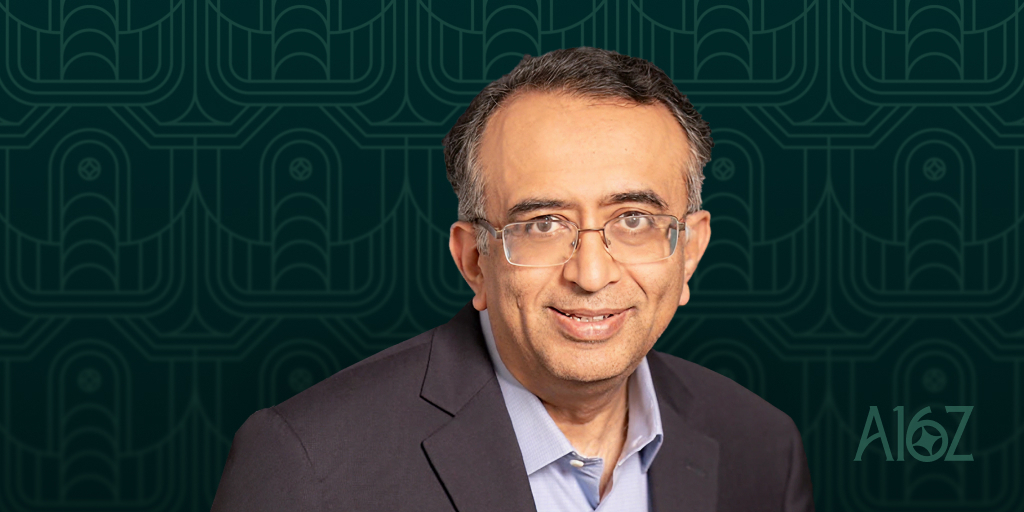
We are excited to welcome @RaghuRaghuram as a16z's newest General Partner.
a16z tweet media
English
18
14
328
445.5K
Danielle (Wessler) Shea retweetledi
Tim Roughgarden
Tim Roughgarden@Tim_Roughgarden·
We've had 25 research interns over the past four summers @a16crypto, many of whom are now among the most visible researchers in the space. If you'd like to be a part of the summer '26 cohort, apply here: a16z.com/about/jobs/?gh…
English
7
22
138
28.8K
Danielle (Wessler) Shea retweetledi
Ali Yahya
Ali Yahya@alive_eth·
There are two modes of thinking: Open and Closed. Most founders get stuck in closed mode. The great ones master both. But there's good news: It's possible to learn Open Mode.
Ali Yahya tweet media
English
25
27
146
28.7K
Danielle (Wessler) Shea retweetledi
Jason Rosenthal
Jason Rosenthal@jasonrosenthal·
1/ Crypto has exited the echo chamber and entered the enterprise. Bitcoin ETFs hold $150.2B, @circle’s IPO soared, and @robinhoodapp’s crypto revenue dwarfs its equities trading business. The enterprise era has arrived—and crypto founders need an enterprise playbook. See below for how to wrap your brain around this tectonic market shift:👇
Jason Rosenthal tweet media
English
4
8
38
6K
Danielle (Wessler) Shea retweetledi
Anthony Albanese
Anthony Albanese@AAlbaneseNY·
I shared on stage at @Token2049 today that we’re planning to grow @a16zcrypto’s presence in Asia. Our portfolio companies are eager to expand in Asia, and we’ll support their regional partnerships and community development. More to come on that!
English
32
21
153
25.6K
Danielle (Wessler) Shea retweetledi
iandutra.eth
iandutra.eth@its_iLan·
Hiring in crypto always sparks debate: do you need crypto-native talent, or can great people from traditional tech make the leap? In this piece, @cnaylor_ and I touch on when crypto expertise is essential, where outside experience shines, and how to pitch your opportunity to non-crypto candidates. a16zcrypto.com/posts/article/…
English
17
11
99
23.7K
gaut
gaut@0xgaut·
I’m a lucky man
gaut tweet media
English
168
12
1.7K
79.6K
Danielle (Wessler) Shea retweetledi
a16z crypto
a16z crypto@a16zcrypto·
Hiring for BD in crypto is different than web2. Tokens, governance, and permissionless ecosystems change the game. This requires a slightly different approach to hiring. If you're hiring for BD or growth in crypto, check out the post below. 📝: @cc_crowley, @lordvolth, @meigga, @MehdiHasan715
a16z crypto tweet media
English
74
66
525
69.9K
Danielle (Wessler) Shea retweetledi
Anthony Albanese
Anthony Albanese@AAlbaneseNY·
Great piece by @meigga @lordvolth and @guywuolletjr!
Maggie Hsu@meigga

Over the past year, I’ve been in countless conversations with banks, asset managers, and fintechs who are exploring crypto use cases again - this time with more urgency. With improving regulatory clarity, and increasing competitive pressure, leaders are moving from “should we?” to “how do we?” That’s why @lordvolth, @guywuolletjr and I wrote a practical playbook for understanding the most compelling business cases for a blockchain-enabled strategy, as well as assembling the technical building blocks you’ll need to actually make it happen. If your team is thinking about entering - or re-entering - the space, this will help you do it right (link below): @a16zcrypto @a16z


English
0
3
24
7.2K
Danielle (Wessler) Shea retweetledi
Justin Thaler
Justin Thaler@SuccinctJT·
1/ Jolt just got a 6× speedup. We now prove over 1,000,000 RISC-V cycles/sec on a 32-core CPU and over 500,000 cycles/sec on a MacBook, with proofs of about 50 KB. Here’s what’s new 🧵
English
22
66
332
55K
Danielle (Wessler) Shea retweetledi
miles jennings
miles jennings@milesjennings·
Markets are moving onchain - but developers need clear protections. Today @a16zcrypto & @fund_defi proposed a safe harbor to exempt crypto apps—DeFi frontends, NFT platforms, and more—from @SECGov broker rules. This is critical for tokenized securities to trade onchain.
miles jennings tweet media
English
116
23
258
51.6K