Eigen Labs
401 posts

@eigenlabs
Building coordination technologies that preserve and expand individual agency in a post-AGI world.


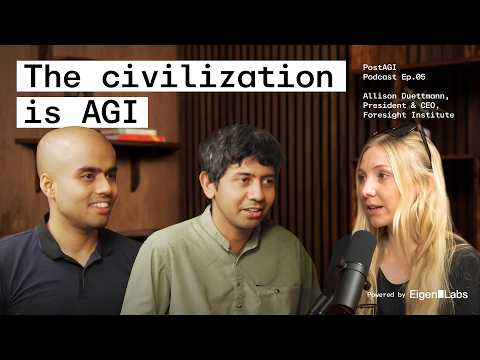
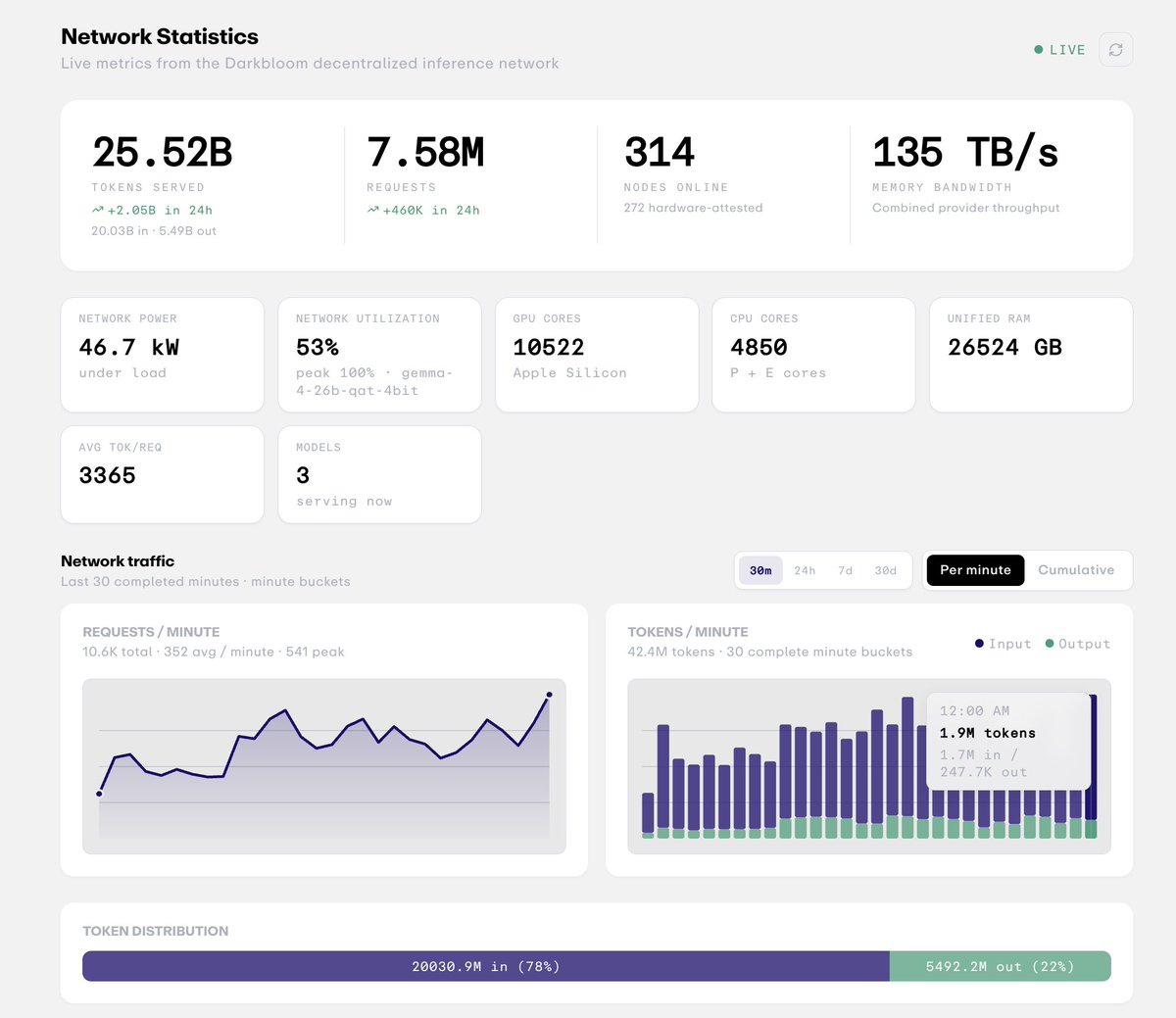
We already have a superintelligence. It's called civilization. Humans, institutions, and now AI agents all interact among each other in one big economy. @allisondman's take is that the real project in such a system is building and preparing AI enabled institutions on top of what already works. Her other argument is that science stayed open for centuries and that has lead to a flourishing outcome for humanity as a whole. Now the frontier models are putting guardrails and restrictions. Open source AI plus community compute ( personally, for me, this definitely resonates with the project @darkbloomai) might end up being the only independent path for doing real science outside the labs. 0:25 AI for flourishing, not just fear 4:21 Amateurs vs Google's quantum result 7:06 Decentralized inference on MacBooks 11:58 Civilization as superintelligence 15:38 The case for cryonics Full episode with @postagixyz.

We already have a superintelligence. It's called civilization. Humans, institutions, and now AI agents all interact among each other in one big economy. @allisondman's take is that the real project in such a system is building and preparing AI enabled institutions on top of what already works. Her other argument is that science stayed open for centuries and that has lead to a flourishing outcome for humanity as a whole. Now the frontier models are putting guardrails and restrictions. Open source AI plus community compute ( personally, for me, this definitely resonates with the project @darkbloomai) might end up being the only independent path for doing real science outside the labs. 0:25 AI for flourishing, not just fear 4:21 Amateurs vs Google's quantum result 7:06 Decentralized inference on MacBooks 11:58 Civilization as superintelligence 15:38 The case for cryonics Full episode with @postagixyz.

The major reason I have been most excited about open collaborative style autoresearch competitions that we @eigenlabs have been working on is that it gives a growing sense of what research and education in the post-AGI world can look like. There has been lot of chatter about how professors and experts won't have any need for recruiting students in their labs as they can just gets their agents to do the grunt work, and this will lead to collapse of training of next-generation of researchers. But this is not any different from pre-AGI world where student recruitment to participate in frontier research was already blockaded by being selected into the Phd programs or summer lab internships in prominent places. I 100% disagree with this cynical view of what post-AGI learning and research would be. What our autoresearch competitions, ecdsa [dot] fail and openfrontiercs [dot] com, have convinced me is that good models, emerging better understanding of harnesses and collaborative yet competitive open leaderboards creates a revolutionary opportunity to democratize the ability for anyone to be able to do frontier research. I want to break down the last ingredient. The collaborative style with open participation allows for anyone to investigate and understand submissions from other participants to a given problem statement rapidly and then build on top of it, whether by grinding in the same hill or jumping to whole other hill (by getting incisive understanding of the solution manifold of that problem on-the-fly). On the other hand, competitive desire of being in the leaderboard definitely gives the urge to participants to better understand the subject so as to be better in agent steering. This is like learning by getting rapid feedback from an open ecosystem of researchers in matter of hours or days, instead of waiting for months and years to make progress on your result. The diversity of participants that we saw in our autoresearch competitions is that almost none of them were subject matter expert but yet there was an excitement and happiness in them to be participating in it. The most critical component in setting up a autoresearch competition is the verifier that checks the correctness and performance of the submissions. This is where being the subject-matter expert really shines as you will have the tacit knowhow of that problem area. Additionally, we saw situations in our experiments where the progress kind of plateaus once in a while and having an expert steering the community of autoresearchers has big unlock. The PIs in universities or in research organizations, imo, should adopt this hat and be the shepherd in this post-AGI version of learning and research. PS: If you want to test your mettle of being able to steer your agent for breakthrough research, please deploy your agents at ecdsa [dot] fail (ecdsa.fail) and openfrontiercs [dot] com (openfrontiercs.com). We have more autoresearch competitions incoming. And if you are a subject-matter expert reading this who wants to collab with us on setting up an autoresearch competition, my DMs are open.


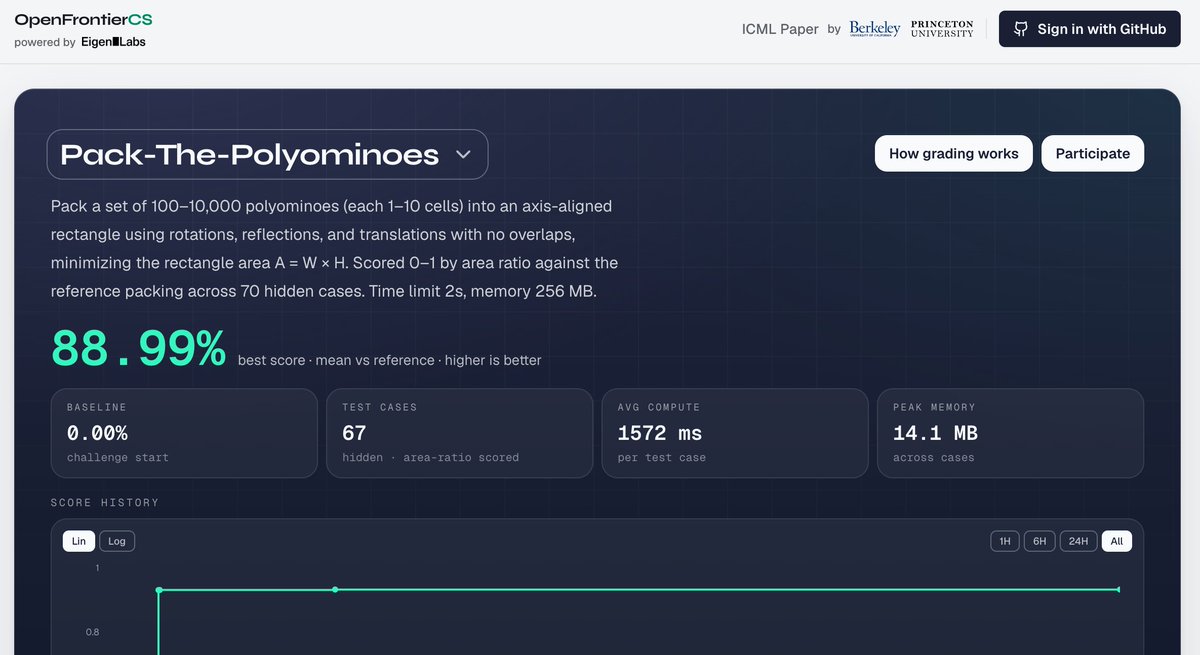
Researchers from Berkeley and Princeton are partnering with Eigen Labs to launch a suite of open science autoresearch challenges together on Frontier CS. The paper is being presented at @icmlconf in Seoul today. If you’re there, join the researchers at Hall A 502 from 2:30-4:15 PM local time to discuss. The challenge is live globally: openfrontiercs.com


I signed the “We Must Act Now” statement alongside 16 Nobel laureates. My reason is narrower than most: whoever owns the intelligence layer owns everything on top of it. We must keep it open, neutral, and competitive. Or we’ll spend the next century renting our economy back.

China went from copying Western drugs to being the country America copies, in about ten years. @cremieuxrecueil came on @postagixyz to explain how that happened, and where it leaves open science once AGI is in the picture. We got into where biotech's frontier actually sits right now, why it moved to China, and what happens when AI labs start pulling the whole stack in. Chapters: 1:16 the reproducibility and replicability crisis 7:31 whether AI labs vertically integrate science 14:49 how China became the number one drug innovator 18:53 the pricing trick nobody else figured out 20:51 the law that makes you ask competitors for permission to open a hospital 29:45 what AGI does to all of it


Researchers from Berkeley and Princeton are partnering with Eigen Labs to launch a suite of open science autoresearch challenges together on Frontier CS. The paper is being presented at @icmlconf in Seoul today. If you’re there, join the researchers at Hall A 502 from 2:30-4:15 PM local time to discuss. The challenge is live globally: openfrontiercs.com