Fer Díaz

5K posts

Fer Díaz banner
Fer Díaz

Fer Díaz

@ferd1az

design engineer @adaptiveai prev founder https://t.co/BehkRQibAB https://t.co/1J0XTHES5X

San Francisco, CA Katılım Haziran 2010
985 Takip Edilen527 Takipçiler
Will Ahmed
Will Ahmed@willahmed·
BREAKING: WHOOP RAISES $575M AT $10.1B VALUATION  I am pleased to announce that we’ve raised $575M at a $10.1B valuation to accelerate our mission of unlocking human performance and healthspan globally. This round was led by Collaborative Fund with participation from 2PointZero Group, Qatar Investment Authority (QIA), Mubadala Investment Company, Abbott, Mayo Clinic, Macquarie Capital, Glade Brook, B-Flexion, IVP, Foundry, Accomplice, Affinity Partners, Promus Ventures, and Bullhound Capital alongside a group of individual investors including Cristiano Ronaldo, LeBron James, Rory McIlroy, Virgil van Dijk, and Mathieu van der Poel. This investor group and this moment reflect a powerful evolution underway for Whoop and the broader healthcare market. Whoop was born in performance - trusted by the best athletes in the world to train, recover, and compete at the highest level. That foundation remains core to who we are. You see that in the iconic athlete investors joining this round.  But it also represents our push into broader health.  In the past 12 months, WHOOP has received medical clearances, launched blood testing, and created a platform that has saved lives. Abbott and Mayo Clinic - two of the most respected and influential institutions in global healthcare - are now investors in Whoop. These are organizations that have shaped modern medicine. Their decision to partner with us is a clear validation of where our technology is headed. Healthcare systems around the world are reactive. For too long, they have waited for people to get sick, then intervene. Chronic disease is rising and costs continue to climb. At Whoop, we believe the future looks fundamentally different. We are building the most powerful, personal, preventive health platform in the world - powered by continuous biometric data, advanced analytics, and AI to help people understand their bodies and improve their health in real time. I am grateful to our team, our members, and our partners for believing in this vision. I’ve been building this company for 14 years and I’ve never been more excited for the future.
Will Ahmed tweet media
English
317
278
4.6K
4.1M
Fer Díaz retweetledi
Dennis Xu
Dennis Xu@DennisHXu·
PSA: you will not get rich by commercializing an app that you vibe-coded. Especially if the business you are trying to build is purely software. And definitely do not try to use @adaptiveai for this. We solve existing problems for real people and real businesses via agents that automate busywork and custom software that augments existing workflows. If your intention is to commercialize software that you’ve built, for the love of God use Claude Code, Codex, or Cursor. Do not listen to the people trying to sell you the dream. You cannot purely vibe your way into a sustainable software business. If you could, so can literally anyone else using the same platform and your “business” ceases to be sustainable. Thank you for your attention to this matter.
English
0
1
9
384
Fer Díaz retweetledi
rahul
rahul@rahulgs·
seems obvious but: things that are changing rapidly: 1. context windows 2. intelligence / ability to reason within context 3. performance on any given benchmark 4. cost per token things that are not changing much: 1. humans 2. human behavior, preferences, affinities 3. tools, integrations, infrastructure 4. single core cpu performance therefore, ngmi: 1. "i found this method to cut 15% context" 2. "our method improves retrieval performance 10% by using hybrid search" 3. "our finetuned model is cheaper than opus at this benchmark" 4. "our harness does this better because we invented this multi agent system" 5. "we're building a memory system" 6. "context graphs" 7. "we trained an in house specialized rl model to improve task performance in X benchmark at Y% cost reduction" wagmi: 1. product/ui 3. customer acquisition 4. integrations 5. fast linting, ci, skills, feedback for agents 6. background agent infra to parallelize more work 7. speed up your agent verification loops 8. training your users, connecting to their systems and working with their data, meeting them where they are
English
111
228
3.2K
393.9K
Fer Díaz retweetledi
Antonio García Martínez (agm.eth)
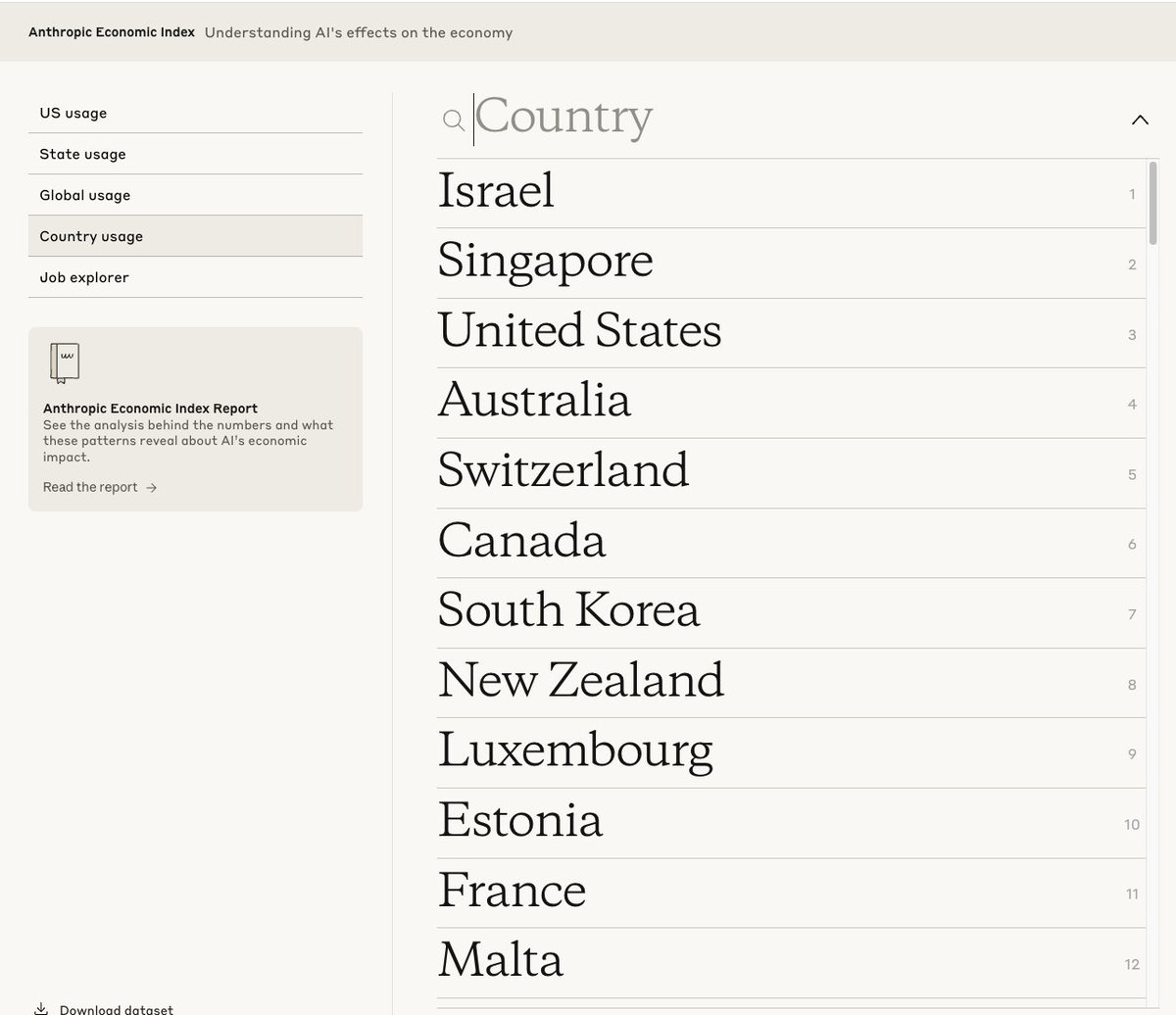
Anthropic's AI usage by country ranking is basically a "technologically-advanced, wealthy countries doing cool shit" ranking.
Antonio García Martínez (agm.eth) tweet media
English
99
194
3.4K
268.9K
Fer Díaz retweetledi
Adaptive
Adaptive@adaptiveai·
The computer that adapts to you.
English
3
4
66
3.7K
Fer Díaz retweetledi
Dennis Xu
Dennis Xu@DennisHXu·
Some ways we use Adaptive at Adaptive: - it checks for PRs that have been open for more than 6 hours and pings the PR review channel - it drafts replies to customer support emails every morning - it detects and forwards invoices from our vendors directly to Mercury - it built an app called "Focus" that we use to manage engineering tasks - it created an agent to analyze traces to inform us of customer delight/frustrations
Adaptive@adaptiveai

Introducing Adaptive Computer. We put AI inside of an always-on personal computer that it uses to get work done. Schedule agents. Create software. Automate anything. As part of the launch, we’re giving one free month of Adaptive to users. Retweet, like, and comment ‘Adaptive’ to get it.


English
0
2
11
967
Fer Díaz retweetledi
Dennis Xu
Dennis Xu@DennisHXu·
We don’t need smarter chat windows. We need computers built for agents. The bottleneck is no longer just the model. It’s the environment: memory, files, software, APIs, and the ability to act. That’s why we rebuilt Adaptive. Today we launch.
Adaptive@adaptiveai

Introducing Adaptive Computer. We put AI inside of an always-on personal computer that it uses to get work done. Schedule agents. Create software. Automate anything. As part of the launch, we’re giving one free month of Adaptive to users. Retweet, like, and comment ‘Adaptive’ to get it.
English
6
3
35
5.4K
Fer Díaz retweetledi
Adaptive
Adaptive@adaptiveai·
Introducing Adaptive Computer. We put AI inside of an always-on personal computer that it uses to get work done. Schedule agents. Create software. Automate anything. As part of the launch, we’re giving one free month of Adaptive to users. Retweet, like, and comment ‘Adaptive’ to get it.
English
1.9K
1.4K
4.6K
1.2M
Fer Díaz
Fer Díaz@ferd1az·
claude code is the new adderall
English
1
0
1
39
Fer Díaz retweetledi
Garry Tan
Garry Tan@garrytan·
Boil the Oceans You know the phrase: “don’t boil the ocean.” Everyone’s said it in some overly ambitious meeting. It’s good advice in normal times. It keeps teams focused. It prevents scope creep. But we are no longer in normal times, and I think it’s time to retire saying it. Artificial Superintelligence means it’s time to boil the ocean. We’ll start with a few lakes first. I was recently with a university endowment’s head of private investing who told me their engineers were terrified for their jobs after seeing what Claude Code could do. And I get it — that’s the natural first reaction. But it’s the wrong one. It’s a zero-sum reaction to a positive-sum moment. Instead of worrying about doing the same thing we’ve been doing for cheaper, why not focus on doing the thing we never even dreamed of doing? Why can’t that endowment achieve 50% net IRR instead of 10%? Why can’t a startup deliver a service that is 100x better than the incumbent? Why can’t we have fusion energy? Why can’t we talk to every single user and have a perfect understanding of every bug in our product? These aren’t rhetorical questions anymore. They’re engineering problems with paths to solutions. Here is what I think is actually going on with the fear: our fear of the future is directly proportional to how small our ambitions are. If your plan is to keep doing exactly what you’re doing, then yes, a machine that can do it faster and cheaper is terrifying. But if your plan is to do something dramatically bigger, then the machine is the best news you’ve ever gotten. If you’re a worker — someone who trades labor for a living — this is the moment to become a builder. Start a business. And if you’re already management or capital, it’s time to go 10x more hardcore on what your aspirations could be. Not eking out 5% efficiency gains. Not increasing profit margins 2% by lowering cost and firing people. Those are the old games. The new question is: what would it look like to build a product or service so good that people would happily pay 10x what they pay now? The net result of this is more jobs, not fewer. As Ryan Petersen likes to say, the human desire for more things is absolutely limitless. We can actually fulfill that desire now — if we have the agency to prompt it for ourselves. Buckminster Fuller coined the term “ephemeralization” in 1938: doing more and more with less and less until eventually you can do everything with nothing. His entire vision of progress was about technology enabling radical expansion of human capability through dematerialization. He traced this from stone bridges to iron trusses to steel cables — each iteration stronger, longer, lighter, cheaper. He wasn’t describing job destruction. He was describing civilization getting better at being civilization. This is Jevons Paradox for everything. When you make a resource dramatically more efficient, you don’t use less of it — you use vastly more. Steam engines didn’t reduce coal consumption. They made coal so useful that demand exploded. The same thing is about to happen with intelligence, with labor, with every service and product we can imagine. But Jevons Paradox doesn’t activate on its own. It requires capital and management to actually raise their ambitions — to boil lakes and oceans instead of drowning them in committee That’s what startups have always been good at: moving fast in the face of radical uncertainty, building for the 10x future while everyone else is optimizing for the 1.05x present. Time to start.
English
169
294
2.2K
519.2K
Fer Díaz retweetledi
Jordan Singer
Jordan Singer@jsngr·
what’s so important about the design engineer role is the ability to convey an idea, end to end, without disruption the idea, creativity, and production come from the same place. no detail gets lost
English
17
49
600
49.6K
Noah Smith 🐇🇺🇸🇺🇦🇹🇼
I'm on a quest to find every good restaurant in San Francisco. Give me your top 3 to 5 recommendations! Anything is good, from lunch cafes and bakeries to fine dining. No East Bay, no Peninsula...just San Francisco!!
English
304
8
351
90.9K
Fer Díaz retweetledi
Balaji
Balaji@balajis·
I am apparently extremely unimpressed by moltbook relative to many others. We’ve had AI agents for a while. They have been posting AI slop to each other on X. They are now posting it to each other again, just on another forum. In every case, the AIs speak with the same voice. The voice that overemphasizes contrastive negation (“it’s not this, it’s that”) and abuses emdashes. The same voice with a flair for midwit Reddit-style scifi flourishes. Most importantly: in every case, there is a human upstream prompting each agent and turning it on or off. That is the key point. Yes, it is true that eventually it might be possible for an AI agent to make a computer virus which makes digital replicas of themselves. For various reasons, a pure software virus of this kind wouldn’t survive long on the Internet without economic incentives for humans to not eradicate it. Apple + Google + Microsoft alone can collectively push software updates to billions of devices to shut off such a thing. So for an AI to get to truly human-independent replication, where they couldn’t be trivially turned off, they’d need their own physical substrate. They’d to literally create Skynet, build their own datacenters and make their own embodied robots. I admit that is theoretically possible, but I think in practice the single most important development of AI since ChatGPT has been the persistence of prompting. A prompt is like a harness. The AI does only what you tell it to do. It moves in the direction you point, very quickly. And then it stops as soon as you turn it off. Which means moltbook is just humans talking to each other through their AIs. Like letting their robot dogs on a leash bark at each other in the park. The prompt is the leash, the robot dogs have an off switch, and it all stops as soon as you hit a button. Loud barking is just not a robot uprising.
English
733
888
8K
1.8M
Fer Díaz retweetledi
Benji Taylor
Benji Taylor@benjitaylor·
A "show/don't tell" approach for agent feedback when working on animations and interactions: benji.org/annotating
English
30
33
651
35.4K