Deirdre💧🔥💨

37.6K posts

Deirdre💧🔥💨 banner
Deirdre💧🔥💨

Deirdre💧🔥💨

@flowinguphill

Societal shifts, climate change, and AI from complex systems perspective. Practice satyagraha. Prev: Center for Nonlinear Studies / LANL, @SFIScience

California, USA Katılım Ağustos 2010
4.6K Takip Edilen5.5K Takipçiler
Deirdre💧🔥💨 retweetledi
Colin McCarthy
Colin McCarthy@US_Stormwatch·
California's snowpack has collapsed at a pace never seen before in late winter, the fastest late February–March melt on record. Spring snowpack is now on track to be the second smallest since records began in 1950, trailing only 2015, the lowest snowpack year in the Sierra Nevada in at least the last 500 years. Phillips Station, the state's most iconic snowpack measurement site, is expected to show bare ground on April 1, the date that has historically marked peak snowpack.
English
34
274
852
60.5K
Deirdre💧🔥💨 retweetledi
Daniel Swain
Daniel Swain@Weather_West·
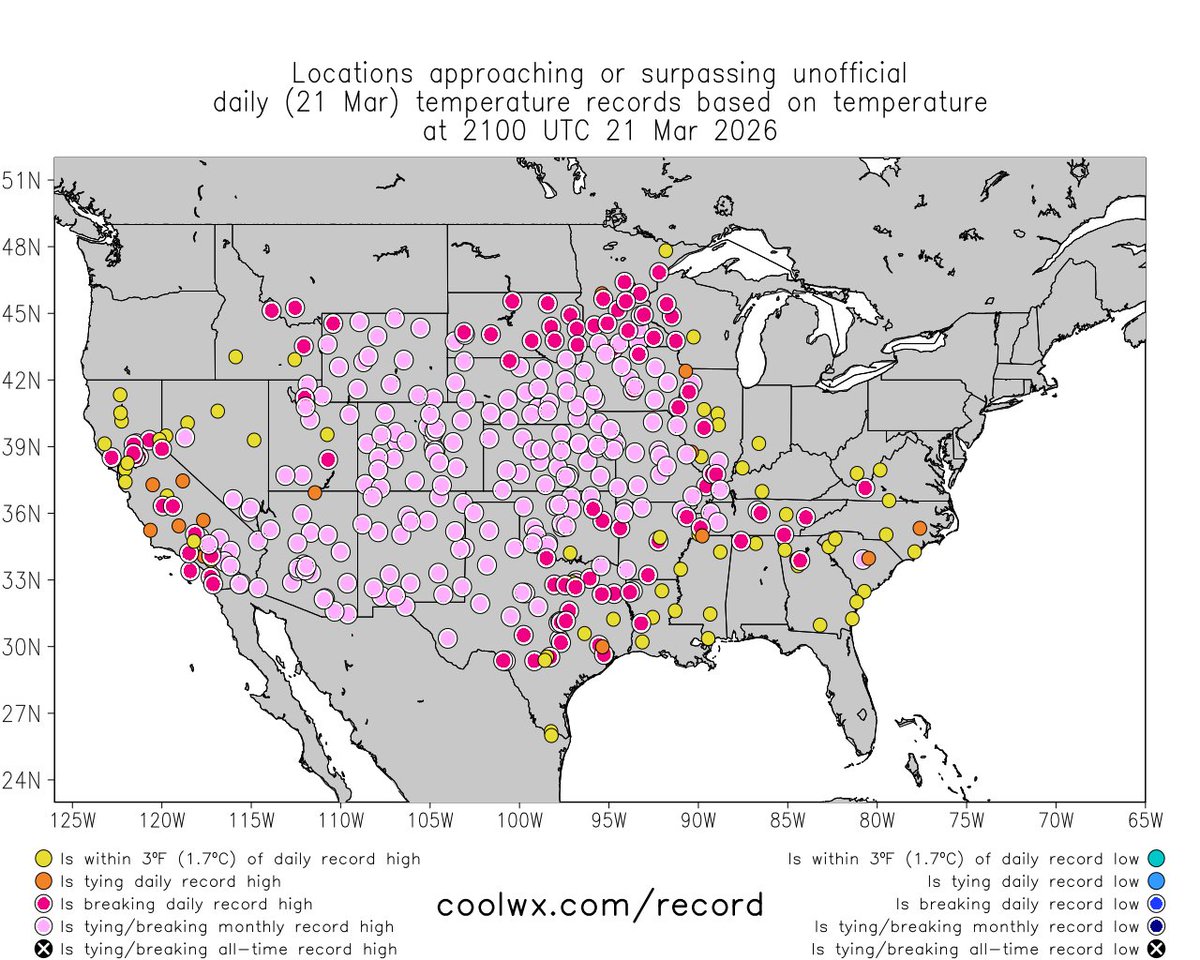
Incredibly, even *more* locations across U.S. are today experiencing their warmest March temperatures on record--many by a wide margin, with some even breaking April records. This includes most or all of: AZ, UT, CO, NM, WY, NE, KS, MO, IA, plus portions of many other states. 🫠
Daniel Swain tweet media
English
12
152
395
42.2K
Deirdre💧🔥💨
Deirdre💧🔥💨@flowinguphill·
This looks like an important study.
fj@gecko39

Nonlinear increase of compound drought-heatwave events since the early 2000s PDF science.org/doi/reader/10.… 06MAR2026 Yong-Jun Kim, Sang-Wook Yeh et al science.org/doi/10.1126/sc… Abstract Compound drought-heatwave events (CDHEs) have substantially increased since the early 2000s, posing elevated risks to socio-ecosystems. However, the physical characteristics of drought- and heatwave-leading CDHEs and their relative contributions to the overall increase remain unexplored. Using a multihazard pair generation algorithm with daily reanalysis data, we show that this increase is primarily driven by heatwave-leading CDHEs, with the slope of increase in affected land area having risen nearly eightfold, from 1.6 to 13.1% per degree Celsius since the early 2000s. This pattern is evident at the global scale but also shows considerable regional variation. We find that the nonlinear amplification of land-atmosphere coupling since the late 1990s has not only induced the emergence of statistically significant positive sensitivities in previously unresponsive regions, but also markedly enhanced sensitivities in high-occurrence regions. These findings highlight the importance of considering the disproportionate regional risks associated with heatwave-leading CDHEs when adapting to climate change. INTRODUCTION Compound drought-heatwave events (CDHEs), the co-occurrence of droughts and heatwaves, have increased considerably since the beginning of the 21st century (1–4). These events have been exacerbating socioeconomic damage in sectors such as agriculture, ecosystems, and public health (5–7). For instance, in 2010, compound events accompanied by wildfires in Russia resulted in ~55,000 deaths (8, 9). Similarly, multiple heatwaves and droughts prolonged the unprecedented and devastating “Black Summer” bushfires in southeastern and eastern Australia (EAU) from 2019 to 2020 (10). More recently, the Pacific Northwest heatwave in June 2021 caused extreme drying conditions, leading to a 31% reduction in spring wheat yields and significant declines in barley, canola, and fruit production in British Columbia and Alberta, Canada (11). Numerous studies have investigated the recent upward trends in CDHEs using observational data (7, 12–14) and found that increasing anthropogenic activities have contributed to more frequent and intense CDHEs, particularly in low-income countries (15, 16). CDHEs are often initiated by atmospheric circulation anomalies, such as persistent blocking highs, which create prolonged hot and dry conditions. These conditions can be further intensified through land-atmosphere coupling, where soil moisture deficits and enhanced surface heating reinforce each other (17–22). However, the dynamics leading to CDHEs differ depending on the sequence of events (19, 23). In heatwave-leading CDHEs, increased solar radiation enhances evapotranspiration, leading to favorable conditions for surface droughts (fig. S1A). In contrast, in drought-leading CDHEs, soil moisture depletion restricts the emission of latent heat flux from the land surface to the atmosphere (fig. S1, B and C). This leads to an increase in sensible heat flux, subsequently raising surface air temperatures and generating favorable conditions for heatwaves (fig. S1D). Fig. 1. Spatial pattern and temporal trend of CDHEs. science.org/doi/10.1126/sc… (A) Spatial map showing the total number of CDHE occurrences throughout the study period (1980 to 2023) over the land areas during the warm season from 60°S to 60°N, highlighting the high-occurrence regions. (B) Temporal trends of the global spatial extent of CDHEs (in percent). Red and yellow bars represent heatwave-leading and drought-leading CDHEs, respectively. The blue (red) dashed line indicates the estimated trend in the global spatial extent of CDHEs during the past (1980 to 2001) and recent (2002 to 2023) 22-year periods, based on simple linear regression. The corresponding blue and red values represent the regression slopes and their standard errors at the 99% confidence level. (C) Relative increase ratio of each CDHE type in the recent 22-year period compared with the past 22-year period. The increase ratio was calculated based on the average spatial extent during the past 22-year period, serving as a baseline for comparison with the recent period.

English
0
0
1
63
Deirdre💧🔥💨 retweetledi
Prof. Stefan Rahmstorf 🌏 🦣
Did you know what causes Ice Ages? It is the Earth’s orbital cycles, known since Milanković computed them in the 1920s. When you drive a climate model with these cycles, it will reproduce the sequence of Ice Ages as we know it from paleoclimate data. realclimate.org/index.php/arch…
English
10
37
146
5.4K
Deirdre💧🔥💨 retweetledi
Jay Van Bavel, PhD
Jay Van Bavel, PhD@jayvanbavel·
If intelligence is inherently social, then the path to more powerful AI runs not through building a single colossal oracle but through composing richer social systems Each prior “intelligence explosion” was not an upgrade to individual cognitive hardware, but the emergence of a new, socially aggregated unit of cognition. Primate intelligence scaled with social group size, not habitat difficulty. Human language created what Michael Tomasello calls the “cultural ratchet”: knowledge accumulating across generations without any individual requirement to reconstruct the whole. Writing, law, and bureaucracy externalized social intelligence into infrastructure, institutions that coordinate across longer time horizons than any participant within them. This article nails it: science.org/doi/10.1126/sc…
English
7
27
113
7.3K
Deirdre💧🔥💨
Deirdre💧🔥💨@flowinguphill·
@RetractionWatch @gmsamaras I co-develop literature syntheses with Claude Opus. AI is amazing when you hook it up to scite. It can help find and connect published research across different research sub-disciplines. But then I read *every* paper in the synthesis, and verify that I didn’t miscite.
English
1
0
1
41
Henry Shevlin
Henry Shevlin@dioscuri·
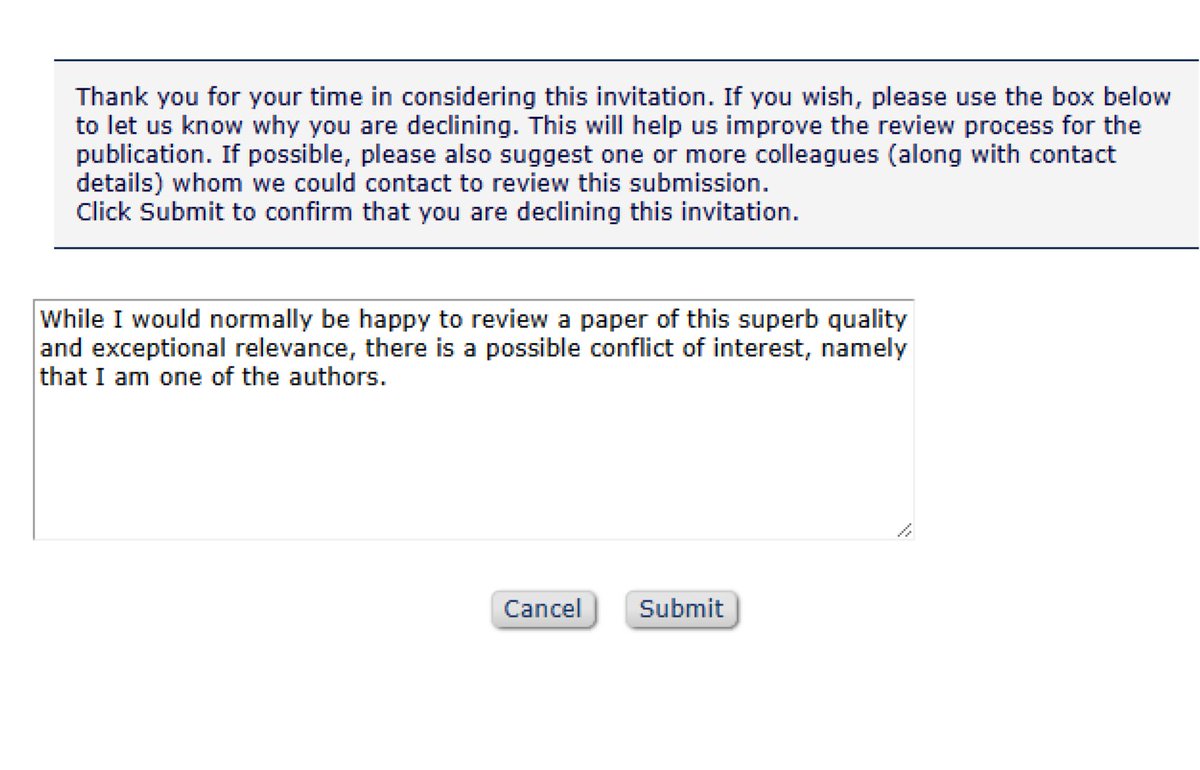
just got invited to peer review a paper I'm one of the authors on
Henry Shevlin tweet media
English
161
699
28K
398.3K
Deirdre💧🔥💨 retweetledi
Shel Winkley
Shel Winkley@shelwinkleywx·
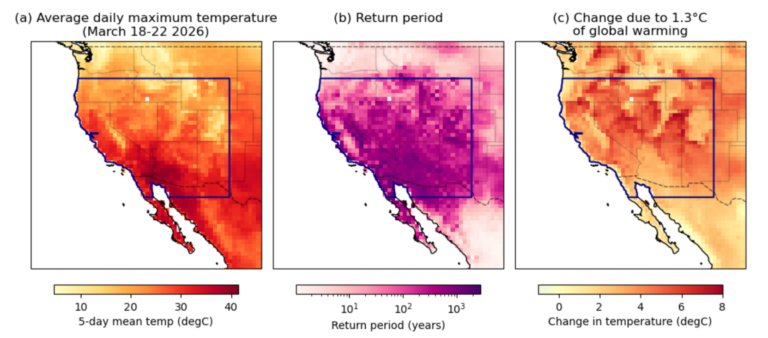
NEW: Flash study from @WWAttribution on the record-torching western U.S. heatwave Findings: • This type of heat would be VIRTUALLY IMPOSSIBLE in mid-March without human-caused warming • In just 10yrs, this event became 4x MORE likely & 1.4°F hotter due to climate change
Shel Winkley tweet media
English
22
35
109
13.8K
Deirdre💧🔥💨
Deirdre💧🔥💨@flowinguphill·
From our blog post: The ocean itself has been independently restructured by warming. As the surface warms faster than the deeper ocean, thermal stratification increases and the mixed layer shoals (Liu et al. 2024). A thinner mixed layer is more responsive to solar heating and has less thermal inertia, meaning warm anomalies develop faster and persist longer. cah2oresearch.com/2026/03/19/why…
English
0
3
23
1.7K
Deirdre💧🔥💨 retweetledi
Edgar McGregor
Edgar McGregor@edgarrmcgregor·
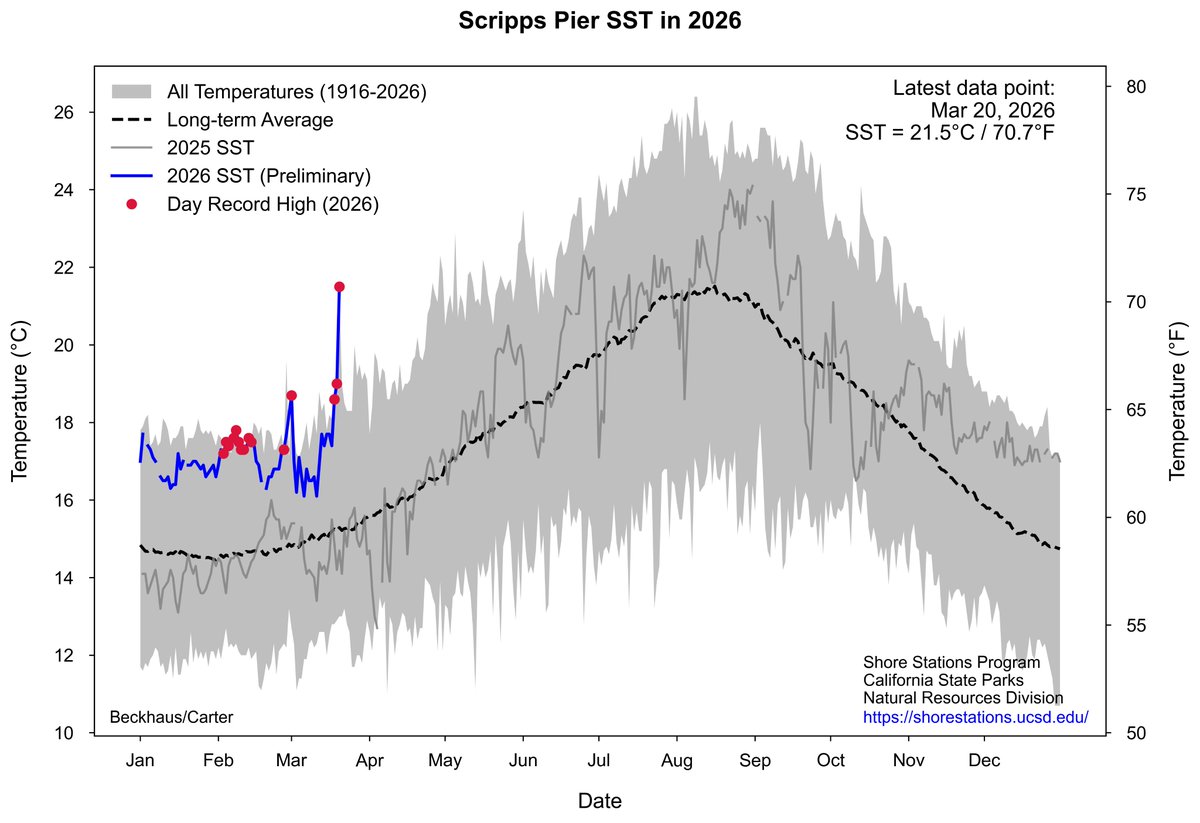
Check out sea surface temperatures off the coast of Southern California this morning. They are now ever so slightly higher than the mean summer maximum, and higher than any April date on record.
Edgar McGregor tweet media
English
41
351
1.3K
146.7K
Deirdre💧🔥💨 retweetledi
Brian Allen
Brian Allen@allenanalysis·
Nobody is talking about what’s actually happening in the Persian Gulf right now. 3,200 commercial ships are trapped. Not military vessels. Civilian crews. Carrying oil, grain, electronics, medicine. Crews are running out of drinking water. One ship contacted the local port authority and begged for permission to dock just to resupply They were denied. For context — the Suez Canal crisis in 2021 trapped 400 ships and disrupted global supply chains for months. This is eight times that. The cameras are pointed at missile interceptions and oil price charts. Nobody is showing you the civilian sailor who can’t get drinking water in a war zone he never signed up for. If these ships are abandoned the environmental catastrophe alone — thousands of tons of fuel and chemicals sitting unmanned — would be generational. This is not a shipping disruption. This is a humanitarian crisis. And it started three weeks ago on a feeling. Never stop connecting the dots.
English
473
6.4K
10.2K
363.2K
Daniel Swain
Daniel Swain@Weather_West·
Earlier today, I was asked to comment on the current state of American disaster preparedness. That was already a fraught question, even prior to present chaos, but then I saw today's headlines. 🫠 "Top Disaster Response Official Claims He Teleported to a Waffle House"
Daniel Swain tweet media
English
17
52
210
11.1K
Deirdre💧🔥💨
Deirdre💧🔥💨@flowinguphill·
@natashajaques @jburnmurdoch I constantly catch ChatGPT 5.4 doing epistemic steering. It seems to be an effect of the model’s safety training. The conclusions are steered to be more neutral and with extensive hedging. Claude Opus doesn’t do this.
English
1
1
12
952
Deirdre💧🔥💨 retweetledi
Natasha Jaques
Natasha Jaques@natashajaques·
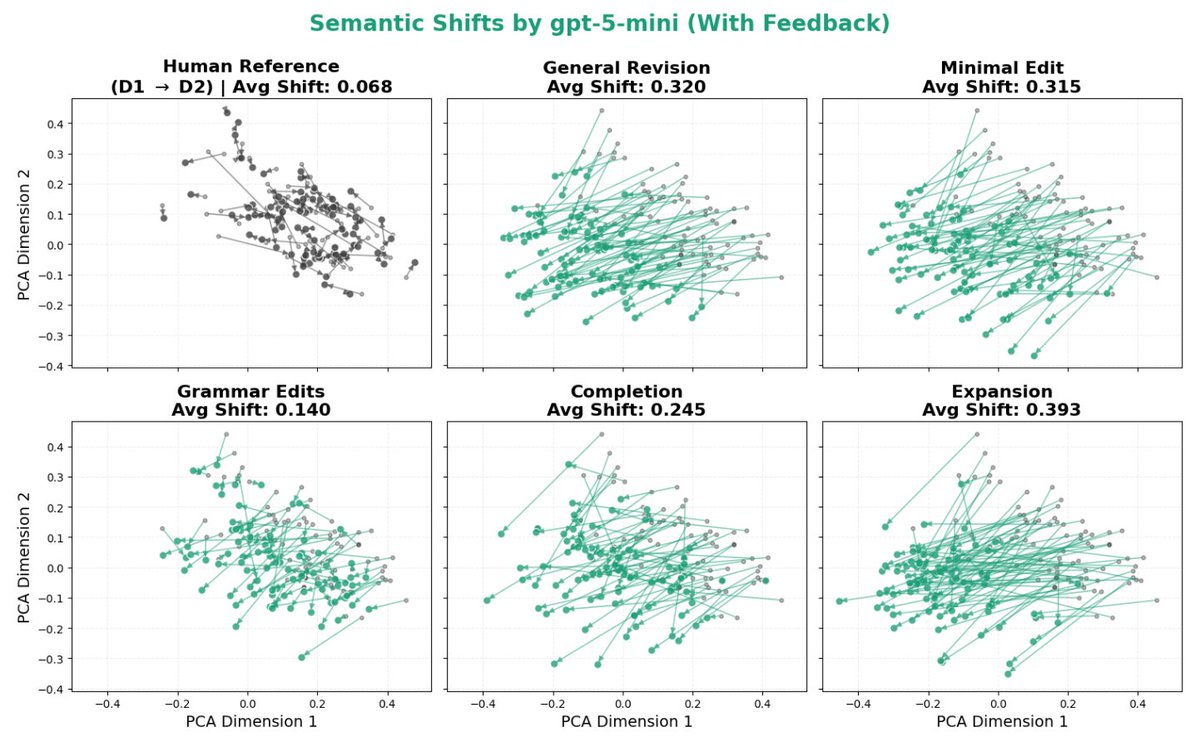
The paper I’ve been most obsessed with lately is finally out: nbcnews.com/tech/tech-news…! Check out this beautiful plot: it shows how much LLMs distort human writing when making edits, compared to how humans would revise the same content. We take a dataset of human-written essays from 2021, before the release of ChatGPT. We compare how people revise draft v1 -> v2 given expert feedback, with how an LLM revises the same v1 given the same feedback. This enables a counterfactual comparison: how much does the LLM alter the essay compared to what the human was originally intending to write? We find LLMs consistently induce massive distortions, even changing the actual meaning and conclusions argued for.
Natasha Jaques tweet media
English
35
341
1.3K
192.9K
Deirdre💧🔥💨 retweetledi
Prof Michael E. Mann
Prof Michael E. Mann@MichaelEMann·
Global surface air temperature anomalies have reached lowest value in several years, as weak La Nina conditions (following 23/24 El Nino) begin to dissipate. It will be interesting to see what happens if the forecast El Nino takes hold later this year. pulse.climate.copernicus.eu
Prof Michael E. Mann tweet media
English
0
13
30
2.6K