felipe | mo0x.eth | 🦇🔊

32 posts

felipe | mo0x.eth | 🦇🔊 banner
felipe | mo0x.eth | 🦇🔊

felipe | mo0x.eth | 🦇🔊

@fselmo2

testing @ethereum

Durango, CO Katılım Temmuz 2014
175 Takip Edilen105 Takipçiler
felipe | mo0x.eth | 🦇🔊 retweetledi
Toni Wahrstätter ⟠
Ethereum is about to fundamentally change how blocks are executed. With the upcoming Glamsterdam hardfork, it's shipping EIP-7928: Block-level Access Lists, a proposal that brings parallelization to the EVM. Here's a short explainer of what it is, how it works, and why it's a big deal for scaling. Let's start from the top. Alongside EIP-7732 (ePBS), EIP-7928 is the execution-layer (EL) headliner for Glamsterdam. Like ePBS, the main focus has been scaling Ethereum, though both proposals come with a bunch of other, equally important properties on the side e.g. removing trust requirements from the PBS pipeline or improving sync. EIP-7928 adds a Block Access List (BAL) to every Ethereum block. A BAL is a list of accounts and storage slots that the block touches, but that's not all: it also contains post-transaction state diffs (this part is critical!). Post-transaction state diffs tell you what the state looks like after each transaction. Quick example: user A swaps 1 ETH for DAI on DEX B. The BAL tells you that user A's ETH balance decreased by 1 ETH + tx fees and their nonce went up by 1; that DEX B's ETH balance went up by 1 ETH; and that inside the DAI contract, user A's DAI balance increased while DEX B's decreased. In other words, all of that info becomes statically available, something that previously required tracing the transaction. Client software (Geth, Nethermind, Besu, Erigon, Reth, Ethrex, Nimbus) can use this to do a few very powerful things: 1. Parallelize transaction execution. Knowing the post-state of each tx resolves the dependencies between them. No transaction has to wait on the previous one anymore, so execution can be perfectly parallelized. Instead of large parts of block validation sitting idle waiting on sequential execution, clients can finally make much better use of modern hardware. 2. Batch prefetch. One of the most cumbersome jobs for a node has been fetching the state needed for execution from disk. Because state locations (e.g. the exact storage slot in the DAI contract where user A's balance lives) are only discovered along the way, while executing, state-fetching has been a real drag on scaling: it blocks execution, takes time, and eventually slows everything down. With BALs, everything a node needs for execution is known upfront and can be loaded into cache in one go, in parallel. This speeds things up even further. 3. Parallelize post-state root calculation. Another expensive task is walking the updated state tree to compute the post-state root, which is needed so that everyone agrees on what's on disk after executing the block. With the post-tx state already in the BAL, nodes can do this in parallel while executing. A heavy task that used to wait until all transactions had finished can now run alongside prefetching and execution. 4. Snap sync (v2). An often overlooked, less sexy aspect of blockchains is syncing. Nodes need to catch up with the chain, and they need to catch up faster than the chain progresses. Today, most nodes do snap sync: downloading blocks, headers, and state in parallel while chasing the tip, and then "healing" the database once they're close to the head. Healing means asking peers for trie nodes, receiving them, validating them, and updating the local DB. It's iterative, networking-heavy, can take a while, and especially higher throughput pushes that phase to its limits. BALs help here too: with snap v2, nodes can catch up to the tip and skip the healing phase entirely. Syncing at higher throughput becomes more robust and reliable. So, to summarize, a BAL contains two things: -> The state locations the block accesses -> The state changes after each tx (incl. the new values) We're already seeing big performance gains today: on 6-core machines, EL clients validate blocks up to 5x faster, making block gas limits of 300M a very realistic outcome. ePBS will add to that by decoupling the block from the payload, giving validators 2-4x more time for execution. To not overshoot (security stays priority #1), the fork will likely ship with a 200M gas limit, but we shouldn't be stuck there for long before pushing to 300M and beyond. That's a 10x in scaling since we started taking the topic seriously, without touching hardware requirements. None of this would have happened without people going all-in, heads down, shipping: so many hours spent in calls debating the right design, so many iterations refining the specs, and tons of test cases written (and still being worked on). The road from whiteboard to production-ready code has been a journey, and we're not at the finish line yet, but from what I can tell, things look super bullish for Ethereum. Glamsterdam will be a fork that shows what's possible when a distributed, decentralized community works on a shared goal, laser-focused on providing enough block space to onboard the next wave of users.
English
41
151
751
62.9K
felipe | mo0x.eth | 🦇🔊 retweetledi
Thomas Coratger
Thomas Coratger@tcoratger·
AI bug-finding models are getting better, leading some to claim that open-source code and smart contracts are doomed. The solution has been discussed by @VitalikButerin. AI-assisted Formal Verification. Particularly bullish on this for cryptography and speccing related work. 🧵
English
2
3
52
5.3K
felipe | mo0x.eth | 🦇🔊 retweetledi
vitalik.eth
vitalik.eth@VitalikButerin·
Many people have claimed that with AI-assisted bug finding, secure code (and hence trustless anything) will be impossible. I have a much more optimistic take, and AI-assisted formal verification is a major part of the reason why: vitalik.eth.limo/general/2026/0…
English
441
395
2.5K
412.1K
Julian
Julian@_julianma·
Life Update: I have decided to leave the Ethereum Foundation. I’m very grateful to have worked with so many talented and inspiring people on an incredibly important project over the past four years. I’m proud of the work we’ve done. Here are some of my personal highlights: - FOCIL. It will likely be the first multiple-proposer gadget live on any major chain. In a world where everything is financialized, my job was to prevent these proposer seats from being traded. - Fast Confirmation Rule Go-To-Market. Designed and led the GTM strategy for FCR. A new consensus rule that drops bridging time from Ethereum L1 to L2s and exchanges down to 13 seconds. - Strategy. Argued which markets Ethereum should go for and how. Trying to bring protocol design and ecosystem development closer to each other. Why did I leave? The first three years at the EF I did market design research. The last year, I focused on product and growth work (the FCR GTM and strategic work). I really enjoy that domain and want to move further in that direction. I’m taking some time to explore ideas that build on the financial infrastructure that crypto has built. I would love to catch up with friends made along the way. My DMs are open 🙂
English
59
25
559
67.3K
carlbeek
carlbeek@CarlBeek·
After 7 incredible years, I've decided that Friday May 29th will be my last day at the Ethereum Foundation. I'm humbled by the projects I got to work on along the way: from the KZG ceremony, to helping architect the early design of the Beacon Chain, and a lot in between. At the age of 23, the Ethereum space welcomed me on the basis of having some great (and many stupid) ideas and let me influence a multi-billion dollar technology, an incredible opportunity I will remain forever grateful for. Ethereum has had a huge impact on me, and I hope my work has had an impact on Ethereum, and in turn on the world. To every researcher, core dev, EFer, and community member, whether we worked together closely or not: thank you. The strength of Ethereum is, and always will be, the people behind it striving to make it what it is. I'm grateful to have spent these years among you. What's next: I don't entirely know yet. For now I'll be enjoying time with my wife and our 1-month-old while I figure it out. Longer term, I'll find or create something with brilliant people at the intersection of engineering excellence, hard problems, and useful products driving economic activity at scale. If that resonates, or you just want to catch up, slide into my DMs!
English
60
27
486
138K
felipe | mo0x.eth | 🦇🔊
End of an era, start of another 🫡. We're transitioning the maintenance and development of the web3 Python libraries that I've helped maintain the last few years, as part of the old @EthereumPython team, to the newly formed ApeWorX Collective. Happy to see them in good hands! :)
Ape Framework@ApeFramework

An important update from us: @apeworx/introducing-the-apeworx-collective" target="_blank" rel="nofollow noopener">paragraph.com/@apeworx/intro…

English
0
4
16
1.4K
Josh Stark (0xstark.eth)
Josh Stark (0xstark.eth)@0xstark·
After 5 years on the @ethereumfndn leadership team, I’ve decided to step away and pass the torch. I made this decision in early March, and will wrap up my work at the end of April. I’ve made no plans for the future, other than taking a long break to reset and spending time with my family & friends. Working for Ethereum at the Ethereum Foundation has been a great honour. I’m proud to have worked with great people inside and outside of the EF, and proud of what our community has accomplished together. And I’m grateful to have worked with @aerugoettinea, @dannyryan, @hwwonx, @tkstanczak, @tjuliang, @VitalikButerin, and @AyaMiyagotchi on the leadership team over the years. We share a vision and a set of values that mean I will always be your ally and your friend. This journey has been a gift. I have had the rare privilege of seeing up close how small teams of great people can do the impossible. It has changed how I see the world and my place in it. We do not need to accept the world as it is, or where we fear it is going. That is not hope, it is definite: I have seen the proof. The Ethereum ecosystem has reliably done things the world told us was impossible. It is easy to forget how much real fear and doubt there was that Ethereum would never launch, that DeFi would never work, or that Proof of Stake would never ship. The lesson is not that our success was guaranteed and the doubters are always wrong, but that truly wicked problems can be overcome when great people make an extraordinary effort. You must make an extraordinary effort.
English
140
64
1K
92.3K
felipe | mo0x.eth | 🦇🔊 retweetledi
ً
ً@lightclients·
.@nero_eth outlines how EIP-8141 frame transactions will reduce our reliance on centralized services like relayers and improve privacy: ethresear.ch/t/frame-transa…
English
2
19
100
15.1K
Bewinxed
Bewinxed@Bewinxed·
@banteg Man this is amazing, been bookmarking these posts so I can possibly attempt it on red alert 2 and tib sun
English
4
0
8
1.1K
banteg
banteg@banteg·
i decompiled a cult 2003 game and rewrote it from scratch in 2 weeks using codex. read more about my project. banteg.xyz/posts/crimsonl…
banteg tweet media
English
56
76
664
190.9K
trent.eth
trent.eth@trent_vanepps·
as of last friday, I no longer work at the EF nothing but respect for the brilliant people i worked with over the last 5 years on network upgrades + funding efforts I intend to continue working on @ProtocolGuild and Ethereum political economy as long as funding is available
English
128
44
854
68.7K
felipe | mo0x.eth | 🦇🔊 retweetledi
nixo.eth 🦇🔊🥐
nixo.eth 🦇🔊🥐@nixorokish·
Core devs are targeting next week for the 1st Glamsterdam devnet for @ethereum's next upgrade ePBS has been an incredibly structurally complex change, splitting block production into 2 coordinating parties inside consensus Getchu a download on the upgrade's status here: (🧵)
nixo.eth 🦇🔊🥐 tweet media
English
11
64
250
50K
felipe | mo0x.eth | 🦇🔊 retweetledi
Justin Drake
Justin Drake@drakefjustin·
Today is a monumentous day for quantum computing and cryptography. Two breakthrough papers just landed (links in next tweet). Both papers improve Shor's algorithm, infamous for cracking RSA and elliptic curve cryptography. The two results compound, optimising separate layers of the quantum stack. The results are shocking. I expect a narrative shift and a further R&D boost toward post-quantum cryptography. The first paper is by Google Quantum AI. They tackle the (logical) Shor algorithm, tailoring it to crack Bitcoin and Ethereum signatures. The algorithm runs on ~1K logical qubits for the 256-bit elliptic curve secp256k1. Due to the low circuit depth, a fast superconducting computer would recover private keys in minutes. I'm grateful to have joined as a late paper co-author, in large part for the chance to interact with experts and the alpha gleaned from internal discussions. The second paper is by a stealthy startup called Oratomic, with ex-Google and prominent Caltech faculty. Their starting point is Google's improvements to the logical quantum circuit. They then apply improvements at the physical layer, with tricks specific to neutral atom quantum computers. The result estimates that 26,000 atomic qubits are sufficient to break 256-bit elliptic curve signatures. This would be roughly a 40x improvement in physical qubit count over previous state-of-the-art. On the flip side, a single Shor run would take ~10 days due to the relatively slow speed of neutral atoms. Below are my key takeaways. As a disclaimer, I am not a quantum expert. Time is needed for the results to be properly vetted. Based on my interactions with the team, I have faith the Google Quantum AI results are conservative. The Oratomic paper is much harder for me to assess, especially because of the use of more exotic qLDPC codes. I will take it with a grain of salt until the dust settles. → q-day: My confidence in q-day by 2032 has shot up significantly. IMO there's at least a 10% chance that by 2032 a quantum computer recovers a secp256k1 ECDSA private key from an exposed public key. While a cryptographically-relevant quantum computer (CRQC) before 2030 still feels unlikely, now is undoubtedly the time to start preparing. → censorship: The Google paper uses a zero-knowledge (ZK) proof to demonstrate the algorithm's existence without leaking actual optimisations. From now on, assume state-of-the-art algorithms will be censored. There may be self-censorship for moral or commercial reasons, or because of government pressure. A blackout in academic publications would be a tell-tale sign. → cracking time: A superconducting quantum computer, the type Google is building, could crack keys in minutes. This is because the optimised quantum circuit is just 100M Toffoli gates, which is surprisingly shallow. (Toffoli gates are hard because they require production of so-called "magic states".) Toffoli gates would consume ~10 microseconds on a superconducting platform, totalling ~1,000 sec of Shor runtime. → latency optimisations: Two latency optimisations bring key cracking time to single-digit minutes. The first parallelises computation across quantum devices. The second involves feeding the pubkey to the quantum computer mid-flight, after a generic setup phase. → fast- and slow-clock: At first approximation there are two families of quantum computers. The fast-clock flavour, which includes superconducting and photonic architectures, runs at roughly 100 kHz. The slow-clock flavour, which includes trapped ion and neutral atom architectures, runs roughly 1,000x slower (~100 Hz, or ~1 week to crack a single key). → qubit count: The size-optimised variant of the algorithm runs on 1,200 logical qubits. On a superconducting computer with surface code error correction that's roughly 500K physical qubits, a 400:1 physical-to-logical ratio. The surface code is conservative, assuming only four-way nearest-neighbour grid connectivity. It was demonstrated last year by Google on a real quantum computer. → future gains: Low-hanging fruit is still being picked, with at least one of the Google optimisations resulting from a surprisingly simple observation. Interestingly, AI was not (yet!) tasked to find optimisations. This was also the first time authors such as Craig Gidney attacked elliptic curves (as opposed to RSA). Shor logical qubit count could plausibly go under 1K soonish. → error correction: The physical-to-logical ratio for superconducting computers could go under 100:1. For superconducting computers that would be mean ~100K physical qubits for a CRQC, two orders of magnitude away from state of the art. Neutral atoms quantum computers are amenable to error correcting codes other than the surface code. While much slower to run, they can bring down the physical to logical qubit ratio closer to 10:1. → Bitcoin PoW: Commercially-viable Bitcoin PoW via Grover's algorithm is not happening any time soon. We're talking decades, possibly centuries away. This observation should help focus the discussion on ECDSA and Schnorr. (Side note: as unofficial Bitcoin security researcher, I still believe Bitcoin PoW is cooked due to the dwindling security budget.) → team quality: The folks at Google Quantum AI are the real deal. Craig Gidney (@CraigGidney) is arguably the world's top quantum circuit optimisooor. Just last year he squeezed 10x out of Shor for RSA, bringing the physical qubit count down from 10M to 1M. Special thanks to the Google team for patiently answering all my newb questions with detailed, fact-based answers. I was expecting some hype, but found none.
English
346
1.2K
5.9K
1.5M
felipe | mo0x.eth | 🦇🔊 retweetledi
Fe Language
Fe Language@official_fe·
Fe is back. 💫 𝐅𝐞 𝟐𝟔.𝟎.𝟎 𝐢𝐬 𝐨𝐮𝐭 𝐭𝐨𝐝𝐚𝐲: a new compiler, a new type system, and a fresh start. The last release was November 2023. We spent the time in between rebuilding from the ground up. We rewrote the compiler from scratch. Here's why 👇
Fe Language tweet media
English
11
35
75
24.5K
felipe | mo0x.eth | 🦇🔊 retweetledi
Justin Drake
Justin Drake@drakefjustin·
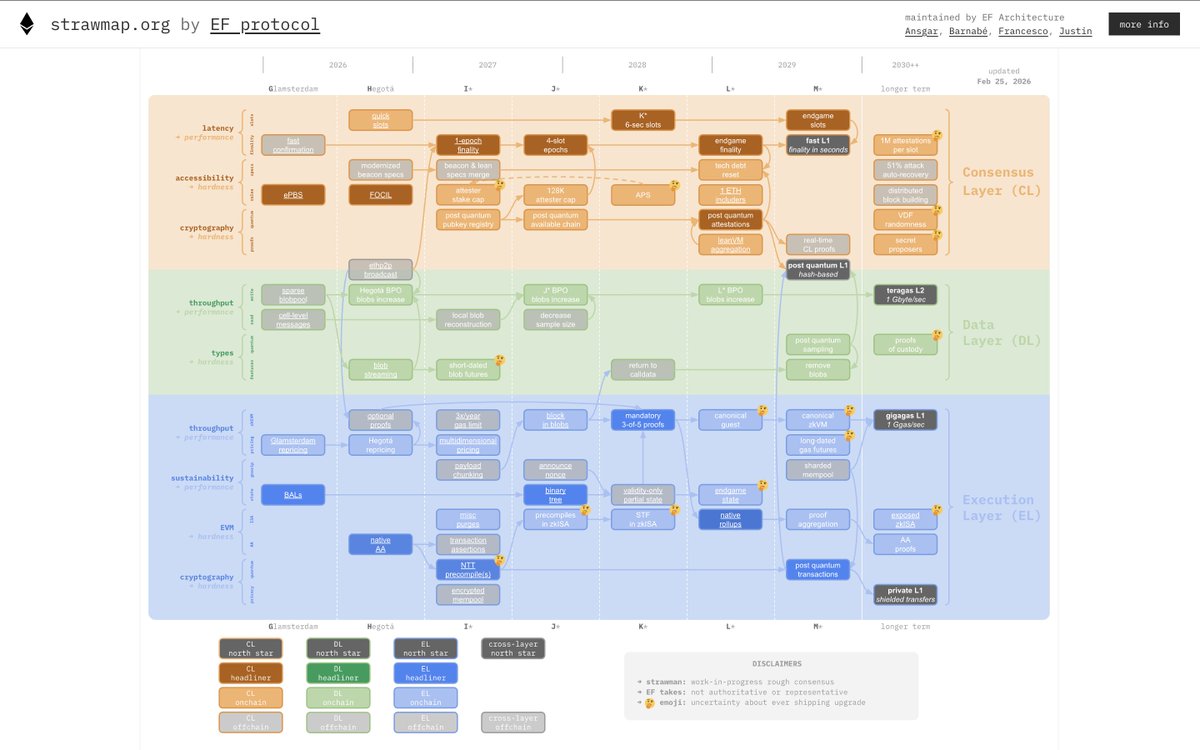
Introducing strawmap, a strawman roadmap by EF Protocol. Believe in something. Believe in an Ethereum strawmap. Who is this for? The document, available at strawmap[.]org, is intended for advanced readers. It is a dense and technical resource primarily for researchers, developers, and participants in Ethereum governance. Visit ethereum[.]org/roadmap for more introductory material. Accessible explainers unpacking the strawmap will follow soon™. What is the strawmap? The strawmap is an invitation to view L1 protocol upgrades through a holistic lens. By placing proposals on a single visual it provides a unified perspective on Ethereum L1 ambitions. The time horizon spans years, extending beyond the immediate focus of All Core Devs (ACD) and forkcast[.]org which typically cover only the next couple of forks. What are some of the highlights? The strawmap features five simple north stars, presented as black boxes on the right: → fast L1: fast UX, via short slots and finality in seconds → gigagas L1: 1 gigagas/sec (10K TPS), via zkEVMs and real-time proving → teragas L2: 1 gigabyte/sec (10M TPS), via data availability sampling → post quantum L1: durable cryptography, via hash-based schemes → private L1: first-class privacy, via shielded ETH transfers What is the origin story? The strawman roadmap originated as a discussion starter at an EF workshop in Jan 2026, partly motivated by a desire to integrate lean Ethereum with shorter-term initiatives. Upgrade dependencies and fork constraints became particularly effective at surfacing valuable discussion topics. The strawman is now shared publicly in a spirit of proactive transparency and accelerationism. Why the "strawmap" name? "Strawmap" is a portmanteau of "strawman" and "roadmap". The strawman qualifier is deliberate for two reasons: 1. It acknowledges the limits of drafting a roadmap in a highly decentralized ecosystem. An "official" roadmap reflecting all Ethereum stakeholders is effectively impossible. Rough consensus is fundamentally an emergent, continuous, and inherent uncertain process. 2. It underscores the document's status as a work-in-progress. Although it originated within the EF Protocol cluster, there are competing views held among its 100 members, not to mention a rich diversity of non-EFer views. The strawmap is not a prediction. It is an accelerationist coordination tool, sketching one reasonably coherent path among millions of possible outcomes. What is the strawmap time frame? The strawmap focuses on forks extending through the end of the decade. It outlines seven forks by 2029 based on a rough cadence of one fork every six months. While grounded in current expectations, these timelines should be treated with healthy skepticism. The current draft assumes human-first development. AI-driven development and formal verification could significantly compress schedules. What do the letters on top represent? The strawmap is organized as a timeline, with forks progressing from left to right. Consensus layer forks follow a star-based naming scheme with incrementing first letters: Altair, Bellatrix, Capella, Deneb, Electra, Fulu, etc. Upcoming forks such as Glamsterdam and Hegotá have finalized names. Other forks, like I* and J*, have placeholder names (with I* pronounced "I star"). What do the colors and arrows represent? Upgrades are grouped into three color-coded horizontal layers: consensus (CL), data (DL), execution (EL). Dark boxes denote headliners (see below), grey boxes indicate offchain upgrades, and black boxes represent north stars. An explanatory legend appears at the bottom. Within each layer, upgrades are further organized by theme and sub-theme. Arrows signal hard technical dependencies or natural upgrade progressions. Underlined text in boxes links to relevant EIPs and write-ups. What are headliners? Headliners are particularly prominent and ambitious upgrades. To maintain a fast fork cadence, the modern ACD process limits itself to one consensus and one execution headliner per fork. For example, in Glamsterdam, these headliners are ePBS and BALs, respectively. (L* is an exceptional fork, displaying two headliners tied to the bigger lean consensus fork. Lean consensus landing in L* would be a fateful coincidence.) Will the strawmap evolve? Yes, the strawmap is a living and malleable document. It will evolve alongside community feedback, R&D advancements, and governance. Expect at least quarterly updates, with the latest revision date noted on the document. Can I share feedback? Yes, feedback is actively encouraged. The EF Protocol strawmap is maintained by the EF Architecture team: @adietrichs, @barnabemonnot, @fradamt, @drakefjustin. Each has open DMs and can be reached at first.name@ethereum[.]org. General inquiries can be sent to strawmap@ethereum[.]org.
Justin Drake tweet media
English
208
417
1.6K
618.9K
felipe | mo0x.eth | 🦇🔊 retweetledi
lean Ethereum
lean Ethereum@leanEthereum·
Ethereum Foundation's long-term quantum strategy...
GIF
Justin Drake@drakefjustin

Today marks an inflection in the Ethereum Foundation's long-term quantum strategy. We've formed a new Post Quantum (PQ) team, led by the brilliant Thomas Coratger (@tcoratger). Joining him is Emile, one of the world-class talents behind leanVM. leanVM is the cryptographic cornerstone of our entire post-quantum strategy. After years of quiet R&D, EF management has officially declared PQ security a top strategic priority. Our journey began in 2019, with the "Eth3.0 Quantum Security" presentation at StarkWare Sessions. Since 2024, PQ has been central to the @leanEthereum vision. The pace of PQ engineering breakthroughs since then has been nothing short of phenomenal. It's now 2026, timelines are accelerating. Time to go full PQ: → PQ ACD: Antonio Sanso (@asanso) kicks off a bi-weekly All Core Devs PQ transactions breakout call next month. These sessions focus on user-facing security, covering dedicated precompiles, account abstraction, and longer-term transaction signature aggregation with leanVM. → PQ foundations: Today we are announcing a $1M Poseidon Prize to harden the Poseidon hash function. We are betting big on hash-based cryptography to enjoy the strongest and leanest cryptographic foundations. Check out our other $1M PQ initiative, the Proximity Prize. → PQ devnets: Multi-client PQ consensus devnets are live! Shoutout to pioneers @zeamETH, @ReamLabs, @PierTwo_com, @geanclient, @ethlambda_lean, as well as established consensus teams Lighthouse, Grandine, and soon Prysm. This incredible teamwork is coordinated by @corcoranwill via weekly PQ interop calls. → PQ workshops: Building on last year's PQ workshop in Cambridge (see photo), the EF is hosting another 3-day PQ event in October. Top experts from around the world will convene. In addition, a PQ day is set for March 29 in Cannes just ahead of EthCC. → PQ FV and AI: Last week Alex Hicks (@alexanderlhicks) ran a specialised maths AI for 8 hours, at a $200 cost. It one-shotted a formal proof one of the hardest lemmas in the foundations of hash-based snarks. Mind-blowing. Applied cryptography will never be the same. → PQ roadmap: A comprehensive breakdown of the EF's proposed PQ strategy will be shared soon™ on pq[.]ethereum[.]org. The roadmap targets a full transition in coming years with zero loss of funds and zero downtime. Stay tuned :) → PQ education: The ZKPodcast (@zeroknowledgefm) is producing a 6-part video series on Ethereum's PQ strategy. EF Enterprise Acceleration is also preparing material for enterprises and nation-states. Finally, Ethereum is now represented on the PQ advisory board that Coinbase announced yesterday. Believe in something. Believe in PQ security.

English
6
16
204
9.4K
felipe | mo0x.eth | 🦇🔊 retweetledi
Justin Drake
Justin Drake@drakefjustin·
Today marks an inflection in the Ethereum Foundation's long-term quantum strategy. We've formed a new Post Quantum (PQ) team, led by the brilliant Thomas Coratger (@tcoratger). Joining him is Emile, one of the world-class talents behind leanVM. leanVM is the cryptographic cornerstone of our entire post-quantum strategy. After years of quiet R&D, EF management has officially declared PQ security a top strategic priority. Our journey began in 2019, with the "Eth3.0 Quantum Security" presentation at StarkWare Sessions. Since 2024, PQ has been central to the @leanEthereum vision. The pace of PQ engineering breakthroughs since then has been nothing short of phenomenal. It's now 2026, timelines are accelerating. Time to go full PQ: → PQ ACD: Antonio Sanso (@asanso) kicks off a bi-weekly All Core Devs PQ transactions breakout call next month. These sessions focus on user-facing security, covering dedicated precompiles, account abstraction, and longer-term transaction signature aggregation with leanVM. → PQ foundations: Today we are announcing a $1M Poseidon Prize to harden the Poseidon hash function. We are betting big on hash-based cryptography to enjoy the strongest and leanest cryptographic foundations. Check out our other $1M PQ initiative, the Proximity Prize. → PQ devnets: Multi-client PQ consensus devnets are live! Shoutout to pioneers @zeamETH, @ReamLabs, @PierTwo_com, @geanclient, @ethlambda_lean, as well as established consensus teams Lighthouse, Grandine, and soon Prysm. This incredible teamwork is coordinated by @corcoranwill via weekly PQ interop calls. → PQ workshops: Building on last year's PQ workshop in Cambridge (see photo), the EF is hosting another 3-day PQ event in October. Top experts from around the world will convene. In addition, a PQ day is set for March 29 in Cannes just ahead of EthCC. → PQ FV and AI: Last week Alex Hicks (@alexanderlhicks) ran a specialised maths AI for 8 hours, at a $200 cost. It one-shotted a formal proof one of the hardest lemmas in the foundations of hash-based snarks. Mind-blowing. Applied cryptography will never be the same. → PQ roadmap: A comprehensive breakdown of the EF's proposed PQ strategy will be shared soon™ on pq[.]ethereum[.]org. The roadmap targets a full transition in coming years with zero loss of funds and zero downtime. Stay tuned :) → PQ education: The ZKPodcast (@zeroknowledgefm) is producing a 6-part video series on Ethereum's PQ strategy. EF Enterprise Acceleration is also preparing material for enterprises and nation-states. Finally, Ethereum is now represented on the PQ advisory board that Coinbase announced yesterday. Believe in something. Believe in PQ security.
English
340
687
3.2K
1.2M
felipe | mo0x.eth | 🦇🔊 retweetledi
Ethereum
Ethereum@ethereum·
Ethereum is the #1 choice for global financial institutions. Over the last few months, adoption has accelerated. Here are 35 stories of how institutions are building on Ethereum. 1/ @krakenfx launched xStocks on Ethereum, issuing tokenized versions of popular U.S. stocks and ETFs as ERC-20 tokens. Kraken’s eligible clients can now deposit and withdraw fully collateralized equities, directly on Ethereum. 2/ @OndoFinance launched Ondo Global Markets on Ethereum with 100+ tokenized U.S. stocks & ETFs. 24/7 access to programmable equities, backed by real securities, is now available alongside DeFi integrations for lending, trading, and more. 3/ @ChinaAMC_HK launched its Select USD Money Market Fund on Ethereum, one of the first tokenized funds from a major Chinese asset manager. One of Asia’s largest firms (over $449B AUM) now provides access to high-quality, short-term USD instruments with 24/7 settlement. 4/ @Fidelity introduced the FDIT tokenized money market fund on Ethereum. The Fidelity Digital Interest Token (FDIT) brings the bank’s investors the speed of onchain settlement alongside the stability of traditional instruments. 5/ @Google announced the Agent Payments Protocol (AP2), enabling AI agents to autonomously execute payments using stablecoins on Ethereum. Built in collaboration with The Ethereum Foundation, Coinbase, MetaMask, and others, AP2 allows AI to transact securely, bridging the gap between automated intelligence and finance. 6/ @UBS, @PostFinance, @sygnumofficial, and the Swiss Bankers Association successfully piloted Deposit Tokens on Ethereum. By demonstrating legally binding cross-bank settlement on Ethereum’s public infrastructure, the proof-of-concept paves the way for programmable, instant, cross-institution settlement. 7/ Santander’s @openbank_es launched ETH trading services in Germany, allowing customers to buy, sell, and custody ETH directly through their bank accounts. This integration is a strong signal of institutional confidence in ETH under MiCa regulation. 8/ @AmericanExpress launched Amex Passport, blockchain-based travel stamps minted as NFTs on Ethereum L2 @base. Cardholders can now create an onchain record of experiences and memories from international trips, blending loyalty rewards with digital ownership. 9/ The first tokenized S&P 500 Index Fund licensed by @SPDJIndices, SPXA, was launched by @centrifuge on Base. 10/ SWIFT and 30+ banks are designing a blockchain ledger to support tokenized assets and real-time, 24/7 cross-border payments alongside existing financial systems, starting with a prototype with Consensys. @swiftcommunity connecting 11,500+ institutions globally will create a bridge between traditional finance and onchain value. 11/ @SocieteGenerale FORGE, an integrated subsidiary of the 161-year-old commercial bank, deployed EURCV & USDCV lending and trading on Ethereum DeFi protocols Morpho and Uniswap. One of the largest custodians in Europe now provides institutional-grade collateral and liquidity for DeFi markets. 12/ @Stripe expanded its crypto support on Ethereum to include stablecoin-based subscriptions and recurring billing. Hundreds of thousands of companies that use Stripe can now accept USDC for subscriptions with automatic renewals, building on Ethereum for lower-cost payments with near-instant settlement. 13/ @Securitize and @FGNexusio tokenized the FGNX stock on Ethereum, representing the first NASDAQ-listed preferred equity issued fully onchain. Ethereum is the platform to build programmable assets that bring public markets to the digital age. 14/ @AntGroup, the fintech behind @Alipay, launched @JovayNetwork, a L2 for institutional tokenization. The company behind one of the world's largest retail platforms is now building global institutional settlement for tokenized assets on Ethereum. 15/ @jpyc_official launched the world's first yen-pegged regulated stablecoin on Ethereum. Complaint, programmable yen transactions are now available worldwide, backed 1:1 by yen reserves under Japan’s Payment Services Act. 16/ @BNYglobal and Securitize announced a tokenized AAA-rated CLO fund on Ethereum. Institutional credit moving onchain brings liquidity and transparency to traditional asset classes. 17/ Google partnered with @Polymarket, integrating onchain prediction market data to Google search results. The largest search provider now leverages the Ethereum ecosystem as a primary source of truth. 18/ @StartaleGroup released the Startale App, a SuperApp for @soneium's growing Ethereum L2. Mainstream users in the Soneium L2 ecosystem can now access simple onchain interactions and rewards with a unified platform for wallets, assets, and apps. 19/ @jpmorgan migrated its tokenized deposit product, JPM Coin (JPMD), from its internal permissioned blockchain to Base. Moving from a private chain to an Ethereum L2 will meet demand from JPMorgan’s institutional clients for payments, collateral, and margin settlement on public infrastructure. 20/ @Mastercard announced it will build on Ethereum L2 @0xPolygon to expand its Crypto Credential program to self-custody wallets. Working with @mercuryo_io, the expansion will allow Mastercard users to send crypto using verified, human-readable aliases. 21/ @Amundi_ENG, Europe’s largest asset manager ($2.75T AUM), launched a tokenized share class of its euro money market fund on Ethereum mainnet. Bringing traditional cash management onchain unlocks 24/7 settlement and composability for euro-denominated capital. 22/ Sony Bank announced plans to launch a USD-pegged stablecoin on @soneium, its Ethereum L2, in early 2026. From gaming to finance, Sony is building its ecosystem’s home base on Ethereum. 23/ @WisdomTreeEU introduced the world’s first physically-backed ETP for @LidoFinance Staked Ether. The fund will provide European investors with regulated exposure to the spot price of stETH and its ETH staking rewards. 24/ The @CFTC announced a pilot program that will allow ETH, BTC, and USDC to be used as collateral in US derivatives markets, alongside new guidance on using tokenized assets as collateral. This marks a significant shift in how ETH and other digital assets can be integrated into regulated US markets. 25/ @BlackRock filed for a staked ETH ETF. Following the success of their spot ETH ETF, this filing seeks to unlock the value of Ethereum's native staking reward rate for traditional investors. 26/ The @ADI_Foundation, backed by IHC, announced the mainnet launch of institutional L2 @ADIChain_, part of the @zksync Elastic Network. Supported by the UAE's largest conglomerate, ADIChain will host the country's regulated stablecoins and aims to bring 1 billion people onchain across the Middle East, Asia and Africa. 27/ JP Morgan launched MONY, their first tokenized money market fund, on Ethereum mainnet. The firm seeded the fund with $100M of its own capital, signaling their commitment to public chain tokenization. 28/ @coinbase announced Coinbase Tokenize, built on Base, as their new end-to-end institutional platform for tokenizing RWAs. Combining issuance, custody, compliance, trading, and infrastructure, the new product will streamline the process of bringing assets like tokenized stocks, equities, funds, and real estate onchain in the Ethereum ecosystem. 29/ @RobinhoodApp added 500 tokenized assets on @arbitrum, bringing their platform to nearly 2000 assets tokenized. With over $14M in total tokenized value, Robinhood continues deepening their integration with Ethereum’s L2 ecosystem. 30/ @BlackRock, @Mastercard, and @FTI_Global partnered with the ADI Foundation in the UAE, builders of the ADIChain L2. The group will explore tokenized asset structures, digital asset regulatory frameworks, stablecoin settlement, and cross-border payment infrastructure. 31/ @SoFi became the first national US retail bank to issue a stablecoin (SoFiUSD) on a public, permissionless blockchain. Launched on Ethereum, SoFiUSD will first be used for faster, cheaper internal settlements for the fintech giant and its partners. 32/ @telcoin launched eUSD on Ethereum and Polygon, a regulated U.S. dollar stablecoin issued by Nebraska state-chartered digital asset depository institution Telcoin Digital Asset Bank. The launch marks another milestone in U.S.-regulated banks issuing stablecoins directly on public blockchains, bringing traditional regulated banking to the Ethereum ecosystem. 33/ @Grayscale distributed the first ETH staking rewards to ETHE ETF shareholders. In a first for US regulated products, investors received Ethereum’s native yield directly, proving that staked ETH ETFs can deliver the economic utility of the network. 34/ @MorganStanley filed for a Staked Ether ETF, doubling down on its crypto strategy. One of the world’s largest wealth managers is moving beyond spot exposure to capture Ethereum’s native staking yield for clients, signaling a shift to productive participation. 35/ The ADI Foundation partnered with M-Pesa to bring 60M+ users onchain. Africa’s largest mobile money platform is integrating blockchain rails to power instant cross-border payments and stablecoin transactions, merging massive fintech scale with Ethereum’s global settlement layer. — Ethereum is the trusted, global settlement layer for real-world adoption, used by institutions, governments, and enterprises worldwide. Learn more about building on the institutional liquidity layer: institutions.ethereum.org
English
574
1.2K
5.6K
769.1K