Y V Chawla

5.1K posts

Y V Chawla banner
Y V Chawla

Y V Chawla

@fundamentalexp

Author - Fundamental Expressions Understanding the format of life. Books, personal and group talks by Y V Chawla https://t.co/8fBw9HAVB3

Chandigarh-India Katılım Nisan 2010
57 Takip Edilen98 Takipçiler
Sabitlenmiş Tweet
Y V Chawla
Y V Chawla@fundamentalexp·
@AstronomyVibes To talk about consciousness is thinking. World arises by your being conscious of it. You and the world is one process, bound to each other process. To see the Total Field of Existence as 'you' is the point.
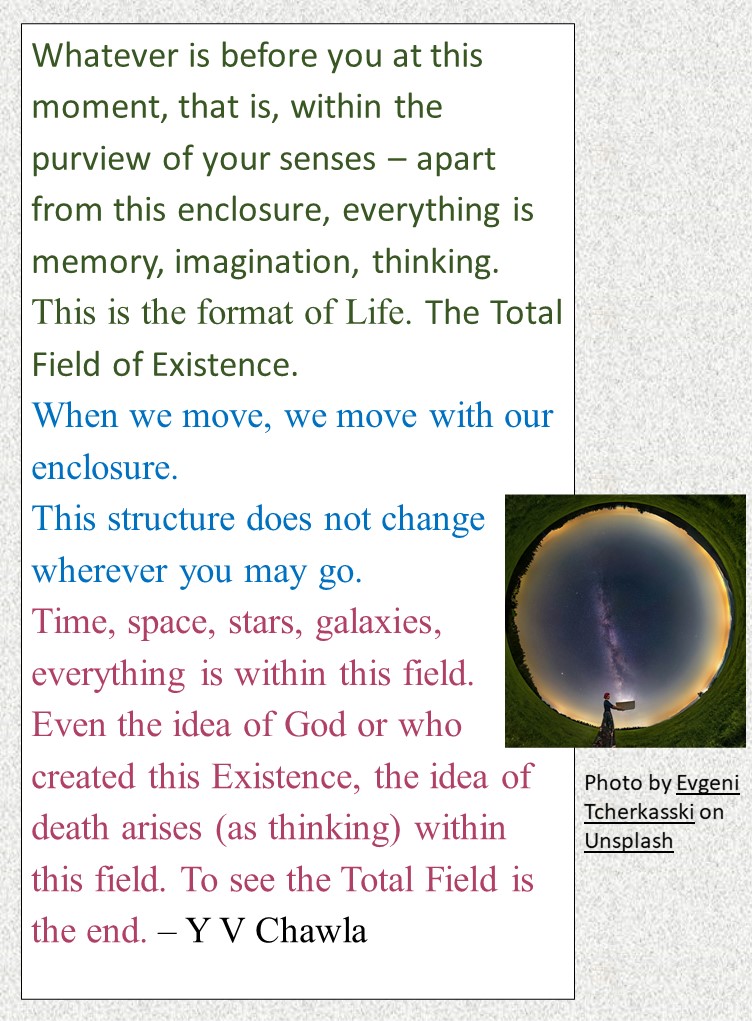
Y V Chawla tweet media
English
0
0
1
527
Y V Chawla
Y V Chawla@fundamentalexp·
@thecurioustales Not only boredom, one shies away from the feeling of sadness, confusion, fear, uncertainty . One runs to solacing ideas or seeks relief by complaining, blaming, feeling guilty to bypass the feeling of uneasiness. Once noticed, whole energy is gathered here, opens up to the new.
English
0
0
0
1
The Curious Tales
The Curious Tales@thecurioustales·
20,000 people deliberately introduced boredom into their lives and generated 41% more breakthrough insights within one week. Yes, Dr. Manoush Zomorodi demonstrated what neuroscientists long suspected: "deliberate boredom boosts creative output and strengthens the brain’s capacity for original thinking." In that study, 20,000 participants added periods of unstimulated time to their routines, and experienced 41% more creative breakthrough moments within seven days. Your default mode network operates like a background processor that only runs when conscious attention stops demanding resources. During unstimulated moments, this network begins cross referencing every memory, skill, and experience you've accumulated, hunting for patterns your focused mind missed. The insights we call "creativity" are actually sophisticated pattern recognition happening below conscious awareness. Modern humans have accidentally trained themselves to interrupt this process every time it begins. The average person checks their phone 96 times per day. Every notification, every scroll, every background podcast cuts the neural pattern matching short before it completes. We've created a civilization where the mental state required for original thinking gets treated like an emergency that needs immediate correction. Watch people in waiting rooms, elevators, or checkout lines. The moment external stimulation drops below a certain threshold, hands automatically reach for phones. The discomfort they're avoiding is literally their brain attempting to do the background processing that produces breakthrough insights. Evolutionary biologists argue boredom developed as a survival mechanism. Animals that could sit unstimulated and let their minds wander were more likely to notice environmental changes, recognize new food sources, and develop innovative hunting strategies. Boredom forced our ancestors into the mental state where novel solutions emerge from existing knowledge. We've pathologized our most important cognitive function. The corporate world talks endlessly about innovation while designing work environments that make innovation neurologically impossible. Open offices with constant interruption. Back to back meetings with no processing time. Performance metrics that reward immediate output over deep thinking. Then companies spend millions on creativity consultants and innovation workshops, trying to artificially recreate what the human brain does naturally during sustained boredom. Participants in Zomorodi’s study generated more ideas and also described a welcome shift: during quiet, unstimulated moments, answers to long-running challenges often came into clear focus. With fewer distractions, their brains kept working on the underlying patterns and had the space to bring that recognition to completion. The quality gap between stimulated and unstimulated thinking becomes stark when you map it against major discoveries. The pattern repeats across every domain: breakthrough insights emerge during mental downtime, not during intense focus. Modern neuroscience explains why. The default mode network draws connections between brain regions that don't communicate during focused attention. Areas responsible for memory, emotion, sensory processing, and abstract thinking create novel combinations only when executive control relaxes. Constant stimulation keeps executive control active, blocking the cross domain communication that generates original ideas. Silicon Valley understood this before the research proved it. Google's famous "20% time" and similar policies were more thsn just about employee satisfaction. Companies discovered that structured boredom produces more valuable innovations than structured brainstorming sessions. Engineers who spend one day per week on self directed, unstimulated projects generate patents at higher rates than those focused solely on assigned tasks. The pharmaceutical industry treats boredom as a symptom of depression and prescribes stimulants to eliminate unstimulated mental states. Meanwhile, the same industry struggles with declining innovation rates in drug discovery. The connection isn't coincidental. Educational systems double down on the same mistake. Schools pack schedules with back to back classes, eliminate recess, and assign homework that fills every unstimulated moment. Then educators wonder why creative problem solving scores have declined for three consecutive decades. Students arrive at universities neurologically unprepared for the kind of open ended thinking that produces original research. The economic implications compound across generations. Industries that depend on creative problem solving hire workforces trained to avoid the mental states where creative problem solving occurs. Then they implement productivity tools and collaborative platforms that further fragment attention and eliminate the sustained boredom where breakthrough solutions develop. Zomorodi's experiment succeeded because participants actively resisted their conditioning. They scheduled specific periods of deliberate understimulation. They sat without phones, music, or conversation. They allowed their minds to wander without redirecting attention to productive tasks. Within days, their brains remembered how to complete the background processing that constant stimulation had been interrupting. The 41% increase in creative output came from creating better conditions for creativity to flow naturally, supported by replacing unhelpful habits with more supportive ones. Most people reading this will agree intellectually but continue reaching for stimulation the moment boredom threatens. The addiction to constant input runs deeper than conscious decision making. Your brain interprets unstimulated time as a threat that requires immediate correction. But those breakthrough insights you've been waiting for are sitting in your default mode network right now. They've been trying to surface for weeks, maybe months. Every time you reach for external stimulation, you're interrupting the neural process that would deliver them. Your next original idea is one boring afternoon away. The only question is whether you'll give it the unstimulated space it needs to emerge.
DAN KOE@thedankoe

Normalize disappearing for an extended period of time to do a factory reset on your focus and creativity.

English
20
155
634
44.1K
Y V Chawla
Y V Chawla@fundamentalexp·
@PhilosophyOfPhy World arises by your being conscious of it. You and the world is bound to each other process. It means – whatever comes before you belongs to you, it can not be escaped. All complaining, blaming, feeling guilty drops. The circuit ‘you and the world’ is seen as complete.
English
0
0
0
110
Philosophy Of Physics
Philosophy Of Physics@PhilosophyOfPhy·
Max Planck, the father of quantum theory, once remarked, “Science cannot solve the ultimate mystery of nature. And that is because, in the last analysis, we ourselves are part of the mystery that we are trying to solve.” With this, he highlighted a profound truth: as humans probe the universe, we are not mere observers but an intrinsic part of the very reality we study. Our consciousness, our perceptions, and our existence are woven into the cosmic fabric, placing natural limits on the reach of science. In essence, some mysteries remain beyond complete explanation because we cannot step entirely outside the system we seek to understand.
Philosophy Of Physics tweet media
English
98
357
1.2K
61.2K
Y V Chawla
Y V Chawla@fundamentalexp·
@NightSkyNow You can observe when you see that you and the world is one process, bound to each other process. It means – whatever comes before you belongs to you, it can not be escaped. All complaining, blaming, feeling guilty drops. The circuit ‘you and the world’ is seen as complete.
English
0
0
0
28
Night Sky Now
Night Sky Now@NightSkyNow·
🚨 Does Your Focus Shape Reality? Science Says Observation Matters In quantum physics, scientists have found that the very act of observing tiny particles can change how they behave. This is called the “observer effect.”It means that, at the smallest levels of nature, watching something can influence its outcome. 💡 Some thinkers and psychologists draw an inspiring comparison to everyday life. If matter reacts to observation, could our thoughts, beliefs, and focus also affect the reality we experience? When we choose to focus on growth instead of fear, or possibility instead of limitation, our mindset and actions naturally shift — and that can change what we attract and how we live. 🧠 Techniques like Matrix Reimprinting explore this mind-body connection. By helping people reframe painful memories and release emotional stress, these methods aim to “reset” how the brain and body respond — promoting healing and positive change. ⚠️ However, scientists emphasize an important point: Quantum physics doesn’t prove that our thoughts directly change physical matter like magic. The observer effect happens at subatomic scales, not in everyday objects. Still, the lesson remains meaningful — our attention and beliefs can absolutely shape how we think, feel, and behave, and that changes our life outcomes. 🔍 Bottom line: Focus is powerful. What we choose to see and believe helps shape the world we live in — scientifically, emotionally, and energetically.
Night Sky Now tweet media
English
16
38
152
4.1K
Y V Chawla
Y V Chawla@fundamentalexp·
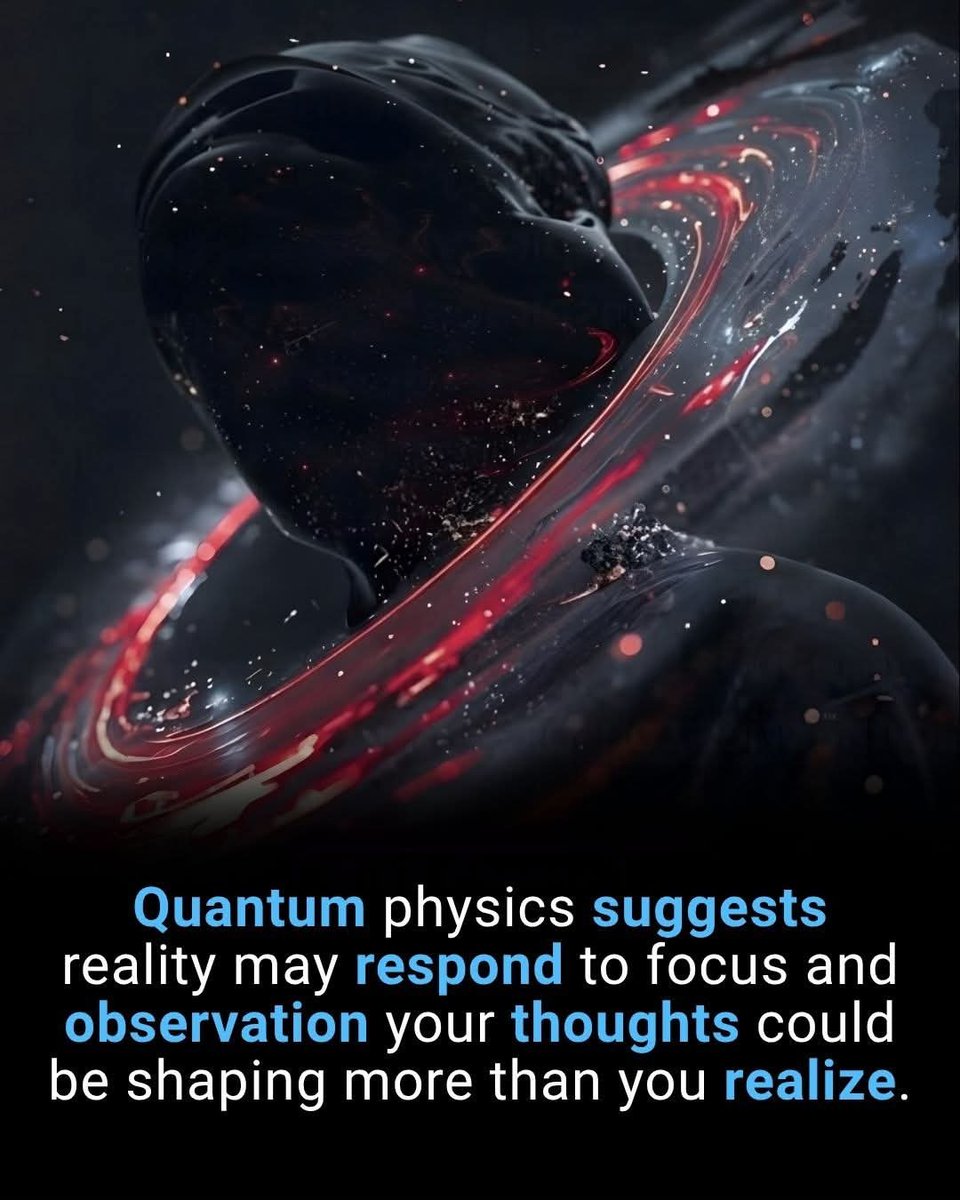
@AstronomyVibes You are on the ground of all possibilities when you see that you and the world is one process, bound to each other process. It means – whatever comes before you belongs to you, it can not be escaped. All complaining, blaming, feeling guilty drops.
English
0
0
0
40
Astronomy Vibes
Astronomy Vibes@AstronomyVibes·
Quantum physics reveals that reality isn’t as fixed as it seems. On the tiniest scales, the simple act of observation can influence how particles behave a phenomenon known as the observer effect. Some researchers and psychologists draw an inspiring parallel to daily life, suggesting our focus, beliefs, and expectations may subtly influence how we experience reality. In this view, thoughts are more than passing ideas they’re forms of energy that interact with the world around us. When you focus on growth instead of fear, or potential instead of limitation, your mindset may align with outcomes that reflect those frequencies. Therapeutic approaches like Matrix Reimprinting explore this link between mind and matter by helping people reframe emotional memories and release stored stress. It’s a space where science, psychology, and energy awareness meet showing that how we perceive the world might just help shape what we live. Credit: Sources American Psychological Association, Institute of Noetic Sciences, Scientific American, National Geographic, CERN.
Astronomy Vibes tweet media
English
13
37
113
3.4K
Y V Chawla
Y V Chawla@fundamentalexp·
हर पल दो संभावनायें होती हैं. या तो आप जो चाहते हो, वह होगा या नहीं होगा. आप 'नहीं होगा' की संभावना को मिटा कर राहत पाना चाहते हो. यह नहीं हो सकता. आपको इस संभावना के बारे में चुप रहना होगा. आप मूल धरातल पर हैं. अब आप जो चाहते हैं, स्पष्ट हो जाता है. qr.ae/pFGQ19
Y V Chawla tweet media
हिन्दी
0
0
0
8
Y V Chawla
Y V Chawla@fundamentalexp·
@Math_files Actuality, reality is either painful or pleasurable to us from moment to moment. Once one sees this, one is not enticed by probability. The discomforting gap (uncertainty) between 'what is' and 'what you think should be' has to be borne to see the Total picture.
English
0
0
0
349
Math Files
Math Files@Math_files·
“Probability does not exist.” This bold statement was made by Bruno de Finetti, and at first it sounds completely wrong. After all, we use probability all the time—weather forecasts, games, and even daily decisions. So what did he really mean? De Finetti wasn’t saying that uncertainty isn’t real. Instead, he was challenging the idea that probability is something built into the world, like weight or temperature. According to him, probability lives in our minds, not in nature. Think about a weather forecast that says there is a 50% chance of rain. That number is not floating in the clouds. It comes from a meteorologist who studies data—like wind patterns, humidity, and past weather—and then makes an informed judgment. Another expert, using slightly different data or methods, might give a different percentage. So, probability is really a way of expressing how confident someone is about an uncertain event, based on what they know. So, probability is not a fixed truth—it’s a personal estimate. It helps us make decisions when we don’t have complete information. De Finetti’s idea explains that uncertainty is part of life, and probability is just a tool we use to deal with it more wisely.
Math Files tweet media
English
126
193
998
83.6K
Y V Chawla
Y V Chawla@fundamentalexp·
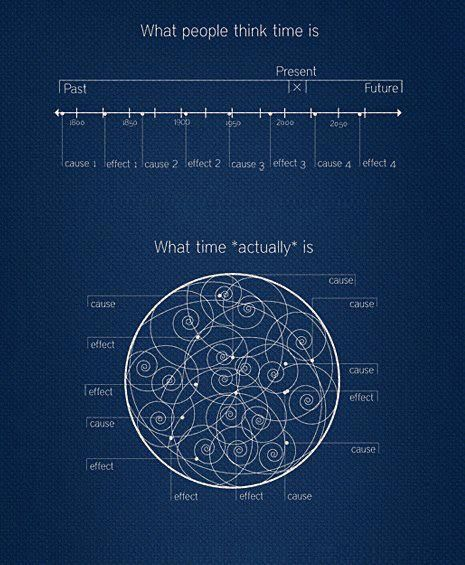
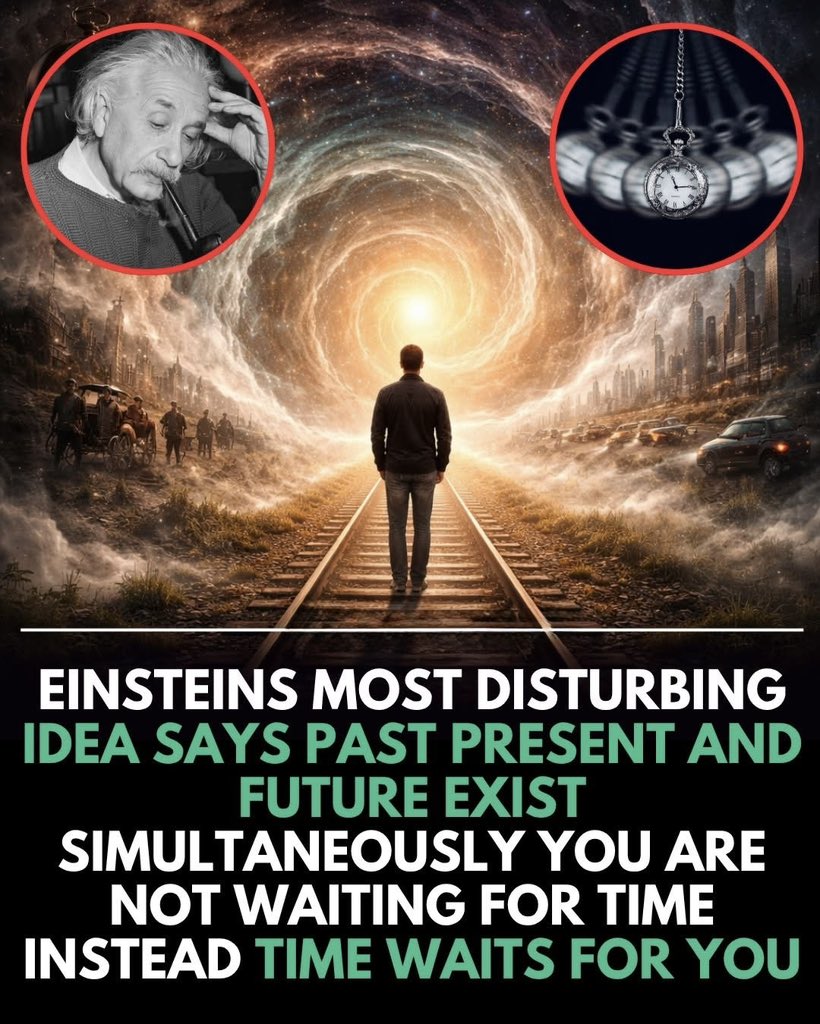
@NightSkyToday Time is a calculation in the memory for our daily activities. We are living in timeless zone where time is recognised through memory or thinking. Apart from clock time, time is tenseness between past and now and now and future.
English
0
0
2
1.1K
Night Sky Today
Night Sky Today@NightSkyToday·
According to Einstein, past, present, and future exist simultaneously, and time is merely an illusion.
Night Sky Today tweet mediaNight Sky Today tweet media
English
182
395
2.9K
93.3K
Y V Chawla
Y V Chawla@fundamentalexp·
@ElonogyX 'Who created this Universe, from where it has come' arises as thinking. We have to see the limit of thinking to see the Total picture of Existence.
Y V Chawla tweet media
English
0
0
0
21
Elonogy
Elonogy@ElonogyX·
Elon Musk: “My essential philosophy is curiosity. I’d like to understand the meaning of life — is the Standard Model of physics correct? The beginning of life, the beginning of existence, and the end of the universe. What questions do we not know to ask, that we should ask? AI will help us with these things. I’m trying to understand how do we get here, what’s going on, what’s real. Are there aliens? Maybe there are. If we’ve got spaceships traveling to other star systems, we may encounter aliens, or find many long-dead alien civilizations. I just want to know what’s going on. I’m curious about the universe — that’s my philosophy.”
English
61
97
346
9.8K
Y V Chawla
Y V Chawla@fundamentalexp·
@cosmosarcive 'Who created this Universe' arises as thinking. We have to see the limit of thinking to see the Total picture of EXistence.
Y V Chawla tweet media
English
0
0
1
30
Cosmos Archive
Cosmos Archive@cosmosarcive·
"If we say “God” made the universe, then surely the next question is, “Who made God?” If we say “God” was always here, why not say the universe was always here? If we say that the question “Where did God come from?” is too tough for us poor mortals to understand, then why not say that the question of, “Where did the universe come from?” is too tough for us mortals? In what way, exactly, does the God hypothesis advance our knowledge of cosmology? What predictions does it make on which the hypothesis will stand or fall?" - Carl Sagan ( 1981 interview with U.S. Catholic magazine)
Cosmos Archive tweet media
English
69
34
111
8.8K
All day Astronomy
All day Astronomy@forallcurious·
PHYSICS🚨: Time is an illusion — meaning the Past, Present, and Future exist simultaneously, physicist claims
All day Astronomy tweet media
English
152
579
3.1K
70.8K
Y V Chawla
Y V Chawla@fundamentalexp·
@cosmosarcive We are conscious against being not conscious (as brain can not see anything without contrast). This tenseness is life energy. Can you see that you and your death can not meet at any point? Once one sees this, all questions 'about life' drop.
Y V Chawla tweet media
English
0
0
0
27
Cosmos Archive
Cosmos Archive@cosmosarcive·
Earth isn’t the “perfect haven” we think it is. It’s actually a beautiful, chaotic death trap. Neil deGrasse Tyson reminds us that 99% of species are gone and three-quarters of our own planet would end us in minutes. We aren’t living in a cozy nest; we’re survivors on a rock that’s constantly testing our resolve. The universe doesn't owe us hospitality; it’s our ingenuity that keeps the lights on.
English
34
37
146
7K
Y V Chawla
Y V Chawla@fundamentalexp·
@AstronomyVibes ‘Who created you or the Universe’ arises as thinking. Thinking is not the total field. Senses see, touch, listen and so on, breathing in and out is going on, there is memory and imagination and thoughts arising in the mind. This is the format of Life.
Y V Chawla tweet media
English
0
0
0
68
Astronomy Vibes
Astronomy Vibes@AstronomyVibes·
"If we say God made the universe, then surely the next question is, "Who made God?" If we say God was always here, why not say the universe was always here? If we say that the question "Where did God come from?" is too tough for us poor mortals to understand, then why not say that the question of "Where did the universe come from?" is too tough for us mortals?" ~ Carl Sagan
Astronomy Vibes tweet media
English
38
28
87
10.8K
Y V Chawla
Y V Chawla@fundamentalexp·
@Saganismm ‘Who created you or the Universe’ arises as thinking. Thinking is not the total field. Senses see, touch, listen and so on, breathing in and out is going on, there is memory and imagination and thoughts arising in the mind. This is the format of Life.
Y V Chawla tweet media
English
0
0
0
17
Saganism
Saganism@Saganismm·
"If we say God made the universe, then surely the next question is, "Who made God?" If we say God was always here, why not say the universe was always here? If we say that the question "Where did God come from?" is too tough for us poor mortals to understand, then why not say that the question of "Where did the universe come from?" is too tough for us mortals?" = Carl Sagan
Saganism tweet media
English
412
380
1.7K
103.4K
Y V Chawla
Y V Chawla@fundamentalexp·
@NextScience We seek relief by complaining, blaming, feeling guilty to cover up the irritation, discomfort any situation creates within us. If you can let go this relief - whole energy is gathered here.
English
0
0
0
13
Next Science
Next Science@NextScience·
🚨 THE SILENT HABIT THAT’S CHANGING YOUR BRAIN… WITHOUT YOU NOTICING What if something you do every day is quietly rewiring your brain? Research suggests that constant complaining doesn’t just affect your mood—it may actually weaken how your brain functions. Each time you focus only on problems, your body releases more cortisol, the stress hormone. Over time, this can make it harder for your brain to adapt, learn, and stay flexible. But here’s the unsettling part… your brain gets used to it. The more you complain, the easier it becomes to stay stuck in that pattern. It’s like training your mind to see the negative first—without even realizing it. Now imagine the opposite. Shifting your focus, even slightly, can begin to rebuild those pathways. The brain is always listening… and always changing. So the real question is: What are you training your brain to become? Source: Dweck, C. Mindset: The New Psychology of Success. Random House. Sapolsky, R. Why Zebras Don’t Get Ulcers. Holt Paperbacks.
Next Science tweet media
English
7
26
105
2.4K
Y V Chawla
Y V Chawla@fundamentalexp·
@AstronomyVibes Human being is a complete mechanism. One shies away from the feeling of sadness, confusion, fear, uncertainty. One runs to solacing ideas or seeks relief by complaining, blaming,feeling guilty to bypass the feeling of uneasiness. Once noticed, whole energy(code) is here.
English
0
0
1
422
Astronomy Vibes
Astronomy Vibes@AstronomyVibes·
🚨 What If Your Entire Life… Is Just Code? In 2003, philosopher Nick Bostrom published a paper with a question so unsettling that it still echoes through science and philosophy today: What if our entire universe is actually a computer simulation? At first it sounds like science fiction. But the idea is surprisingly logical when you think about the direction technology is heading. Look at how far we have already come. Just a few decades ago, computers could barely display simple graphics. Today, video games create entire worlds filled with cities, forests, weather, and characters that react to our actions. Virtual reality can make our brains feel as if we are standing somewhere else entirely. Now imagine technology thousands—or even millions—of years in the future. A civilization that advanced might possess computers powerful enough to simulate entire planets… entire histories… even entire universes. Inside those simulations could exist conscious beings who believe their world is real. Beings just like us. Bostrom suggested something called “ancestor simulations.” The idea is simple but chilling. Advanced civilizations might run simulations of their past to study history or understand how their species evolved. These simulations would contain billions of simulated people living normal lives, completely unaware that their reality is artificial. If a single advanced civilization created thousands or millions of such simulations, then the number of simulated minds would become vastly greater than the number of real biological minds. And this leads to a disturbing possibility. Statistically speaking, a randomly existing mind would be far more likely to be inside a simulation than in the original reality. In other words… the odds might not be in our favor. Think about your daily life for a moment. The sky above you, the ground beneath your feet, every star in the night sky, every memory you have ever experienced—what if all of it is simply information being processed somewhere else? What if reality itself is being rendered like a giant cosmic video game? Some scientists have even wondered whether strange features of the universe could hint at something deeper. Why do the laws of physics follow precise mathematical rules? Why does the universe appear almost perfectly tuned for life? And why does space and time seem to have limits at the smallest measurable scales? To some thinkers, these questions sound eerily similar to the rules of a programmed system. Of course, none of this proves we live inside a simulation. Many scientists remain skeptical, arguing that simulating an entire universe would require unimaginable amounts of energy and computing power. Others point out that the idea may be impossible to test. But the mystery remains. If advanced civilizations somewhere in the cosmos eventually develop the ability to simulate conscious beings—and if they choose to run these simulations—then billions or trillions of simulated worlds could exist. And in a universe filled with simulations, the most unsettling question of all appears: How do we know ours is the original one? Right now, you are reading these words, feeling the world around you, believing this moment is real. But somewhere, far beyond our understanding, there might be a machine quietly running the code of an entire universe… including you.
Astronomy Vibes tweet media
English
73
92
427
18.5K
Y V Chawla
Y V Chawla@fundamentalexp·
क्या आज के समय में अध्यात्म की पुकार को समझने वाला कोई मठ आश्रम है?(question from quora) *प्रश्न यह नहीं कि कौन सा आश्रम सही है, अपितु यह कि आप आश्रम से क्या चाहते हैं? (पूरा उत्तर पढ़ें) bit.ly/4vRXFdO (Image-AI generated)
Y V Chawla tweet media
हिन्दी
0
0
0
20
Y V Chawla
Y V Chawla@fundamentalexp·
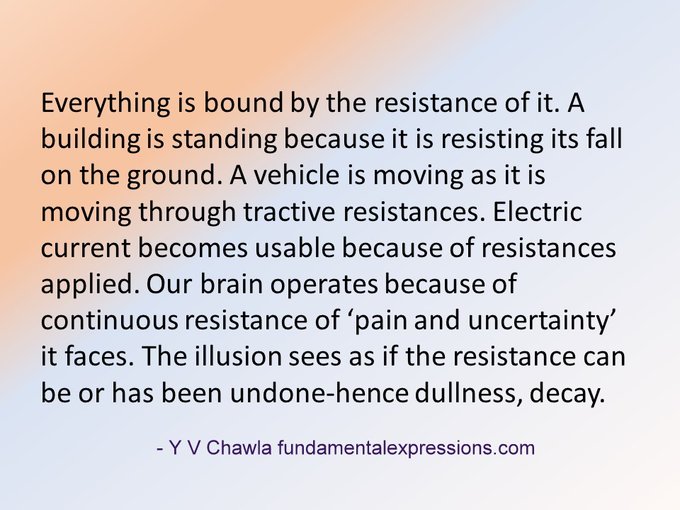
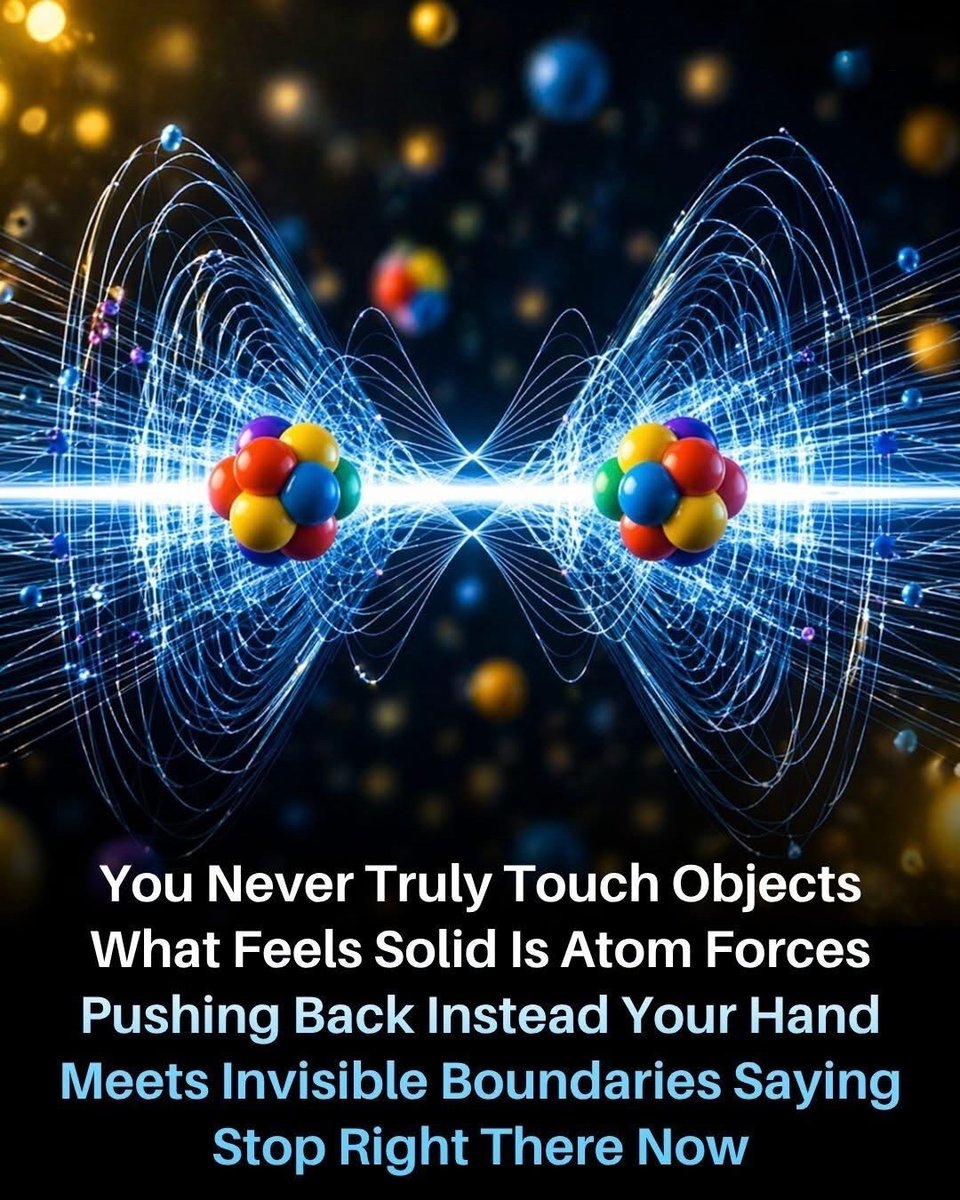
@BrainyScience Everything is bound the resistance of it. It is all oneness, resistance is created to live, to enjoy through time.
Y V Chawla tweet media
English
0
0
0
16
Science Unfold
Science Unfold@ScienceUnfold·
🧲 YOU NEVER REALLY TOUCH ANYTHING — YOUR HAND NEVER MAKES CONTACT It feels like you’re touching your phone, your desk, or even your own skin… but science says something strange is happening. At the atomic level, you are never actually making contact. The atoms in your hand and the atoms in the object never collide. Instead, invisible electromagnetic forces push back, creating a “force field” of resistance. That sensation of touch? It’s really your atoms saying stop right there. So every moment of contact you feel is actually a battle of invisible forces, not solid meeting solid. Reality is far more mysterious than it looks. Source Feynman, R. P., Leighton, R. B., & Sands, M. The Feynman Lectures on Physics, Volume II. Addison-Wesley.
Science Unfold tweet media
English
8
22
66
1.6K
Y V Chawla
Y V Chawla@fundamentalexp·
@AstronomyVibes There is only ‘what is’ from moment to moment. Time is calculated in the memory through contrast. Now and past, now and future. Brain works through contrasts only. We are conscious against not being conscious (contrast). This is the Totality, the Original contrast.
English
0
0
0
20
Astronomy Vibes
Astronomy Vibes@AstronomyVibes·
Albert Einstein's mathematical framework of relativity proved that space and time are mechanically fused into a singular, rigid geometric structure known as the "block universe." In this exact architectural model, time does not actively "happen" or physically move forward. Instead, every single microscopic event—from the absolute beginning of the universe to its final absolute end—already exists simultaneously within this massive four-dimensional coordinate system. This means your biological consciousness is simply traveling through a pre-existing structural framework. The past has never truly vanished, and the future is already completely constructed; your central nervous system is merely sequentially rendering the environmental data as you physically move along your specific geometric coordinate path.
Astronomy Vibes tweet media
English
36
82
219
9.2K