
Sabitlenmiş Tweet
Fystack
890 posts


Fystack
@fystack
Fystack helps Web3 projects, fintechs & stablecoin issuers automate digital asset workflows across multiple chains at scale — secure, compliant, self-hosted.
github.com/fystack Katılım Mart 2025
79 Takip Edilen266 Takipçiler

95% isn't just a security best practice. In Japan, it's a legal requirement for crypto exchanges.
Japan's stablecoin framework doesn't apply the same custody rules to every participant. Crypto exchanges, stablecoin distributors, and trust issuers each operate under different regulatory obligations.
In our latest guide, we explain:
- The 95% cold storage rule
- How foreign stablecoins like USDC enter the Japanese market
- Common misconceptions about Japan's Travel Rule
- What changed under the 2026 regulatory updates
If Japan is on your expansion roadmap, this guide is a good place to start.
fystack.io/blog/japan-sta…

English
Getting licensed is only the beginning.
Keeping your custody infrastructure compliant across multiple Southeast Asian markets is the harder challenge.
Our latest guide compares licensing, AML, Travel Rule, and data residency requirements across five jurisdictions.
Read more: fystack.io/blog/southeast…

English
Many fintechs see compliance as something to add later. That decision becomes more expensive as the business grows.
Every new regulation can mean another integration, another vendor, and another layer of operational complexity.
The teams that scale successfully don't treat compliance as an add-on.
They build it into their infrastructure from day one.
As APAC regulations continue to evolve, that approach is becoming less of a competitive advantage and more of a business requirement.
Read more → fystack.io/blog/apac-fint…

English
Many fintechs think the biggest cost of compliance is buying another KYT solution.
It usually isn't.
The hidden costs often appear later:
• More vendors to manage
• More systems to integrate
• More operational complexity as regulations evolve
Our latest blog explores why compliance becomes much harder when it's added after the product has already scaled.
Read more → fystack.io/blog/apac-fint…

English
Stablecoin isn't just changing payments. It's changing how fintech teams think about infrastructure.
#Visa and #Mastercard arrived at two completely different answers.
One bought the stack.
The other scaled through partners.
Neither strategy is universally right. It depends on what you're optimizing for: speed, control, capital, or compliance.
We put together a simple infographic breaking down the trade-offs and a deeper article explaining when to build, partner, or buy stablecoin infrastructure.
Full analysis: fystack.io/blog/visa-vs-m…
#Stablecoin #Fintech #Payments #Infrastructure #DigitalAssets #Fystack
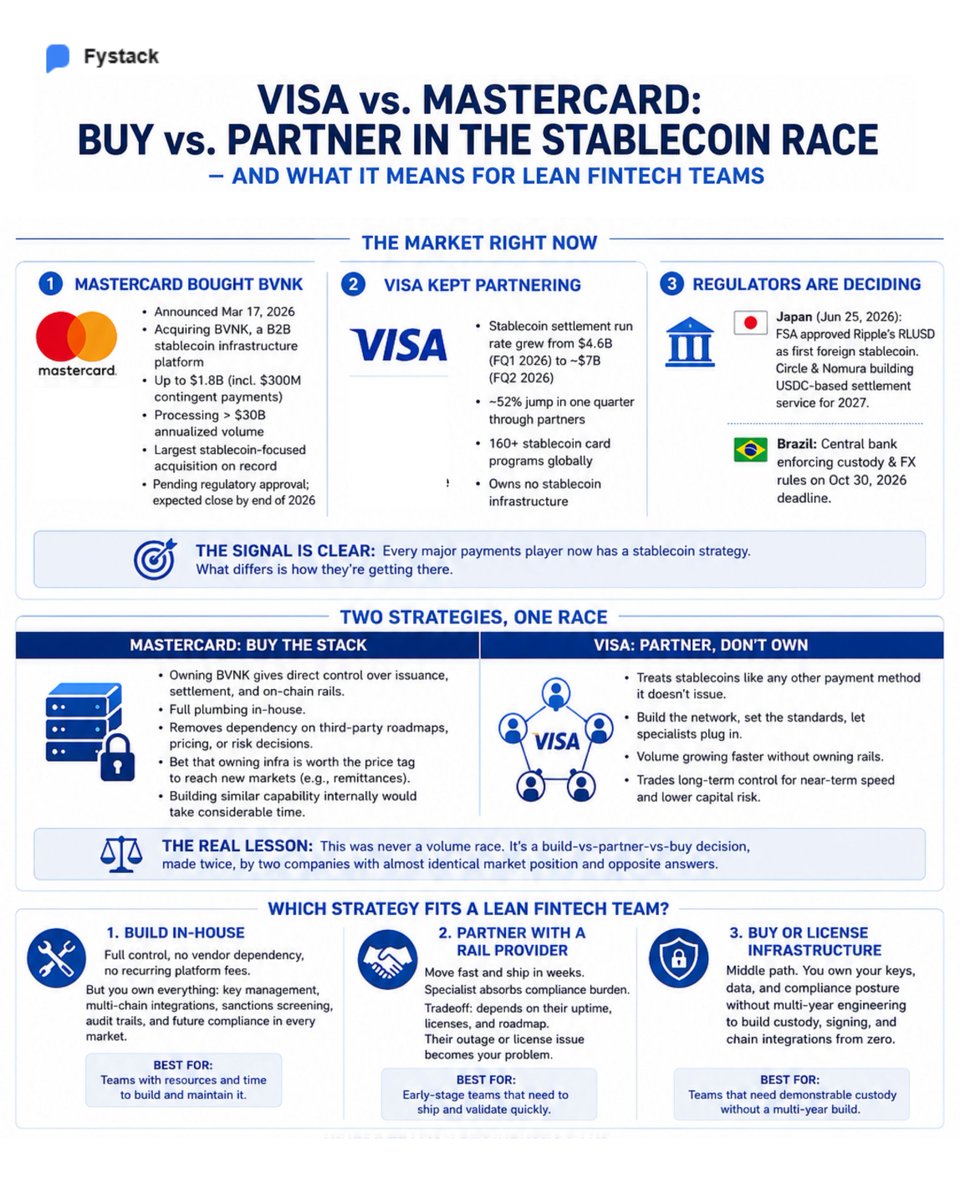
English
Mastercard spent 1.8B USD to buy stablecoin infra. Visa spent almost nothing and still grew faster.
Same market. Same opportunity. Two opposite strategies.
Build vs buy vs partner is not theory anymore. It is happening at global scale.
Full breakdown 👇
fystack.io/blog/visa-vs-m…

English
If you're building a stablecoin business in Southeast Asia, here's one mistake that can quietly kill your expansion plans:
Treating Southeast Asia as a single market.
Vietnam, Singapore, Indonesia, Thailand, Malaysia, and the Philippines all have completely different rules around stablecoins, licensing, Travel Rule implementation, data localization, and foreign operator access.
The challenge isn't understanding six regulations.
It's making one cross-border payment that complies with all six.
In this guide, we break down:
• The stablecoin framework in each major SEA market
• Vietnam's new pilot regime and what it means for foreign companies
• Where the FATF Travel Rule creates operational friction
• Why data localization is changing custody architecture
• The infrastructure decisions businesses should make before entering the region
If Southeast Asia is part of your expansion roadmap, this should save you weeks of research.
Read here: fystack.io/blog/one-regio…
English
A lot of crypto teams make the same mistake:
They answer trust questions with technical answers.
User: "What happens if your company disappears?"
Team: "We use MPC with threshold signatures..."
Wrong conversation.
This guide covers the 7 custody questions users actually ask, what each question is really probing for, and how to answer in plain English.
fystack.io/blog/the-7-cus…

English
Fystack’s open source policy engine sits right at the signing layer to evaluate rules independently, blocking unauthorized transactions.
Read the full guide: dub.sh/ai-agent-guard…
English

@AdevarLabs Thanks for the partnership, Adevar Labs. We believe trust is earned through transparency and continuous improvement. The audit process helped strengthen our infrastructure and validate the security measures behind Apex Backend.
English

Audit Completed for @Fystack
Fystack builds MPC-based stablecoin payment infrastructure for fintechs, neobanks, and payment providers. Self-hosted deployment and flat pricing.
Grateful to work with the Fystack team and help them Ship Safely. 🚀
Public report & testimonial below🧵:
English
🛡️ Apex Backend Infrastructure Audit: Completed
Apex Backend - the infrastructure powering payments, wallet signing, API access, and webhooks - has successfully completed an independent security audit by @AdevarLabs.
Audit scope:
✔ Authentication, sessions & API access control
✔ Checkout & payment flows
✔ Wallet signing & MPC message handling
✔ Webhook delivery
✔ Database, deployment & CI/CD configuration
The engagement included both a full security audit and a dedicated remediation review to independently verify implemented fixes.
We believe transparency matters more than security badges, which is why we're publishing the complete report.
fystack.io/blog/fystack-c…

English
The Middle East now offers multiple virtual asset licensing frameworks, but each jurisdiction serves a different purpose.
Some are built for exchanges.
Some focus on institutional finance.
Others are designed to attract innovation and digital asset businesses.
Choosing the right jurisdiction can impact your timeline, costs, investor access, and future scalability.
We've summarized the key licensing hubs and the typical licensing journey in the infographic below.
If you're evaluating expansion into the Middle East, this is a useful starting point.
fystack.io/blog/middle-ea…
#Fintech #Web3 #Crypto #VirtualAssets #Compliance #MiddleEast

English

🚀 @ProprXYZ now accepts crypto at checkout, powered by @boom_fi
Crypto payments built for prop traders - instant, lower fees, global, no banking friction.
#PropTrading #CryptoPayments #BoomFi

English


@stablecoing @eldoradoio @paradigm @cbventures @VerdaVentures Four years building cross-border payments for people who genuinely need it, now backed by Paradigm.
Congrats @stablecoing & @eldoradoio, well deserved.
English

Four years ago, we started @eldoradoio to fix one thing: moving money across borders should be as easy as sending a message.
Today, I'm proud to share that El Dorado has raised a $9 million Series A led by @paradigm, with participation from @cbventures and @VerdaVentures.
English

We are excited to be working with @AureaHub 🤝
They bring white-label DeFI infrastructure to banks
They bring white-label infrastructure to banks and merchants across Europe.
Now their customers can settle with our MiCA-compliant stablecoins. EURQ, USDQ, PLNQ and GBPQ.
Aurea@AureaHub
🧵1/ 🤝 Aurea and @Quantoz are now operating together. For the first time, there's a fully EU-regulated cross-border payments stack: DNB-supervised stablecoin issuance, distributed to banks and merchants across Europe through Aurea's white-label infrastructure.
English