Rajat Agrawal

1.5K posts

Rajat Agrawal

Rajat Agrawal

@gabagenius

Katılım Eylül 2011
119 Takip Edilen261 Takipçiler
Rajat Agrawal retweetledi
Jeffrey Currie 🆔++
Jeffrey Currie 🆔++@CommodMkt·
Welcome to the most asymmetric trade in modern financial history. The thread below lays out why. The opportunity exists because capital has chased the AI trade while ignoring the physical assets AI requires to run — assets that have quietly become the best-performing asset class of the decade. Since October 2020 when we first called for the commodity super cycle: QCI Total Return +217%, GSCI Total Return +205%, Gold +140%. NASDAQ trails at +130%. S&P 500 at +85%. The top three are all commodities. Yet oil cannot get out of its own way while copper and the broader atom complex prints fresh highs . That is the dislocation. That is the trade. Get long. Buckle in. Hang on for the ride. Forgive the longer posts in this thread — attempting to mimic my old 10-bullet commodity takes. On to it.
English
83
351
1.9K
364.9K
Rajat Agrawal retweetledi
Ole S Hansen
Ole S Hansen@Ole_S_Hansen·
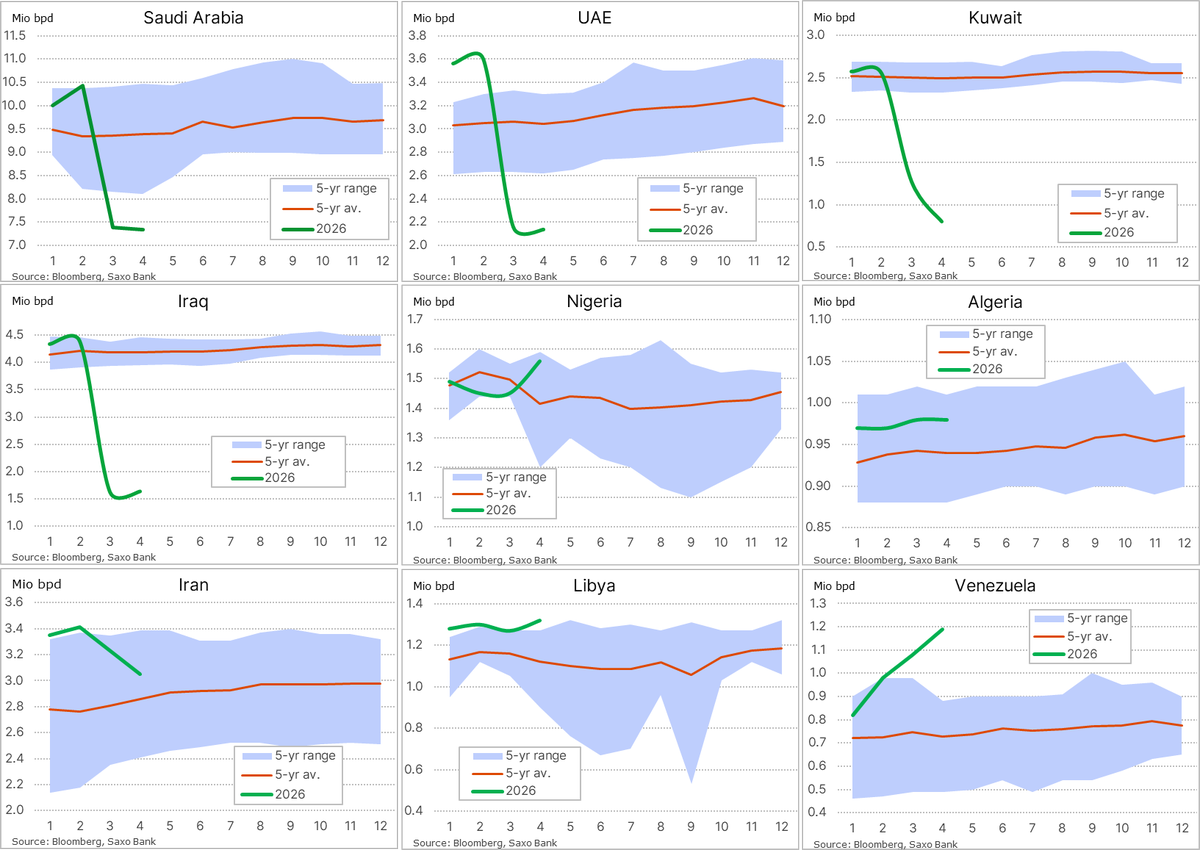
Iran has, as expected, has seen the smallest decline in output (-11%) since the war started, while production across other Persian Gulf producers has collapsed. Saudi Arabia (-29%) - and to a lesser extent the UAE (-40%) - have been partly shielded by pipeline infrastructure that allows crude exports to bypass the Strait of Hormuz, while Iraq (-63%) and Kuwait (-69%) have taken the biggest hit. Meanwhile, Venezuela’s production continues to recover, reaching a seven-year high, while Libya holds output near a 13-year high. Data from Bloomberg's monthly survey #CrudeOil #MiddleEast #OPEC
Ole S Hansen tweet media
English
27
374
872
106.1K
Rajat Agrawal
Rajat Agrawal@gabagenius·
@Fullcarry At this point, a small surprise will be to not remove ‘at least next several quarters’
English
0
0
1
90
Ed Bradford
Ed Bradford@Fullcarry·
Bond market betting there will be no QRA surprise tomorrow morning. 5s30s continues to flatten and now eyeballing 90 bps
English
4
4
68
6.3K
Rory Johnston
Rory Johnston@Rory_Johnston·
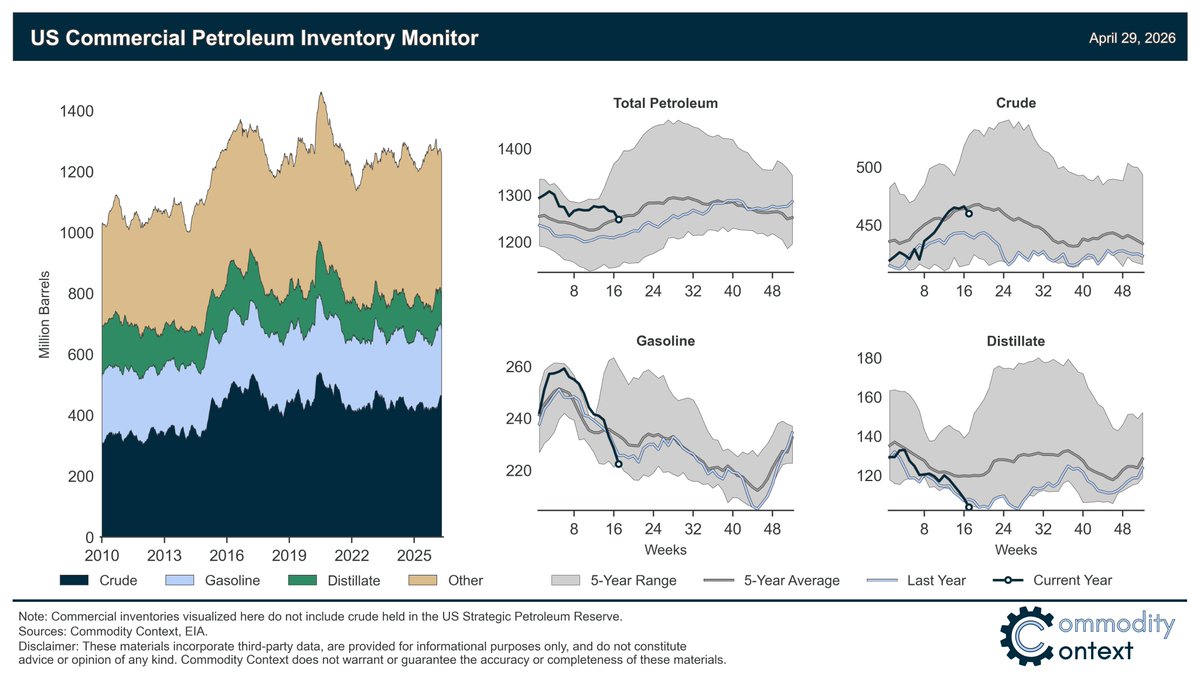
Thereeeeee sheeeee goessssss US commercial petroleum inventories fell by a headline 17 million barrels, PLUS another 7.1 million barrels of SPR crude draws. 13.3 MMbbl total crude draw (comm + SPR), 6.1 MMbbl gasoline draw, 4.5 MMbbl diesel draw.
Rory Johnston tweet media
English
59
397
1.9K
355.5K
Rajat Agrawal retweetledi
HFI Research
HFI Research@HFI_Research·
Well done JPM. It is just math.
HFI Research tweet mediaHFI Research tweet mediaHFI Research tweet media
English
21
572
3.9K
1.1M
Stephen Stapczynski
Stephen Stapczynski@SStapczynski·
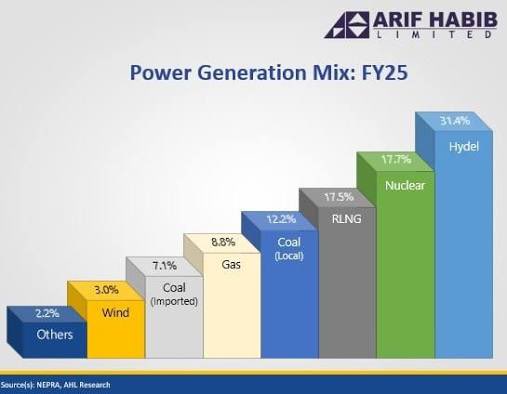
The crux of Pakistan’s problems is its continued dependence on LNG The country adopted the fuel about a decade ago. And it remains a key part of the power mix (17% in the last fiscal year)
Stephen Stapczynski tweet media
English
7
9
31
4.2K
Stephen Stapczynski
Stephen Stapczynski@SStapczynski·
Electricity is now a luxury in Pakistan 🇵🇰 ⚡️ When global fuel supplies contract, rich countries typically pay up. The emerging world, meanwhile, just stops That’s what’s happening in Pakistan. Blackouts have worsened since the war halted LNG deliveries bloomberg.com/news/articles/…
English
8
96
220
25.5K
Rajat Agrawal retweetledi
Yet another commodity guy
Yet another commodity guy@tleilax___·
Commodity "Widow-Maker" Trades - A comprehensive field guide A "widow-maker" is a trade that looks attractive on paper (mean-reverting, carry-positive, statistically cheap, or seasonally obvious) but has a long, nasty left tail driven by structural asymmetries: storage/delivery mechanics, weather, political risk, illiquidity, or short-gamma dynamics. The common thread is bounded upside, unbounded downside, and a payoff profile dominated by rare but catastrophic events. Starting a little thread.
English
22
60
620
93.7K
Rajat Agrawal
Rajat Agrawal@gabagenius·
@ShaleTier7 And the effect is not linear. 35k b/d for a year is probably within margin of error, while 11mm b/d for a day is exponentially more impactful
English
0
0
0
173
Rajat Agrawal retweetledi
John Arnold
John Arnold@johnarnold·
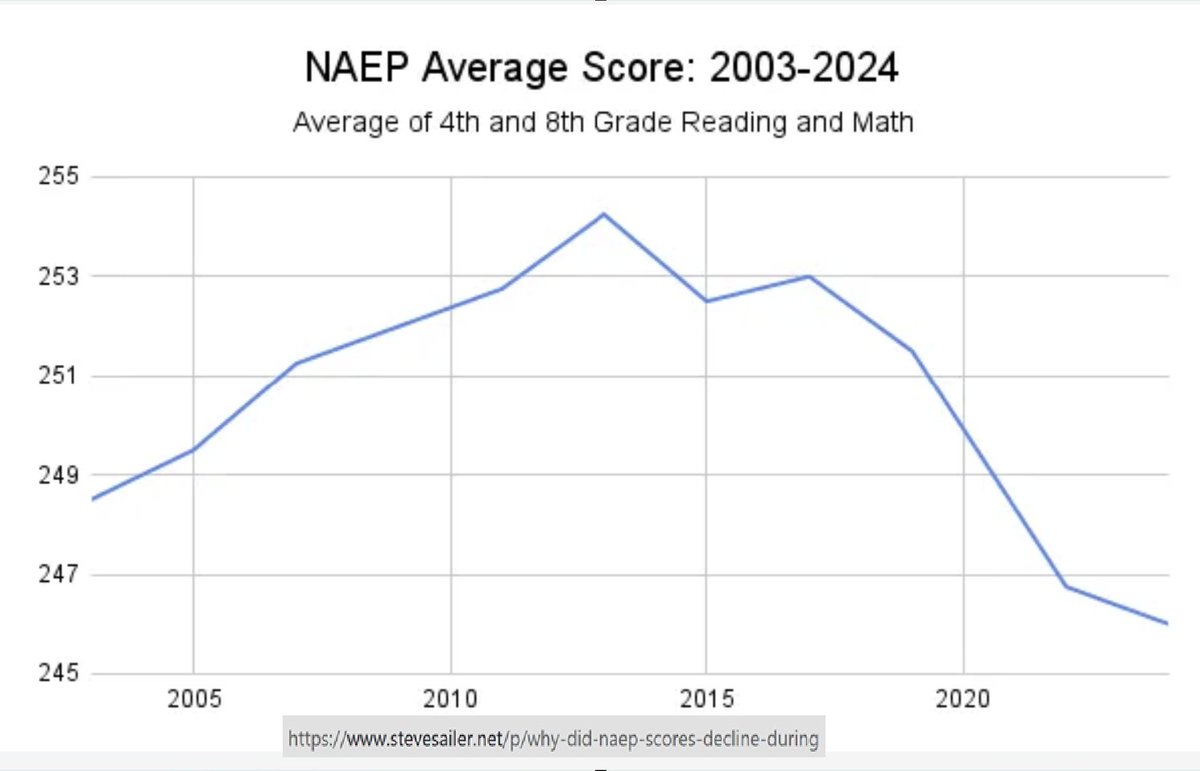
The erosion of K-12 accountability at all levels—districts, schools, teachers & students—since 2016 has corresponded with a drop in outcomes. The fad of the moment in education is "science of reading", but without addressing low standards, curriculum changes alone won't work. 1/n
John Arnold tweet media
English
27
74
395
60.1K
Rajat Agrawal retweetledi
JH
JH@CRUDEOIL231·
What is the North Sea physic mkt, and how should the gap between the paper and physical markets be resolved? Every time I post about the physical market, I see a lot of complaints about why oil prices aren't rising further. Many ppl even criticize me, claiming I’m not explaining things properly. First, I’ll summarize the basic components of the North Sea market. ICE Brent Futures: A financially settled paper contract used primarily for broad directional hedging and speculation without the intention of physical delivery. EFP (Exchange of Futures for Physical): A swap that acts as a bridge, allowing a trader to convert a paper futures position into a physical cargo contract. Forward Brent: A standardized OTC physical swap for future delivery. It represents actual oil but remains non-dated bc the exact loading schedule is not yet determined. Dated Brent: The global benchmark price for physical crude. It is assessed daily by agencies like Platts based on actual trades of the most competitive grade within the BFOET+WTI basket, triggered once specific loading dates are confirmed (typically 10-30 days prior). CFD: A short-term swap representing the price difference between Forward Brent and Dated Brent. It is used to plot the physical forward curve and assess whether the market is in contango or backwardation. DFL (Dated to Frontline): A swap that links the physical Dated Brent assessment directly to the front-month ICE Futures contract, managing exposure between the physical and financial markets. Diff (Grade Basis): The premium or discount applied to a specific physical cargo relative to the Dated Brent benchmark. Driven by crude quality, logistics, and refinery demand, this unhedgeable spread is where physical traders generate profit. This alone should be enough. From there, I’ll explain how the gap between the paper market and the physical market actually closes. A massive divergence between Dated Brent (physic) and ICE Brent futures (paper) typically indicates acute near-term physical tightness relative to forward expectations. If Dated Brent remains at $120-130/bbl leading into the expiration of the front-month ICE Brent futures contract (currently around $100/bbl), the futures contract must converge toward the physical price. The convergence is not optional; it is mathematically enforced by the exchange's settlement rules and market arbitrage. This operates through three primary mechanisms: 1) Cash Settlement via the ICE Brent Index ICE Brent futures are cash-settled upon expiration and do not involve physical delivery. Expiring contracts are settled against the ICE Brent Index. The Index is a calculated average of trading activity in the relevant physical Forward BFOET(Brent, Forties, Oseberg, Ekofisk, Troll)+WTI Midland market during the final trading days of the futures contract. Bc Forward Brent and Dated Brent are intrinsically linked, a physical market sustaining $130 will generate an ICE Brent Index near $130. Consequently, any futures positions left open at expiration are forcibly settled at this higher Index price. 2) The Arbitrage Channel (EFP Mechanism) If a $30 spread exists between paper and physical markets, traders will immediately exploit the arbitrage using the EFP mechanism. Traders buy the undervalued ICE Brent futures at $100 and simultaneously sells a physical Forward Brent cargo at $130. They execute an EFP to swap their long paper futures position into a long physical Forward position. The newly acquired long physical position cancels out their short physical position, locking in a profit (minus the EFP swap cost). To execute this arbs on a large scale, traders must aggressively buy ICE futures. This massive purchasing volume forces the futures price up until the gap closes and the arb window is eliminated. 3) Forced Short Covering Market participants holding short positions in the ICE Brent futures market face extreme risk if the physical market disconnects to the upside. Knowing the contract is destined to cash-settle against a $130 physical Index, paper shorts cannot afford to hold their $100 positions into expiration. They are forced to buy back their futures contracts to close their positions before the expiry date. This forced buying—often resulting in a short squeeze—accelerates the upward momentum of the ICE futures price, driving it into alignment with the physical market. Through the combination of final index settlement and active EFP arbs, the paper market is structurally tethered to physical reality as expiration approaches. #oott #iran
English
102
311
1.8K
344.1K
Rajat Agrawal retweetledi
Shanu Mathew
Shanu Mathew@ShanuMathew93·
Trying to bridge thoughts from different sources & podcast given the focus around the AI buildout. How much data center capacity is actually coming online per year — and who is absorbing it? I've been trying to square some numbers across multiple sources on real, energized gigawatts being added annually in the US, who's consuming them, and what we actually know versus what's estimated. The installed base FERC confirmed in their March 2026 State of the Markets report that US data center capacity exceeded 50 GW at year-end 2025. Industry estimates put total US capacity in the 35-40 GW range at year-end 2024 (Bain was at ~35GW, Morgan Stanley's model pegged it at 37 GW). That implies roughly 10-15 GW of net additions in 2025, a massive step-up from prior years. Total facility power, critical IT load, and hyperscale-only all produce different baselines — I haven't seen two sources use the same definition consistently. Frontier labs Brad Gerstner @altcap (investor in both @OpenAI and @AnthropicAI) says OAI and Anthropic have 1.5-2 GW each today, going to ~5 GW by year-end. @dylan522p at @SemiAnalysis (@dwarkesh_sp @dwarkeshpodcast Podcast, March 2026): Both at roughly 2-2.5 GW today. Both reach 5-6 GW by year-end 2026, OpenAI slightly higher. Both targeting ~10 GW by end of 2027. @sarahfriar disclosed 1.9 GW for OpenAI at year-end 2025. Anthropic's operational capacity is likely in the 1.5-2 GW range. On year-end targets, there's a wide gap between what's been contracted (Stargate US + UAE, NVIDIA 10 GW partnership, CoreWeave, Google TPU mega-deal) and what will physically be energized by December. Dylan's 5-6 GW per lab is likely the more physically grounded number, built bottom-up. Per Dylan, Anthropic was conservative on locking up compute early while OpenAI signed aggressively with Microsoft, CoreWeave, Oracle, & even SoftBank Energy — so Anthropic has to now pay premium rental rates or go to lower-quality providers to catch up (but Gerstner's comments made it sound like the take rate wasn't that high). Neither leading lab owns or builds data centers. Their ~6 GW of combined incremental capacity in 2026 is physically built and operated by AWS, Google, Microsoft, CoreWeave, Oracle, and others but contractually dedicated to serving OpenAI and Anthropic workloads. Assume a meaningful chunk of AWS's disclosed additions goes to Anthropic's Trainium/Rainier clusters, and a meaningful chunk of CoreWeave's build goes to OpenAI. CoreWeave also recently signed a multi-year agreement to support Anthropic's Claude models, with new capacity coming online in 2026. Frontier lab demand and hyperscaler supply overlap — they are not additive. Hyperscaler disclosures on physical delivery These are a mix of US and global figures, and facility power vs. IT load definitions vary across companies. Amazon (AWS): @ajassy disclosed AWS added 3.9 GW of new power capacity in 2025 (1.2 GW in Q4 alone). Operating from a base of roughly 8 GW at year-end 2025, with a target to double total capacity by year-end 2027 implying ~16 GW total. Still describes demand as outpacing supply. AWS operates 38 regions across 27 countries = the 3.9 GW is almost certainly global, not US-only, though the US is the clear majority. Microsoft: @SatyaNadella's team disclosed over 2 GW added in FY2025, with roughly 1 GW brought on in the December quarter alone. 400+ data centers globally. Also targeting roughly double capacity by 2027. SemiAnalysis reported that Microsoft paused over 3.5 GW of capacity that would have been built by 2028, though Reuters/TD Cowen put the figure lower at ~2 GW of terminated leases in the US and Europe, and Bernstein says actual cancelled contracts total only "a couple hundred megawatts." The precise number is disputed. The directional point is clear that Microsoft was recalibrating its self-build vs. lease mix but now seems to be building again. Google (Alphabet): @sundarpichai and team guided 2026 capex at $175-185B, nearly double 2025. No explicit "we added X GW" disclosure comparable to AWS. Dylan describes them as "still capacity constrained" and acting fast = buying an energy company, putting down turbine deposits for 2028-29, negotiating long-term power agreements. A large chunk of new capacity is going to TPUs for internal products (Gemini across Search, Android, Workspace) and the Anthropic deal (~1 GW in 2026, ~3.5 GW from 2027). Without a disclosed GW figure, I'd estimate 3-5 GW of 2026 additions based on capex trajectory similar to the other giants. Meta: @finkd guided $115-135B in 2026 capex, nearly double 2025. Building for internal AI workloads (Llama training, inference across Instagram-WhatsApp-Threads) + Meta Superintelligence Labs. 1 GW campus in El Paso (investment scaled from $1.5B to $10B), 1 GW campus in Lebanon, Indiana, JV in Louisiana (~$27B estimated), Prometheus bringing 1 GW online in 2026. On top of the self-build, Meta committed $35.2B to CoreWeave across two deals for third-party capacity. Independent builders and neoclouds @elonmusk's @xai: Colossus 2 in Memphis is targeting 1-2 GW of capacity to support 550,000 next-gen Nvidia chips, scaling to 1 million GPUs. Deployed 35 natural gas turbines generating 420 MW behind the meter to work around grid constraints. @CoreWeave's team added 490 MW across 11 data centers in 2025 (260 MW in Q4). Total active capacity hit 850 MW at year-end against 3.1 GW contracted. Planning $30-35B of 2026 capex. Also acting as lead builder on the 1.2 GW Stargate Abilene campus for OpenAI. @nebiusai: Tracking toward 800 MW - 1 GW of available capacity in 2026. 310 MW facility in Finland. Meta agreed to buy $12B of AI computing capacity from Nebius by 2027, with an option for an additional $15B over five years — up to $27B total. Sense-checking the total - A few different ways to triangulate: Morgan Stanley forecasts ~24 GW of global additions in 2026 * 50-60% US = ~13-14GW. BloombergNEF has something like ~8-10GW of IT Load * 1.4 PUE = ~12-13GW. @climatetech_vc data showing at least 16 GW of US data center capacity slated to come online in 2026 across 140 projects but warns 30-50% may face delays due to power constraints and equipment shortages. Crude capex math: $600-700B in 2026 hyperscaler capex at roughly $40-50B per GW of fully-built capacity also implies mid-teens GW. That's an imprecise conversion as capex covers equipment, data center shells, chips, and land that enter service across different years but it provides another directional anchor. Colliers reported that North American data center absorption hit 15.6 GW in 2025, double the 2024 level. The narrower CBRE primary-colocation-market figure of 2.5 GW only captures a subset of traditional leased space and misses hyperscaler self-build, behind-the-meter neocloud facilities, and training clusters entirely. @EpochAIResearch's frontier data center tracker confirms the step-function: most of the largest campuses (e.g., Meta Hyperion at 2.2 GW, Microsoft Fairwater above 1 GW) don't fully arrive until 2027-2028. It seems a reasonable base case for 2026 US net energized capacity additions: ~15 GW vs. bear case 12-13 GW (permitting delays push energizations into 2027) vs. bull case 18-20 GW (everything announced delivers on schedule). The bucket breakdown: Frontier labs (OpenAI + Anthropic): ~6 GW. Physically built by AWS, Google, Microsoft, CoreWeave, Oracle but contractually dedicated to OpenAI and Anthropic training and inference workloads. ~3 GW incremental per lab. Hyperscaler first-party AI: ~4-5 GW. Microsoft Copilot across 900M MAUs and GitHub Copilot. Google Gemini across Search, Android, Workspace plus DeepMind. Amazon Alexa+ rebuild, internal retail/logistics AI. Meta ad retrieval, recommendations, Llama training. Third-party AI cloud and independent builders: ~2-3 GW. xAI and Meta as external customer of CoreWeave/Nebius. Enterprise builders. Sovereign AI. Inference demand through Bedrock, Vertex, and Foundry APIs. Non-AI cloud + overbuild/commissioning lag: ~2 GW. Traditional enterprise workloads plus power energized ahead of full rack load. Where I'm probably wrong and why the number could be higher than 15 GW ~90% of the incremental build in this framework is AI-related. Only ~1 GW goes to traditional cloud. The most likely source of upside: enterprise inference and cloud AI demand growing faster than this would model. Oracle's remaining performance obligations have exploded to $523B. AWS's non-Anthropic AI business is running at $15B+ ARR. Amazon's custom chip business alone is a $20B+ run-rate. The absorption data supports this. Colliers/Jefferies put North American absorption at 15.6 GW in 2025 = demand is tracking much closer to total additions than people assume. If enterprise adoption of AI APIs is inflecting harder than I'm capturing, the "third-party AI cloud" and "hyperscaler first-party" buckets could each be 1-2 GW bigger, pushing total additions toward 18-20 GW. If the enterprise inference layer is scaling as fast as the hyperscalers are betting (Copilot seats, Gemini in Search, Claude Code adoption, agentic workflows) then 15 GW is conservative and $600B+ in 2026 hyperscaler capex is well supported. Lot of figures and disclosures so I'm sure I slipped up along the way. What did I get wrong? Anything else to include?
Shanu Mathew tweet mediaShanu Mathew tweet mediaShanu Mathew tweet mediaShanu Mathew tweet media
Shanu Mathew@ShanuMathew93

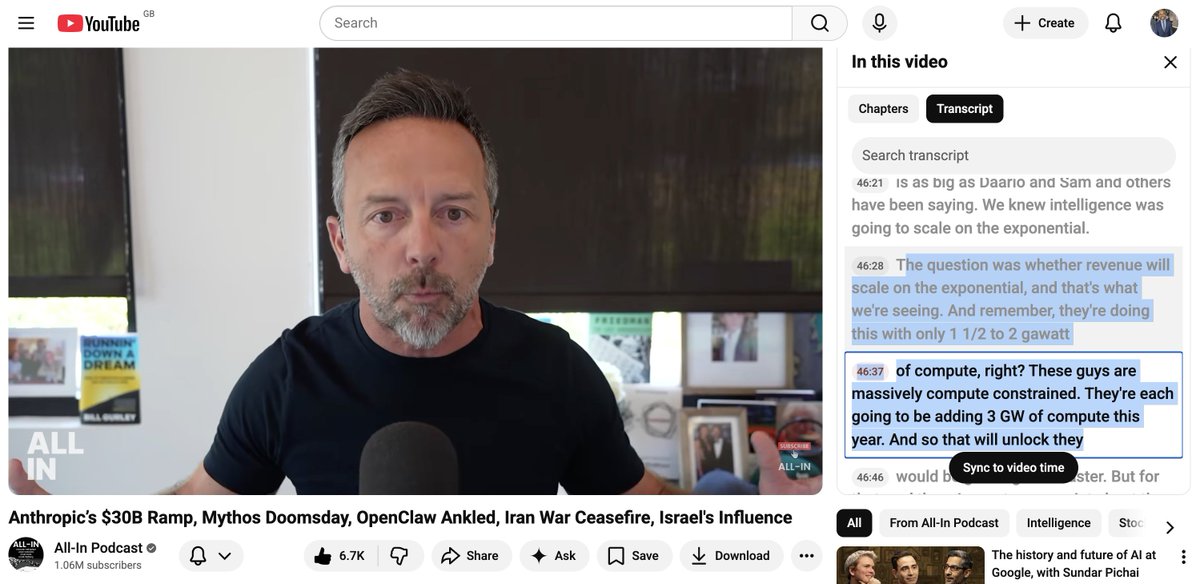
.@altcap had some insightful takes and some arguably newer disclosures on OAI/Anthropic (he's an investor in both) worth tracking: Anthropic's Revenue Ramp: Brad called this the fastest revenue explosion in technology history. $1B run rate end of 2024, $4B by mid-2025, $9B by end of 2025, then $30B by end of March 2026. He noted they hit their year-end target by Q1. To contextualize the monthly adds, he said Anthropic added the equivalent of Databricks plus Palantir combined in a single month. He wouldn't be shocked if Anthropic exits the year at $80-100B in revenue. "TAM for Intelligence" Thesis: Brad's central argument is that intelligence has a near-infinite TAM, fundamentally different from any prior technology market. He stressed this isn't zero-sum between Anthropic and OpenAI. Millions of self-interested actors (consumers, enterprises, 1,000+ paying $1M+ annually) are all demanding the product simultaneously. Same Jevons paradox argument: unit cost of intelligence is plummeting because model capability is surging, which drives more consumption. Gross Margins and "Accidental Profitability": Brad pushed back hard on the narrative that these companies are bleeding cash. His logic: the biggest cost input is compute, and Anthropic only has ~1.5-2 GW of capacity. That compute cost is relatively fixed whether revenue is $1B or $80B. So gross margins are expanding 'explosively.' He suggested the companies may hit 'accidental profitability' because they literally can't spend revenue fast enough on compute buildout. He also noted Anthropic has only 2,500 people versus Google crossing similar revenue thresholds with 120,000. Inference costs are down 90% year over year. Anthropic's Strategic Focus as Competitive Advantage: Brad credited Anthropic's discipline in saying no. No multimodal, no video, no hardware, no chips, no building data centers. They concentrated entirely on coding and co-work as the path to AGI/ASI, executed with 2,500 people all pulling in the same direction. That focus, combined with the coding lead, is what let them come from being "counted out" a year ago to now dominating that market OpenAI Feelin Shor-term Pain but Still Optimistic: Brad said he's a buyer of OpenAI shares today despite the negative vibes (employees leaving, strategy questions, secondary market trading below last valuation). He called it "peak OpenAI FUD." His case: it starts with great researchers and models. The upcoming Spud model (first Blackwell-trained model) is being previewed and people are telling him it's on par with Mythos. Gross vs. Net Revenue Distraction: Brad dismissed the gross vs. net revenue debate (Anthropic reportedly presents gross, OpenAI net). He said the hyperscaler distribution commissions are single-digit percentages of total revenue. Whether you haircut Anthropic by 5-10% or gross up OpenAI, the comparison is roughly apples-to-apples and it's a distraction from the real story.

English
21
66
476
144.2K
Adam⛰️
Adam⛰️@AssetTraveller·
Swapped some names into Arc resources. Flat on year despite their number 1 revenue driver (Condensate) exploding in price. FCF numbers for this year + future years are ROBUST in various sensitivities. $ARX
English
4
2
30
2.7K
Rajat Agrawal
Rajat Agrawal@gabagenius·
@johnarnold The ‘money at stake’ cohort is very nimble and switches views frequently, while the fundamental analysts understand the inertia of the physical market. But making money based on physical market tightness seems a game of paying high theta bill.
English
0
0
1
355
John Arnold
John Arnold@johnarnold·
There’s an enormous disconnect on Iran between analysts' grim assessments and the market’s sanguine response. I put more weight on the views of those with money at stake, but the level of this divide does give me pause.
English
47
36
564
56.7K
Rajat Agrawal retweetledi
JH
JH@CRUDEOIL231·
I actually wrote this back on March 18th to explain things to my Korean friends, but I'm posting it here on X as well since so many ppl still seem to get it wrong. Global Total Crude Inventory = Commercial MOI + Commercial Available Inventory + Surplus crude + SPR The world looks like it’s overflowing with oil, but prices don’t wait for all 2 billion barrels of global inventory to vanish before they spike. Every single time oil crossed $100/bbl, it was the same story. Take the US as the prime example. Right now, US commercial crude inventory is sitting around 440 million barrels, but that number physically cannot drop below 280–300 million. You might say, "What the hell are you talking about? Just draw it down, you idiot lol." But let’s look a bit closer. That "Commercial MOI" I mentioned stands for Minimum Operating Inventory. This isn't oil sitting in a refinery tank or a hub ready to be used instantly. MOI is the volume physically locked in the system you cannot pull out. It’s the baseline required just to keep the entire US oil system running. Here are the main components: 1) Linefill: This is the oil filling the entire pipeline network across the US. bc of the "push from one end to get out the other" structure, about 110–120 million barrels must stay in the pipes at all times. 2) Tank Bottoms: This is the volume at the very bottom of storage tanks that pumps literally can’t reach. Estimated at around 80–90 million barrels. 3) In-transit & Working Stock: The minimum volume sitting on tankers, barges, or waiting at refineries to be blended and fed into the units. Without this base feed, the refinery simply stops. Just combining Linefill and Tank Bottoms (Unavailable Stocks) gives you ~200 million barrels. Add the Working Stock needed for operational flexibility, and ~300 million barrels becomes the actual hard floor. I used the US as an example, but you probably get the point by now. The "Global Total Onshore Inventory" figure includes all that MOI—Linefill, Tank Bottoms, etc. Since it’s global, we don't have the exact numbers, but this MOI accounts for 60-70% of the total figure. Minimum Working Stock is another 20-25%. Most of those 2.3 billion barrels are scattered across tens of thousands of kilometers of pipelines and the bottoms of thousands of storage tanks. The vast majority is essential just to keep the system alive; it’s physically impossible to gather it all in one place and dump it onto the market. Therefore the actual available crude—the delta actually moves prices and balances—is much smaller than ppl think. That’s why the oil market sees massive price swings even over a quarterly shift of just 1mb/d. Think of the "buffer" I mentioned as cash on hand for immediate liquidity. The rest of those 2.3 billion barrels? That’s like your factory equipment. No matter how much equipment you have, if you run out of cash, you go bankrupt. The oil market is the same; once that tiny sliver of available crude vanishes, the system hits a crisis and faces desperate bidding. Right now, we are in the phase of burning through the "excess cash" in the corporate account. And we're doing it very fast. Next we'll start dipping into personal savings. But like most business owners, there isn't actually much cash in the personal account. It’ll run dry in no time. Now imagine if you knew as long as you kept the factory running, you could eventually pay off the debt and fix the cash flow—but right now you don’t have a single cent of available cash. What happens? To keep the factory from going under, you’d do anything to scrape together cash for the electric bill and payroll. You’d sell your kid’s iPhone or even put your wife on the street—you’d do anything desperate to get that cash. Once we hit that stage, prices go absolutely vertical. Bottom line: when the buffer is gone, you have to start withdrawing all available commercial inventory. The pace will be lightning fast. Even the ppl who were sitting on the sidelines hoping for the war to end will start bidding desperately bc they need oil 'right now'. I’m not just acting calm or pretending I’m okay with this taking a long time. Even if you believe a long position is the way to go, there’s a specific process and setup must be cleared for the environment to force prices up. And it won't take that long. Until then I expect vol to be absolutely violent in both directions. #oott #com
English
23
95
624
67.6K
Alpha_Ex_LLC
Alpha_Ex_LLC@Alpha_Ex_LLC·
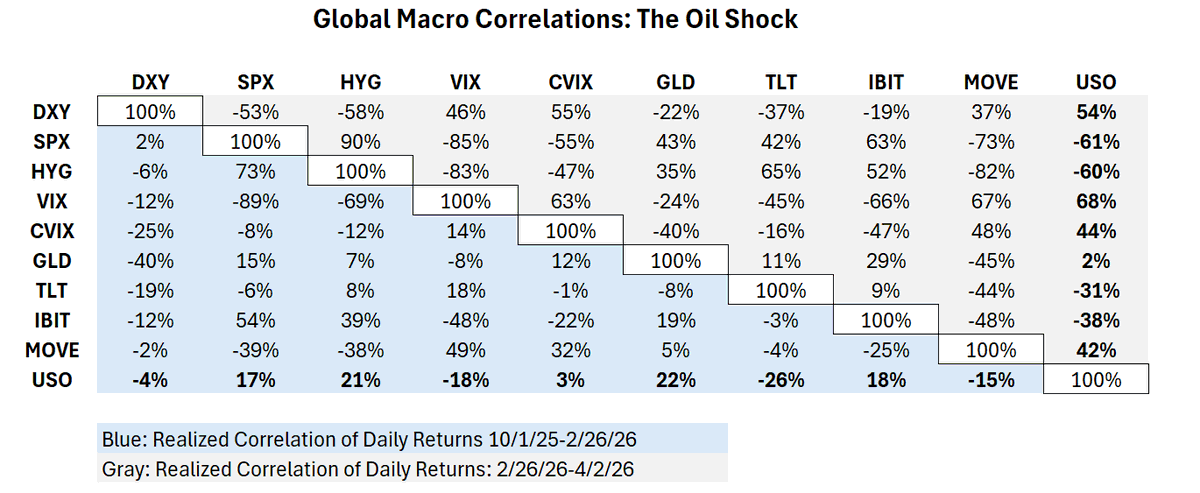
To bring the oil shock to life, here's a correlation matrix of daily returns for a series of macro assets. Top part of matrix shows correls since 2/26/26. Bottom part from 10/1/25-2/26/26. USO (proxy for crude futures) in bold. Strikingly intensified correlations post Feb 26th. Because all of these assets are more correlated to crude, they are also more correlated to each other. Since 2/26, the SPX/TLT correl is 42%. Before it was -6%. Similarly, the negative correl between the MOVE and HYG has become much more negative. Crude is at the center of it all. We can also map OTM call vol on crude very closely to OTM call vol on an index of corn, wheat, soybeans and sugar (below).
Alpha_Ex_LLC tweet mediaAlpha_Ex_LLC tweet media
English
3
14
92
14.7K
Rajat Agrawal
Rajat Agrawal@gabagenius·
@johnarnold Also, no capacity-related costs either. So, all-in, ERCOT far cheaper than PJM
English
0
0
1
287
John Arnold
John Arnold@johnarnold·
Remarkable that realized ERCOT wholesale prices (2025 in orange) are near inflation-adjusted lows since 2012, even as Texas has seen the fastest load growth in the country. It highlights the upside of a policy and business climate that broadly supports growth.
John Arnold tweet media
English
20
56
372
38.3K
Rajat Agrawal
Rajat Agrawal@gabagenius·
@JavierBlas Current severe backwardation will force people to learn that only latter 1/3 of any month is when both WTI and Brent refer to the same month
English
0
0
4
816
Javier Blas
Javier Blas@JavierBlas·
If you manage outside money, put the letters “CFA” at the end of your social media name, and today you are asking “Why is WTI trading above Brent?,” I’m afraid your clients have a problem.
English
89
137
2.1K
320K
Rajat Agrawal retweetledi
Nick Timiraos
Nick Timiraos@NickTimiraos·
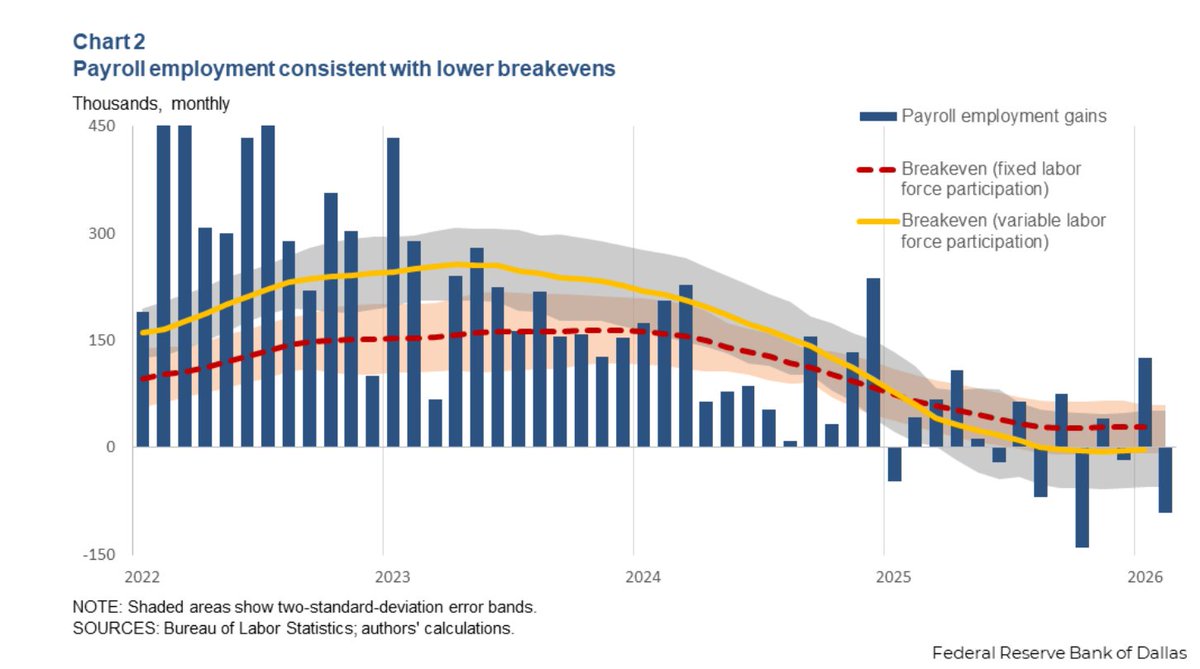
Dallas Fed: Using newly available microdata that measure net unauthorized immigration through December 2025, an estimate of breakeven job growth is lower than previously thought and could be slightly negative. Monthly job change of -3,000 per month would have been enough to hold the unemployment rate steady between August and December. dallasfed.org/research/econo…
Nick Timiraos tweet media
English
14
96
371
267.2K