Thierry P. Gaillard

11.7K posts

Thierry P. Gaillard banner
Thierry P. Gaillard

Thierry P. Gaillard

@gathea69

Digital project manager since 2012 - Team manager since 2003 - Trainer since 1997 - I am also a front-end developer. Tweets 🇫🇷& 🇺🇸.

France Katılım Ekim 2011
1.5K Takip Edilen4.4K Takipçiler
Sabitlenmiş Tweet
Thierry P. Gaillard
Thierry P. Gaillard@gathea69·
En 2025, le plus gros changement apporté à mes habitudes de développeur a été l'utilisation de l'IA générative (principalement Gemini) dans mes outils de codage pour m'assister dans mes tâches. Grâce à cela, j'ai gagné en confiance en moi et en plaisir de coder. J'ai surtout renforcé considérablement mes compétences en explorant avec mon partenaire IA de codage des sujets jusque là peu ou pas abordés. Le codage, qui est une tâche fastidieuse par moment, est devenu beaucoup plus fun et c'est tant mieux. En 2026, je mets l'accent sur l'apprentissage. En particulier, je souhaite acquérir des compétences en matière de programmation d'agents IA autonomes et suivre le Google Developer Program. Mais face à cet ambitieux programme, je dois mettre en place une feuille de route précise et détaillée à partir d'objectifs précis afin d'utiliser au mieux du temps dont je dispose.
Français
0
0
3
386
Thierry P. Gaillard
Thierry P. Gaillard@gathea69·
Cela me rappelle les commentaires de mes clients sur le coût des publicités sur Google. Le problème n'est pas de savoir si c'est cher ou pas. Le problème est de savoir si cela rapporte plus que cela coûte et si les personnes sont suffisamment bien formées pour optimiser le coût/utilisation du token. Mettre un plafond de dépense mensuel n'est quand même pas bien compliqué.
Bruno Guglielminetti | Mon Carnet@Guglielminetti

Depuis deux ans, les directions encouragent leurs employés à l’utiliser l'IA et les dirigeants veulent montrer aux marchés qu’ils ne rateront pas le virage. Mais un nouveau problème apparaît maintenant avec force : l’IA coûte cher, parfois beaucoup plus cher que prévu. moncarnet.com/2026/05/29/qua…

Français
0
0
1
10
Thierry P. Gaillard retweetledi
Les Électrons Libres
Les Électrons Libres@lel_media·
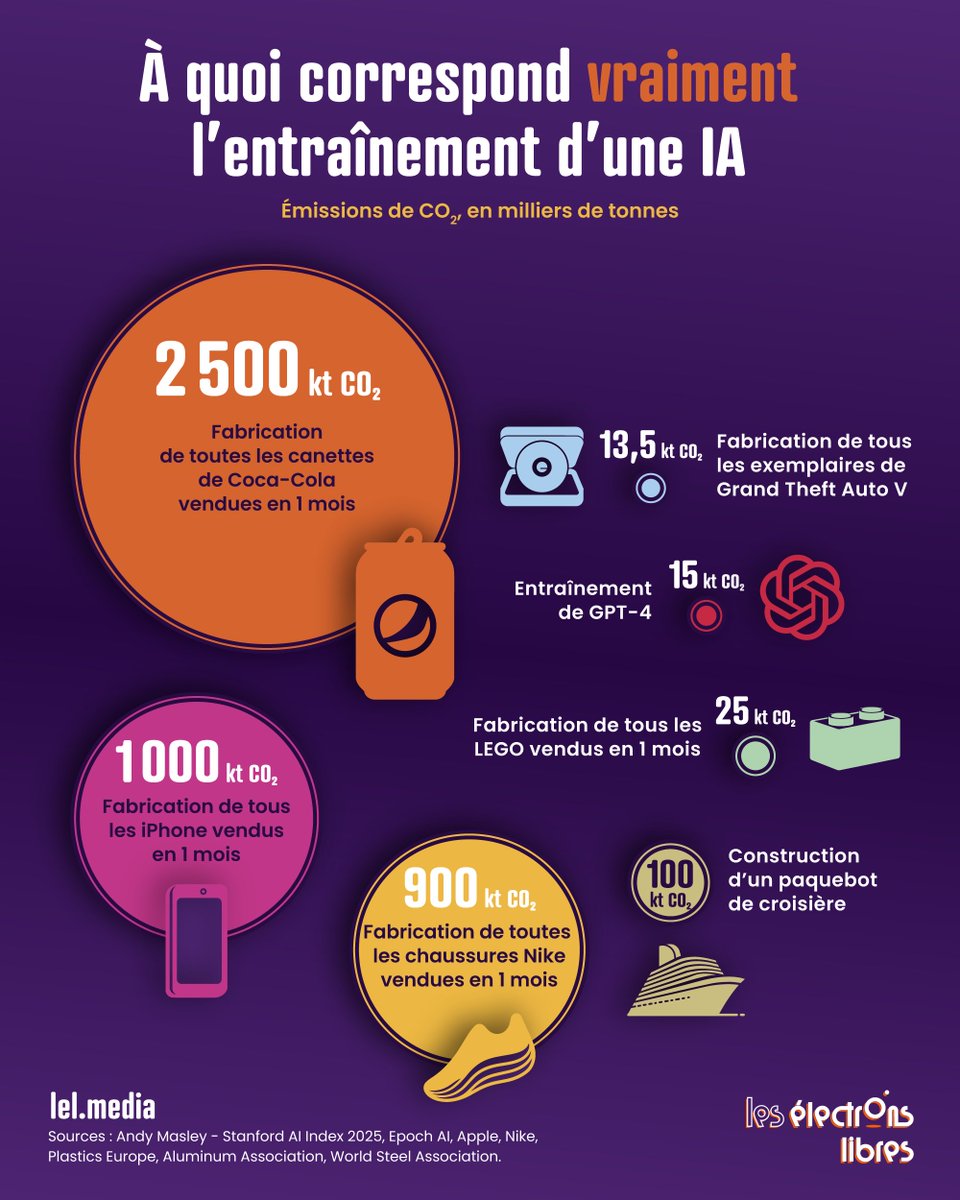
4h de production de canettes de Coca-Cola. 12h de fabrication de chaussures Nike. 1/7e de la construction d’un navire de croisière. L’entraînement d’un grand modèle d’IA est-il vraiment le désastre écologique annoncé ? par @Cobra_FX_
Les Électrons Libres tweet media
Français
5
38
93
7.9K
Thierry P. Gaillard
Thierry P. Gaillard@gathea69·
Si vous êtes enseignant ou parents d'adolescents, je vous recommande le site Web que @GoogleResearch et @Stanford ont créé pour former à l'IA. Pas de cours ennuyeux, mais un jeu inspiré par la recherche en IA du monde réel, dont l'objectif est l'apprentissage actif. Gratuit et en français. Accessible à tout le monde. research.google/ai-quests/intl…
Français
0
0
0
8
Thierry P. Gaillard retweetledi
Géraldine Woessner
Géraldine Woessner@GeWoessner·
La désinformation propagée par @hugoclement, grâce à @FranceTV est subtile... Elle n'est est pas moins ravageuse. J'ai regardé ce soir son émission "Sur le Front", sur @france5 : un modèle de manipulation "par omission". Du grand art, je dois dire. On décrypte ? C'est parti. 🧵
Géraldine Woessner tweet media
Français
229
2.4K
5.5K
452.6K
Thierry P. Gaillard retweetledi
JS Ferjou
JS Ferjou@jsferjou·
Certains parlent de l’impact de l’IA sur les urnes La vraie révolution, plus souterraine, est aussi plus radicale : la fin du monopole de la parole légitime La fin d’une illusion 
Jusqu’à présent pour dominer le débat public, il suffisait d’avoir ce que Pierre Bourdieu appelait le « capital symbolique » : rhétorique, jargon et vernis culturel Thomas Sowell l’avait parfaitement décrit : les intellectuels traditionnels excellent dans la virtuosité verbale, mais n’assument en général aucune responsabilité face au réel 
Si un maçon se trompe, son mur s’effondre. Si un intellectuel de salon se trompe, il publie un deuxième livre pour expliquer pourquoi le premier avait raison malgré tout Les réseaux sociaux ont ouvert la parole à tous et cassé la verticalité de la parole publique. L’IA offre désormais l’efficacité rhétorique à chacun Regardez le succès de @brivael : ses analyses structurées en quelques minutes grâce à l’IA sont relayées par @elonmusk ou @JMilei Parce que la machine a démocratisé le jargon Les gardiens du temple s’insurgent : « Comment un internaute lambda peut-il manier les concepts sans diplôme ? Démagogie ! Populisme ! » La police du débat public est littéralement débordée Et si vous regardez bien les réseaux, les clashes entre nouveaux venus et gardiens du temple prompts à agiter (nous gaver de…) leurs thèses et la légitimité monopolistique que leur confèreraient leurs postes au CNRS se multiplient déjà 
Preuve que le choc a lieu en ce moment même Nous vivons une révolution cognitive : pour la première fois dans l’histoire, la capacité à formuler, structurer et argumenter n’est plus une ressource rare. L’argument d’autorité se dissout dans le LLM Et non, on ne confond pas la forme et le fond. Un plombier ou un artisan comprend souvent bien mieux les réalités économiques, voire la nature humaine, qu’un sociologue au CNRS 
Ce qui lui manquait, c’était juste le code d’accès : l’habillage sémantique pour être audible Attention, je ne dis absolument pas que le travail du sociologue devient inutile. La recherche et la rigueur scientifique gardent TOUTE leur valeur Mais l’IA vient les mettre en concurrence sur leur propre terrain : celui de l’expression publique C’est le retour d’un concept clé théorisé par Antonio Gramsci : celui de l’intellectuel organique. Pour Gramsci, chaque groupe social crée ses propres penseurs, issus du terrain, pour donner une cohérence politique aux aspirations de la base. Jusqu’ici, l’homme de la rue devait déléguer sa pensée aux intellectuels officiels. Aujourd’hui, l’IA lui permet de devenir son propre intellectuel organique. Ne tombons pas dans l’illusion d’une société sans tête : nous aurons toujours besoin d’élites. Mais nous assistons à leur grand remplacement. Comme le streaming a ringardisé les directeurs des programmes télé, l’IA rend obsolètes les directeurs de conscience. Les élites de la parole vont devoir céder une part de la place aux élites de l’action Nous vivons une révolution cognitive qui devient une révolution anthropologique. La question n’est plus celle de l’accès à la parole mais de la force de frappe du propos Alors, que nous reste-t-il si les machines gèrent la culture, la logique et la mise en forme de nos idées ? 
Le tempérament Le courage physique d’incarner ses positions, la colonne vertébrale de celui qui vit ce qu’il dit. L’IA fournit les mots gratuitement, mais elle ne donnera jamais le coffre pour monter sur le ring. La rhétorique vaut moins ; le caractère, lui, n’a jamais coûté aussi cher.
Français
16
41
103
15.1K
Thierry P. Gaillard retweetledi
Thomas Kurian
Thomas Kurian@ThomasOrTK·
Today we’re introducing Google AI Threat Defense - a comprehensive AI-powered cybersecurity solution designed to help continuously monitor for and stop AI-powered threats before they can impact your business. Here’s how it works: 1. AI Threat Defense uses our cybersecurity platform @wiz_io to scan and prioritize what applications and systems have the highest security risk. 2. Gemini and other frontier AI models can then autonomously perform continual deep scanning of your applications - starting with those at the highest risk - to identify security vulnerabilities. 3. The capabilities of CodeMender - a new software repair agent - are then used to verify and accelerate the patching of vulnerabilities. 4. And our @wiz_io autonomous agents continuously test your systems to find unknown vulnerabilities before adversaries do so that you can remediate them before you are attacked. While other model providers focus on using AI to find and flag vulnerabilities, Google AI Threat Defense actively prioritizes your most critical real-world risks and accelerates their remediation using a variety of models since no single model finds a superset of the vulnerabilities found by all other models.
English
46
261
1.4K
179.6K
Thierry P. Gaillard retweetledi
Supersocks
Supersocks@iamsupersocks·
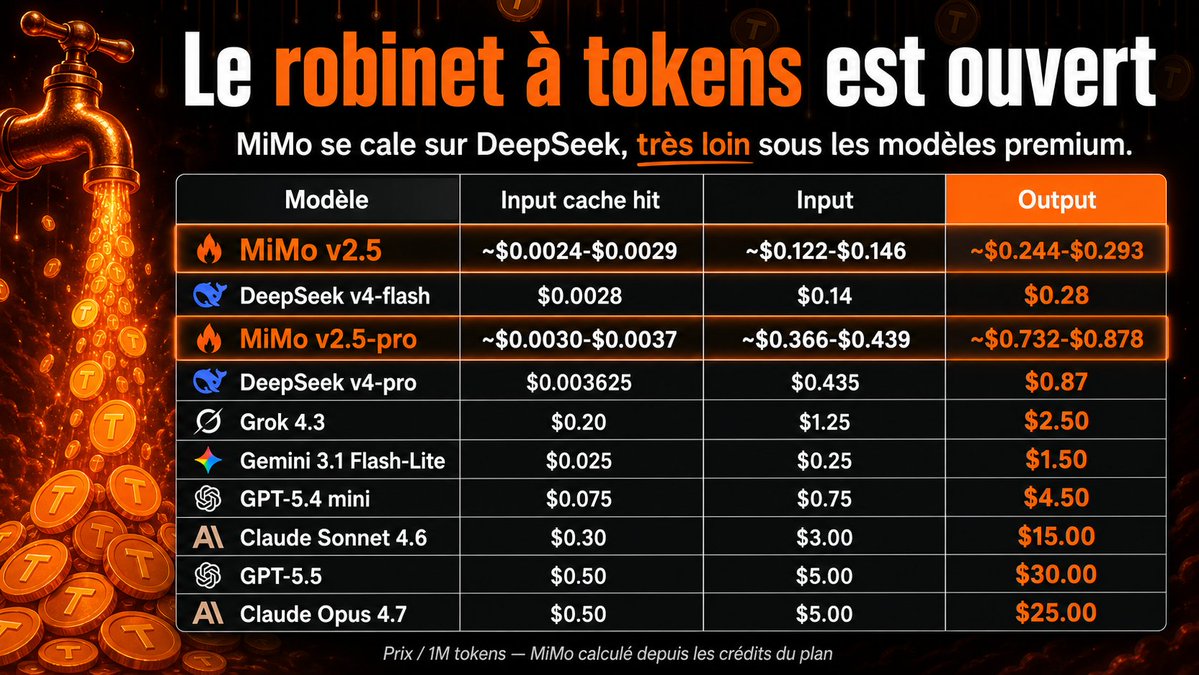
pricing démoniaque. l'animal MiMo est environ 28x à 41x moins cher que les gros modèles premium occidentaux en output. 10M output tokens (ce que je consomme avec mon petit dej) : > GPT-5.5 ≈ $300 > Claude Opus 4.7 ≈ $250 > DeepSeek V4 Flash ≈ $3 > MiMo Flash ≈ $3
Supersocks tweet media
Supersocks@iamsupersocks

Dites-moi que ça couvre quand même le prix de l'élec. Xiaomi via MiMo lance une offre venue des ténèbres pour vous abreuver de tokens, comme il se doit.

Français
7
4
38
7.8K
Thierry P. Gaillard retweetledi
Pierre-Louis Biojout (PLB)
France is losing €10B every year because installing AC is considered shameful. It's not just a question of priorities. In France, putting in air conditioning is socially looked down on. Meanwhile the science is brutal: - Harvard study (2018): students without AC during a heatwave had 13% slower reaction times and significantly worse working memory than students with AC. - Lan et al. (2022): cognitive performance dropped 10% when the office went from 24°C to 26°C, even when subjects reported feeling comfortable. - Multiple studies show measurable drops in math and verbal test scores above 32°C. Now do the math. Only ~25% of French households have AC (vs ~90% in the US). For 2 to 3 months a year, a huge chunk of the white collar workforce is operating at reduced cognitive capacity during the day and sleeping badly at night. On a €2.8T economy, even a conservative productivity hit lands in the tens of billions per year. I'm the first guy to buy an AC the moment I notice my sleep slipping. The ROI is obvious. In SF, founders go further: AC at home, air quality monitors, Eight Sleep to lock the bed at the exact temperature window for deep sleep. If your job is to do more than just sit around role playing all day, you cannot afford a single bad night or a foggy afternoon. If you create real value in the economy, you owe it to yourself to install AC. Stop optimizing for the opinion of people who don't ship anything.
Julien Chaumond@julien_c

Who else feels like they lose ~20 IQ when it’s hot outside?

English
37
40
281
30.4K
Thierry P. Gaillard retweetledi
Big Brain AI
Big Brain AI@realBigBrainAI·
Andrew Ng, co-founder of Google Brain and Coursera, on the worst career advice being given about AI right now: He doesn't mince words about what he's hearing from supposed experts: "As early as earlier this year and certainly last year, there are a few people advising others to stop learning to write code because AI will automate it." His reasoning is rooted in a historical pattern most people miss: "As something becomes easier, more people should do it, not fewer. When the world moved from assembly language to COBOL, there were actually articles saying, 'Well, we now have COBOL. Programming is so easier. Looks like we don't need programmers anymore.' But the opposite happened." Andrew believes the same thing is happening now with AI-assisted coding: "As we now have AI assisted coding, a lot more people should be coding. And I think the demand for software, custom software, has no practical ceiling. So the cost of software engineering comes down, which it is, we'll just get more and more great software out in the world." But here's where the advice gets uncomfortable for experienced engineers. @AndrewYNg is honest about what he's seeing on the ground: "It is true that a fresh college grad that is really on top of AI will outperform a full stack engineer with 10 years of experience that is still doing things they were back in 2022, 3 years ago before GenAI." However, there's a nuance most people miss when they hear that stereotype: "The other piece that is less well appreciated is the best engineers I know are not fresh college grads. They're actually very experienced engineers that deeply understand architecture and the conceptual framework of how to think about computers and additionally are on top of AI and on top of these AI skills."
English
39
183
870
209.3K
Thierry P. Gaillard retweetledi
Edouard 🌐👶🏗️
🧬 Un blé résistant à la sécheresse développé par une joint-venture franco-argentine (avec le gène HaHB4 du tournesol, −30% d’eau nécessaire) est commercialisé en Argentine depuis 2022. Le semencier a dû délocaliser sa recherche là-bas parce qu’ici c’est interdit. CRISPR permet d’adapter la vigne, les arbres fruitiers, les céréales à des vitesses impossibles par sélection classique. La sélection conventionnelle pour la résilience climatique prend des décennies expliquent 35 Prix Nobel qui ont supplié le Parlement européen en janvier 2024 d’autoriser les NGT (CRISPR).
Edouard 🌐👶🏗️ tweet media
Nicolas Goldberg@GoldbergNic

Vraiment un sujet passionnant : que planter dans nos sols en 2060 compte tenu du réchauffement climatique pour garder une agriculture efficiente?

Français
6
174
423
29.3K
Thierry P. Gaillard retweetledi
Nico
Nico@nicos_ai·
Google acaba de publicar el estándar de Code Review que usan sus ingenieros internos. Literalmente puedes darle esta documentación a un agente de IA y convertirlo en un revisor de código con estándares de Google. La mayoría de IAs solo generan código. Ahora también pueden: → detectar malas prácticas → revisar arquitectura → pedir cambios útiles → validar legibilidad y mantenibilidad → dar feedback estilo Google El documento incluye cómo revisan código realmente dentro de Google: → criterios de aprobación → qué bloquea un merge → cómo escribir código fácil de aceptar → términos internos como LGTM y CL No es teoría. Es el sistema real que usa Google para revisar millones de líneas de código. Enlace abajo 👇
Nico tweet media
Español
47
192
1.7K
123.9K
Thierry P. Gaillard retweetledi
Google Antigravity
Google Antigravity@antigravity·
We’re thrilled to announce the Antigravity CLI, a lightweight way to spin up the same Antigravity agents right from the terminal. 💻 It gives you the exact same harness and same models, with a product experience tailored for the command line. It adapts entirely to you: your keybindings, your themes, your workflows. Full Antigravity CLI Walkthrough:
English
166
217
2.2K
192.6K
Thierry P. Gaillard retweetledi
𝄢 Jason Barnard 🇺🇦
𝄢 Jason Barnard 🇺🇦@jasonmbarnard·
AI brand measurement isn't a dashboard problem. It's a methodology problem Start at the bottom of the funnel. Build upward. Teach the engine your conversion path That's the Funnel Query Pathway & it's the only macro read that holds over time. searchengineland.com/funnel-query-p… @sengineland
𝄢 Jason Barnard 🇺🇦 tweet media
English
0
1
3
164
Thierry P. Gaillard retweetledi
Géraldine Woessner
Géraldine Woessner@GeWoessner·
La vérité derrière le mirage de la ferme du Bec Hellouin : esclavage, cultures faméliques et pollution massive aux nitrates… Une enquête magistrale de @TerreTerre13, à lire absolument ! (surtout dans les écoles de journalisme, les rédactions parisiennes et les milieux enseignants…)
Les Électrons Libres@lel_media

x.com/i/article/2057…

Français
39
539
1.3K
67.8K
Thierry P. Gaillard retweetledi
Logan Kilpatrick
Logan Kilpatrick@OfficialLoganK·
Gemini 3.5 Flash ranks #1 on the APEX-Agents-AA benchmark, outperforming much larger models a whole size above it.
Logan Kilpatrick tweet media
English
288
99
1.7K
474K
Thierry P. Gaillard retweetledi
m_ric
m_ric@AymericRoucher·
You don't understand the current AI race if you don't think about it in terms of compute - and compute clearly distinguishes 3 tiers of companies. Arthur Mensch, Mistral's CEO, recently had a hearing at the French Assemblée Nationale. He elegantly framed the AI race as a compute issue, where sovereignty would be ~"the ability to get leverage along the AI value chain" from electrons to tokens. He also provided numbers (in MW) for Mistral's available compute : I was surprised at how low these numbers were compared to the gargantuan numbers touted by US labs. So I ran the numbers, based on the recent and excellent @EpochAIResearch study, adding in my (not that reliable) AI-powered estimates of Chinese compute (see assumptions in blog post). And I found out that there are 3 quite separate tiers. 1. US Champions are really far ahead. Anthropic, OpenAI and Google each command multiple gigawatts (OpenAI ~15 GW once you count the Stargate/Azure/Oracle capacity it rents). Ever wondered why their Claude/GPT /Gemini consistently top benchmarks? Now you know. By the way, tick in Meta and xAI and you'll see them entering tier 1 too with their recent buildouts. 2. Chinese giants scale fast. Alibaba, ByteDance, Tencent, Huawei and the three state telcos are racing from hundreds of MW toward multi-GW, increasingly on domestic Ascend silicon and the national "East Data West Compute" grid. They report "computing power" in EFLOPS rather than MW, so their points here are estimates, could be quite off the mark. 3. The contenders. Europe's Mistral commands ~90 MW today and aims at 1 GW by 2029, an order of magnitude behind the leaders. Interestingly, some of the best Chinese labs (DeepSeek, Moonshot, Zhipu, MiniMax) have no longstanding compute : they are pure-play : they rent or get allocations from government capacity for specific efforts. DeepSeek (~90 MW, the only one of this category that owns its cluster) is the largest. With all that said, I hope someday someone in Europe wakes up to the absolute necessity of building compute faster than we do today. If you want to go inspect the graph, I've got the interactive version and full sources in my blog post, link below.
m_ric tweet media
English
36
133
657
94.6K