
geetfun

10.7K posts

geetfun banner
geetfun

geetfun

@geetfun

ex @google Make app store screenshots: https://t.co/EDnhuwrce6 Build Guides: https://t.co/2ZVY3w8WvA Send Emails: https://t.co/wMe3Ll7mnJ Play Games: https://t.co/XDHcesaYsd


Earth Katılım Ağustos 2014
1.3K Takip Edilen3.2K Takipçiler
geetfun
geetfun@geetfun·
@DeItaone Buffet has an opinion. He just doesn’t want to share it with you.
English
0
0
0
46
*Walter Bloomberg
*Walter Bloomberg@DeItaone·
BUFFETT SAYS HE DOESN'T KNOW IF HE WOULD CUT INTEREST RATES IF HE WERE AT THE FEDERAL RESERVE
English
22
25
249
48.1K
Options selling with Christian
So what happens if the war ends? Couple days of Green and then the market starts spiraling back down due to fears of recession?
English
98
9
629
99.8K
Danielle Fong 🔆
Danielle Fong 🔆@DanielleFong·
Learn to weld. Learn to code. Change a diaper. Plan an invasion. Butcher a hog. Conn a ship. Design a building. Write a sonnet. Balance accounts. Build a wall. Set a bone. Comfort the dying. Take orders. Give orders. Cooperate. Act alone. Solve equations. Analyze a new problem. Pitch manure. Program a computer. Cook a tasty meal. Fight efficiently. Die gallantly. Specialization is for insects.
Dan Primack@danprimack

"Learn to weld" will go down like "learn to code." Lot of companies building AI "brains" for robots that should, among other things, know how to weld. Idea that AI won't disrupt blue collar work feels like fallacy.

English
29
113
1.3K
49.7K
zerohedge
zerohedge@zerohedge·
*S&P 500 INDEX ERASE GAINS TO TURN NEGATIVE
English
61
59
1.1K
85.6K
zerohedge
zerohedge@zerohedge·
There's your "most convex trade ever"
zerohedge tweet media
English
20
30
328
101.7K
Cliff Cornell
Cliff Cornell@cliffcornell_·
“If you didn’t live through 2008, you have no clue what a REAL bear market is” Usually directed at a bunch of younger folks who have watched their crypto assets get cut in half 3-4 times and experience 20% drops on a near monthly basis.
English
15
0
51
3.1K
`
`@ick_real·
When people get in their 50s and 60s and up, do you start thinking about how many years you have left? I’m curious
English
4.5K
156
4.9K
966.8K
Invest In Assets 📈
Invest In Assets 📈@InvestInAssets·
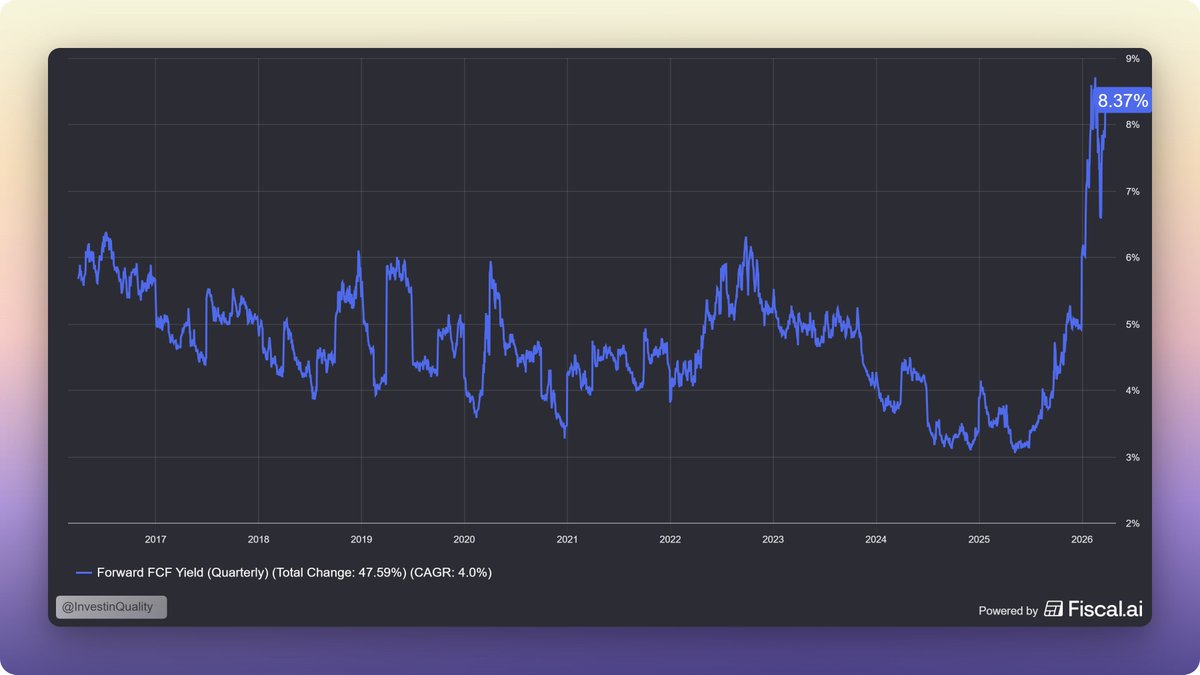
Constellation Software is trading at its highest forward FCF yield ever. Is AI Constellation's downfall?
Invest In Assets 📈 tweet media
English
9
1
47
9.7K
geetfun
geetfun@geetfun·
@yongfook 😂 it’s still “taste”. Not good taste, but taste nonetheless
English
1
0
4
576
Jon Yongfook
Jon Yongfook@yongfook·
“The only true moat now is taste” - guy wearing Patagonia vest
Jon Yongfook tweet media
English
71
104
1.7K
123.3K
The_Real_Fly
The_Real_Fly@The_Real_Fly·
Mid term drawdowns produced 100% win rate returns 1 year out $SPY
The_Real_Fly tweet media
English
57
145
1K
439.9K
The Kobeissi Letter
The Kobeissi Letter@KobeissiLetter·
Investors are ramping up bets against Oracle’s credit: Oracle’s, $ORCL, 5-year credit default swaps (CDS) are up to 191 basis points, the highest since the 2008 Financial Crisis peak. Company’s CDS have QUADRUPLED since mid-2025, meaning protection against Oracle’s default now costs ~$191,000 for every $10 million of principal. By comparison, the 2022 bear market peak was ~127 basis points. This comes as Oracle’s CDS has become a preferred instrument for investors to hedge or bet against AI debt, as Big Tech is issuing debt at an unprecedented pace to finance AI. Oracle also has the most-liquid investment-grade CDS, with average weekly trades hitting as much $830 million. Meanwhile, JPMorgan is now offering a basket of CDS covering $GOOGL, $AMZN, $META, $MSFT, and $ORCL, providing a new way to bet against the Big Tech debt. Oracle’s credit risk is up to 2008 levels.
The Kobeissi Letter tweet media
English
123
212
1.6K
315.3K
geetfun
geetfun@geetfun·
@stevehou Damn. $2B for essentially a ticker symbol.
English
0
0
1
420
Steve Hou
Steve Hou@stevehou·
What’s stopping Zuck from spending up to $2B to buy C3.ai (current mcap $1.1B) and change the name (and the ticker) of his company from Meta to AI?
Steve Hou tweet media
English
26
6
216
49.2K
Peter Berezin
Peter Berezin@PeterBerezinBCA·
The forward P/E ratio for the S&P 500 has fallen from a high of 23.1 in late October to 19.5 at present (Chart 36). About one-third of the decline in the P/E ratio has been due to the drop in stock prices, with the rest being explained by the rise in forward earnings estimates. The fact that earnings estimates have continued to increase in the face of growing macroeconomic uncertainty is less reassuring than it might appear. Historically, earnings estimates have lagged broader macroeconomic developments. Perhaps even more importantly from an investment perspective, earnings estimates have also lagged stock prices. This was most recently visible in 2022/23. S&P 500 forward earnings estimates rose right through June 2022, even though stocks had peaked five months earlier. Earnings estimates then fell until February 2023, bottoming four months after the equity bull market had resumed (Chart 37). Between 1985 and 2010, the S&P 500 rose more when forward earnings estimates had increased over the prior month than when they had decreased. Since 2010, however, stocks have actually fared better when earnings estimates were declining (Table 2). This suggests that stock prices could continue to drop if the macroeconomic outlook worsens, even if earnings estimates temporarily remain in an uptrend. The preceding is an excerpt from my Second Quarter 2026 Strategy Outlook, which discusses the outlook for the global economy and all the major asset markets. Clients can read the whole thing here: bcaresearch.com/reports/second…
Peter Berezin tweet mediaPeter Berezin tweet media
English
25
107
472
129.9K
Lou Pai, CEO, Enron Energy Services (parody)
Alright, I’m going to settle this as someone who has sold and hedged many barrels of crude oil, and been a market maker for others who have done the same. Physical crude sales are linked to a benchmark. Could be NYMEX WTI, ICE Brent, Dated Brent, MEH, Dubai, Oman, whatever. You pay or get paid that index price, plus adders of some kind (shipping, marketing fee, quality diff, etc). But at least like 95% of what you pay/ get paid is going to be the index price. You don’t do correlation analysis nonsense in choosing which index to hedge. You use the index to which your phys sales are tied to hedge. So if you’re an Asia refiner, you don’t just decide to start hedging Brent even though you have a supply agreement with a seller to whom you have to pay Dubai. As John put it, you hedge the exposure you have. Now if you want to adjust your purchase contracts to Brent, you can probably do that, but you’re going to pay out the ass for transportation, which will be included as a cost in your marketing agreement. The huge spread in Dubai/Brent was likely mostly a function of cost of transportation and that it takes time to move barrels from the North Sea to the Gulf/Asia. Now that a few weeks have gone by, supplies from the North Sea have arrived in Asia, and low and behold, spot prices in the Gulf have come in to reflect less acute local scarcity, while Brent prices have moved up to reflect the demand supplies are getting from Asia. It’s not some wonky derivative trading nonsense. It is purely basic physical supply and demand at work.
Tracy Shuchart (𝒞𝒽𝒾 )@chigrl

Now John will say you can't hedge that way. You absolutely can. The reason Asian refiners were hedging against Dubai in the first place was convention. Their crude slate was predominantly Middle East, their product pricing was Dubai referenced, and keeping everything in the same benchmark universe simplified the book. But as more WTI Midland enters the Asian crude diet, hedging against the Brent benchmark that actually contains that grade is a tighter correlation, not a looser one. Not to mention the fact that S&P Global Platts, on March 2nd suspended nominations for any crude grade that requires transit through the Strait of Hormuz. That killed three of the five grades immediately. Dubai, Upper Zakum, and Al Shaheen all load from inside the Strait and can't get out. Only Oman (loads outside the Strait) and Murban remain deliverable.
English
24
48
611
105.1K
geetfun
geetfun@geetfun·
@DividendGrowth There are more than one way to "get rich" anyway. So even if Buffett missed an opportunity, he finds other way to win scoped to his level of comfort and expertise.
English
0
0
1
142
Dividend Growth Investor
Dividend Growth Investor@DividendGrowth·
This is what Seth Godin said about Warren Buffett in his 2000 book "Unleashing the Ideavirus" This reflects the sentiment at the time about Mr Buffett, who was widely believed to "have lost his touch "
Dividend Growth Investor tweet media
English
8
2
59
9.5K
geetfun
geetfun@geetfun·
@Restructuring__ I'm an old guy who remembers what it was like. Thank you for bringing up the Apollo chart.
English
0
0
0
113
Restructuring__
Restructuring__@Restructuring__·
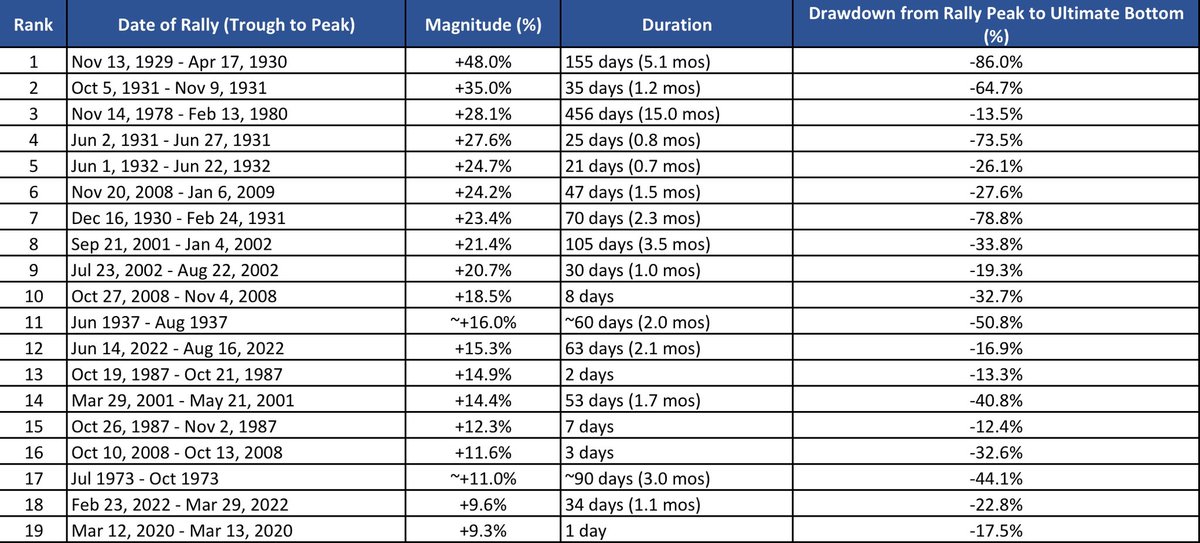
The amount of financial illiteracy on this website makes me so sick. For the love of god, if you think that the S&P/Nasdaq today represents a generational buying opportunity, please read this. Let's take a step back and decompose stock returns. Stock returns are the sum of dividend yield and price appreciation. Dividend yield has historically been between 1% and 2% every year (excluding 2008), so there is not much debate here. Price appreciation is the result of (i) earnings (EPS) growth and (ii) change in price to earnings (also called valuation/multiples). (i) EPS have compounded at ~6% for decades. Some people argue that AI will change the growth algorithm, but let's keep this aside as this is not what is driving the narrative. (ii) Change in multiple: this is essential to understand. If you buy stocks at a very expensive multiple, it will be really hard to make money, unless your earnings really grow quickly. Today, people who are screaming "buy the S&P because it is only trading at 20x forward earnings" are honestly financially illiterate. Plain and simple. They only look at the last 5 years, which has seen extremely elevated multiples, and think that buying at these levels is buying at a cheap valuation. Do you remember when Apollo posted that image saying the next 10 years' returns will be 0% and everyone talked about it for 2 days? Well, let's revisit that image with what has happened since. The S&P has contracted modestly, and the forward multiple is 20.5x today, vs 22.5x in December. What does this mean if we look at historical performance? That the expected return when buying the S&P at this valuation is 2% per year for the next decade. Read that again. The expected return when buying the S&P at this valuation is 2% per year for the next decade! Does this seem to you like a generational opportunity?
Restructuring__ tweet media
Polymarket Money@PolymarketMoney

NASDAQ 100 OFFICIALLY ENTERS CORRECTION
English
54
42
546
127.1K
geetfun
geetfun@geetfun·
@elerianm Diversified in asset classes. Not diversified in crowded trades.
English
1
0
0
165
Mohamed A. El-Erian
Mohamed A. El-Erian@elerianm·
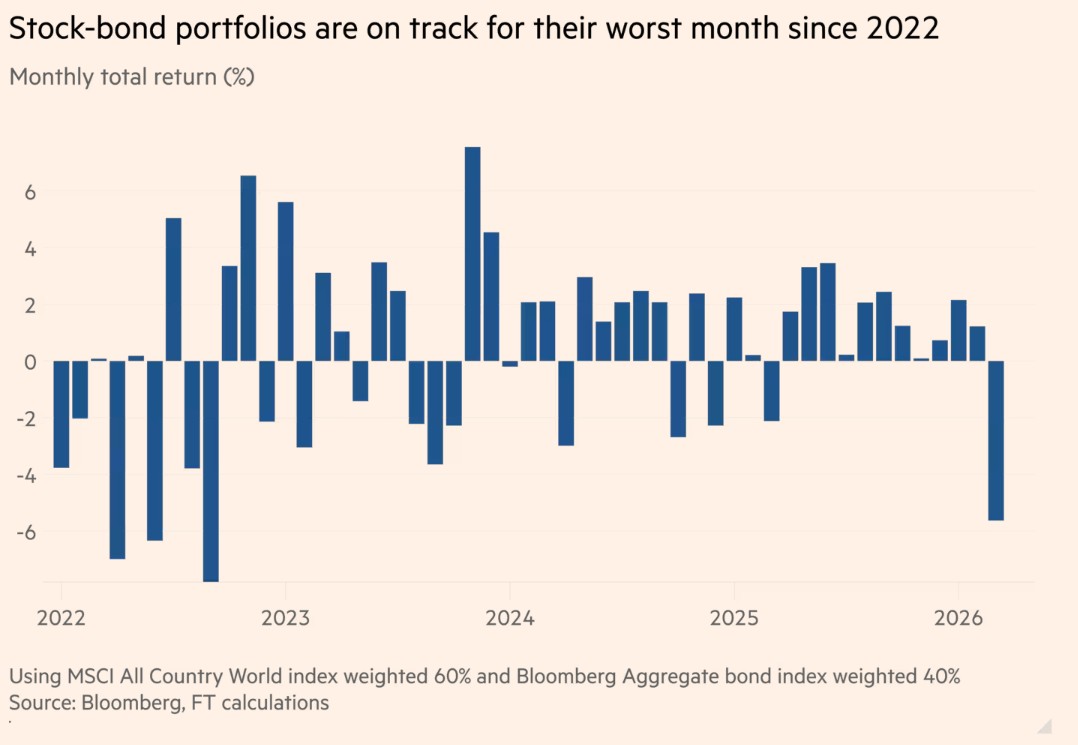
Further to my earlier posts on the difficulties investors face in mitigating portfolio risks, here's a chart from the FT article on: "Stocks and bonds slump in tandem as Iran shock leaves investors ‘nowhere to hide’: Traditional 60-40 portfolio of global equities and fixed income on course for worst month since 2022." #economy #markets #investing #investors @FT
Mohamed A. El-Erian tweet media
English
31
67
306
38.6K